
通胀对冲工具

Search documents
比特币跌破7万美元 杠杆头寸强制平仓助推抛盘潮
Xin Lang Cai Jing· 2026-02-05 17:34
Core Viewpoint - Bitcoin has experienced a significant decline, dropping below $70,000 and reaching a low of $66,596, marking its lowest level since October 2024, with its market capitalization shrinking by nearly half since its record high four months ago [2][6]. Group 1: Market Dynamics - The recent sell-off in Bitcoin has been exacerbated by forced liquidations of leveraged positions and broader market turmoil, leading to a cascading effect on other cryptocurrencies and related ETFs [2][6]. - The decline has erased all gains made since Trump's return to the White House, which had previously boosted Bitcoin's value due to his pro-cryptocurrency stance [2][6]. - Geopolitical tensions have intensified, causing disruptions in global financial markets and dampening risk appetite, which has contributed to Bitcoin's sharp decline since mid-January [2][6]. Group 2: Investor Sentiment - The current market environment is characterized by fear and uncertainty, with a lack of strong buyers leading to a chain reaction of ETF redemptions and liquidations that amplify each downturn [2][6]. - The perception of Bitcoin as a hedge against inflation or a stable store of value has shifted, as it behaves more like a high-risk asset during periods of financial market stress [4][8]. - The recent sell-off has affected the entire digital asset space, with smaller, illiquid speculative tokens experiencing even greater declines [4][8]. Group 3: Future Outlook - Despite the current bearish outlook, some analysts suggest that the worst may be over, and historical volatility has often been viewed as a buying opportunity by long-term investors [4][8]. - The sell-off has been driven by multiple factors, including declines in tech stocks, strong performance of gold, and a general risk-averse sentiment among investors [4][8].

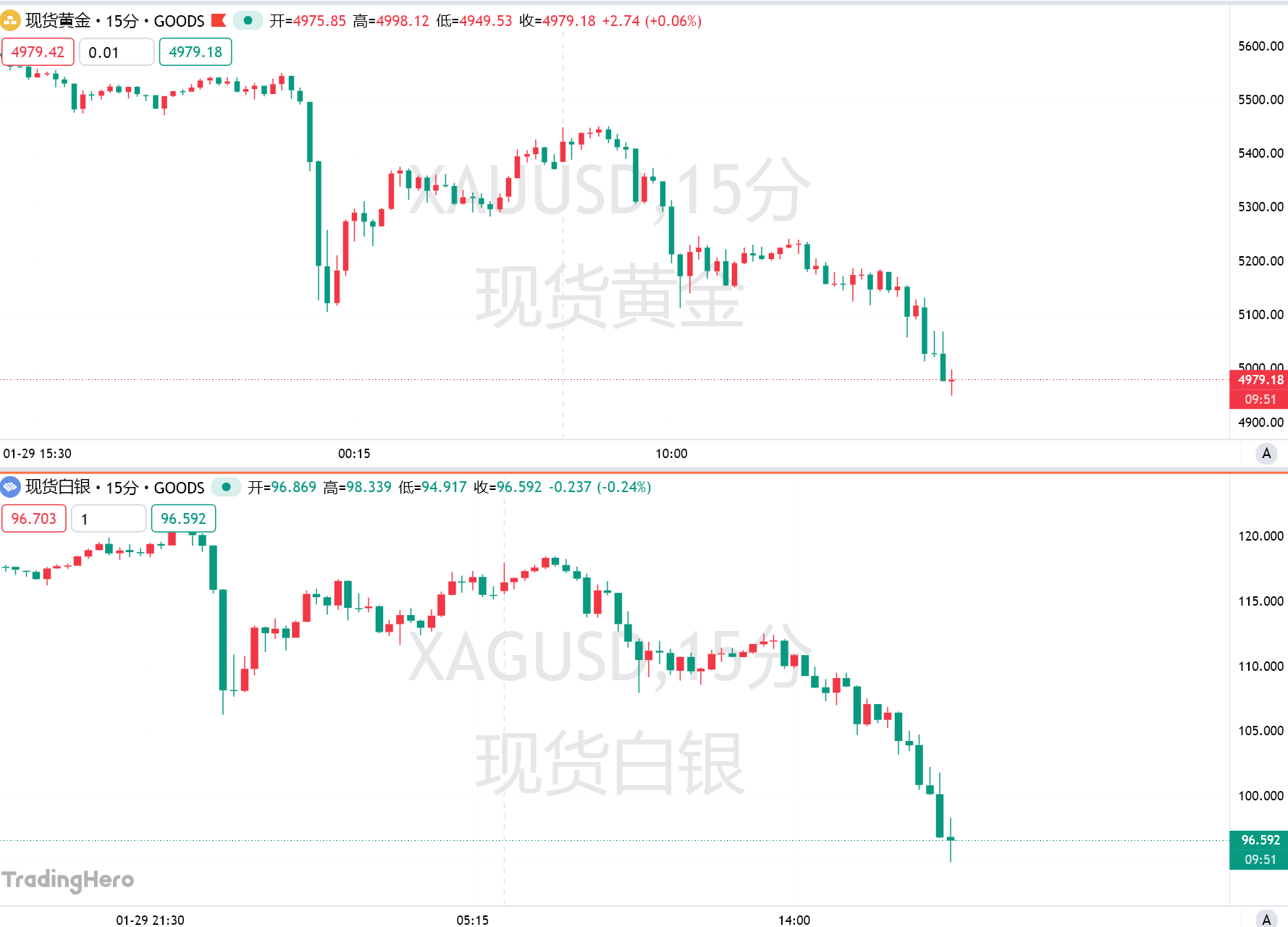
黄金日内暴跌逾400美元,白银盘中下破95关口,贵金属短期保值属性被证伪?
Jin Shi Shu Ju· 2026-01-30 09:59
Core Viewpoint - The recent surge in precious metal prices, particularly gold, has come to a halt due to various factors, including the potential nomination of Kevin Warsh as the Federal Reserve Chairman, which is seen as supportive of the US dollar [2][3]. Group 1: Market Dynamics - Spot gold prices fell below $5,000 per ounce, experiencing a significant drop of over $400 in a single day, marking a decline of nearly $600 from the recent historical high, with a daily drop exceeding 7% [1]. - The price of silver also faced a decline, briefly falling below $95 per ounce before a slight rebound [1]. Group 2: Analyst Insights - Christopher Wong from OCBC Bank noted that the volatility in gold prices reflects a "boom and bust" narrative, indicating that while the news of Warsh's nomination triggered the sell-off, a correction was already anticipated [3]. - Technical indicators, such as the Relative Strength Index (RSI), suggested that both gold and silver were overbought, with gold's RSI reaching 90, the highest level in decades [3]. Group 3: Economic Context - The attractiveness of gold is closely tied to its perception as a "safe-haven asset" and an "inflation hedge," particularly in light of rising government debt and uncertainties surrounding interest rates and inflation [4]. - The Trump administration's aggressive policies have heightened concerns about the US economy, leading to a trend of "selling America" among some investors [4]. Group 4: Investment Behavior - Investors are increasingly diversifying away from US dollar assets, viewing gold as a preferred option in their portfolios amid fears of economic instability [4]. - Simon Popple from Brookville Capital highlighted that the perception of US Treasury bonds as nearly risk-free has changed, prompting a more cautious approach to capital allocation [5]. Group 5: Market Sentiment - The recent price movements in gold have sparked a buying frenzy among investors, driven by market trends and heightened interest in volatile assets [5]. - Chris Beauchamp from IG Group emphasized that despite gold's favorable investment attributes, its ability to preserve value is often overestimated, particularly in the short term [5][6].
传奇投资人炮轰黄金:保值纯属自欺欺人,定价完全没有依据!
Jin Shi Shu Ju· 2026-01-15 12:21
Core Viewpoint - Howard Marks questions the validity of gold as a wealth storage tool, arguing that its pricing cannot be rationally determined, unlike cash-flow generating assets such as stocks, bonds, and real estate [1][2] Group 1: Gold as an Investment - Marks emphasizes that gold, like other alternative assets, does not generate cash flow, making its pricing fundamentally unquantifiable [1] - He compares gold to oil, citing the 2008 price surge and subsequent crash, illustrating the unpredictability of hard asset pricing [1] - The only reason gold is considered a value storage tool is due to collective belief, not intrinsic value [1] Group 2: Historical Context and Market Trends - Marks refers to a 2010 memo where he stated that while gold appears to have ideal investment characteristics, its value as an inflation hedge is negligible [1] - Despite Marks' skepticism, analysts note that geopolitical tensions and central bank purchases have driven gold prices up by 7% since 2026 [2]
黄金在全球外汇黄金储备比例升至30%,硬通货就是黄金,怪不得那么多国人都是非洲淘金!
Sou Hu Cai Jing· 2025-10-18 19:25
Group 1 - The core viewpoint of the articles highlights a significant shift in global monetary reserves, with gold's share rising to 30% and the dollar's share declining from 43% to 40%, indicating a profound transformation in the global monetary system [2] - The World Gold Council projects that global central banks will purchase a net total of 1,136 tons of gold in 2024, with emerging markets accounting for over 70% of this demand, as these countries seek to create a "safety cushion" for their currencies [2] - The average global inflation rate exceeded 6% in the first half of 2025, while the spot price of gold in London rose by 22% year-on-year, reinforcing gold's role as an inflation hedge [4] Group 2 - The increase in gold reserves is intertwined with a surge in demand for gold mining jobs in Africa, with a 120% year-on-year increase in recruitment for gold-related positions, driven by rising gold prices and favorable conditions for Chinese workers [6] - The challenges faced by Chinese miners in Africa, including health risks and legal uncertainties, highlight the complexities of the gold rush, where individuals are navigating a landscape shaped by global economic changes [6][8] - The articles suggest that the key to addressing the challenges of illegal mining and ensuring sustainable cooperation between China and Africa lies in establishing regulated cross-border mining partnerships and improving labor protections for overseas workers [8][9]
