
配对交易

Search documents
高盛大宗经纪业务部门称美国软件股将持续反弹 曾推抗AI替代的配对交易股票篮子
Jin Rong Jie· 2026-02-26 13:29
Core Viewpoint - Goldman Sachs' brokerage division indicates that U.S. software stocks are expected to continue rebounding after previous market volatility due to concerns that AI tools could disrupt the software industry [1] Group 1: Market Strategy - Goldman Sachs has introduced a customized stock basket to address the volatility in software stocks, betting on companies with attributes resistant to AI replacement [1] - The basket employs a pair trading strategy, going long on companies that require physical execution, are under regulatory protection, or involve human accountability, as well as suppliers directly benefiting from the proliferation of AI in computing services, data infrastructure, and cybersecurity [1] - Conversely, the strategy involves shorting companies whose workflows are easily automated or replicated internally by AI [1]

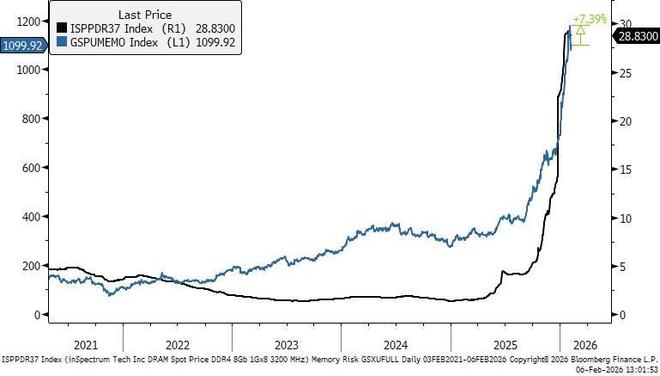
被错杀的存储?高盛:内存市场的基本面并未发生任何变化
Ge Long Hui A P P· 2026-02-08 03:39
Group 1 - The core viewpoint is that the market volatility has impacted the pair trading strategy of going long on memory beneficiary stocks versus shorting memory impact stocks, with the gap exceeding 7% compared to memory prices [1] - Despite the focus on the software and other market segments, the fundamentals of the memory market remain unchanged, and unless there is a significant slowdown in capital expenditures, the increasing prevalence of artificial intelligence is expected to further boost demand [1] - Memory-related stocks have seen their expected earnings grow by over two times, while the earnings of memory input cost-related stocks have lagged behind the market [1]

贵金属巨震催生套利良机!100亿基金惊现大幅折价
Jin Shi Shu Ju· 2026-02-04 09:47
Core Insights - The volatility in the precious metals market is creating unusual market phenomena, potentially offering opportunities for investors seeking bargains [1] - The Sprott Physical Gold and Silver Trust (CEF), a closed-end physical precious metals fund with $10 billion in assets, experienced a significant discount of 9.5% to its net asset value (NAV) last week [1] - The discount reached a historical peak of 11.4% on January 30, coinciding with record daily declines in gold and silver prices [1][2] Group 1 - The unusual discount on CEF shares allows investors to effectively purchase gold and silver at a price of 89 cents for every dollar of value [2] - The average discount rate for CEF since its inception in 2018 has been around 4%, but it recently widened significantly [2] - The increase in discount is closely linked to the recent surge in gold and silver price volatility, complicating the understanding of current price movements [2][3] Group 2 - The current market conditions may create favorable opportunities for investors looking to engage in pairs trading, where they can buy CEF shares and short-sell a basket of gold and silver [2] - The fund's holdings consist of approximately 59% gold and 41% silver, with a management fee of 0.48% [2] - Other Sprott funds, such as the Sprott Physical Silver Trust (PSLV) and Sprott Physical Gold Trust (PHYS), are also experiencing widening discounts, indicating a broader trend in the market [3][4] Group 3 - The significant price dislocation between physical metals and the funds holding them highlights the potential for mispricing during periods of high market volatility [4] - Investors are reminded that while prices may eventually revert to their mean, the timing of such corrections is unpredictable [4]
错失恐惧症与泡沫恐慌交织,预示2026年股市波动加剧
Xin Lang Cai Jing· 2025-12-22 10:37
Core Viewpoint - Investors are caught in a dilemma between missing out on the AI boom and fearing a potential bubble burst, leading to expected market volatility in the U.S. stock market in 2026 [1] Group 1: Market Trends and Predictions - The stock market has experienced alternating phases of significant sell-offs and rapid rebounds over the past 18 months, a trend likely to continue into 2026 [1] - Some strategists predict that the AI sector may follow a historical pattern of "boom-bust" cycles seen in previous technological revolutions [1] - The performance of tech companies, which have a disproportionate market influence, is expected to diverge from other components of the S&P 500 in 2025, potentially stabilizing overall market volatility [1] Group 2: Volatility and Trading Strategies - Strategists anticipate that market volatility will be supported in 2026 due to the instability often associated with expanding asset bubbles, with potential for over 10% declines followed by rapid rebounds [2] - UBS strategists suggest that regardless of whether the AI trend continues or collapses, profiting from increased volatility in the Nasdaq 100 index is key, recommending strategies like straddles or OTC swaps [2] - The VIX index is expected to maintain a median range of 16 to 17 in 2026, but could spike significantly during risk-averse market conditions [2] Group 3: Options Pricing and Trading Strategies - The imbalance of investment funds is projected to influence options pricing, potentially steepening the volatility curve [3] - Pair trading strategies, betting on individual stock volatility rising while index volatility narrows, are expected to gain popularity, although some funds are taking contrarian positions due to overcrowding [3][4] - Investors are encouraged to explore various forms of pair trading to extract profits, as the traditional strategy has become widely known and its excess return potential diminished [4] Group 4: Market Dynamics and Risk Management - A model proposed by Societe Generale suggests that a flattening yield curve signals a buy in volatility, while a steepening curve indicates a sell, with the model having successfully avoided major downturns in the past [5] - The current low leverage levels in U.S. corporate sectors may be the beginning of a new leverage cycle driven by AI, which could elevate credit spreads and stock market volatility [5] - Investors are advised to prepare for extreme market conditions in 2026, driven by fears of missing out, conflicting narratives around AI, and uncertainties from U.S. government policies [5]