股市波动率

Search documents
国泰海通|海外策略:鹰派沃什交易落地,股市波动率攀升
国泰海通证券研究· 2026-02-03 14:00
Market Performance - Emerging markets saw a narrowing increase last week, with MSCI global index up by 0.2%, MSCI developed markets flat at 0.0%, and MSCI emerging markets up by 1.4% [1] - In the bond market, the U.S. 10Y Treasury yield experienced the largest increase, while commodities like oil surged and gold and silver saw notable pullbacks [1] - The global energy sector showed consistent growth, with Chinese stocks performing strongly in cyclical sectors, and utilities and communications in Europe and the U.S. outperforming [1] Trading Sentiment - Global market trading volume increased last week, with major indices experiencing higher volatility [1] - A/H/U.S./European/Japanese stock trading volumes rose, while Korean stock trading volume decreased [1] - Investor sentiment in Hong Kong improved and reached historical highs, while U.S. investor sentiment also remained at historical highs [1] - Volatility increased across Hong Kong, U.S., European, and Japanese stocks, while U.S. Treasury bond volatility decreased [1] - Valuations for both developed and emerging markets improved compared to the previous week [1] Earnings Expectations - Earnings expectations for Japanese and European stocks were revised upward last week, with the following changes: 1) Hong Kong's Hang Seng Index 2025 EPS forecast adjusted from -2.1% to -2.0% 2) U.S. S&P 500 Index 2025 EPS forecast revised from +10.5% to +11.8% 3) Eurozone STOXX 50 Index 2025 EPS forecast adjusted from -4.5% to -4.4% [2] Economic Expectations - The U.S. economic surprise index rose last week, potentially due to stronger-than-expected corporate earnings and easing geopolitical tensions [2] - The European economic surprise index also improved, likely supported by better-than-expected GDP growth in the Eurozone for Q4 [2] - The Chinese economic surprise index showed marginal improvement, influenced by expectations surrounding real estate and service consumption policies, as well as improved Sino-British relations [2] Capital Flows - The hawkish nomination of Walsh as the next Federal Reserve Chair has influenced market expectations, with a slight decrease in the anticipated number of rate cuts for 2026 [3] - Global liquidity remained stable, with significant capital inflows into China, the U.S., South Korea, India, and Europe [3] - The largest incremental capital inflow into Hong Kong stocks came from the Hong Kong Stock Connect [3]


全球股市立体投资策略周报 2月第1期:鹰派沃什交易落地,股市波动率攀升-20260203
GUOTAI HAITONG SECURITIES· 2026-02-03 09:17
Market Performance - Emerging markets saw a narrowing of gains, with MSCI Global up by 0.2%, MSCI Developed Markets flat at 0.0%, and MSCI Emerging Markets up by 1.4% [8][11] - In developed markets, the South Korean Composite Index performed the best with a gain of 4.7%, while Germany's DAX was the weakest, down by 1.5% [8] - In the emerging markets, the Hang Seng Index was the top performer, increasing by 2.4%, while Mexico's MXX declined by 0.9% [8] Trading Sentiment - Global markets experienced increased trading volumes, with major indices showing a rise in volatility [24] - The Hong Kong stock market saw a decrease in short-selling ratio to 12.9%, indicating a high investor sentiment [24][27] - North American investment sentiment reached historical highs, with the NAAIM manager exposure index rising to 92.6% [24][27] Fund Flows - The nomination of Kevin Warsh as the next Federal Reserve Chair has triggered hawkish trading expectations [55] - As of January 30, market expectations indicate the Federal Reserve is anticipated to cut rates 2.1 times in 2026, a slight decrease from the previous week [55][58] - The Hong Kong stock market saw a net inflow of HKD 5.9 billion, with significant contributions from the Stock Connect program [62][64] Earnings Expectations - Earnings expectations for Japanese and European stocks were revised upward, with the Hang Seng Index's 2025 EPS forecast adjusted from -2.1% to -2.0% [66] - The S&P 500's 2025 EPS forecast was raised from +10.5% to +11.8%, with the industrial sector seeing the largest upward revision of +7.9% [66] - In the European market, the Eurozone STOXX50's 2025 EPS forecast improved from -4.5% to -4.4% [66]
错失恐惧症与泡沫恐慌交织,预示2026年股市波动加剧
Xin Lang Cai Jing· 2025-12-22 10:37
Core Viewpoint - Investors are caught in a dilemma between missing out on the AI boom and fearing a potential bubble burst, leading to expected market volatility in the U.S. stock market in 2026 [1] Group 1: Market Trends and Predictions - The stock market has experienced alternating phases of significant sell-offs and rapid rebounds over the past 18 months, a trend likely to continue into 2026 [1] - Some strategists predict that the AI sector may follow a historical pattern of "boom-bust" cycles seen in previous technological revolutions [1] - The performance of tech companies, which have a disproportionate market influence, is expected to diverge from other components of the S&P 500 in 2025, potentially stabilizing overall market volatility [1] Group 2: Volatility and Trading Strategies - Strategists anticipate that market volatility will be supported in 2026 due to the instability often associated with expanding asset bubbles, with potential for over 10% declines followed by rapid rebounds [2] - UBS strategists suggest that regardless of whether the AI trend continues or collapses, profiting from increased volatility in the Nasdaq 100 index is key, recommending strategies like straddles or OTC swaps [2] - The VIX index is expected to maintain a median range of 16 to 17 in 2026, but could spike significantly during risk-averse market conditions [2] Group 3: Options Pricing and Trading Strategies - The imbalance of investment funds is projected to influence options pricing, potentially steepening the volatility curve [3] - Pair trading strategies, betting on individual stock volatility rising while index volatility narrows, are expected to gain popularity, although some funds are taking contrarian positions due to overcrowding [3][4] - Investors are encouraged to explore various forms of pair trading to extract profits, as the traditional strategy has become widely known and its excess return potential diminished [4] Group 4: Market Dynamics and Risk Management - A model proposed by Societe Generale suggests that a flattening yield curve signals a buy in volatility, while a steepening curve indicates a sell, with the model having successfully avoided major downturns in the past [5] - The current low leverage levels in U.S. corporate sectors may be the beginning of a new leverage cycle driven by AI, which could elevate credit spreads and stock market volatility [5] - Investors are advised to prepare for extreme market conditions in 2026, driven by fears of missing out, conflicting narratives around AI, and uncertainties from U.S. government policies [5]
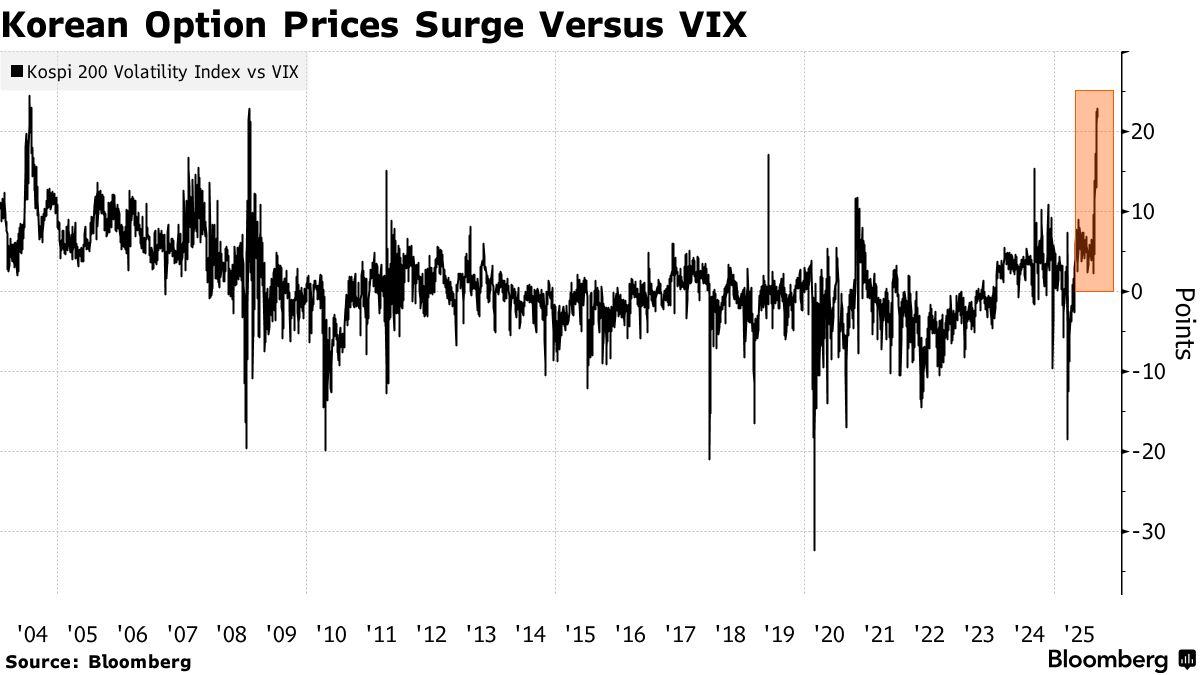
全球“最牛”股指亮起危险信号!韩国股市波动率飙升,投资者焦虑情绪升温
智通财经网· 2025-11-12 04:21
Group 1 - Increased speculation on volatility in the South Korean stock market has raised concerns about the sustainability of its strong performance this year, with the KOSPI volatility index reaching levels not seen since April during the Trump tariff crisis [1] - The KOSPI index has surged by 73% this year, aiming for its largest annual gain since 1999, outperforming all other global indices, while the KOSPI 200 index, which includes blue-chip stocks, has risen by 85% [1] - The rise in the KOSPI index is primarily driven by significant gains in semiconductor stocks like Samsung Electronics and SK Hynix, which hold a larger weight in the index [1] Group 2 - Analysts indicate that the current high levels of the KOSPI index reflect investor anxiety, with expectations for the market's continued rise appearing overly optimistic [4] - Both call and put option prices have increased, with the implied volatility for call options exceeding the one-year average, while put options remain below this level, indicating active positioning by traders [4] - Foreign investors have adjusted their portfolios in response to recent market volatility, selling approximately 1.65 trillion KRW (about 1.1 billion USD) in futures contracts linked to the KOSPI index, following its largest weekly decline since April [4]