银行风险管理

Search documents
公开选聘五位高管 廊坊银行欲加速摆脱业绩泥淖
Bei Jing Shang Bao· 2026-02-11 23:53
Core Viewpoint - Langfang Bank is undergoing significant changes by publicly recruiting five senior management positions to address its declining performance and improve risk management and compliance capabilities [1][2][5]. Group 1: Management Changes - The bank is seeking to recruit two vice presidents, a board secretary, a chief risk officer, and a chief compliance officer to strengthen its management team and enhance operational efficiency [2][3]. - The recruitment process combines internal selection and external hiring, with candidates required to have relevant banking experience and educational qualifications [2][3]. Group 2: Performance Challenges - Langfang Bank has faced a continuous decline in revenue and net profit from 2020 to 2024, with revenue dropping from 52.49 billion to 36.13 billion and net profit falling from 14.18 billion to 2.43 billion [5][6]. - The bank's asset quality is under pressure, with a non-performing loan ratio increasing to 2.44% and a significant drop in the provision coverage ratio [6]. Group 3: Strategic Initiatives - The bank is actively seeking to introduce state-owned capital to strengthen its control and foundation for development, with a major shareholder now holding 19.99% of the bank's shares [6][7]. - A capital increase plan has been approved, aiming to raise up to 29.09 billion shares, which will enhance the state-owned capital's share to 57.37% [6][7]. Group 4: Early Signs of Recovery - Recent measures have led to a positive turnaround, with a 26.23% year-on-year increase in revenue in the first half of 2025 and a reduction in the non-performing loan ratio to 2.23% [7][8]. - The bank's management acknowledges that while the early signs of recovery are promising, long-term efforts are needed to address structural challenges and improve overall performance [8].
盈利能力保持韧性、资产规模稳步扩张 首批8家上市银行2025年业绩预喜
Shang Hai Zheng Quan Bao· 2026-01-25 23:31
Core Insights - The first batch of eight listed banks has reported positive earnings forecasts for 2025, with all banks achieving year-on-year growth in net profit, and seven of them also reporting revenue growth [1][2]. Group 1: Earnings Performance - All eight listed banks reported a year-on-year increase in net profit, with seven banks achieving both revenue and net profit growth, indicating a robust overall performance [2]. - Among the city commercial banks, Hangzhou Bank led with a 12.05% increase in net profit, while Ningbo Bank and Nanjing Bank reported growth rates of 8.13% and 8.08%, respectively [2]. - In the joint-stock banks category, Pudong Development Bank showed a notable net profit growth of 10.52%, while CITIC Bank, China Merchants Bank, and Industrial Bank reported increases of 2.98%, 1.21%, and 0.34%, respectively [2]. Group 2: Revenue Growth - Seven banks achieved year-on-year revenue growth, with only CITIC Bank experiencing a slight decline of 0.55% [2]. - Ningbo Bank's revenue grew by 8.01% to 71.968 billion yuan, driven by a significant 30.72% increase in net income from fees and commissions, highlighting the growth of intermediary business [2]. - Pudong Development Bank's revenue reached 173.964 billion yuan, marking a 1.88% increase, while Industrial Bank and China Merchants Bank reported revenues of 212.741 billion yuan and 337.532 billion yuan, respectively [2]. Group 3: Asset Expansion - The total assets of several banks have expanded significantly, with China Merchants Bank surpassing 13 trillion yuan and Industrial Bank reaching 11 trillion yuan [3]. - Smaller banks showed even faster growth, with Nanjing Bank, Ningbo Bank, and Hangzhou Bank's total assets increasing by 16.63%, 16.11%, and 11.96%, respectively, focusing on technology finance, green finance, and inclusive finance [3]. Group 4: Asset Quality - The core indicators of asset quality remain stable, with a decrease in the non-performing loan (NPL) ratio for four of the eight banks, while three banks maintained their ratios [4]. - Pudong Development Bank saw a significant reduction in its NPL ratio, decreasing by 10 basis points to 1.26%, while CITIC Bank and China Merchants Bank also reported slight declines [4]. - City commercial banks demonstrated particularly strong asset quality, with several banks maintaining NPL ratios below 1% [4]. Group 5: 2026 Strategic Focus - Many banks have outlined their strategic priorities for 2026, focusing on optimizing business structures, expanding intermediary income sources, and strengthening risk management [6]. - Bank of Communications emphasized increasing financial support for key sectors and enhancing services for small and micro enterprises [6]. - Beijing Bank has deployed ten key initiatives for 2026, aiming for qualitative and quantitative improvements in performance [7].
珠海华润银行新年领566万罚单!不到两年罚没超1700万
Nan Fang Du Shi Bao· 2026-01-16 13:09
Core Viewpoint - Zhuhai China Resources Bank has received a fine of 5.5 million yuan for multiple violations, highlighting significant internal management shortcomings and compliance risks [2][4][6]. Regulatory Penalties - The bank and its branches have accumulated fines exceeding 17 million yuan in less than two years, indicating frequent compliance issues [6][8]. - Recent penalties include 700,000 yuan for rigid repayment of asset management plans and 120,000 yuan for severe violations of prudent operation rules in loan business [6][10]. Key Violations - The three core violations include non-compliance with related party transaction regulations, inaccurate loan classification, and insufficient provisioning for non-performing loans [4][5]. - These issues reflect systemic vulnerabilities in the bank's risk management framework, with potential risks of interest transfer and asset quality deterioration [4][5]. Financial Performance - The bank's net profit has significantly declined, dropping from 20.03 billion yuan in 2022 to 4.49 billion yuan in 2024, a decrease of 67.97% year-on-year [10][11]. - Despite an increase in operating income from 65.23 billion yuan in 2022 to 71.32 billion yuan in 2024, the profitability has sharply decreased [10][11]. Management Changes - The bank has undergone management changes, with a focus on market-based recruitment for senior positions, indicating a shift towards more competitive management practices [12]. - Recent appointments include Qian Xi as the general manager and Yuan Zhizhong as the new president, reflecting a strategic move to enhance leadership quality [12].


中信银行多家一级分行行长调整
Xin Lang Cai Jing· 2026-01-07 09:19
Group 1 - Major changes in the core management of CITIC Bank are expected by the end of 2025, with Lu Wei resigning from his positions as executive director and president due to work adjustments [1][15] - Chairman Fang Heying will temporarily assume the responsibilities of the president following Lu Wei's departure [1][15] - Multiple first-level branch leaders of CITIC Bank have also undergone changes, indicating a significant restructuring within the organization [1][15] Group 2 - Zhu Yiming, the former president of the Shijiazhuang branch, has been appointed as the president of the Shanghai branch, which is the third-largest branch of CITIC Bank with total assets of 619.609 billion yuan as of June 2025 [3][18] - The former president of the Kunming branch, Cao Yaming, has been assigned to lead the Shijiazhuang branch [5][20] - Xu Zhen, the deputy president of the Nanjing branch, will now oversee the Kunming branch, while Li Yi and Ge Jun have been promoted to deputy presidents of the Chengdu branch [7][22][29] Group 3 - As of June 2025, CITIC Bank has established 1,477 business outlets in 153 major cities across the country, including 37 first-level branches and 125 second-level branches [12][27] - The bank has faced multiple administrative penalties, including a fine of 2.3 million yuan for the Chengdu branch due to mismanagement in credit, trade financing, and bill business [12][27] - In December 2025, eight branches in Jiangsu received fines totaling 6.6 million yuan for various issues, highlighting systemic management deficiencies at the local branch level [14][29]


官宣!金喜年出任中信银行风险总监,已获监管核准
2 1 Shi Ji Jing Ji Bao Dao· 2025-12-04 11:53
Core Viewpoint - CITIC Bank has officially approved the appointment of Jin Xinian as the Chief Risk Officer, effective from December 2, 2025, following the resignation of the previous officer, Hu Gang, due to work adjustments [1][3]. Group 1: Appointment Details - The appointment of Jin Xinian was based on a board resolution made on September 28, 2023, which also confirmed Hu Gang's continued role as Vice President [3]. - Jin Xinian currently holds multiple positions, including member of the Party Committee, Vice President, Chief Risk Officer, and General Manager of the Credit Execution Department [3]. Group 2: Professional Background - Jin Xinian, born in March 1971, has 32 years of extensive experience in the Chinese banking industry and holds an MBA from Shanxi University of Finance and Economics, along with a senior economist title [3]. - His career began at Agricultural Bank of China, where he held various positions from July 1993 to March 2017, including Deputy General Manager of the Major Client Department [3]. Group 3: Recent Roles - Since joining CITIC Bank in March 2017, Jin has served as General Manager of the Investment Banking Department and the Corporate Banking Department, and later as Party Secretary and President of the Guangzhou Branch [3]. - He was appointed General Manager of the Credit Execution Department in November 2024 and became a member of the Party Committee in April 2025, subsequently promoted to Vice President in August 2025 [3]. Group 4: Management Structure - CITIC Bank's senior management team includes the President, multiple Vice Presidents, a Business Director, and a Board Secretary, reflecting a trend in the industry where many banks have a Chief Risk Officer [4]. - The bank's risk governance is integrated into its top-level design, aligning with the industry standard of having a comprehensive risk management framework [4].
BBVA(BBAR) - 2025 Q3 - Earnings Call Transcript
2025-11-26 16:02
Financial Data and Key Metrics Changes - BBVA Argentina's inflation-adjusted net income for Q3 2025 was ARS 38.1 billion, a decrease of 39.7% quarter over quarter, resulting in a quarterly ROE and ROA of 4.7% [8][9] - The capital ratio decreased by 170 basis points to 16.7%, primarily due to the temporary impact of sovereign debt valuation, yet remains at ample levels to support growth [7][15] Business Line Data and Key Metrics Changes - Total loans to the private sector grew by 6.7% in real terms, with a consolidated market share of 11.39% [6][13] - Deposits increased by 10.2% in real terms, with market share rising 44 basis points to 10.09% [7][14] - Non-performing loan (NPL) ratio reached 3.28%, remaining below the system average, reflecting effective credit risk management [7][13] Market Data and Key Metrics Changes - Deposit rates surged from 30% in July to peaks of 70% in September, influenced by political uncertainty and monetary policy changes [4][5] - The liquidity ratio stood at 44.3% of deposits, indicating a comfortable liquidity position despite a decrease from the previous quarter [7][16] Company Strategy and Development Direction - The company maintains a focus on operational efficiency, managing fees and controlling expenses to navigate a volatile environment marked by high interest rates [3][4] - BBVA Argentina aims to continue driving activity and operational efficiency while generating sustained value for shareholders [17] Management's Comments on Operating Environment and Future Outlook - Management noted that the high interest rates have negatively impacted intermediation margins and increased delinquency levels, but they remain optimistic about future growth [5][10] - The expectation is for a challenging Q4 2025, with potential increases in NPLs, but a recovery is anticipated in 2026 [34][35] Other Important Information - The bank's total operating expenses decreased by 3.4% quarter over quarter, reflecting proactive efficiency measures [10][11] - The bank continued dividend payments corresponding to the 2024 financial year income, demonstrating a commitment to shareholder value [17] Q&A Session Summary Question: Guidance on loan and deposit growth - Management reiterated guidance of 45%-50% real loan growth and 30%-35% deposit growth, with ROE expectations in the high single digits [22][23] Question: Genuine loan growth versus refinancing - Management believes the loan growth is genuine, primarily driven by US dollar loans to companies, with retail loans remaining flat due to high NPLs [23] Question: Daily reserve requirements and NIM evolution - Changes in reserve requirements are expected to improve liquidity and profitability, with a stable NIM anticipated moving forward [32][38] Question: Asset quality outlook - NPLs are expected to rise slightly in Q4 2025 but should stabilize and improve in 2026 [34][35] Question: Capital level stabilization - Management aims for a capital ratio around 17% for 2025, with a comfortable management level slightly below 13% [46][47] Question: Credit demand and NPL absorption - Demand for retail loans is expected to recover slowly, while commercial loans are seeing high demand, particularly in US dollars [45][50] Question: Coverage ratios and NPL outlook - Coverage ratios are currently comfortable at 98%-100%, with expectations for improvement in 2026 as NPLs stabilize [62]

新格局下的银行风险管理:从被动防御到主动布局
Sou Hu Cai Jing· 2025-11-25 02:31
Core Viewpoint - Commercial banks are facing a new normal where external risks outweigh internal risks, and macro risks surpass micro risks, necessitating a shift from traditional risk management to a more proactive and systematic risk governance paradigm [2] Group 1: External Risks and Challenges - Geopolitical conflicts, technological disruptions, and policy shifts are significant external uncertainties impacting banks' strategic security and operational resilience [2] - Traditional, static risk prevention methods are insufficient to meet the challenges posed by this complex environment [2] Group 2: Information Integration and Risk Governance - Banks need to establish a dynamic, intelligent risk intelligence system to integrate information across business and risk functions, addressing issues like "data silos" and "information lag" [2][3] - A comprehensive information collection and analysis framework should be built, covering macro, meso, and micro levels to identify risk and opportunity factors [3] Group 3: AI and Risk Monitoring - The introduction of AI technologies, such as machine learning and natural language processing, can enhance real-time analysis of vast amounts of structured and unstructured data, improving early risk signal detection [5] - A digital bank's "AphaMo" project exemplifies the use of AI to achieve significant improvements in risk feature extraction efficiency and risk differentiation [5] Group 4: Strategic Risk Management - Establishing a "strategic risk agile team" with cross-departmental authority can facilitate rapid resource allocation and coordination in response to major risk events [13] - Banks should balance risk and growth by integrating risk assessment into business decision-making processes, ensuring that risk management is not seen as opposing business development [14] Group 5: Decision-Making and Governance - A restructured decision-making mechanism is necessary to ensure that business and risk functions are aligned, with a focus on maintaining a balance of power and appropriate assessment incentives [14] - The integration of risk and opportunity assessments into strategic management processes is essential for adapting to environmental changes and emerging risks [15] Group 6: Proactive Risk Management - A comprehensive risk evaluation system should be developed, linking risk assessment results to the bank's overall evaluation framework, influencing resource allocation and strategic decisions [17][18] - The goal is to create a closed-loop management system that integrates risk, assessment, and strategy, enhancing the bank's resilience in uncertain environments [18]

华夏银行COO、CRO、CFO齐亮相,首席风险官9个月2次调整成焦点
Xin Lang Cai Jing· 2025-10-28 05:36
Group 1: Management Changes - Huaxia Bank has undergone a significant management reshuffle, appointing a new team of three "chiefs" including a Chief Operating Officer (COO), Chief Risk Officer (CRO), and Chief Financial Officer (CFO) [1][3] - The new CRO, Fang Yi, previously served as the chairman of Beiyin Wealth Management for just over two months before his appointment, raising questions about the stability of the position [4][7] - The bank's internal adjustments reflect a strategic focus on enhancing operational efficiency and risk management capabilities [1][4] Group 2: Regulatory Issues - Huaxia Bank received the largest penalty in the banking sector this year, amounting to 87.25 million yuan, due to non-compliance in loan and financial management practices [7][8] - The bank has faced a total of 11 penalties in 2025, totaling 99.07 million yuan, primarily related to credit violations [8] - The rapid turnover in key risk management positions may hinder the continuity and stability of the bank's risk strategy [3][7] Group 3: Financial Performance - For the first three quarters of 2025, Huaxia Bank reported a revenue of 64.881 billion yuan, a year-on-year decrease of 8.79%, and a net profit of 17.982 billion yuan, down 2.86% [11][14] - The decline in revenue and profit is attributed to reduced fair value gains and a narrowing interest margin, with net interest income falling to 46.294 billion yuan, a decrease of 1.62% year-on-year [11][12] - Investment income accounted for nearly 20% of total revenue, indicating a reliance on non-interest income streams amid challenging market conditions [10][11]

邢台银行领465万元罚单:10名高管被问责
Huan Qiu Wang· 2025-06-16 06:26
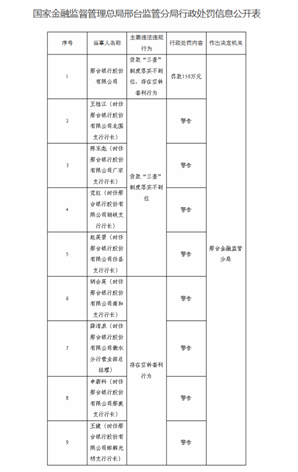
Core Viewpoint - The recent administrative penalties imposed on Xingtai Bank by the Hebei Regulatory Bureau highlight significant management deficiencies and regulatory compliance issues within the bank, raising concerns about its risk management capabilities amid rapid business expansion [1][2]. Summary by Categories Regulatory Penalties - Xingtai Bank was fined a total of 4.65 million yuan for three major violations, with penalties including 1.5 million yuan for inadequate implementation of the loan "three checks" system and 2.85 million yuan for inaccurate loan risk classification [2]. - Ten branch managers and department heads were held accountable, receiving warnings and fines, indicating a systemic issue in management oversight [2]. Financial Performance - As of the end of 2024, Xingtai Bank reported total assets of 173.18 billion yuan, an increase of 20.91 billion yuan from the beginning of the year, and an annual operating income of 5.32 billion yuan, reflecting a growth of 87% [4]. - The net profit for 2024 was approximately 608 million yuan, with a year-on-year increase of 25.88%, demonstrating rapid expansion despite the regulatory challenges faced [4]. Risk Management Issues - The penalties reveal critical shortcomings in Xingtai Bank's risk management practices, including ineffective loan review processes, inaccurate risk classification, and non-compliance in managing out-of-area institutions [4]. - The bank's rapid growth has not been matched by improvements in its risk control capabilities, raising concerns about its long-term sustainability and operational integrity [4].
行长“闪辞”后迎人事新动向,港股最“迷你”银行如何打破增速放缓困局
Bei Jing Shang Bao· 2025-04-22 15:09
Core Viewpoint - The recent personnel changes and disappointing financial performance of Yibin Bank highlight the challenges it faces in achieving strategic transformation and overcoming development bottlenecks, particularly in light of its close ties to the liquor industry and rising credit risks [1][6][10]. Personnel Changes - Yibin Bank is undergoing significant personnel changes, with Jiang Lin, a member of the board of directors and deputy secretary of the party committee, being proposed for a key position in a municipal enterprise [3][5]. - The sudden resignation of Yang Xingwang, the bank's long-serving president, due to health reasons, has raised concerns about the bank's leadership stability [4][5]. Financial Performance - Yibin Bank's financial results for 2024 show stagnation, with revenue and net profit growth nearly flat, indicating a significant slowdown compared to previous years [6][7]. - As of the end of 2024, the bank's total assets reached 109.205 billion yuan, a year-on-year increase of 16.9%, but the growth in revenue and net profit was only 0.5% and 0.1%, respectively [7][8]. Business Structure and Risks - The bank's reliance on low-yield businesses, particularly in the ticket discounting sector, has negatively impacted overall revenue, with a significant increase in the average balance of low-yield ticket discounting [8][9]. - The bank's asset quality is under pressure, with rising non-performing loan rates in key sectors such as manufacturing and wholesale/retail, indicating potential credit risks [9][10]. Historical Context and Challenges - Yibin Bank's current challenges are compounded by historical issues related to its previous major shareholder, the "Contemporary System," which has left lingering impacts on the bank's operations and financial health [10][11]. - The bank's dependency on the liquor industry, particularly its major client Wuliangye, raises concerns about its ability to diversify and manage risks effectively [9][12]. Strategic Recommendations - To improve its performance, Yibin Bank should consider diversifying its business model, reducing reliance on a single industry, and enhancing its risk management capabilities [12][13]. - Emphasizing technological advancements and expanding into high-yield sectors could help the bank stabilize and grow its earnings [12].