银行承兑汇票

Search documents
票据成为洗钱工具?多家银行发布提醒!
券商中国· 2026-03-23 12:50
Core Viewpoint - The article highlights the increasing prevalence of invoice money laundering schemes and the recent regulatory measures taken to combat this issue, particularly focusing on the role of banks and the importance of vigilance among businesses [2][5]. Group 1: Recent Developments in Money Laundering Cases - Xiamen police recently disclosed a case involving the joint efforts of law enforcement and enterprises to combat invoice money laundering [1] - In response to the rise in invoice money laundering cases, multiple banks have launched anti-fraud and anti-money laundering campaigns, urging businesses to be cautious [2][5]. Group 2: Mechanisms of Invoice Money Laundering - Bank acceptance bills, which are credit payment instruments guaranteed by banks, have become targets for criminals due to their strong liquidity and backing [3]. - A case from Xiamen involved a company receiving an unusual offer to sell a 1 million yuan acceptance bill, where the buyer transferred funds before the bill was officially delivered, raising red flags [3]. - The "low-price acquisition + advance payment" scheme has been warned against by police in various regions, indicating a common tactic used by fraudsters [4]. Group 3: Regulatory Measures and Bank Responses - The implementation of the "Special Anti-Money Laundering Measures Management Method" in February has included invoices in the scope of special preventive measures, marking a significant regulatory enhancement [2][5]. - Banks have been proactive in issuing warnings about invoice money laundering scams, emphasizing the risks associated with seemingly attractive offers [6]. - Financial institutions are now responsible for tracing and verifying the background of invoice transactions to prevent money laundering activities [6]. Group 4: Innovations in Invoice Management - The Shanghai Bill Exchange launched a comprehensive service platform aimed at addressing pain points in the invoice market, facilitating real-time access to discount rates and transaction services for businesses [7]. - The platform integrates various functions to improve transparency and efficiency in the invoice trading process, moving from offline to online collaboration [7].

开年严监管!70张金融大罚单密集落地,百万级千万级重罚频现
Xin Lang Cai Jing· 2026-02-27 10:42
Group 1 - Jiangxi Anfu Rural Commercial Bank was fined 1.8 million yuan for violations in personal loan issuance, risk exposure delays, and inadequate responsibility for bad debt write-offs [1] - Quanzhou Bank was fined 6.25 million yuan for false data in small and micro enterprise loans, inadequate risk classification management, and improper deposit absorption [2] - Hubei Xiaogan Rural Commercial Bank was fined 1.2 million yuan for non-compliance in major related transactions and misappropriation of personal loan funds [3] Group 2 - China Life Insurance Hubei Branch was fined 1.17 million yuan for fabricating false materials and providing improper benefits to policyholders [4] - Xiamen Rural Commercial Bank was fined 6.05 million yuan for inadequate management in governance, credit, and wealth management [5] - China Orient Asset Management Shanghai Branch was fined 1.5 million yuan for serious violations in prudent operation rules regarding bad asset acquisitions [6] Group 3 - China Construction Bank Shanghai Branch was fined 4.2 million yuan for severe violations in internet loan risk management and project financing [7] - China Export-Import Bank Guangdong Branch was fined 1.1 million yuan for misclassifying self-operated business as policy business [8] - Agricultural Bank of China Zhoushan Branch was fined 3.85 million yuan for imprudent credit management [9] Group 4 - CITIC Bank Nanning Branch was fined 1.1 million yuan for inadequate loan investigation and post-loan management [10] - China Agricultural Bank Hainan Branch was fined 1 million yuan for inadequate loan-related business and improper employee management [11] - Zhejiang Min Tai Commercial Bank was fined 7.15 million yuan for multiple serious violations in loan management and reporting [12] Group 5 - Shanghai Bank was fined 4.5 million yuan for concealing bad loans and providing false documentation [13] - China Postal Savings Bank Fujian Branch was fined 2.8 million yuan for inadequate internal control management in credit business [14] - Guangfa Bank Guangzhou Branch was fined 1.85 million yuan for serious violations in loan business and unauthorized high-level management [15]
江西银行因贷款管理不到位收罚单 27日收报0.7港元
Sou Hu Cai Jing· 2026-02-27 10:29
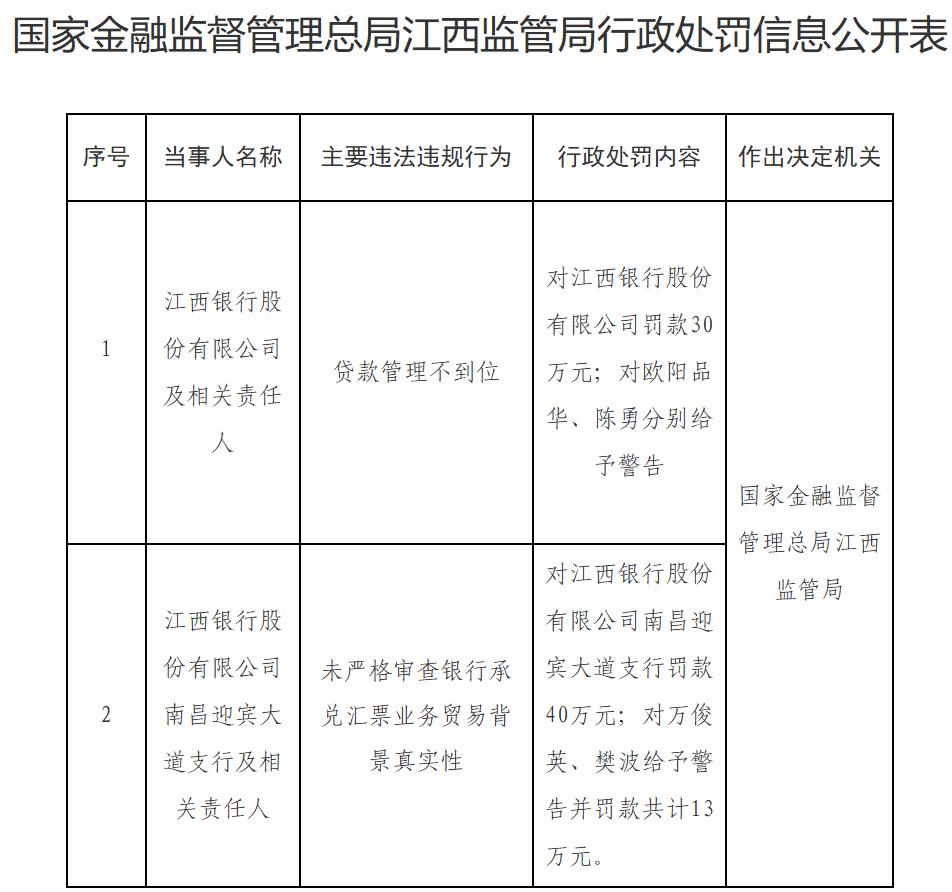
Core Viewpoint - Jiangxi Bank has been penalized for inadequate loan management, drawing market attention to its compliance issues [2][5]. Regulatory Actions - Jiangxi Bank was fined 300,000 yuan by the Jiangxi Regulatory Bureau of the National Financial Supervisory Administration for poor loan management [2][3]. - Two responsible individuals received warnings due to the same issue [2][3]. - Jiangxi Bank's Nanchang Yingbin Avenue Branch was fined 400,000 yuan for failing to strictly verify the authenticity of trade backgrounds in bank acceptance bill business, with two individuals fined a total of 130,000 yuan [5]. Financial Performance - As of mid-2025, Jiangxi Bank reported total assets of 580.297 billion yuan, a 1.16% increase from the previous year [7]. - The total amount of loans and advances reached 364.903 billion yuan, up 3.39% year-on-year [7]. - Total deposits amounted to 396.770 billion yuan, reflecting a 1.49% increase [7]. - The bank's operating income for the period was 4.604 billion yuan, a decline of 19.91% compared to the previous year [6][7]. - Net profit decreased by 9.64% to 583 million yuan [7]. - The non-performing loan ratio stood at 2.36%, an increase of 0.21 percentage points from the end of 2024 [7]. - The provision coverage ratio was 154.85%, down 5.20 percentage points from the end of 2024 [7]. Stock Performance - Jiangxi Bank's H-shares have been trading below 1 Hong Kong dollar recently, with the stock closing at 0.700 HKD on February 27, down 1.41% for the day, but up 4.48% year-to-date [7].
邮储银行广州市分行:写好“五篇大文章” 赋能高质量发展
Guang Zhou Ri Bao· 2026-02-25 00:41
Core Viewpoint - The Postal Savings Bank of China Guangzhou Branch is committed to enhancing its financial services across various sectors, including technology, green finance, inclusive finance, pension finance, and digital finance, to support the high-quality economic development of Guangzhou [1]. Group 1: Technology Finance - The bank has established a specialized team to analyze and support technology enterprises, providing comprehensive financial service solutions tailored to their specific needs [2]. - By the end of 2025, the bank aims to serve over 800 technology enterprises and issue loans exceeding 15 billion yuan [2]. Group 2: Green Finance - The bank has actively engaged in financing the Nansha-Zhongshan Expressway project, providing a loan of 3 billion yuan to support its construction, which is recognized as a benchmark for green road construction in Guangdong [3]. - The bank's green loan balance is expected to exceed 14 billion yuan by the end of 2025, reflecting its commitment to sustainable finance [3]. Group 3: Inclusive Finance - The bank has developed tailored credit solutions for small and medium-sized enterprises (SMEs), with a loan balance of nearly 35 billion yuan by the end of 2025, serving over 150,000 SMEs [4]. - The bank has also approved various industry-specific loan projects to meet the financing needs of specialized market merchants [5]. Group 4: Pension Finance - The bank has established a comprehensive pension finance system and aims to enhance its services for the elderly, with over 170,000 personal pension accounts and a total deposit amount nearing 6 million yuan by the end of 2025 [6]. Group 5: Digital Finance - The bank is focusing on digital transformation by enhancing the intelligence of its branches and expanding online services, including various livelihood services through its mobile banking platform [7]. - The bank has introduced online micro-loan products to address the financing challenges faced by small and micro enterprises [7].

信用证规模首度超越银票,银行资产配置正经历一场“静默革命”
Sou Hu Cai Jing· 2026-02-09 07:15
Core Insights - The domestic credit letter's outstanding balance has historically surpassed bank acceptance bills for the first time, indicating a significant structural shift in the banking industry driven by regulatory changes, technological advancements, and evolving industry demands [2][3]. Regulatory Changes - The outstanding balance of domestic credit letters has seen a year-on-year growth rate exceeding 18%, while bank acceptance bills have dropped below 5%, highlighting a structural shift in bank asset allocation [3]. - New capital regulations set to be implemented in 2024 assign a credit conversion factor of 20% for domestic credit letters, significantly lower than the one for bank acceptance bills, leading to a clear capital efficiency gradient favoring credit letters [3]. Industry Demand - The transition from standardized bank acceptance bills to credit letters is driven by the complex and dynamic nature of modern supply chains, which require more flexible financial instruments [4][5]. - Credit letters provide a solution to liquidity pressures in supply chains by allowing banks to embed credit at specific points in the trade process, addressing the limitations of traditional financial tools [5]. Technological Innovations - The introduction of AI in document review has reduced processing times from over 48 hours to under 4 hours, decreasing operational costs by over 65%, making it economically viable to serve small and micro enterprises [7]. - Blockchain technology enhances transaction security and transparency, facilitating real-time information sharing and verification, which reduces fraud risk and improves overall transaction efficiency [7]. Banking Transformation - The shift towards credit letters is prompting a profound transformation in banking business models, with banks optimizing their structures to enhance profitability and efficiency [8]. - Banks are increasingly focusing on industry-specific financial solutions, with performance metrics shifting from traditional loan scales to industry chain financing coverage rates [8]. Future Outlook - The banking industry is transitioning from a scale-driven paradigm to one driven by professional capabilities, with future value determined by banks' roles as "credit architects" within supply chains [10]. - The integration of technologies like blockchain and AI will intensify competition in the banking sector, emphasizing the need for deep understanding of industry ecosystems and precise risk pricing capabilities [10].

4.5亿承兑汇票,助化工企业发展
Qi Lu Wan Bao· 2026-01-26 16:19
Core Viewpoint - Recently, Industrial Bank's Jinan Branch successfully facilitated a bank acceptance bill business totaling 450 million yuan for a key chemical enterprise in Jining, effectively meeting the company's payment needs for bulk raw material procurement and reducing overall financing costs [1] Group 1: Financial Solutions - The chemical enterprise, as a leading company in the region, faces challenges such as large amounts for bulk procurement, concentrated payment schedules, and high working capital occupation [1] - The Jinan Branch of Industrial Bank conducted in-depth research on the enterprise and tailored a comprehensive financial service plan centered on bank acceptance bills [1] - The plan features a "high limit, low exposure" design, allowing the enterprise to issue a total of 450 million yuan in bank acceptance bills with only a partial deposit of 250 million yuan, alleviating the pressure on working capital and saving financial costs [1]
精准发力7000万元授信,助力贸易企业稳健发展
Qi Lu Wan Bao· 2026-01-23 06:15
Core Viewpoint - Recently, Industrial Bank's Jinan Branch successfully provided 70 million yuan credit support to a key trading enterprise in Jining, aimed at opening bank acceptance bills, effectively alleviating the company's cash flow pressure during procurement, showcasing the financial institution's commitment to supporting local economic development [1] Group 1: Financing Support - The trading company, as a key regional commercial enterprise, faces significant challenges in procurement funding and long turnover cycles [1] - Upon recognizing the company's urgent need for credit support to expand operations and optimize procurement conditions, Industrial Bank's Jinan Branch quickly responded by organizing a professional team to conduct in-depth research on the company's business model and funding needs [1] Group 2: Innovative Services - In response to the company's actual needs, the Jinan Branch leveraged its advantages in product innovation and service efficiency to tailor a comprehensive financial service plan centered on bank acceptance bills [1] - Through efficient internal and external collaboration mechanisms, the approval process was optimized, allowing for the rapid completion of the 70 million yuan credit approval, ensuring timely funding support for the company at a critical moment [1] Group 3: Economic Development - This credit support will significantly enhance the company's credit strength and procurement capabilities, helping the company secure quality sources and negotiate better procurement conditions, while also notably reducing financing costs [1] - The company’s representative stated that the timely credit support from Industrial Bank not only resolved their funding issues but also provided strong assurance for expanding operational scale and enhancing market competitiveness [1] Group 4: Commitment to Local Economy - This case represents another significant achievement of Industrial Bank's Jinan Branch in continuously deepening its regional market presence and serving the real economy [1] - The relevant person in charge of the Jinan Branch indicated that they will continue to uphold the principle of "serving the real economy and assisting enterprise development," constantly innovating financial products and optimizing service models to provide precise and efficient financial services for more enterprises, injecting strong financial momentum into the high-quality development of the regional economy [1]

兴业银行济南分行办理4.5亿承兑汇票,助力化工企业稳健发展
Qi Lu Wan Bao· 2026-01-23 05:38
Core Viewpoint - The successful issuance of a 450 million yuan bank acceptance bill by Industrial Bank's Jinan branch for a key chemical enterprise in Jining demonstrates the bank's commitment to supporting the real economy and enhancing financial efficiency for local industries [1] Group 1: Financial Solutions - The bank acceptance bill business, totaling 450 million yuan, includes an exposure limit of 200 million yuan, effectively meeting the client's payment needs for bulk raw material procurement [1] - The financial solution designed by the bank allows the enterprise to open a total of 450 million yuan in bank acceptance bills with only a partial deposit of 250 million yuan, significantly alleviating the pressure on liquidity caused by full payment [1] - The 200 million yuan exposure limit optimizes the enterprise's debt structure while substantially reducing financial costs [1] Group 2: Client Profile and Needs - The chemical enterprise is a leading company in the region, facing challenges such as large amounts for bulk purchases, concentrated payment schedules, and high working capital occupation [1] - The bank conducted in-depth research to accurately understand the client's dual needs for "ensuring payments" and "enhancing fund returns" [1] - A professional service team was quickly assembled to tailor a comprehensive financial service plan centered around the bank acceptance bill [1] Group 3: Future Commitment - The successful implementation of the 450 million yuan bank acceptance bill business reflects the bank's mission to serve the real economy [1] - The bank plans to continue providing professional financial products and efficient services to support the development of local pillar industries and inject stronger financial momentum into the regional economy [1]
比亚迪减少“迪链”,改用它→
Jin Rong Shi Bao· 2026-01-13 02:36
Group 1 - BYD plans to gradually abandon its proprietary supply chain finance platform "Di Chain" over the next 1-2 years, shifting towards more standardized payment methods such as bank acceptance bills, commercial acceptance bills, and cash [1] - "Di Chain" has supported BYD's expansion for ten years, providing a digital voucher system for accounts receivable management and factoring financing services to over 10,000 suppliers [1] - The transition is driven by compliance issues, high discount costs for suppliers, and accumulated hidden debts, alongside tightening regulatory policies [1] Group 2 - In September 2025, the Ministry of Industry and Information Technology and other departments issued a plan to ensure key automotive companies adhere to payment commitments and establish payment norms for supplier accounts [2] - BYD's financial report shows that as of September 2025, its accounts payable amounted to 222.8 billion yuan, with only 22.2 billion yuan in payable bills, representing just 0.62% of total payables [2] - Recent data indicates a significant increase in BYD's issuance of commercial bills, with amounts of 2.7 billion yuan, 2.3 billion yuan, and 4.5 billion yuan in the last three months of 2025, reflecting a commitment to reduce "Di Chain" usage [2] Group 3 - Bills are widely recognized in commercial activities due to their dual attributes of "credit + circulation," serving as a written certificate for unconditional payment [3] - The fundamental function of bills is payment, providing a safer and more flexible alternative for large transactions compared to cash, especially beneficial for companies facing cash flow challenges [5] - Bills can also serve as a financing tool, allowing companies to discount them with financial institutions for immediate cash flow needs [6][7] Group 4 - The credit attribute of bills acts as an "invisible business card" for companies, where the acceptance of a bill depends on the issuer's credit rating [8] - Long-term stable use of bills can enhance a company's credit record, leading to better payment terms and lower barriers for future transactions [8] Group 5 - Risks associated with bills include the potential for forgery and alteration, particularly with traditional paper bills, as well as the risk of non-payment if the issuer's credit fails [9] - Operational risks arise from non-compliance with legal requirements in the creation and transfer of bills, which can render them invalid [9] - Understanding bills as standardized financial tools can enhance the financial security and operational stability of companies within the supply chain [10]

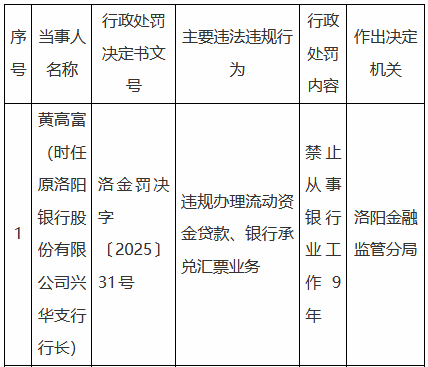
违规办理流动资金贷款、银行承兑汇票业务,原洛阳银行兴华支行行长被禁业9年
Xin Lang Cai Jing· 2025-12-31 07:54
Core Viewpoint - The news reports that Huang Gaofu, the former branch manager of the Xinghua branch of Luoyang Bank, has been banned from the banking industry for 9 years due to violations related to the handling of working capital loans and bank acceptance bills [1][3]. Group 1 - Huang Gaofu was found to have violated regulations by improperly handling working capital loans and bank acceptance bill transactions [1][2]. - The administrative penalty was issued by the Luoyang Regulatory Bureau of the National Financial Supervision Administration [1][4]. - The ban from the banking industry will last for 9 years, indicating a significant consequence for the violations committed [1][3].