
锁定利润

Search documents
关于这几天的A股,我有话想说
Sou Hu Cai Jing· 2025-11-20 11:31
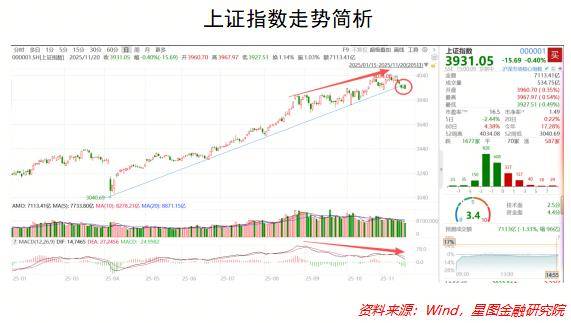
Market Overview - The A-share market experienced a collective decline, with the Shanghai Composite Index down 0.40%, Shenzhen Component down 0.76%, and ChiNext down 1.12%, while the Northbound 50 fell by 1.00%. The total trading volume was 1.72 trillion yuan, a decrease of 20 billion yuan from the previous day, with over 3,850 stocks declining [1] Reasons for Market Adjustment - The first reason for the market adjustment is profit-locking by institutional investors, as November is recognized as a settlement month for public funds and a critical period for annual performance assessment. Institutions tend to shift from seeking excess returns to locking in profits, leading to active portfolio adjustments [2] - The second reason is the uncertainty surrounding the Federal Reserve's interest rate cuts, which has impacted global liquidity. Recent reports suggest that the Fed may not lower interest rates in the first half of next year, disrupting expectations for liquidity easing and causing capital outflows from the Asia-Pacific region, including A-shares [3] - The third reason is the rising tensions in Sino-Japanese relations, which have raised market concerns. Recent remarks from the Japanese Prime Minister and subsequent countermeasures from China, such as travel warnings and import restrictions, have created uncertainty in economic and trade prospects between the two countries, affecting market sentiment [4] Long-term Market Outlook - Despite the current adjustment, the underlying logic supporting the bull market remains intact. China's rapid advancements in technology and military capabilities, along with ongoing policies aimed at boosting economic development and industrial upgrades, are expected to provide key support for the capital market [4] - The market is anticipated to undergo a period of consolidation, which may help digest profit-taking and repair valuation structures, ultimately paving the way for a return to an upward trajectory towards new highs [4] Investment Strategy - Given the recent market corrections, several risk signals have emerged, including the breaking of key moving averages and a decline in trading volume to around 1.7 trillion yuan. If trading volume does not rebound above 2 trillion yuan quickly, the index may struggle to achieve upward momentum in the short term [5] - Investors are advised to adopt a balanced allocation strategy, avoiding heavy bets on high-priced technology stocks and instead diversifying into lower-priced sectors such as AI applications, consumer goods, pharmaceuticals, and dividend assets. This approach allows for both offensive and defensive positioning in response to upcoming market conditions [5][7]

从杠杆ETF到数字币 美国市场正在“微妙变化”
智通财经网· 2025-09-27 10:37
Core Insights - The U.S. financial market is experiencing a subtle shift despite positive economic data, Federal Reserve rate cuts, and a near-high stock market [1] - Retail investors, previously seen as "latecomers," are now leading a withdrawal from high-risk assets, indicating a cautious sentiment [1][5] Group 1: Market Trends - U.S. leveraged ETFs faced an outflow of approximately $7 billion this month, the highest level recorded since 2019 [1] - The digital currency market saw a loss of about $300 billion in market value, while major U.S. stock indices, including the S&P 500 and Nasdaq 100, recorded their first weekly decline in a month [1] - Retail investors are locking in profits after months of market exuberance, rather than signaling panic [2] Group 2: Institutional Responses - Professional asset management firms are adopting more cautious strategies in response to changing market sentiment [3] - Morgan Stanley's Andrew Slimmon noted that the market is overbought, particularly in speculative stocks, which are nearing bubble territory [4] - Lido Advisors is implementing hedging strategies, such as selling covered call options and buying put spreads for protection during market pullbacks [4] Group 3: Retail Investor Behavior - Retail investors, often labeled as "dumb money," have been leading the market cycle, indicating a potential shift in market dynamics [6] - The withdrawal from the most speculative areas of the market by retail investors may signal increasing market fragility and a quiet recalibration [6]
从杠杆ETF到数字币,美国市场正在“微妙变化”
Hua Er Jie Jian Wen· 2025-09-27 08:05
Core Insights - The U.S. financial market is experiencing a subtle shift despite positive economic data, Federal Reserve rate cuts, and a near-high stock market [1] - Retail investors, previously seen as "dumb money," are leading a withdrawal from high-risk assets, signaling potential market vulnerability [6] Group 1: Market Trends - U.S. leveraged ETFs faced an outflow of approximately $7 billion this month, the highest level recorded since 2019 [1] - The digital currency market saw a loss of about $300 billion in market value, while major U.S. stock indices, including the S&P 500 and Nasdaq 100, recorded their first weekly decline in a month [1] Group 2: Retail Investor Behavior - The recent asset withdrawal is not a panic signal but rather a strategic move by investors to lock in profits after months of market exuberance [2] - For instance, the Direxion Daily Semiconductors Bull 3x Shares (SOXL) fund, despite a 31% increase this month, experienced over $2.3 billion in outflows [2] Group 3: Institutional Response - Professional asset management firms are adopting more cautious strategies in response to changing market sentiment [3] - Morgan Stanley's Andrew Slimmon noted that the market is overbought, particularly in speculative stocks, indicating a dangerous signal [4] - Lido Advisors is implementing hedging strategies, such as selling covered call options and buying put spreads for protection during market corrections [4] Group 4: Signals from Smart Money - The withdrawal led by retail investors may indicate a significant signal for market participants, as they have previously outperformed institutions in timing market movements [6] - The current cautious stance of retail investors could suggest increasing market fragility and the beginning of a quiet recalibration [6]