锂电池出口退税调整

Search documents
【周度分析】车市扫描(2026年1月1日-1月11日)
乘联分会· 2026-01-14 08:41
Market Overview - From January 1 to 11, the national retail sales of passenger cars reached 328,000 units, a year-on-year decrease of 32% and a month-on-month decrease of 42% [2][5] - The wholesale volume for the same period was 381,000 units, down 40% year-on-year and 30% month-on-month [2][8] - In the new energy vehicle sector, retail sales were 117,000 units, a 38% year-on-year decline, while wholesale was 167,000 units, down 30% year-on-year [2][5] Production Trends - In the first week of January, production of pure fuel light vehicles was 91,000 units, a 63% year-on-year decrease, while production of hybrid and plug-in hybrid vehicles was 139,000 units, down 17% year-on-year [3][6] Policy Impact - The National Development and Reform Commission announced a policy to promote large-scale equipment updates and a trade-in program, which is expected to boost domestic car consumption [5] - The policy will maintain strong incentives for commercial vehicle updates, while subsidies for passenger vehicle trade-ins are projected to decrease by 20% on average by 2025 [5] Market Dynamics - The weak retail performance in January is attributed to the recent expiration of the vehicle purchase tax exemption policy, but market conditions are expected to improve as local subsidy details are fully implemented [6][9] - The January sales are anticipated to show slight growth due to pre-orders and the impact of the upcoming Spring Festival [9] International Trade Developments - The Ministry of Commerce reported progress in negotiations regarding the EU-China electric vehicle case, which aims to provide price commitments to Chinese exporters, thus avoiding high tariffs [10] - This agreement is seen as a significant breakthrough, allowing Chinese electric vehicles to maintain access to the EU market and stabilizing industry expectations [10] Pricing Trends - The average retail price of passenger vehicles has slightly decreased, influenced by structural changes in the market, with the average price expected to drop to 170,000 yuan in 2025 [11] - The average price of new energy vehicles is also declining, from 184,000 yuan in 2023 to 161,000 yuan in 2025, reflecting structural changes in consumer preferences [12] Export Tax Adjustments - The recent announcement to reduce export tax rebates for lithium batteries is expected to have minimal impact on supply and demand, as the first quarter's domestic demand is only 18% of the annual total [13] - This adjustment aims to align export prices with market realities and address international trade concerns [13]


崔东树:锂电池出口退税对供需影响不大
Zhi Tong Cai Jing· 2026-01-12 12:17
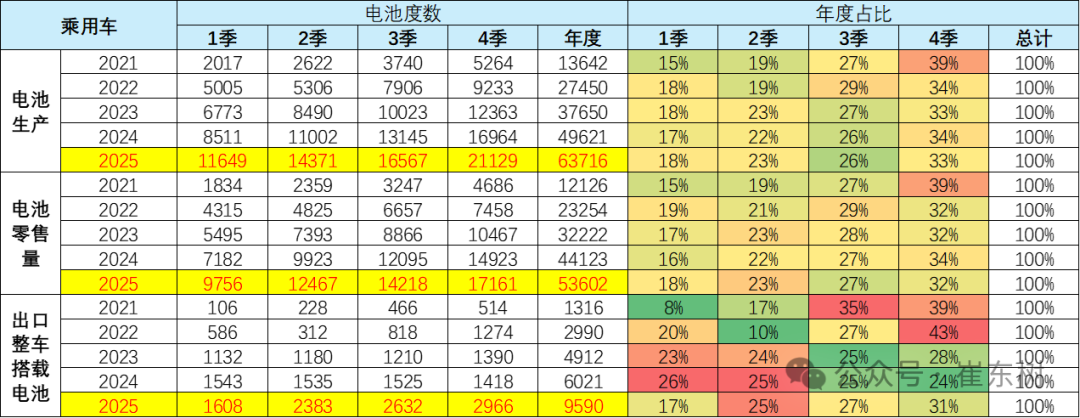
Core Viewpoint - The Ministry of Finance and the State Taxation Administration announced the cancellation of VAT export rebates for photovoltaic products, including lithium batteries, effective January 8, 2026. This move aims to align export prices with market supply and demand, reduce the phenomenon of "subsidizing overseas consumers," and address international concerns to ease trade frictions [1]. Group 1: Lithium Battery Demand Analysis - The overall demand for lithium batteries in passenger vehicles is projected to continue growing, although the expected explosive growth is not as pronounced. December saw a month-on-month decline of 5% in production, indicating lower-than-expected demand for lithium batteries [5][6]. - In December, the production of lithium batteries for new energy passenger vehicles reached 6,916 million degrees, a year-on-year increase of 20%, but a month-on-month decrease of 5%. The total for the year was 63,608 million degrees, reflecting a 29% increase [6]. - Retail demand for lithium batteries in new energy passenger vehicles showed significant weakness in December, with only 6,059 million degrees sold, indicating a slowdown in demand growth [9][10]. Group 2: Export Trends - The export of lithium batteries for new energy passenger vehicles has shown strong growth, primarily driven by BYD's contributions. However, the demand for batteries from independent suppliers remains limited [3][14]. - The export of lithium batteries is expected to face challenges, with a significant decline in exports to the U.S. projected for 2025, down 9.5 percentage points compared to 2024. The EU remains the primary market, accounting for about 40% of exports [20]. - In 2024, the export of lithium batteries is anticipated to be impacted by EU sanctions and tariffs, leading to a reduction in demand [14][20]. Group 3: Market Dynamics - The adjustment in export tax rebates is seen as a strategic move to stabilize the market and reduce speculation in lithium carbonate prices, particularly as the first quarter typically sees lower domestic demand for lithium batteries [1]. - The overall structure of lithium battery exports is shifting, with a notable decrease in exports to the U.S. and an increase in exports to the EU and Southeast Asia [20]. - The domestic demand for lithium batteries is expected to remain weak in the first quarter of 2026, with production adjustments likely necessary to align with fluctuating demand [3][18].

碳酸锂行情日报:强预期再加杠杆,三分钟打卡下班
鑫椤锂电· 2026-01-12 07:51
Market Overview - The lithium carbonate market is experiencing a surge due to expectations of increased exports of lithium batteries. On January 12, the spot settlement price for battery-grade lithium carbonate (99.5%) reached 152,000 CNY per ton, an increase of 10,000 CNY from the previous working day. The price for battery-grade lithium hydroxide (56.5% coarse particles) also rose by 10,000 CNY to 120,000 CNY per ton [1][2] - Futures trading saw a significant rise, with the main contract closing at 156,060 CNY per ton, up 12,880 CNY from the previous day, while open interest continued to decline [1] Price Trends - The ICC lithium battery settlement prices on January 9 and January 12 showed notable increases across various lithium products: - Lithium concentrate rose from 1,920 CNY to 2,040 CNY, a 120 CNY increase - Battery-grade lithium carbonate increased from 14.2 CNY to 15.2 CNY, a rise of 1 CNY - Lithium hydroxide went from 12 CNY to 13 CNY, also up by 1 CNY - Lithium iron phosphate increased from 5.08 CNY to 5.24 CNY, a 0.16 CNY increase - Three-element materials remained stable at 18 CNY [2] Industry Sentiment - Recent discussions in the market were focused on the potential for lithium carbonate prices to rise significantly. Following the announcement of a reduction in export tax rebates for lithium batteries, market expectations have shifted positively. Approximately 50% of surveyed companies believe that lithium carbonate prices could reach 200,000 CNY by April 1, while 30% anticipate prices could hit 250,000 CNY, with a small fraction expecting prices to exceed 300,000 CNY [6][10] Regulatory Changes - The Ministry of Finance and the State Administration of Taxation announced a reduction in the export tax rebate rate for battery products from 9% to 6% starting April 1, 2026, and a complete cancellation of the VAT export rebate for battery products from January 1, 2027. This change is expected to increase export costs, impacting market dynamics [9][10] Supply Chain Developments - The first shipment of lithium concentrate (approximately 30,000 tons) from Hainan Mining arrived at Yangpu Port on January 9, indicating ongoing supply chain activities in the lithium sector [9] - Xingfa Group plans to produce and sell 70,000 tons of lithium iron phosphate in 2026, primarily supplying BYD, reflecting the growing demand for lithium battery materials [9]