车购税免税政策

Search documents
乘联分会:1月1-18日全国乘用车市场零售67.9万辆 同比下降28%
智通财经网· 2026-01-21 11:23
Group 1: Market Performance - From January 1 to 18, the national passenger car retail sales reached 679,000 units, a year-on-year decrease of 28% and a month-on-month decrease of 37% [1][5] - During the same period, the wholesale volume of passenger cars was 740,000 units, down 35% year-on-year and 30% month-on-month [1][9] - The retail sales of new energy vehicles (NEVs) in the same timeframe were 312,000 units, reflecting a 16% year-on-year decline and a 52% month-on-month decline [1][5] Group 2: Production Trends - In the first two weeks of January, the production of pure fuel light vehicles was 91,000 units, down 85% year-on-year and 77% month-on-month [1] - The production of hybrid and plug-in hybrid vehicles totaled 139,000 units, a year-on-year decrease of 65% and a month-on-month decrease of 75% [1] Group 3: Policy Impact - The National Development and Reform Commission announced a policy to implement large-scale equipment updates and a trade-in program, which is expected to boost domestic car consumption [5] - The subsidy for passenger car trade-ins is projected to decrease by 20% to 30% compared to 2025, indicating a structural adjustment in the policy [5][11] Group 4: Future Outlook - The market is expected to improve as local subsidy details and channels are fully launched, along with the gradual release of purchasing power before the Spring Festival [5] - The first month of the year typically sees a "New Year sales boost," and despite the current weak performance, there is an anticipation of a slight increase in year-on-year sales due to pre-orders and market dynamics [9][11]



【周度分析】车市扫描(2026年1月12日-1月18日)
乘联分会· 2026-01-21 10:57
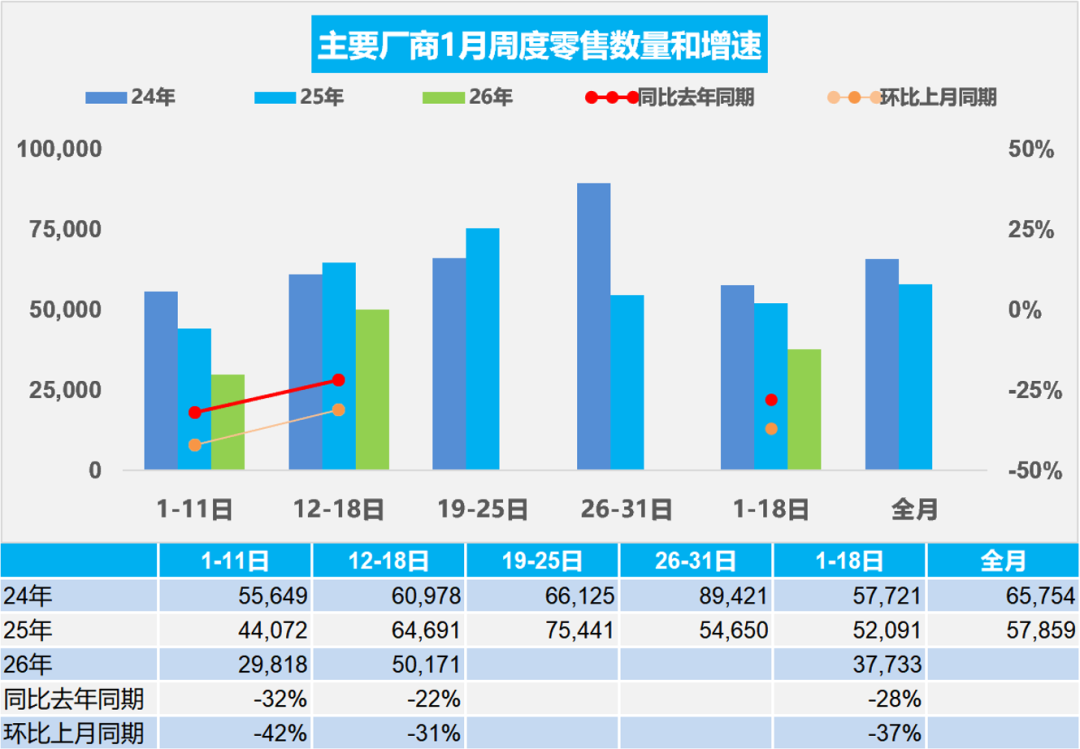
Group 1: Market Overview - From January 1 to 18, the national retail sales of passenger cars reached 679,000 units, a year-on-year decrease of 28% compared to the same period last year, and a month-on-month decrease of 37% [1] - The wholesale volume of passenger cars during the same period was 740,000 units, down 35% year-on-year and down 30% month-on-month [1] - In the new energy vehicle sector, retail sales were 312,000 units, a year-on-year decrease of 16% and a month-on-month decrease of 52% [1] Group 2: Production Trends - In the first two weeks of January, the production of pure fuel light vehicles was 91,000 units, down 85% year-on-year and down 77% month-on-month [2] - The production of hybrid and plug-in hybrid vehicles during the same period was 139,000 units, down 65% year-on-year and down 75% month-on-month [2] Group 3: Policy Impact - The National Development and Reform Commission announced a policy to promote large-scale equipment updates and trade-in subsidies, which is expected to boost domestic car consumption [5] - The subsidy for scrapping and updating passenger vehicles is projected to decrease by 20% to 30% by 2026, while commercial vehicle subsidies remain strong [5][10] Group 4: Sales and Wholesale Trends - The average daily retail sales for the first week of January were 30,000 units, down 32% year-on-year, while the second week saw an average of 50,000 units, down 22% year-on-year [5] - The wholesale average for the first week was 35,000 units, down 40% year-on-year, and for the second week, it was 51,000 units, down 28% year-on-year [8] Group 5: Economic Context - In 2025, the total retail sales of consumer goods reached 501.2 billion yuan, a year-on-year increase of 3.7%, while automotive consumption decreased by 2% [9] - The production of automobiles in December 2025 was 3.41 million units, a year-on-year decrease of 3%, while new energy vehicle production increased by 9% [10] Group 6: Engine Market Stability - Despite the rapid development of the new energy vehicle industry, the automotive engine market remains stable, with gasoline engines maintaining a dominant position [11] - The production of gasoline engines reached 21.13 million units in 2025, while diesel engine production decreased to 2.61 million units due to market adjustments and stricter environmental policies [11] Group 7: Pickup Truck Market Growth - In December 2025, the pickup truck market sales reached 52,000 units, a year-on-year increase of 8.8%, with total sales for the year at 589,000 units, up 11.8% [12] - The export of pickup trucks in December was 28,000 units, a year-on-year increase of 12%, with total exports for the year reaching 300,000 units, up 21% [13]

【周度分析】车市扫描(2026年1月1日-1月11日)
乘联分会· 2026-01-14 08:41
Market Overview - From January 1 to 11, the national retail sales of passenger cars reached 328,000 units, a year-on-year decrease of 32% and a month-on-month decrease of 42% [2][5] - The wholesale volume for the same period was 381,000 units, down 40% year-on-year and 30% month-on-month [2][8] - In the new energy vehicle sector, retail sales were 117,000 units, a 38% year-on-year decline, while wholesale was 167,000 units, down 30% year-on-year [2][5] Production Trends - In the first week of January, production of pure fuel light vehicles was 91,000 units, a 63% year-on-year decrease, while production of hybrid and plug-in hybrid vehicles was 139,000 units, down 17% year-on-year [3][6] Policy Impact - The National Development and Reform Commission announced a policy to promote large-scale equipment updates and a trade-in program, which is expected to boost domestic car consumption [5] - The policy will maintain strong incentives for commercial vehicle updates, while subsidies for passenger vehicle trade-ins are projected to decrease by 20% on average by 2025 [5] Market Dynamics - The weak retail performance in January is attributed to the recent expiration of the vehicle purchase tax exemption policy, but market conditions are expected to improve as local subsidy details are fully implemented [6][9] - The January sales are anticipated to show slight growth due to pre-orders and the impact of the upcoming Spring Festival [9] International Trade Developments - The Ministry of Commerce reported progress in negotiations regarding the EU-China electric vehicle case, which aims to provide price commitments to Chinese exporters, thus avoiding high tariffs [10] - This agreement is seen as a significant breakthrough, allowing Chinese electric vehicles to maintain access to the EU market and stabilizing industry expectations [10] Pricing Trends - The average retail price of passenger vehicles has slightly decreased, influenced by structural changes in the market, with the average price expected to drop to 170,000 yuan in 2025 [11] - The average price of new energy vehicles is also declining, from 184,000 yuan in 2023 to 161,000 yuan in 2025, reflecting structural changes in consumer preferences [12] Export Tax Adjustments - The recent announcement to reduce export tax rebates for lithium batteries is expected to have minimal impact on supply and demand, as the first quarter's domestic demand is only 18% of the annual total [13] - This adjustment aims to align export prices with market realities and address international trade concerns [13]

乘联分会崔东树:2025年1-12月乘用车均价为17万元
Xin Lang Cai Jing· 2026-01-12 06:39
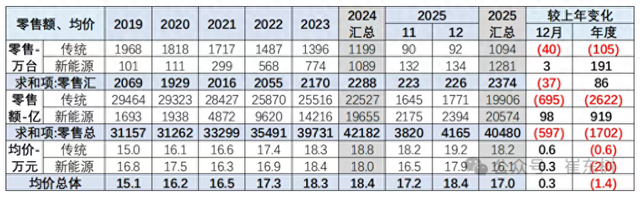
Core Viewpoint - The average price of passenger cars in China is expected to decrease to 170,000 yuan in 2025, down by 14,000 yuan from 2024, indicating a significant shift in the automotive market dynamics [1]. Group 1: Retail Sales and Average Prices - The average price of traditional fuel vehicles increased from 150,000 yuan in 2019 to 183,000 yuan in 2023, but is projected to decline to 182,000 yuan in 2025 [2]. - The average price of new energy vehicles (NEVs) is also on a downward trend, expected to drop from 184,000 yuan in 2023 to 161,000 yuan in 2025, with December 2025 projected at 179,000 yuan [3]. - Overall average prices for vehicles are forecasted to decrease from 184,000 yuan in 2024 to 170,000 yuan in 2025, reflecting a 14,000 yuan reduction [2][3]. Group 2: Market Dynamics and Trends - The market for traditional fuel vehicles is experiencing a notable contraction, particularly in the mid-to-low-end segments, while high-end segments are declining at a slower pace [2]. - The upcoming expiration of tax exemptions for electric vehicles is expected to create a surge in the NEV market, although some low-range and high-energy-consuming models may face pressure to upgrade [3]. - The significant decline in A00-class electric vehicles in December has contributed to an increase in average prices, indicating structural changes in NEV consumption [3].