隐藏式门把手

Search documents
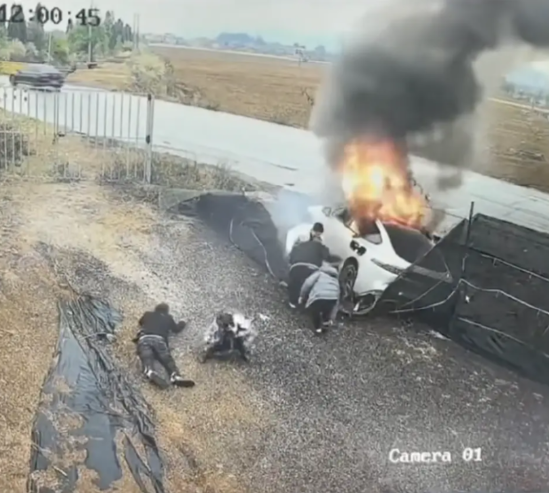
又是隐藏式门把手!东风奕派起火致一死三伤,声明避谈“车门打不开”
Xin Lang Cai Jing· 2026-02-08 08:06
Core Viewpoint - A serious safety incident involving the Dongfeng Yipai 007 has raised concerns about the vehicle's hidden door handle design, which failed to open during an emergency, resulting in one death and three injuries [2][3][12]. Group 1: Incident Details - A video surfaced showing a Dongfeng Yipai 007 catching fire after a collision, with the rear doors unable to be opened from the outside, leading to a rescue attempt that ultimately failed for one passenger [3][15]. - The official statement from Dongfeng Yipai confirmed the incident occurred on March 19, 2025, attributing it to a high-speed collision with a truck, but did not address the issue of the non-functional rear door handles [3][15]. - The vehicle involved was identified as the 2024 model of the Yipai 007, which features a hidden door handle design that has been criticized in previous incidents [5][17]. Group 2: Company Background and Sales Performance - Dongfeng Yipai, a brand under Dongfeng Motor Group, has struggled with low sales, with monthly figures hovering around 5,000 units in 2025, dropping to approximately 3,000 units in November and December [9][21]. - In August 2025, Dongfeng Motor Group announced the integration of its brands, including Yipai, to form Dongfeng Yipai Technology, aiming to enhance its market presence and sales performance [9][21]. - Following the establishment of Dongfeng Yipai Technology, the company reported a total sales figure of 275,000 units for 2025, marking a 28% increase, with January 2026 sales reaching 21,269 units, a 145% year-on-year growth [9][21]. Group 3: Safety and Technology Focus - The General Manager of Dongfeng Yipai Technology emphasized the importance of safety, stating that the company has built a technological moat in safety, control, intelligence, and quality [11][23]. - The hidden door handle design was implemented for safety reasons, preventing the handles from popping out during a collision, which is a strategy adopted by many vehicles in the industry [6][18]. - A new national standard prohibiting fully hidden door handles will take effect on January 1, 2027, requiring all vehicles to have mechanical release mechanisms [5][17].

长城魏建军再批隐藏门把手和一体化压铸,存在安全风险和维修缺陷
Jin Rong Jie· 2025-12-22 23:33
Group 1 - The company has decided to revert to traditional mechanical door handle designs for all future models due to the practical shortcomings of hidden door handles, which add significant weight and pose potential safety risks in emergencies [2] - The company has identified that integrated die-casting technology does not reduce manufacturing costs in the domestic market and presents challenges in production flexibility, leading to higher overall costs and insurance premiums for vehicles using this technology [3] Group 2 - In November, the company sold 127,394 new vehicles, marking a year-on-year increase of 3.70% and a month-on-month increase of 9.07%, with 35,999 of these being new energy vehicles, which saw a 15.20% year-on-year increase [5] - From January to November, the company sold 279,530 new energy vehicles, a year-on-year increase of 20.41%, and 411,848 vehicles overseas, reflecting a 45.77% year-on-year growth, achieving record high sales [5] - The cumulative global sales of the company reached 14.7646 million vehicles by November 2024 [5]


十大关键词回顾2025年中国汽车市场
Xin Lang Cai Jing· 2025-12-14 10:06
Core Insights - The Chinese automotive industry is undergoing a structural transformation in 2025, shifting from price competition to technology-driven growth, and from domestic focus to global expansion, marking a new development stage [1] Group 1: Price War Aftermath - The price war in the automotive industry has entered its third year, with profit margins dropping to 4.5% in the first three quarters of 2025, below the 6% average of downstream industrial enterprises [3] - There are signs of easing in the price war, indicating a shift from vicious competition to rational development, as companies recognize that quality, service, and technological innovation are essential for long-term success [3] Group 2: 60-Day Payment Terms - Major automotive companies have adopted a 60-day payment term, reflecting a significant change in the industry ecosystem and addressing long-standing payment issues that strained supply chains [6] - This shift enhances the credit system within the supply chain, allowing suppliers to invest more in innovation and quality improvement, thus fostering a healthier industry environment [6] Group 3: 5-Second Acceleration Standard - A new regulation proposes that new vehicles must achieve a 0-100 km/h acceleration time of no more than 5 seconds, marking a fundamental shift in competitive logic within the automotive industry [9] - This standard encourages companies to focus on safety, user experience, and practical technology rather than extreme performance metrics [9] Group 4: 50% Penetration Rate of New Energy Vehicles - By November 2025, new energy vehicles accounted for 53.6% of domestic passenger car sales, indicating a shift from policy-driven to market-driven growth in the sector [11] - This milestone signifies that new energy vehicles have become mainstream, reshaping the industry landscape and prompting traditional automakers to accelerate their electrification strategies [11] Group 5: Subsidy Phase-Out - The phase-out of subsidies for new energy vehicles is set to begin in 2026, transitioning the industry from reliance on government support to market-driven growth [14] - This change is expected to enhance market competition and compel companies to improve product quality and cost control [14] Group 6: New Normal in Exports - In 2025, China's automotive exports are projected to exceed 6.8 million units, maintaining the top position globally for the third consecutive year, with a significant increase in new energy vehicle exports [16] - The export model is evolving from product trade to a more integrated approach involving industry chain and technology exports [16] Group 7: Smart Driving Popularization - 2025 marks the year of smart driving technology's widespread adoption, with significant advancements in urban navigation assistance systems [19] - Regulatory measures are being implemented to ensure safety and compliance, balancing innovation with social responsibility [19] Group 8: Joint Venture Counterattack - Traditional joint venture brands are launching a "localization 2.0" strategy to regain market share in the new energy era, focusing on deep localization and embracing electrification [21] - This strategy enhances competition and provides consumers with more quality choices while integrating the supply chain into the local ecosystem [21] Group 9: Battery Safety Concerns - Battery safety issues have escalated to a regulatory priority, with new standards mandating thermal monitoring and warning systems for battery packs [24] - These regulations aim to enhance safety and accountability in the industry, pushing companies to prioritize safety investments [24] Group 10: Retreat of Hidden Door Handles - The decline of hidden door handles reflects a broader industry reconsideration of "over-design" in automotive engineering, emphasizing safety and practicality over aesthetics [27] - New regulations require mechanical release functions for door handles, signaling a shift towards user-centric design principles [27]






【Tesla每日快訊】 羅恩·巴倫:沒有馬斯克,就沒有特斯拉!🔥致命設計警訊!(2025/11/4-1)
大鱼聊电动· 2025-11-04 04:03
Investment & Market Analysis - Ron Baron, founder of Baron Capital, publicly supports Elon Musk's 2025 CEO performance award, emphasizing Musk's critical role in Tesla's ecosystem [1] - Baron's funds have 26% of its $44 billion AUM (Assets Under Management) invested in Musk's companies like Tesla, SpaceX, and xAI [1] - Baron anticipates a potential 5x return on investment from the Musk ecosystem by 2035, driven by Robotaxi and Optimus [1] - Baron estimates Tesla's annual EBITDA could reach $400 billion by 2035, potentially supporting a market capitalization exceeding $8 trillion [1] Product Safety & Regulatory Concerns - NHTSA (National Highway Traffic Safety Administration) has upgraded and expanded its investigation into Tesla's door handles due to complaints about electronic failures when the 12V battery is depleted [1] - A lawsuit in Wisconsin alleges that Tesla's door handle design contributed to five fatalities in a Model S crash due to the inability of passengers to escape after the car caught fire [1] - Tesla's chief designer acknowledged the company is working on improving door operation in panic situations [2] - NHTSA requires Tesla to submit all relevant design, software, and failure records by December 10, with potential penalties for late submission [2] Product & Service Updates - Tesla is offering a 30-day free trial of FSD (Full Self-Driving) Supervised with the purchase of a set of four tires at service centers or the online store [2] - FSD v14 is now being rolled out to early Cybertruck testers [2]