高压直流

Search documents
AIDC撬动变压器出海“爆单”
高工锂电· 2026-02-01 11:47
Core Viewpoint - China's transformer industry is expected to become the fourth major export product after "new energy vehicles, photovoltaics, and lithium batteries" [1][7] Group 1: Market Demand and Growth - In early 2026, multiple domestic transformer manufacturers are experiencing a surge in orders, particularly targeting the North American market [2] - In 2025, China's total transformer export value reached 64.6 billion yuan, marking a year-on-year growth of approximately 36% [2] - The high demand for transformers is anticipated to continue into 2026, with many factories operating at full capacity and some orders for U.S. data centers extending into 2027 [2] Group 2: Challenges in the U.S. Market - The U.S. is a critical hub for AIDC (Artificial Intelligence Data Center) development, facing a significant demand for stable power output [3] - There is a growing concern regarding the lengthy timeframes for U.S. power grid construction and expansion, which cannot keep pace with the rapid growth in chip processing capabilities [4] Group 3: Technological Developments and Business Expansion - The construction of independent power plants in the U.S. requires solar power generation and energy storage solutions, including transformers, to create independent power grids [5] - Jinpan Technology reported a staggering year-on-year revenue increase of 337.47% in the AIDC sector, with a contract worth 696 million yuan for power products [6] - The IPO of Jinpan Technology is aimed at expanding overseas production capacity and enhancing research in advanced technologies such as solid-state transformers and high-voltage direct current systems [6]



交付即正义!高盛:高龄的美国电网,正为中国电力产业链提供历史性机遇
Hua Er Jie Jian Wen· 2026-01-14 07:22
Core Insights - The core contradiction in AI infrastructure construction is shifting from merely pursuing GPU quantities to competing for power supply speed, with "Time-to-Power" becoming the most severe bottleneck in AI development [1] - Chinese power solution providers with rapid delivery capabilities and large-scale production advantages are experiencing a historic revaluation opportunity [1] Group 1: Power Supply Challenges - The average lifespan of power grids in the US and EU has reached 35 to 40 years, and the infrastructure is increasingly fragile due to the explosive energy demands of AI data centers (AIDC) [1] - Current domestic power equipment capacity in the US can only meet about 40% of local demand, with interconnection waiting times extending to nearly five years [1] - Goldman Sachs predicts that the power supply shortage in the US will persist until 2030, with a projected 175% increase in electricity consumption by data centers by 2030 [2][3] Group 2: Market Dynamics and Growth - The overall addressable market for AI data center power products is expected to expand at a compound annual growth rate (CAGR) of approximately 39% from 2025 to 2030 [3] - The growth is driven by continuous capacity construction, increasing power density, and a shift from AC to DC architecture, with 800V DC distribution becoming the standard for many AI data center projects [4] Group 3: Competitive Advantages of Chinese Suppliers - Chinese suppliers are gaining a decisive competitive advantage not only through lower costs but also through shorter delivery cycles, which have become a primary decision factor for data center operators [5] - Companies like Siyi Electric and Yinglite are positioned to benefit from the supply shortages in the US market, with Siyi Electric's revenue from the US expected to grow from 26% in 2026 to 28% in 2028 [5][6] Group 4: Product Prioritization - Goldman Sachs has provided a clear preference ranking for Chinese power supply-related product categories: gas turbine blades > power transformers > electrical components > uninterruptible power supplies/power racks > liquid cooling systems > server power [6][7] - Gas turbine blades rank highest due to high material science and manufacturing barriers, while power transformers follow due to labor-intensive manufacturing and lengthy certification processes [7]



“AI闭环”假期刷屏!一文读懂北美数据中心供应链
Hua Er Jie Jian Wen· 2025-10-08 05:50
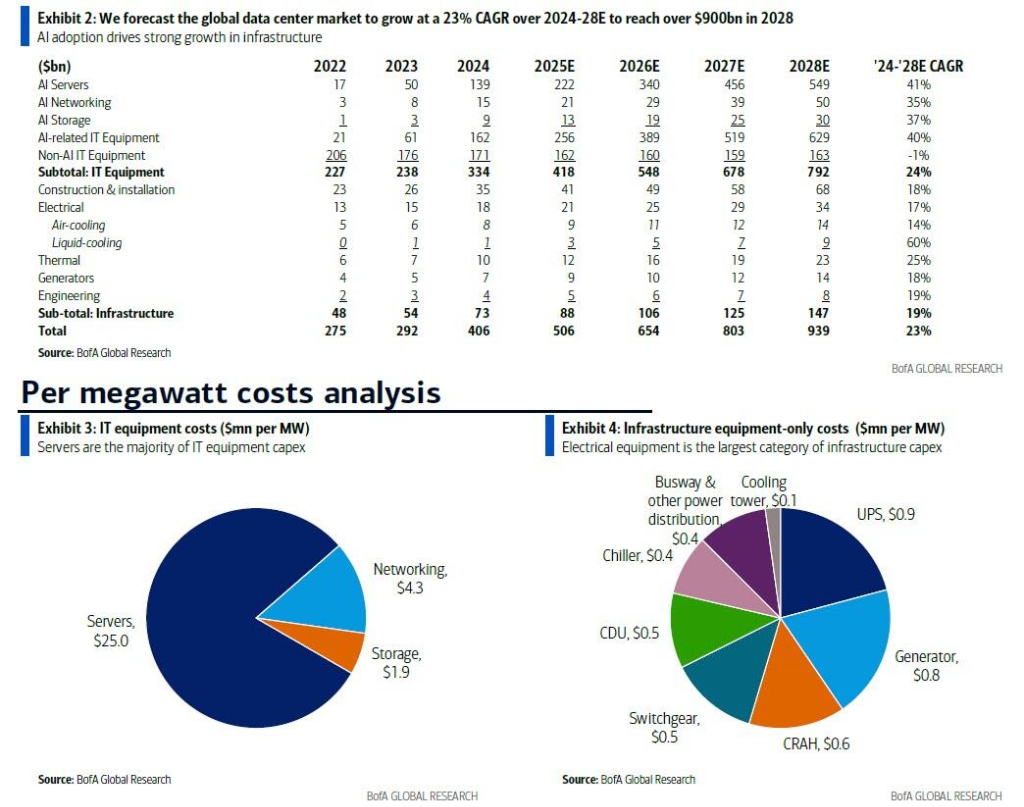
Core Insights - The essence of the AI competition is fundamentally a race for physical infrastructure, particularly data centers, which are expanding at an unprecedented pace, projected to exceed $400 billion in capital expenditure by 2024 and reach $506 billion by 2025, driven by AI demand [1][2] - The data center market is expected to grow at a remarkable compound annual growth rate (CAGR) of 23% from 2024 to 2028, ultimately forming a market exceeding $900 billion by 2028 [1][2] Market Overview - The data center market's growth is no longer driven by traditional enterprises; since 2017, cloud service providers and colocation companies have contributed nearly all new capacity, with major players like Amazon AWS and Microsoft Azure leading the way [5][7] - North Virginia, USA, accounts for nearly 15% of the global hyperscale data center capacity, making it the largest single concentration globally, followed by Beijing, China, at approximately 7% [9] Investment Dynamics - Data centers are viewed as high-value infrastructure assets with clear and attractive return models, exemplified by a typical wholesale colocation project that can yield an internal rate of return (IRR) of 11% over a 20-year holding period [12][13] - The average annual rent per megawatt (MW) is projected to increase from $2.50 in 2022 to $4.38 by 2028, with occupancy rates remaining stable at around 90% [14] Technological Evolution - The "density revolution" in data centers is driven by the exponential increase in power consumption of AI chips, leading to a significant rise in rack power density, with current standards reaching up to 120 kW per rack [15][17] - The global infrastructure for data centers is lagging, with only 5% of existing centers capable of supporting the latest high-power AI chips, necessitating massive upgrades and new constructions [18][19] Infrastructure Transformation - The shift from air cooling to liquid cooling systems is becoming essential due to the limitations of traditional cooling methods, with the market for cooling solutions expected to grow significantly [21][23] - The transition to high-voltage direct current (DC) power systems is underway, promising to reduce copper usage and improve efficiency in power delivery to data centers [25][28] Supply Chain Analysis - The rise of AI is increasing the unit construction costs of data centers, with next-generation AI architectures projected to cost approximately $5.2 million per MW, a 33% increase from traditional setups [30] - Key players in the thermal systems market include Vertiv, Johnson Controls, and Carrier, while Schneider Electric leads in the electrical systems market [32][36] - The IT equipment segment is the largest component of data center investments, with the global server market expected to reach $280 billion in 2024, driven significantly by AI servers [39] Conclusion - The ongoing AI-driven construction boom in data centers is set to surpass the total construction spending of all general office buildings in the coming months, highlighting the critical role of infrastructure in the AI landscape [43][46]