高质量股票

Search documents
经济学家Sharma谈AI泡沫特征:过度投资、过高估值、过度持有、过度杠杆
IPO早知道· 2025-12-06 02:33
Core Insights - The dialogue between Nicolai Tangen and Ruchir Sharma highlights AI as the primary driver of U.S. economic growth, contributing approximately 40% of this year's growth from AI-related capital expenditures, and potentially up to 60% when considering the wealth effect from the stock market [3][4][10]. - Sharma warns of potential bubble risks associated with AI, drawing parallels to the 2000 internet bubble, citing signs of over-investment, over-valuation, over-ownership, and over-leverage in the current market [4][10][11]. - The discussion also points to a surprising global market dynamic where Europe and China are expected to outperform the U.S. by 2025, driven by policy shifts in China's private sector and Europe's resilience in reforming under pressure [4][22][30]. AI's Economic Impact - AI is currently the focal point of the U.S. economy, with significant capital investment leading to a substantial portion of economic growth [10][11]. - The wealth effect from AI-driven stock performance is particularly benefiting the top 10% of wealth holders in the U.S., further driving consumption [10][11]. - Despite the optimistic projections, the actual productivity gains from AI are still in the early stages, with significant improvements expected in the next few years [11][14]. Signs of a Bubble - Sharma identifies four characteristics indicating a potential AI bubble: 1. Over-investment, with AI capital expenditures at about 5% of GDP, similar to levels seen in 2000 [11][17]. 2. Over-valuation of AI-related stocks, which are perceived to be highly inflated [11][17]. 3. Over-ownership, with 52% of American financial wealth currently in stocks, surpassing 2000 levels [11][17]. 4. Over-leverage, as major tech companies are rapidly issuing debt to fund AI initiatives [11][17]. Global Market Dynamics - Europe and emerging markets, including China, are showing stronger performance compared to the U.S., attributed to necessary reforms and a shift in focus towards supporting the private sector in China [22][30]. - The perception of the U.S. as the only viable investment destination has shifted, with international markets gaining traction [22][30]. Federal Reserve and Economic Policy - Sharma critiques the Federal Reserve's asymmetric policy approach, where profits are privatized while risks are socialized, raising concerns about the implications of potential interest rate hikes on the AI bubble [24][26]. - The ongoing high levels of government debt globally are a concern, but the U.S. has not faced the same pressures due to strong belief in AI's potential to enhance productivity [28][29]. Future Predictions - A significant prediction is that the AI bubble may face a reckoning by 2026, with rising interest rates serving as a potential catalyst for a market correction [30][31]. - There is an expectation for a resurgence of high-quality stocks, which have underperformed recently, suggesting a strategic investment opportunity [30][31].


经济学家谈AI泡沫:过度投资、过高估值、过度持有、过度杠杆
Sou Hu Cai Jing· 2025-12-01 14:07
Group 1 - The core discussion revolves around the impact of artificial intelligence (AI) on the U.S. economy, with AI-related capital expenditures contributing approximately 40% to economic growth this year, and potentially up to 60% when including wealth effects from the stock market [2][8] - Ruchir Sharma warns of potential bubble risks in the AI sector, drawing parallels to the 2000 internet bubble, citing signs of over-investment, over-valuation, over-ownership, and over-leverage in the current market [2][9][14] - The conversation highlights a surprising global market dynamic, where Europe and China are expected to outperform the U.S. by 2025, despite the current focus on the U.S. market [2][18] Group 2 - Sharma discusses the shift in China's private economy and technology policies, emphasizing the need for support of the private sector to compete in AI, as evidenced by Alibaba's stock performance following Jack Ma's return [3][19] - The dialogue touches on the Federal Reserve's independence and the global debt issue, with Sharma questioning the Fed's motivations for interest rate cuts amidst persistent inflation [3][21][22] - A bold prediction is made for 2026, suggesting that as the AI bubble faces risks from rising interest rates, high-quality stocks may see a resurgence, while international markets continue to outperform the U.S. [3][25][26]

Interactive Brokers' Steve Sosnick on what he finds ‘interesting' this earnings season
Youtube· 2025-10-27 14:44
Market Overview - Major averages are reaching record highs, indicating strong market momentum and positive sentiment [1][2] - Trade talks and a Federal Reserve meeting are contributing to market optimism, with positive responses to trade news, particularly regarding Asian trade talks [3][4] Earnings Season Insights - Approximately 87% of S&P 500 companies that have reported earnings have exceeded bottom-line estimates, although estimates have been revised down since April [10] - The current earnings season shows that stocks are being rewarded for good news, with a more forgiving market attitude towards companies that miss expectations, as seen with Tesla [11][12] Stock Performance Trends - There is a notable increase in thematic stocks, with significant activity in companies like Beyond Meat, Regetti, and Oaklo [5][6] - Quality stocks, particularly those with strong dividends, are showing latent demand, as evidenced by positive reactions from companies like Coca-Cola and Dr. Pepper to earnings news [6][7] Market Dynamics - A short squeeze has led to a doubling of a basket of the most shorted stocks since the market low in April, with a rally of over 30% since September [5] - The market is currently favoring momentum-driven strategies, although there are considerations for longer-term investments in undervalued stocks [9]


关税不确定性仍存,全球市场何去何从?|华尔街观察
Di Yi Cai Jing· 2025-10-26 07:30
Group 1: Market Sentiment and Trends - Investor interest in the Chinese stock market is at its highest in recent years, as reported by multiple Wall Street investment banks during overseas roadshows [1] - The S&P 500 index has been experiencing a correction, with potential declines of 10% to 15% if trade tensions do not ease in the coming weeks [2][3] - Morgan Stanley's chief China equity strategist suggests that A-shares may outperform Hong Kong stocks if external uncertainties persist [1][6] Group 2: AI and Technology Sector Insights - The recent pullback in AI-related stocks, such as Nvidia and Oracle, has raised concerns about potential risks in the "circular investment" model within the tech sector [4] - Despite the pullback, the overall sentiment in the U.S. tech industry remains positive, with expectations for significant capital expenditure driving capacity and infrastructure upgrades [4][5] - The "Magnificent Seven" tech stocks are projected to see a 24% year-over-year increase in net profits for Q3, while the broader S&P 493 index is expected to grow only 2% [5] Group 3: Investment Strategies and Recommendations - Morgan Stanley recommends focusing on high-quality stocks and avoiding small-cap stocks with rapid valuation expansion and low earnings certainty [1][6] - The firm has shifted its investment strategy from Hong Kong stocks to A-shares, anticipating that A-shares will be less affected by external shocks [6] - The current market environment suggests a cautious approach, with investors advised to wait for uncertainties to resolve before making aggressive moves [6]
万和财富早班车-20250716
Vanho Securities· 2025-07-16 02:11
Core Insights - The report highlights significant growth in the Chinese economy, with GDP increasing by 5.3% year-on-year in the first half of the year and 5.2% in the second quarter [4] - The report identifies key investment opportunities in the solid-state battery sector and the AI hardware market, suggesting that these areas may experience substantial growth [5][7] - The report emphasizes the importance of "anti-involution" as a driving force for market improvement, which may lead to enhanced corporate profitability and attract long-term capital [7] Industry Dynamics - The report notes that the leading company in the optical module sector exceeded expectations in its half-year report, indicating a potential resurgence in the computing industry [5] - The solid-state battery industry is highlighted as a significant investment opportunity, with key companies such as Liyuanheng (688499) and Nandu Power (300068) mentioned [5] - The data center sector is projected to experience explosive growth, with companies like Gaolan Co. (300499) and Feilong Co. (002536) identified as potential beneficiaries [5] Company Focus - China Electric Port (001287) is expected to see a net profit increase of 55.06% to 73.30% in the first half of the year [6] - Nord Shares (600110) anticipates a 56% reduction in losses year-on-year, with high-value-added products entering the market [6] - Bao Energy (000690) is projected to achieve a net profit increase of 42.08% to 58.48% in the first half, benefiting from favorable conditions in the thermal power industry [6] - China International Capital Corporation (601995) expects a year-on-year growth in net profit attributable to shareholders of 55% to 78% [6]
“高质量”标的有望成为推动指数突破的关键力量,创业板50ETF嘉实(159373)盘中涨近1%
Xin Lang Cai Jing· 2025-07-09 03:15
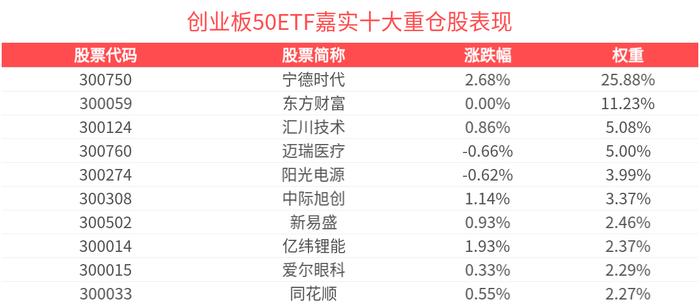
Group 1 - The ChiNext 50 Index has increased by 0.75% as of July 9, 2025, with notable gains from stocks such as AVIC Chengfei (+3.89%), JinkoSolar (+3.40%), and CATL (+2.68%) [1] - The ChiNext 50 ETF (159373) has seen a trading volume of 9.57 million yuan with a turnover rate of 3.11% [1] - Since its inception, the ChiNext 50 ETF has recorded a highest monthly return of 9.54% and an average monthly return of 5.11% during rising months [1] Group 2 - The top ten weighted stocks in the ChiNext 50 Index account for 64.62% of the index, with CATL holding the largest weight at 25.88% [3] - The sectors leading the gains include steel, new energy, building materials, media, communication, and electronics, driven by the "anti-involution" trend and AI industry growth [3][4] - The "anti-involution" trend is expected to improve corporate profitability and attract more long-term capital into the market, with high-quality stocks likely to drive index breakthroughs [3] Group 3 - The AI sector is identified as a key driver of the current technological revolution, creating investment opportunities across multiple industries in the A-share market [4] - Investors can access investment opportunities through the corresponding ChiNext 50 ETF linked fund (023429) [5]