
黄金需求结构

Search documents
2026年金价是否还会上涨 全链路解析
Sou Hu Cai Jing· 2026-02-05 11:48
Core Viewpoint - The overall trend of gold prices in 2026 is expected to be characterized by high volatility and structural upward movement, driven by the Federal Reserve's interest rate cuts, continued global central bank gold purchases, expanding private investment demand, and weakening dollar credit [1][2]. Group 1: Price Predictions - The baseline scenario predicts gold prices to fluctuate between $4,500 and $4,700 per ounce, with extreme scenarios potentially reaching $5,600 per ounce or dropping below $3,440 per ounce [1][2]. - Major institutions have differing predictions for gold prices, with Goldman Sachs raising its target to $5,400 per ounce, Bank of America forecasting a peak of $6,000 per ounce, and Jefferies setting an aggressive target of $6,600 per ounce [7][8]. Group 2: Macro Factors Influencing Gold Prices - Key macro factors include the Federal Reserve's monetary policy, with a predicted federal funds rate median of 3.4% and expected rate cuts of 50-75 basis points, which would lower the cost of holding gold [3]. - The U.S. debt surpassing $38 trillion and high fiscal deficits are weakening dollar credit, prompting a shift towards gold as a hedge against currency depreciation [3]. - Geopolitical uncertainties, such as the Russia-Ukraine conflict and U.S. elections, are expected to sustain demand for gold as a safe haven [3]. Group 3: Central Bank Gold Purchases - Central bank gold purchases are projected to remain a core support for gold prices, with net purchases expected to be around 850 tons in 2026, despite a slight decrease from 2025 [4]. - The trend of "de-dollarization" among emerging markets is driving consistent gold purchases, contributing to a stable bottom support for gold prices [4]. Group 4: Demand and Supply Dynamics - Private investment demand surged by 84% in 2025, reaching 2,175 tons, and is expected to continue driving demand in 2026 [5][9]. - A supply-demand gap is anticipated, with demand projected at 5,270 tons and supply at 4,950 tons, resulting in a gap of 320 tons [5]. - The shift in demand structure indicates that investment demand has overtaken jewelry consumption as the primary source of gold demand [9]. Group 5: Investment Strategies - Ordinary investors are advised to maintain a gold allocation of 5%-15% of their total assets, with lower-risk investors focusing on low-premium gold bars and gold ETFs [10][11]. - The best timing for investment is suggested to be during price corrections, particularly when gold prices fall within the $4,800 to $5,100 per ounce range [12].
中信建投:美联储降息周期有望持续 将为金价上涨注入新动力
智通财经网· 2025-11-30 00:29
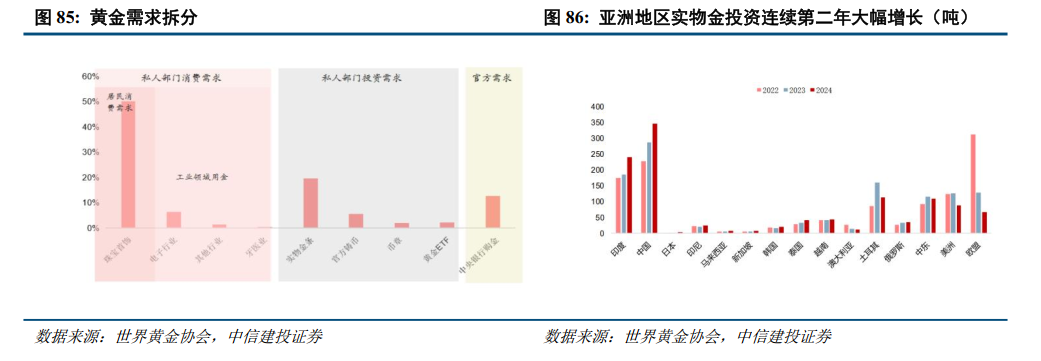
Core Viewpoint - The report from CITIC Securities indicates a significant upward trend in gold prices since 2025, driven by factors such as de-dollarization, central bank gold purchases, and expectations of interest rate cuts by the Federal Reserve [1][9]. Group 1: Gold Price Trends - International spot gold prices have risen from approximately $2,650 per ounce to a peak of $4,381 per ounce, setting new historical highs [1]. - The correlation between gold prices and traditional indicators like the US dollar and real interest rates has weakened, necessitating a refinement of the pricing framework for gold [1][2]. Group 2: Demand Dynamics - The demand for gold is primarily driven by three components: private consumption, private investment (including ETF demand), and official purchases by central banks [2]. - Since 2023, there has been a notable shift in the demand structure for gold, with increased contributions from global central bank purchases and private investment demand in Asia, particularly China [2][3]. Group 3: Central Bank Purchases - Central bank gold purchases are becoming a long-term trend, with demand expected to remain high due to the weakening of the US dollar's credit and the increasing need for asset diversification [3]. - Gold has surpassed the euro to become the second-largest reserve asset for central banks globally, with its share in official reserves projected to reach 20% by 2024 [3]. Group 4: Interest Rate Expectations - The expectation of interest rate cuts by the Federal Reserve in the second half of 2025 is anticipated to further support gold price increases, as lower nominal and real interest rates typically boost gold's appeal [9].


投资激增87%接棒央行 金价强势上攻后暂歇4140
Jin Tou Wang· 2025-11-25 02:20
Core Viewpoint - The international gold market is currently experiencing a slight downward trend, with prices fluctuating around $4,127.63 per ounce, reflecting a decrease of 0.13% [1]. Group 1: Gold Supply and Demand - Gold production is stable, with a total above-ground gold supply projected to reach 216,000 tons by 2024, and a compound annual growth rate of 1.5% from 1960 to 2024 [2]. - The main demand drivers for gold are central bank purchases, investment, and jewelry manufacturing, with central bank purchases becoming a key driver in recent years [2]. - In 2024, the demand structure is expected to consist of 24% from central banks, 26% from investments, and 44% from jewelry manufacturing, with the remainder from technology [2]. - Central bank gold purchases increased from 450 tons in 2021 to 1,089 tons in 2024, while investment demand rose from 1,107 tons to 1,181 tons during the same period [2]. - However, central bank purchases have started to decline as gold prices rise, with a 13% year-on-year decrease in the first three quarters of 2025 [2]. Group 2: Market Trends and Technical Analysis - The gold market exhibited significant volatility recently, with prices initially rising before facing resistance around the 4,100 mark, then rebounding from a strong support level at 4,087 [4]. - The market is expected to continue its upward trend, with key focus areas being the upper line and upper channel region on the daily chart [4]. - Current support levels for gold are concentrated around 4,105 and 4,117 [5].