
黄金投资需求

Search documents
2025年全球黄金总需求达5002吨、需求金额5550亿美元
Xin Lang Cai Jing· 2026-02-14 02:59
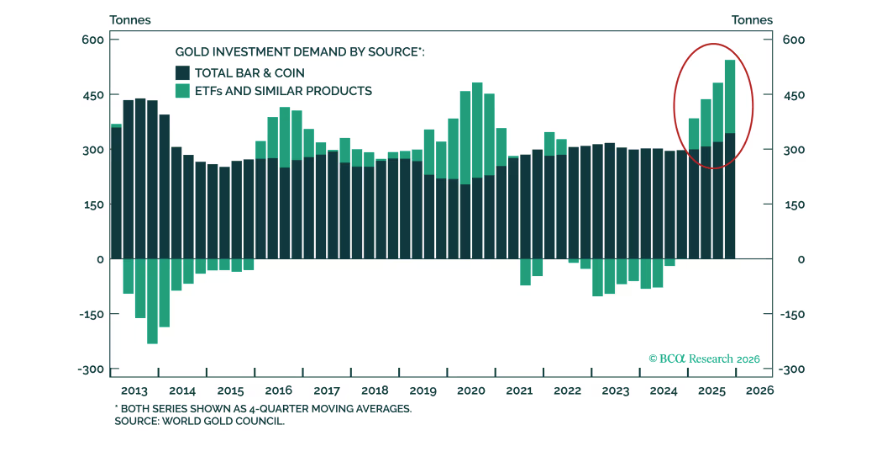
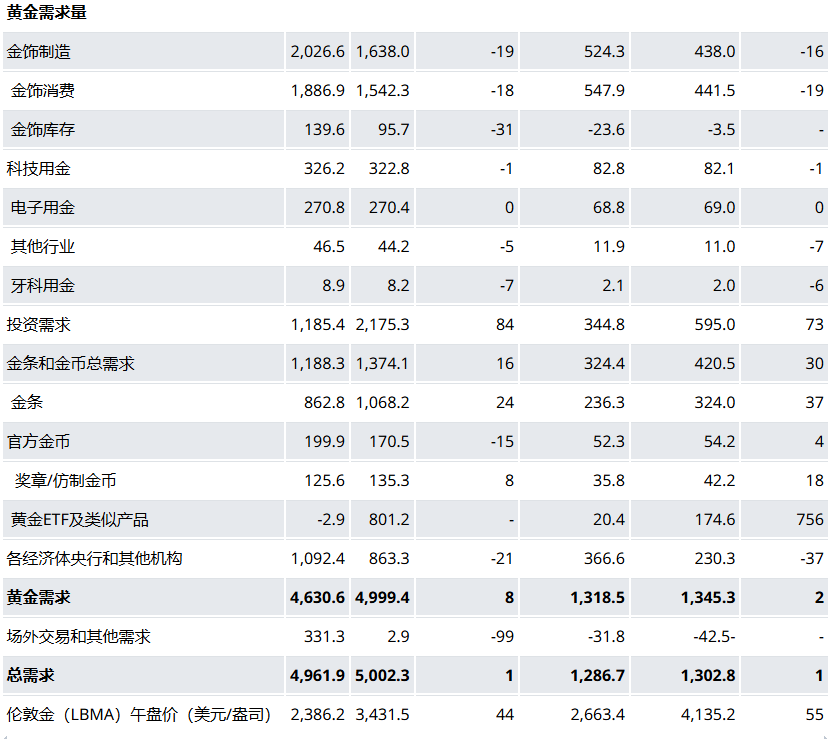
Core Insights - The article highlights a significant increase in global gold demand, reaching a record high of 5,002 tons in 2025, driven by geopolitical and economic uncertainties [1] - Investment demand for gold surged to a milestone level of 2,175 tons, becoming the main driver of total demand growth [1] - Global investors have heavily allocated to gold ETFs, resulting in a net increase of 801 tons for the year, further supporting the rise in demand [1] Summary by Category Gold Demand - Total global gold demand reached 5,002 tons, marking the highest level in history [1] - The total monetary value of gold demand for the year amounted to $555 billion [1] Investment Trends - Gold investment demand rose to 2,175 tons, significantly contributing to the overall demand increase [1] - There was a substantial net increase of 801 tons in gold ETFs as investors sought safe-haven assets and diversification [1]
本轮黄金牛市仍“年轻”!富国银行:今年至少还能再涨20%
Jin Shi Shu Ju· 2026-02-11 01:20
Core Viewpoint - In early 2026, individual investors are significantly accumulating gold to hedge against risks arising from global order fragmentation, leading to record inflows into gold ETFs and increased volatility in the precious metals market [1][6]. Group 1: Gold ETF Investment Trends - Gold ETF investment demand, particularly from Asia, has become a key driver of gold prices in recent months [3]. - In January, global gold ETFs attracted $19 billion in inflows, marking the strongest single month on record, with a 20% increase in total assets under management, reaching a historical high of $669 billion [4]. - The SPDR Gold ETF, the largest physically-backed gold ETF, saw a trading price of $460.67, down 1.4%, but still up over 16% year-to-date [5]. Group 2: Market Volatility and Price Sensitivity - The strategy of using ETFs to hedge against global disorder and diversify away from the dollar and U.S. Treasuries is increasing volatility in the precious metals market [6]. - ETF investors are more sensitive to price changes and market dynamics, leading to potential sell-offs during price corrections, which can significantly impact gold prices [6]. - Recent fluctuations in gold prices included a record closing high of $5,354.80 per ounce on January 29, followed by a sharp decline of about 13% in the subsequent days [6]. Group 3: Long-term Outlook for Gold Prices - Despite potential short-term sell-offs, long-term global investment demand is expected to support higher gold prices, with emerging market central banks likely to continue diversifying their reserves by increasing gold holdings [7]. - The current gold bull market is not considered unusual by historical standards, and significant sell-offs have historically interrupted major bull markets [9]. - Analysts from Wells Fargo suggest that the recent price correction is a healthy adjustment following a strong rally, with expectations for gold prices to rise again, projecting a year-end target of $6,100 to $6,300 per ounce, indicating at least a 20% upside from current levels [10].

金价长期上涨的逻辑还在吗
Zheng Quan Ri Bao· 2026-02-04 07:16
Core Viewpoint - The recent volatility in gold prices, which dropped from over $5,500 per ounce to nearly $4,400 per ounce in just three trading days, is attributed to profit-taking and changes in Federal Reserve monetary policy signals, although long-term macro factors supporting gold prices remain unchanged [1] Group 1: Drivers of Gold Price Movement - The weakening of dollar credit and the ongoing "de-dollarization" trend are identified as core drivers behind the recent rise in gold prices, with central banks expected to purchase 863 tons of gold in 2025, maintaining high demand [2] - Global risk events are increasing, leading to a higher risk premium for gold as a traditional safe-haven asset, with geopolitical conflicts and financial risks altering market perceptions of global risks [3] Group 2: Supply and Demand Dynamics - Total global gold demand is projected to reach a historical high of 5,002 tons in 2025, driven primarily by a significant increase in investment demand, with a year-on-year growth of 84% expected [4] - Central banks are continuing to increase their gold holdings, while private investors are also diversifying into gold assets, contributing to the overall demand [4]
瑞银上调2026年黄金目标价24%至6200美元/盎司
Jin Rong Jie· 2026-01-30 04:10
Core Viewpoint - UBS maintains a bullish stance on gold, raising its price targets for March, June, and September 2026 to $6,200 per ounce, up from a previous target of $5,000 per ounce, representing a 24% increase. The firm expects a moderate decline in gold prices to $5,900 per ounce by the end of 2026 [1] Group 1: Price Predictions - UBS has set extreme scenario forecasts for gold prices, with an upside target of $7,200 per ounce and a downside target of $4,600 per ounce, indicating a volatility close to one standard deviation [1] - The global gold demand is projected to grow by 1% year-on-year in 2025, reaching 5,002 tons, marking the first time total demand exceeds 5,000 tons [1] Group 2: Demand Drivers - Investment demand for gold surged by 84% to 2,175 tons, becoming the primary driver of total demand growth, with gold ETFs seeing a net increase of 801 tons and demand for gold bars and coins reaching 1,374 tons [1] - Central bank gold purchases totaled 863 tons, which, while lower than recent records, remain at high levels [1] Group 3: Market Influences - Poland has raised its gold holding target from 550 tons to 700 tons, suggesting that if more countries follow suit, it may indicate a reduced sensitivity of central banks to gold prices [1] - In the Chinese market, physical gold demand remains strong due to seasonal factors, although a decline is expected after the Lunar New Year [1] - UBS notes that a shift to a hawkish monetary policy by the Federal Reserve could exert downward pressure on gold prices, while escalating geopolitical tensions may drive prices higher [1]

突发,多只ETF基金以及上市交易的石油、黄金LOF被停牌交易!涉及华夏、景顺长城、易方达、广发、嘉实、华安,明天开市起至当日10:30停牌
Jin Rong Jie· 2026-01-29 12:51
Core Viewpoint - Multiple ETFs and listed oil and gold LOFs have been suspended from trading due to significant premiums in secondary market prices compared to their net asset values, posing risks to investors [1][2][3]. Group 1: Fund Suspensions - Several fund companies, including Huaxia Fund, Invesco Great Wall, E Fund, GF Fund, and Harvest Fund, announced that their funds will be suspended from trading starting January 30 until 10:30 AM due to high premium risks [1][3]. - Specific funds affected include Huaxia's Brazil ETF, Invesco Great Wall's Nasdaq Technology ETF, E Fund's Gold Theme LOF, and others related to oil investments [1][2][3]. Group 2: Premium Risks - Huaxia Fund highlighted that its Brazil ETF's secondary market price is significantly above its reference net asset value, indicating a large premium [2]. - E Fund's Gold Theme LOF reported a closing price of 2.248 yuan in the secondary market, warning investors about potential losses if they buy at high premiums [2][4]. Group 3: Market Conditions - Recent price surges in gold and silver have reached historical highs, with London spot gold nearing $5,600 per ounce and silver surpassing $120.43 per ounce [4]. - The World Gold Council reported that global gold investment demand reached a record 2,175 tons in 2025, driven by investors seeking safe-haven assets [5]. - Concerns have been raised about potential delivery defaults in silver on the COMEX, which could undermine pricing mechanisms and impact the broader financial system [5].
2025年全球黄金总需求创历史新高 高金价压制金饰需求
Sou Hu Cai Jing· 2026-01-29 11:20
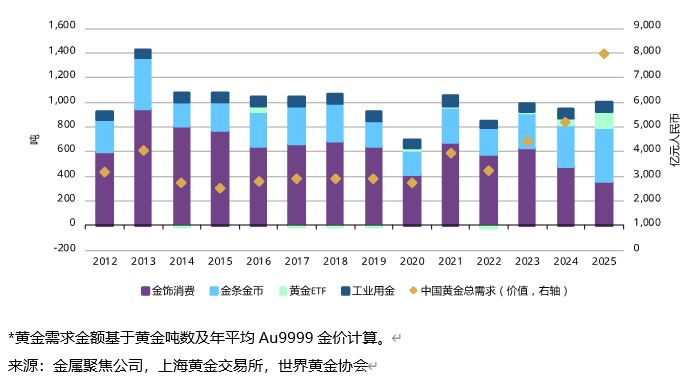
Core Insights - The World Gold Council's report indicates that global gold demand is projected to reach 5002 tons in 2025, marking a historical high, with a total demand value of $555 billion [1] - China's gold demand is expected to hit 1003 tons in 2025, a 6% increase year-on-year, representing the highest level since 2021, with a total demand value of 796 billion yuan [1] Investment Demand - Global gold investment demand is set to rise to 2175 tons, becoming the main driver for the record-breaking total demand in 2025 [1] - Gold ETFs are projected to see a net increase of 801 tons, while physical gold investment demand remains strong, with bar and coin demand reaching 1374 tons, valued at $154 billion [1] - China and India are leading the investment demand growth, with increases of 28% and 17% respectively, together accounting for over 50% of this segment's demand [1][2] Jewelry Demand - Global gold jewelry demand is expected to decline by 18% in 2025 compared to 2024, despite a year-on-year increase of 18% in consumption value to $172 billion [1] - In China, gold jewelry demand is projected to decrease by 25% to 360 tons, while total spending is expected to rise by 8% to 281.4 billion yuan [1] Market Trends - In Q4, China's demand for gold bars and coins surged by 61% quarter-on-quarter and 42% year-on-year, reaching 119 tons [2] - The report highlights a shift towards more affordable gold jewelry products due to high gold prices and stagnant income growth, with lightweight hard gold products gaining popularity among younger consumers [2] Central Bank Activity - Global central bank gold purchases are expected to remain high, with an increase of 863 tons in 2025, although not surpassing the previous three-year average of over 1000 tons [2] - China's official gold reserves are projected to increase by 27 tons, reaching a total of 2306 tons by year-end [2] Supply Dynamics - Global gold supply is expected to grow by 1% in 2025, reaching 5002 tons, with mine production slightly increasing to 3672 tons and recycled gold rising by 3% to 1404 tons [2] Future Outlook - The ongoing economic and geopolitical risks are expected to continue, with strong gold demand trends likely to persist into 2026, as indicated by the recent surge in gold prices [3] - The price of gold is anticipated to exceed $5000 per ounce at the beginning of 2026, reinforcing gold's role as a safe-haven asset during uncertain times [3]
世界黄金协会:2025年全球黄金总需求达到5002吨 创历史新高
Xin Lang Cai Jing· 2026-01-29 08:24
Core Insights - The World Gold Council's report indicates that global gold demand will reach a record high of 5002 tons in 2025, driven by geopolitical and economic uncertainties, resulting in a total demand value of $555 billion [1][3]. Investment Demand - Global gold investment demand is projected to rise to 2175 tons, marking a significant milestone and serving as the primary driver for the record total demand in 2025 [1][3]. - There is a notable influx of investors into gold ETFs, with a net increase of 801 tons for the year [1][3]. - Physical gold investment remains robust, with demand for gold bars and coins reaching 1374 tons, valued at $154 billion [1][3]. - The markets in China and India are particularly strong, with respective year-on-year growth rates of 28% and 17%, together accounting for over 50% of this segment's demand [1][3]. Central Bank Demand - Central bank gold purchases are expected to remain high, with official institutions increasing their holdings by 863 tons in 2025 [1][3]. - Although the total demand from central banks may not exceed the previous three years' average of over 1000 tons, it still plays a crucial role in driving overall demand [1][3]. Jewelry Demand - Global gold jewelry demand is anticipated to decline by 18% compared to 2024, aligning with market expectations, while the total consumption value is expected to increase by 18% to $172 billion, highlighting the long-term appeal of gold jewelry to consumers [2][4]. Supply Dynamics - The report indicates that global gold supply will also reach a new high, with gold mine production increasing to 3672 tons and recycled gold supply growing modestly by 3% [2][4].
世界黄金协会:2025年全年中国黄金需求总量达1003吨 为2021年以来最高水平
Xin Hua Cai Jing· 2026-01-29 08:24
Core Insights - The World Gold Council's report indicates that China's gold investment and consumption demand is projected to reach 274 tons in Q4 2025, marking an 18% year-on-year increase and a significant 60% rise from Q3, making it the second-best Q4 performance since 2016 [1] - Total gold demand for the year 2025 is expected to hit 1,003 tons, a 6% increase year-on-year, representing the highest level since 2021. In monetary terms, the demand will reach a record high of 796 billion RMB (approximately 111 billion USD), a staggering 53% increase year-on-year [1] Segment Analysis - In Q4 2025, gold jewelry demand in China is expected to decline, with a 3% decrease quarter-on-quarter and a 23% drop year-on-year, totaling 82 tons. For the entire year, jewelry demand is projected at 360 tons, down 25% year-on-year. However, consumer spending on jewelry in Q4 will reach 77.8 billion RMB (approximately 11 billion USD), a 19% year-on-year increase, with total annual spending at 281.4 billion RMB (approximately 39.4 billion USD), an 8% increase [3] - Conversely, gold investment demand remains strong, with gold bar and coin demand expected to surge by 61% quarter-on-quarter and 42% year-on-year, reaching 119 tons in Q4. For the full year, investors are projected to purchase 432 tons of gold bars and coins, a 28% increase from 2024, marking a historical high [3] - In Q4, China's gold ETFs saw an inflow of 51 billion RMB (approximately 7.2 billion USD, 54 tons), setting a record for quarterly inflows. The total annual inflow for gold ETFs is expected to reach 110 billion RMB (approximately 15.5 billion USD, 133 tons), with assets under management (AUM) skyrocketing by 243% to 241.8 billion RMB (approximately 34.6 billion USD) and holdings doubling to 248 tons, both achieving historical highs [3] - The People's Bank of China (PBoC) increased its gold reserves by 2.8 tons in Q4, bringing the total to 2,306 tons, which constitutes 8.5% of its total foreign reserves. Throughout 2025, the PBoC's gold purchases remained consistent, totaling 27 tons for the year [4]

世界黄金协会:全球黄金需求首破5000吨,散户和机构成购金主力
Hua Er Jie Jian Wen· 2026-01-29 08:23
Core Insights - Global gold demand is projected to exceed 5000 tons for the first time in 2025, reaching a historical high of 5002 tons, with investment demand surpassing jewelry consumption as the largest source of demand [1][4] - Central bank gold purchases have slowed by 21% to 863 tons, down from over 1000 tons annually from 2022 to 2024, while investment demand surged by 84% to a record 2175 tons [1][6] - The price of gold has seen significant increases, with a 64% rise in 2025, marking the best annual performance since 1979, and reaching over $5300 per ounce [2][5] Investment Demand - Investment demand has dramatically changed the market structure, with a record increase of 84% to 2175 tons, making it the largest demand category, surpassing jewelry consumption [4][5] - Gold ETFs attracted 801 tons of inflows in 2025, marking the second-highest annual increase in history, reversing four years of outflows [5][6] - Retail investment demand in China has now exceeded jewelry consumption for the first time, driven by declining interest rates and weakening confidence in major currencies [5][6] Jewelry Demand - Global gold jewelry demand fell nearly 20% to 1542 tons in 2025, with a significant decline of 24% in the Chinese market, reaching the lowest level since 2009 [6][7] - Despite the drop in demand volume, the total value of gold jewelry demand increased by 18% to a record $172 billion, indicating continued consumer interest [7] - The high gold prices are expected to continue to suppress jewelry demand into 2026 [6][7] Central Bank Purchases - Central banks purchased 863 tons of gold in 2025, a 21% decrease from the previous year, but still at historically high levels [6] - The World Gold Council anticipates a slight further decline in central bank purchases to 850 tons in 2026 [6] - The significant gold purchases by central banks in 2022 and 2023 were key drivers behind the doubling of gold prices over three years [6] Supply Side - Gold mine production increased by 1% to 3672 tons, while recycled gold supply grew by 3% to 1404 tons [7] - Demand for gold in technology applications remained stable, benefiting from ongoing growth in AI-related applications [7]
印度未来几周或将上调金银进口关税以管控进口
Xin Lang Cai Jing· 2026-01-28 09:21
Core Viewpoint - India's gold and silver imports surged to record highs in 2025, raising concerns among policymakers despite soaring precious metal prices, with the government lacking effective control measures [1][10]. Group 1: Import Trends - In 2025, India's gold imports increased by 1.6% year-on-year to $58.9 billion, while silver imports rose significantly by 44% to $9.2 billion [1][10]. - The expenditure on gold and silver imports accounted for nearly 10% of India's foreign exchange reserves in 2025, with expectations of further increases in 2026 due to rising precious metal prices [2][11]. Group 2: Economic Impact - The expansion of import volumes has exacerbated India's trade deficit and put pressure on the Indian rupee, which recently hit a historical low against the dollar [2][12]. - The Indian government has classified gold demand as non-essential and has attempted to curb consumption by raising import duties, thereby increasing consumer costs [2][12]. Group 3: Potential Policy Changes - Traders speculate that the Indian government may raise import duties on gold and silver in the coming weeks due to concerns over trade deficits and further depreciation of the rupee [3][14]. - Historical context shows that the government previously raised gold import duties significantly in 2012-2013 to stabilize a rapidly depreciating rupee, and a similar approach may be considered again [4][14]. Group 4: Demand Dynamics - Despite high gold prices, India's overall gold demand has not plummeted, supported by a significant increase in investment demand, which accounted for over 40% of total consumption in 2025 [6][17]. - The inflow into gold ETFs in India surged by 283% year-on-year to ₹429.6 billion (approximately $4.69 billion) in 2025, indicating a shift towards investment in gold assets [6][17]. Group 5: Silver Market Concerns - The rise in silver prices has also increased India's silver import expenditures, with investment demand becoming a primary driver of silver imports in recent months [9][19]. - The inflow into silver ETFs reached ₹234.7 billion in 2025, up from ₹85.7 billion in 2024, suggesting a growing interest in silver as an investment [9][19].