
AI概念股

Search documents
天娱数科股价异动,AI概念股受市场情绪与资金博弈影响
Jing Ji Guan Cha Wang· 2026-02-11 10:25
Market Performance - On February 10, 2026, Tianyu Digital Technology (002354) experienced a stock price fluctuation, rising by 4.50% to close at 7.66 yuan, with a trading volume of 1.703 billion yuan and a turnover rate of 13.82% [1] - On February 11, the stock price corrected, falling by 3.79% to close at 7.37 yuan, with a trading volume of 1.095 billion yuan [1] - The stock price movements are primarily influenced by market sentiment, capital flow, and changes in the company's fundamentals [1][2] Recent Stock Trends - Recently, certain thematic stocks in the A-share market, such as Jiamei Packaging (002969) and Hengdian Film (603103), have been actively traded, prompting risk warning announcements due to significant short-term price increases [2] - As a representative of AI applications and the digital economy, Tianyu Digital's stock price volatility is also affected by overall market sentiment [2] - On February 10, there was a net inflow of main funds, which shifted to a net outflow on February 11, indicating intensified short-term capital speculation [2] Financial Performance - The company's Q3 2025 report shows a revenue increase of 25.67% year-on-year, with a substantial rise in net profit attributable to shareholders by 597.60%, indicating improved profitability in core operations [3] - Although the 2025 earnings forecast indicates a net loss, the loss has narrowed by 49.98% to between 65.24 million yuan, and excluding asset impairment impacts, the core business has achieved profitability [3] Business Development - The company is gaining market attention for its developments in AI marketing and embodied intelligence sectors [4] Technical Analysis - The stock price has been fluctuating near the 20-day Bollinger Band middle line (7.44 yuan), touching the upper band at 7.75 yuan on February 10 before retreating [5] - Short-term resistance is noted at 7.84 yuan, while support is referenced at 7.03 yuan [5] - The MACD indicator shows a negative divergence, indicating weak short-term momentum [5]

日股全年上涨26%,涨幅比欧美突出
3 6 Ke· 2025-12-31 03:52
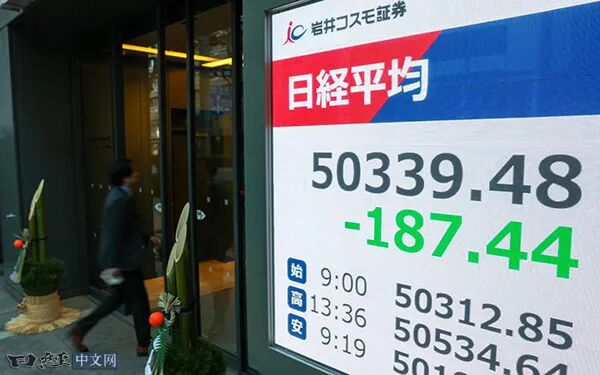
Group 1 - The Nikkei average index closed above 50,000 points for the first time, with a yearly increase of 26% (up 10,444 points), outperforming the US Dow Jones Industrial Average for three consecutive years [2] - The rise in stock prices is attributed to global expectations surrounding generative AI and stable inflation in Japan, alongside increased foreign investment due to the new government led by Prime Minister Kishi [2][6] - The total market capitalization of global stocks reached $146 trillion, increasing by $25 trillion (20%) over the year, with almost all major countries experiencing stock price increases [2][4] Group 2 - Japan's AI-related stocks, such as Advantest, SoftBank Group, and Tokyo Electron, are expected to benefit from increased demand, significantly contributing to the rise of the Nikkei index [5] - Japan's stock market performance has been notably strong, with a 14% increase in 2025, marking the first time since 1989 that it has outperformed the US Dow Jones for three consecutive years [5] - The stability of inflation in Japan has been a key factor, with consumer price increases exceeding the government's target of 2% for over three years [5] Group 3 - The new government under Kishi has led to a surge in overseas investment, with foreign purchases of Japanese stocks exceeding 5 trillion yen, the highest since the first year of Abenomics in 2013 [6] - However, the government's expansionary fiscal policies may pose risks to stock price stability, particularly if inflation continues to rise and affects market confidence [6] - The ability of the ruling party to implement growth strategies without losing market trust will be crucial for the future direction of the stock market [6]

AI泡沫遭质疑之际,慢半拍的苹果意外“躺赢”:股价半年飙35%,跑赢微软、Meta
Hua Er Jie Jian Wen· 2025-12-09 14:02
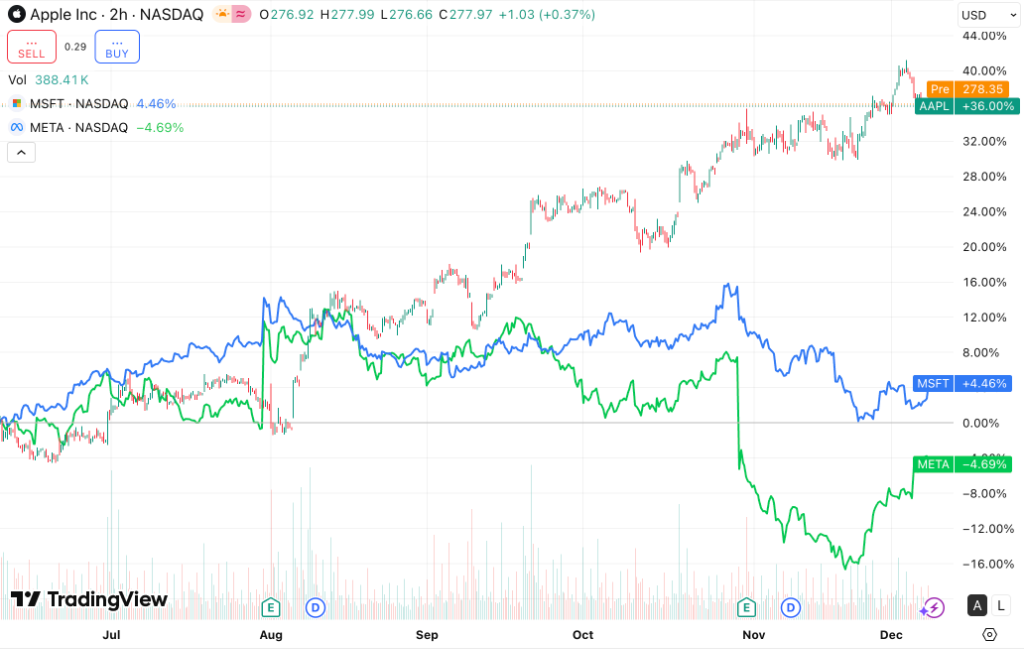
Core Viewpoint - Apple has emerged as an unexpected winner in the market amid Wall Street's cautious investment in artificial intelligence (AI), with its stock price surging over 35% in the second half of the year, contrasting sharply with other tech giants that have faced declines [1][3]. Group 1: Stock Performance - Apple's stock price has dramatically reversed its earlier decline of 18% in the first half of the year, becoming a unique defensive choice for investors [3]. - The company's market capitalization has reached $4.1 trillion, surpassing Microsoft to become the second-largest component in the S&P 500 index, only behind Nvidia [1]. Group 2: Investment Strategy - Apple's cautious approach to AI investments is being reinterpreted as a strategic advantage, allowing it to benefit flexibly when AI technology matures [1][3]. - Glenview Trust Company's CIO Bill Stone describes Apple as a "anti-AI concept stock," emphasizing its avoidance of the current AI arms race and excessive capital expenditures [3]. Group 3: Valuation Concerns - The stock's strong performance has pushed its valuation to historical highs, with a forward P/E ratio of approximately 33, which is significantly above its long-term average of less than 19 [3][4]. - MoffettNathanson's Craig Moffett questions whether investors are paying too high a premium for Apple's defensive attributes, indicating potential concerns about future growth rates [4]. Group 4: Technical Analysis and Long-term Outlook - Technical analysis suggests that Apple's stock price has significantly diverged from its 200-day moving average, indicating potential short-term pullback pressure, especially entering January [6]. - Despite valuation concerns, the long-term trend for Apple remains upward, with the potential for increased hardware demand and growth in its high-margin services business as AI technology matures [6][7].

比特币ETF“血流不止”!投资者单月狂撤35亿美元 流出规模逼近历史纪录
Zhi Tong Cai Jing· 2025-11-24 11:28
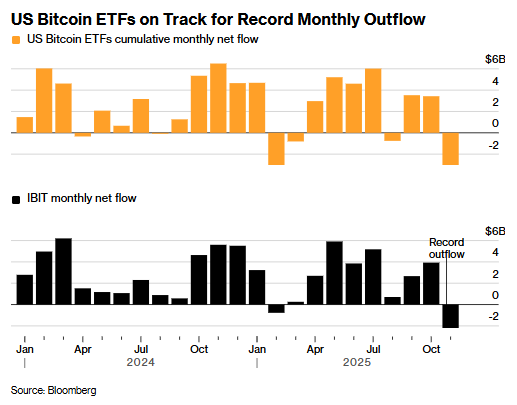
Core Insights - The Bitcoin ETFs listed in the U.S. are experiencing the most significant monthly outflow in nearly two years, with investors withdrawing $3.5 billion since November, approaching the historical record of $3.6 billion set in February [1] - BlackRock's iShares Bitcoin ETF (IBIT.US), which accounts for about 60% of the total assets in this category, has seen redemptions of $2.2 billion this month, potentially marking its worst monthly performance unless a significant reversal occurs [1] - Bitcoin itself is facing its most severe monthly performance since the collapse of the cryptocurrency industry in 2022, despite an improved global policy environment this year [1] Market Dynamics - Bitcoin's price dropped to $80,553 last Friday, with a slight recovery over the weekend, but it still reflects an 8% decline year-to-date [3] - The spot Bitcoin ETF has become a barometer for market sentiment since its launch in January 2024, creating a self-reinforcing feedback loop where inflows accelerate with price increases and outflows intensify with price declines [3] - Citigroup's research indicates that for every $1 billion outflow from Bitcoin ETFs, the price typically drops by 3.4%, suggesting further downside potential for Bitcoin if ETF inflows remain zero [3] Institutional Sentiment - The significant trading volume of Bitcoin ETFs, reaching $11.5 billion last Friday, indicates a temporary release of demand, but ongoing redemptions from IBIT suggest a shift in institutional preferences away from leading products, reflecting a lack of complete market confidence [4] - The broader financial market context shows a pullback in various high-risk assets, including AI stocks and meme stocks, with the S&P 500 facing its worst monthly performance since March [7] - The recent volatility in Bitcoin is viewed as a signal of market fatigue, and stabilization in this asset class could potentially alleviate some tension in the U.S. stock market [7]
天量“AI债”搅动全球市场
Hua Er Jie Jian Wen· 2025-11-24 04:18
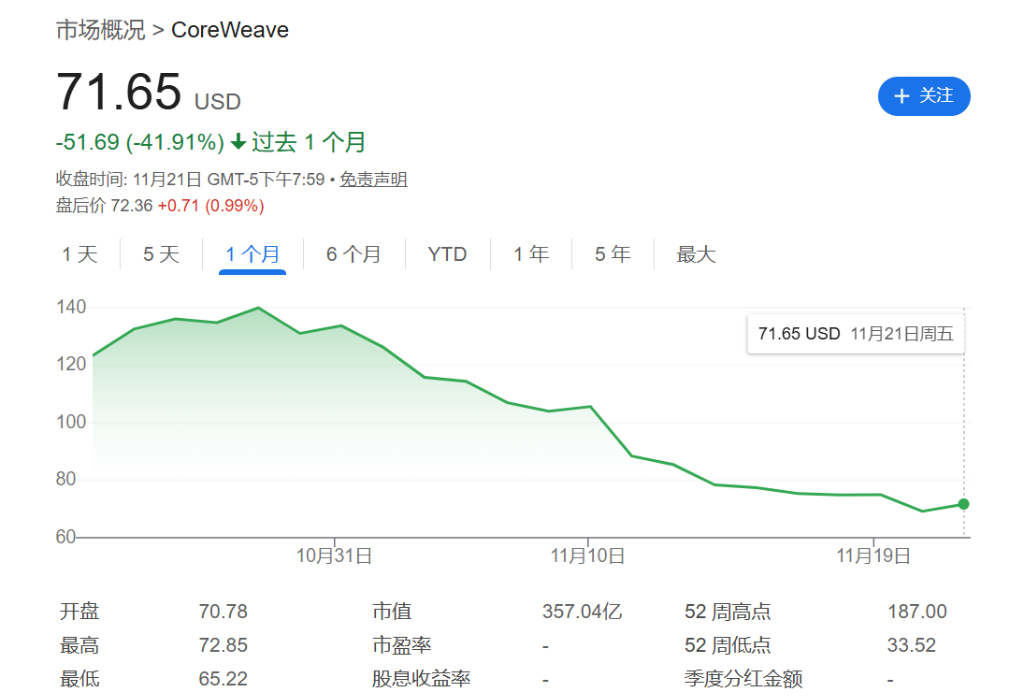
Group 1 - The core point of the article highlights that technology companies are flooding the bond market to fund significant investments in artificial intelligence (AI), with major firms issuing nearly $90 billion in investment-grade bonds since early September 2023, surpassing their total issuance over the previous 40 months [1] - The influx of bond supply has led to a decline in new bond prices, forcing some issuers to offer higher-than-expected interest rates to attract buyers, which has created a ripple effect impacting stock market valuations of AI-related companies [1][2] - The market is experiencing heightened correlation between the bond and stock markets, with concerns that a sell-off in AI stocks could negatively affect credit markets and vice versa, indicating a new risk for investors [1] Group 2 - Not all companies are equally affected by the bond market fluctuations; firms like Alphabet, Amazon, and Microsoft are less impacted due to their substantial cash flows, while Meta faces more pressure due to its lower cash reserves and reliance on debt to support its AI ambitions [2] - Meta's recent bond issuance of $30 billion came with yields significantly higher than its existing bonds, and its bond prices have continued to decline in the secondary market, raising concerns about its financial health [2] - Oracle is in a challenging position, with plans to invest hundreds of billions in AI cloud computing while its bond yields are higher than most of its investment-grade tech peers, indicating potential difficulties in maintaining its investment-grade rating [2] Group 3 - In the speculative-grade bond market, warning signs are evident, particularly for companies like CoreWeave, which has seen its bond prices drop significantly, reflecting investor concerns about execution risks and financing capabilities [3] - CoreWeave's recent bond trading at 92 cents on the dollar, with a yield of approximately 11%, aligns with the average yield of the lowest-rated bonds, indicating a lack of strong traditional business support [3] - The rising costs of financing in the speculative-grade market may ultimately affect investment decisions for these companies, as investors demand higher risk premiums [6] Group 4 - The pressure in the bond market is influencing market sentiment through various channels, including increased trading volumes of Oracle's credit default swaps (CDS), which have contributed to a 24% drop in its stock price [6] - While large tech companies are expected to continue their AI initiatives despite bond market sell-offs, the rising financing costs for speculative-grade tech firms could lead to more cautious investment strategies [6] - Wall Street anticipates that the bond issuance for such companies next year may range between $20 billion and $60 billion, with the potential for lower issuance if financing costs continue to rise [7]




金价,显著上涨!
中国能源报· 2025-11-10 06:44
Group 1 - The core viewpoint of the article highlights a significant increase in international gold prices driven by various factors including a surge in layoffs in the US private sector, a notable decline in global AI concept stocks, and ongoing geopolitical tensions in multiple regions [1] - As of October 10, 2023, at 13:23 Beijing time, the price of December gold futures on the New York Mercantile Exchange reached $4,062.3 per ounce, reflecting an increase of 1.32% [1] - The London spot gold price was reported at $4,053.7 per ounce, with a rise of 1.31% [1]

Palantir(PLTR.US)股价再创历史新高 市值跃升至美股前二十强
智通财经网· 2025-07-25 23:09
Group 1 - Palantir has reached a significant milestone by entering the top 20 highest market capitalization companies in the U.S., with a market value of $375 billion, surpassing companies like Home Depot and Procter & Gamble [1] - The company's stock price has doubled since the beginning of the year, driven by the AI wave and its increasing relationship with the U.S. government [1] - In its latest financial report, Palantir's revenue from U.S. government business surged 45% year-over-year to $373 million, contributing to an overall revenue growth of 39% to $884 million [1] Group 2 - Palantir's current price-to-earnings (P/E) ratio is notably high at 273, making it the only company in the top 20 with a triple-digit P/E ratio, compared to Tesla's P/E of 175 [2] - Despite its increased market value, Palantir's total revenue of $3.1 billion over the past year is significantly lower than that of its peers, such as Mastercard, which reported approximately $29 billion in total revenue [2]
