
AI泡沫论调

Search documents
可选消费W48周度趋势解析:黑五开启拉动海外消费表现优异,A/h消费景气度有一定回升-20251201
Haitong Securities International· 2025-12-01 14:03
Market Performance - The Black Friday kickoff has significantly boosted overseas consumption, leading to a positive sentiment in the A/H-share consumer sectors[1] - Weekly performance of various sectors showed strong growth, with the gaming sector leading at 6.9%, followed by overseas sportswear at 6.8% and overseas cosmetics at 4.1%[11] - Year-to-date performance highlights jewelry as the top performer with a 133.9% increase, while overseas sportswear has seen a decline of 15.4%[11] Sector Analysis - The overseas sportswear sector is expected to have a PE ratio of 30.2x in 2025, which is 57% of the average PE over the past five years[15] - The domestic sportswear sector's expected PE is 14.7x, representing 77% of its historical average[15] - The gaming sector's expected PE is 17.2x, which is only 28% of its five-year average, indicating potential undervaluation[15] Company Highlights - Notable stock performances include Sands China up 11.2% and MGM China up 9.1%, driven by positive trends in Macau's gaming revenue[14] - Lululemon's stock surged by 9.5% due to strong demand for new winter apparel, with expectations for a positive Q3 2025 earnings report[14] - E.L.F. Beauty's stock rose by 8.7% following favorable analyst ratings and improved sales trends[14] Consumer Sentiment - The retail sector saw a 3.6% increase, with Walmart and Target benefiting from the Black Friday shopping season[14] - The luxury goods sector increased by 2.5%, supported by expectations of strong performance during the holiday shopping season despite high valuation levels[14] - Domestic cosmetics stocks rose by 2.2%, with significant growth reported by companies like Shiseido and Marubi[14]
花旗预判到了AI泡沫恐慌! Q3猛砍科技巨头仓位 大举做空纳指与英伟达(NVDA.US) 押注...
Xin Lang Cai Jing· 2025-11-14 09:36
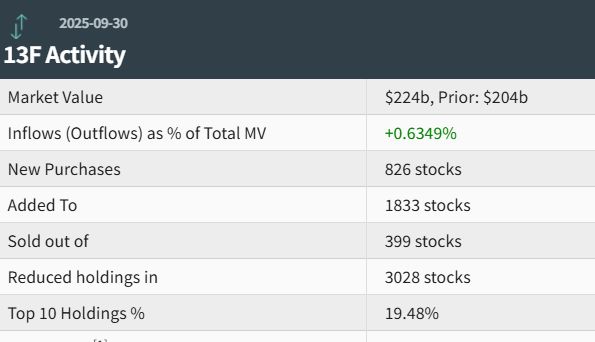
Core Viewpoint - Citigroup has significantly reduced its holdings in major AI-related technology stocks, reflecting concerns over the sustainability of the AI investment boom and the potential for a market correction in these high-valuation stocks [3][9]. Summary by Category Holdings Overview - As of September 30, 2025, Citigroup's total market value of holdings reached approximately $224 billion, up from $204 billion in the previous quarter, marking a 10% increase [1][2]. - The firm added 826 new stocks and increased holdings in 1,833 stocks, while reducing positions in 3,028 stocks and completely selling out of 399 stocks [1][2]. Major Stock Adjustments - Citigroup has notably reduced its positions in major tech giants such as Nvidia, Microsoft, Apple, and Amazon, aligning with the narrative of an "AI bubble" and the subsequent market correction [3][9]. - Despite the reductions in tech giants, Citigroup slightly increased its stake in Broadcom, indicating a positive outlook on its ASIC technology growth prospects [3][4]. Top Holdings - Nvidia remains Citigroup's largest holding with approximately 33.39 million shares valued at about $6.23 billion, although this represents a 28.22% decrease from the previous quarter [6]. - The second-largest holding is the Russell 2000 Index ETF put options, with around 23.99 million shares valued at approximately $5.81 billion, reflecting a 12.26% increase [4]. - Microsoft ranks third with about 9.56 million shares valued at approximately $4.95 billion, down 19.55% from the previous quarter [4]. Strategic Moves - Citigroup has increased its holdings in put options for the Nasdaq 100 Index ETF by 81%, indicating a preparation for potential declines in AI-related stocks [7][8]. - The top five purchases in the third quarter included high-yield corporate bond ETF put options and Nvidia put options, emphasizing a strategy to hedge against potential downturns in the AI sector [8]. Selling Trends - The top five sell-offs included Nvidia, Meta, Amazon, Microsoft, and Apple, further underscoring Citigroup's cautious stance on the AI investment landscape [9].




财报前瞻 | AI泡沫论调下CoreWeave(CRWV.US)业绩万众瞩目 市场期待AI算力租赁爆棚
Zhi Tong Cai Jing· 2025-11-10 07:37
Core Viewpoint - CoreWeave is expected to report strong earnings driven by surging demand for AI computing power, which could counteract the "AI bubble" narrative in the market [1][5] Financial Performance Expectations - Analysts predict an adjusted loss per share of approximately $0.36 and total revenue of about $1.28 billion for CoreWeave, indicating rapid revenue growth but still not achieving profitability [2] - Revenue is expected to show a significant year-over-year increase, with the second quarter revenue rising from approximately $395 million in 2024 to about $1.2 billion in 2025 [2] - CoreWeave's backlog of AI computing capacity orders is nearly $30 billion, reflecting strong demand for AI GPU-intensive cloud computing [2] Company Background - CoreWeave is recognized as a leading provider of cloud-based AI computing resources, particularly for NVIDIA GPUs, and has gained significant market presence due to early adoption of AI computing resources [3][4] - The company became the first to deploy NVIDIA H200 Tensor Core GPUs, enhancing its ability to provide powerful computing capabilities [3] Industry Context - The upcoming earnings report from CoreWeave is seen as a potential indicator of investment sentiment in the AI computing supply chain, especially as the market has recently experienced a downturn due to "AI bubble" concerns [5][6] - Analysts argue that the current AI investment cycle is still in its early stages, comparing it to the late 1990s tech boom rather than a peak speculative bubble [6] Market Implications - CoreWeave's financial results and future outlook could significantly influence investor sentiment towards other major players in the AI computing supply chain, such as NVIDIA and Micron [5][7] - The company's performance is expected to provide insights into the ongoing demand for AI computing resources, which could lead to a rebound in trading activity among AI supply chain participants [7]

美股牛市迎来超级催化剂! 日本赴美5500亿美元投资蓝图出炉 覆盖核能、AI与半导体等领域
Zhi Tong Cai Jing· 2025-10-28 10:06
Core Viewpoint - Japan has announced a significant investment plan of up to $550 billion in the U.S., covering various sectors including nuclear energy, AI, and semiconductors, which is expected to act as a major catalyst for the ongoing bull market in U.S. stocks [1][3]. Investment Overview - The investment plan includes potential projects from major Japanese companies such as SoftBank, Westinghouse, and Toshiba, with individual project investments ranging from $350 million to $100 billion [1][4]. - Energy-related projects, particularly in nuclear energy, are highlighted, with Westinghouse's AP1000 and small modular reactors (SMR) projects each valued at up to $100 billion [3][4]. Economic Implications - The investment is anticipated to boost U.S. economic growth and national security by focusing on sectors like semiconductors, pharmaceuticals, metals, critical minerals, shipbuilding, energy, AI, and quantum computing [3][5]. - The influx of Japanese investment is expected to enhance U.S. manufacturing capacity and employment, particularly in the semiconductor and AI infrastructure sectors [5]. Regulatory Framework - An investment committee will be established to oversee project selection, with the ability to increase tariffs if Japan does not contribute funding [5]. - The investment distribution mechanism involves creating special purpose vehicles (SPVs) for each selected project, with an initial 50/50 allocation, followed by a 90% (U.S.) to 10% (Japan) profit-sharing model [5].