
AI-RAN

Search documents
Nokia and Telia to collaborate on AI-RAN use cases #MWC26
Globenewswire· 2026-03-04 13:00
Core Viewpoint - Nokia and Telia Finland are collaborating to develop and test AI-driven Radio Access Network (RAN) use cases, aiming to enhance network performance and support the commercialization of AI-enabled applications [1][2]. Group 1: Collaboration Details - The partnership focuses on exploring commercial use cases for AI-RAN technology across various industries, including mission-critical applications [2]. - This collaboration is a significant step in Nokia's AI-RAN strategy, which aims to create a powerful ecosystem for future business opportunities and network efficiency improvements [3][4]. Group 2: Technological Advancements - At MWC26, Nokia showcased live demonstrations of AI-RAN technologies, emphasizing their role in cognitive, software-defined radio systems [5]. - Demonstrations included Vision AI with reasoning capabilities, a delivery robot from ServeRobotics, and the monetization of spare GPU capacity in the distributed AI-RAN network [5]. Group 3: Strategic Importance - The collaboration is positioned as a crucial element in the journey towards Autonomous Networks, promising increased network performance and reliability for customers [4]. - Nokia emphasizes the need for networks to provide deterministic, trusted connectivity with embedded safety controls to prepare for the AI Supercycle [3].



Wind River Announces Strategic Collaboration with AMD, Delivering Industry's First Unified O-RAN and AI-RAN Platform
Businesswire· 2026-03-02 05:00
Core Insights - Wind River, an Aptiv company, is collaborating with AMD to create the first commercially available platform that integrates Open RAN functions with AI-RAN workloads on shared hardware [1] Group 1: Collaboration and Innovation - The partnership aims to address a significant challenge for operators, as traditional methods necessitate separate systems for radio access networks [1]


Nokia expands network portfolio for premium performance in the AI-RAN era #MWC26
Globenewswire· 2026-03-01 13:00
Core Insights - Nokia has launched Doksuri Remote Radio Heads (Radios) as part of its AirScale portfolio, aimed at enhancing performance, sustainability, and automation in the AI-RAN era [1][7] - The Doksuri Radios are designed to improve energy efficiency, performance, and ease of installation, facilitating the transition to greener 5G networks [1][7] Product Advancements - Doksuri Radios utilize a next-generation System-on-Chip (SoC) that integrates advanced intelligence, making them a key component in Nokia's AI-RAN strategy [2][3] - The new radios offer up to 30% improvement in power efficiency, combining higher output power with lower energy consumption [8] - Doksuri Radios are up to 25% lighter, which reduces site footprint and simplifies deployments [8] - A unique mounting system allows for installation time reductions of up to 70%, enabling faster and more efficient deployments [8] AI-RAN Ecosystem - Doksuri Radios are positioned as essential enablers in the evolving AI-RAN ecosystem, ensuring compatibility with Open RAN front-haul standards [3] - The integration of AI-ready capabilities into the radio layer helps telecommunications providers meet increasing AI-driven traffic demands while lowering energy consumption and total cost of ownership [4] Marketplace and Automation - Nokia has introduced an rApp Marketplace for its Service Management and Orchestration (SMO) platform, facilitating the development and deployment of automation applications in a multivendor environment [6] - This marketplace aims to enhance network automation, performance, and efficiency, reinforcing Nokia's commitment to AI-driven RAN automation [6] Industry Impact - Nokia's advancements in connectivity are critical for the AI era, addressing the rising demands on network infrastructure performance [7] - The company will showcase its technologies at Mobile World Congress 2026, demonstrating how AI-RAN can optimize network operations and support new AI-driven applications [9]
Nokia expands network portfolio for premium performance in the AI-RAN era #MWC26
Globenewswire· 2026-03-01 13:00
Core Insights - Nokia has launched Doksuri Remote Radio Heads (Radios) as part of its AirScale portfolio, aimed at enhancing performance, sustainability, and automation in the AI-RAN era [1][7] - The Doksuri Radios are designed to improve energy efficiency, performance, and installation simplicity, facilitating the transition to greener 5G networks [1][7] Product Advancements - Doksuri Radios utilize a next-generation System-on-Chip (SoC) that integrates advanced intelligence, making them a key component in Nokia's AI-RAN strategy [2][3] - The new radios offer up to 30% improvement in power efficiency, combining higher output power with lower energy consumption [8] - Doksuri Radios are up to 25% lighter, which reduces site footprint and simplifies deployments [8] - A unique mounting system allows for installation time reductions of up to 70%, enabling faster and more efficient deployments [8] AI-RAN Ecosystem - Doksuri Radios are positioned as essential enablers in the evolving AI-RAN ecosystem, ensuring compatibility with Open RAN front-haul standards [3] - The integration of AI-ready capabilities into the radio layer helps telecommunications providers meet increasing AI-driven traffic demands while reducing energy consumption and total cost of ownership [4] Marketplace and Automation - Nokia has introduced an rApp Marketplace for its Service Management and Orchestration (SMO) platform, facilitating the development and deployment of automation applications in a multivendor environment [6] - This marketplace aims to enhance network automation, performance, and efficiency, reinforcing Nokia's commitment to AI-driven RAN automation [6] Industry Impact - Nokia's advancements in connectivity are critical for the AI era, addressing the rising demands on network infrastructure performance [7] - The company will showcase its technologies at Mobile World Congress 2026, demonstrating how AI-RAN can optimize network operations and support new AI-driven applications [9]

巨头退市!
证券时报· 2025-11-25 13:41
Group 1 - Nokia announced its decision to delist from the Euronext Paris exchange, expected to take effect on December 31, 2025, based on a comprehensive assessment of trading volume, costs, and administrative requirements [1] - The delisting requires approval from the Euronext Paris board and is anticipated to be formalized within three months after receiving this approval [1] - Nokia's shares will continue to be listed on the Helsinki Nasdaq and its American Depositary Receipts will remain on the New York Stock Exchange [1] Group 2 - Nokia's board has decided to issue 166,389,351 new shares in a directed share issue, allowing NVIDIA to make a $1 billion equity investment [3] - NVIDIA will subscribe to these shares at a price of $6.01 per share, resulting in NVIDIA holding 2.9% of Nokia [3] - The partnership aims to adjust Nokia's 5G and 6G software to run on NVIDIA chips, with NVIDIA exploring the use of Nokia's data center technology in AI infrastructure [3]


广撒网,英伟达投资诺基亚或许是一步“臭棋”?
Sou Hu Cai Jing· 2025-11-09 22:50
Core Insights - Nvidia is actively investing in various companies across the AI industry chain, including a recent investment in Nokia, which is seen as a strategic move to position itself against Huawei [2][3][4] - The collaboration aims to prepare for the 6G era, focusing on integrating AI capabilities with network infrastructure, which is crucial for future technological advancements [3][5] - Nvidia's investment strategy reflects a broader approach to secure its position in the AI and telecommunications sectors, with significant financial commitments to other companies like Intel and OpenAI [4][5] Investment Strategy - Nvidia has invested $10 billion in Nokia, which is relatively small compared to its other investments, indicating a broad investment strategy to capture various opportunities in the AI landscape [4] - The partnership with Nokia is intended to leverage the potential of 6G technology and AI-RAN (Artificial Intelligence and Radio Access Network), aiming to create a new ecosystem for AI applications [5] Market Positioning - Nokia currently ranks third in the global telecommunications equipment market, trailing behind Huawei and Ericsson, which raises questions about its ability to lead in the 6G market [3][4] - Nvidia's choice of Nokia may be influenced by the potential of the European market and Nokia's relative financial constraints compared to its competitors [3][4] Future Outlook - The collaboration is seen as a way for Nvidia to enhance its AI chip integration into Nokia's communication devices, facilitating advanced applications like autonomous vehicles and drones [5] - Nvidia's CEO has expressed concerns about the security of current U.S. communication technologies, positioning the partnership as a means to regain technological leadership in the 6G space [5]
Nokia extends SoftBank Corp. partnership with network modernization deal in Japan
Globenewswire· 2025-11-05 02:00
Core Insights - Nokia has expanded its partnership with SoftBank Corp. through a new deal to supply advanced 4G and 5G radio access equipment in Japan, focusing on network modernization and 5G standalone coverage expansion [1][9] - The deployment will utilize Nokia's energy-efficient AirScale Radio Access Network solutions, including Habrok Massive MIMO radios and AirScale baseband equipment, enhancing performance and energy efficiency [2][3] - Both companies are founding members of the AI-RAN Alliance, collaborating on AI-RAN and 6G technologies, including joint research and field trials [5] Group 1 - The agreement includes the modernization of existing network infrastructure and the expansion of 5G coverage across Western Japan [1] - Nokia's solutions are designed to deliver ultra-high performance while maintaining extreme energy efficiency, powered by ReefShark System-on-Chip technology [2] - The partnership aims to improve network efficiency, reduce emissions, and enhance user experience for SoftBank's customers [4] Group 2 - Nokia's AI-powered MantaRay solution will be implemented for enhanced network management and Self-Organizing Network capabilities [2] - The collaboration includes testing in the 7 GHz frequency band for 6G in Tokyo using Massive MIMO technology [5] - Nokia's long-standing partnership with SoftBank is highlighted as a strength in advancing towards Advanced-5G networks [3]
诺基亚:退市
Mei Ri Jing Ji Xin Wen· 2025-11-04 13:47
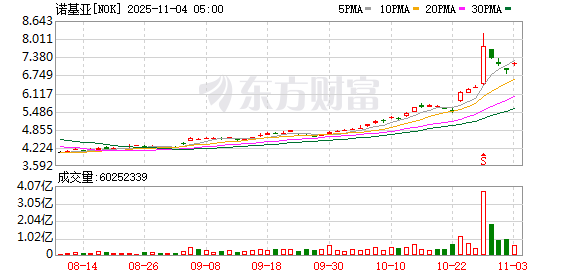
Core Viewpoint - Nokia's board has decided to apply for the delisting of its shares from the regulated market of Euronext Paris, based on a comprehensive assessment of trading volume, costs, and administrative requirements related to its listing there [2][4]. Group 1: Delisting Announcement - Nokia's stock will continue to be listed on the Helsinki Nasdaq and its American Depositary Receipts will remain on the New York Stock Exchange [2]. - The delisting requires approval from the Euronext Paris board and is expected to take effect within three months after approval [4]. - As of November 3, Nokia's stock closed at €6.14, up 4.24% from the previous day, with a market capitalization of €34.236 billion, approximately ¥267 billion [4]. Group 2: Financial Performance - In Q3 2025, Nokia reported adjusted net sales of €4.833 billion, a 12% year-over-year increase, while operating profit fell by 10% [8]. - The CEO highlighted robust growth across all business segments, driven by increasing demand for advanced and reliable connectivity solutions amid an AI supercycle [8]. Group 3: Strategic Partnerships - Nokia announced a strategic partnership with NVIDIA, involving a directed share issue of 166,389,351 new shares for a $1 billion equity investment by NVIDIA, which will result in NVIDIA holding 2.9% of Nokia [8]. - The partnership aims to enhance Nokia's 5G and 6G software to operate on NVIDIA chips, while NVIDIA will explore the use of Nokia's data center technology in AI infrastructure [8][9]. - Following the investment announcement, Nokia's stock surged over 26% on October 28 [9].
诺基亚官网宣布,公司股票从巴黎泛欧交易所退市
Zheng Quan Shi Bao Wang· 2025-11-04 12:26
Group 1 - Nokia announced the decision to delist its shares from the Euronext Paris exchange based on a comprehensive assessment of trading volume, costs, and administrative requirements [1] - The delisting process is subject to approval by the Euronext Paris board and is expected to take effect within three months after approval [1] - Nokia's shares will continue to be listed on the Helsinki Nasdaq and its American Depositary Receipts will remain on the New York Stock Exchange [1] Group 2 - Nokia's board has decided to issue 166,389,351 new shares in a directed share issue, allowing NVIDIA to make a $1 billion equity investment [2] - NVIDIA will acquire a 2.9% stake in Nokia at a subscription price of $6.01 per share, contingent upon certain customary closing conditions [2] - The partnership aims to adjust Nokia's 5G and 6G software to run on NVIDIA chips, while NVIDIA will explore the use of Nokia's data center technology in AI infrastructure [2]
突发!巨头退市!
Zheng Quan Shi Bao· 2025-11-04 12:16
Group 1 - Nokia's board has decided to apply for the delisting of its shares from the regulated market of Euronext Paris, based on a comprehensive assessment of trading volume, costs, and administrative requirements [1] - The shares will continue to be listed on the Helsinki Nasdaq and the American Depositary Receipts will remain listed on the New York Stock Exchange [1] - The delisting process requires approval from the Euronext Paris board and is expected to take effect within three months after approval [1] Group 2 - Nokia's board has approved a directed share issue of 166,389,351 new shares to enable NVIDIA to make a $1 billion equity investment [2] - NVIDIA will subscribe to these shares at a price of $6.01 per share, resulting in NVIDIA holding 2.9% of Nokia's shares [2] - The partnership aims to adjust Nokia's 5G and 6G software to run on NVIDIA chips, while NVIDIA will explore the use of Nokia's data center technology in AI infrastructure [2]