Agent Infra

Search documents
当AI已成为共识,企业究竟该如何真正“用起来”?
吴晓波频道· 2026-01-07 00:30
Core Insights - The main challenge for companies in adopting AI is not the technology itself but the speed of decision-making by leaders, with only 1% of companies achieving "mature deployment" of AI despite 92% planning to invest more in it [2][3][32] - AI's integration into businesses requires a transformation in internal capabilities, including strategic choices, organizational collaboration, data and processes, governance, and risk control [4][32] Group 1: AI Infrastructure and Deployment - The future of AI opportunities lies in two layers of infrastructure: AI Infra (computational power) and Agent Infra (intelligent agent infrastructure), which are essential for scaling AI applications [8][9] - Companies need to connect models, computational power, data, tools, and processes to succeed in the AI landscape [9] - AI deployment in enterprises requires building a knowledge base, creating digital employees, and optimizing workflows to fundamentally reshape work processes [13][28] Group 2: AI as a Collaborator - The perception of AI as a collaborator rather than just a tool is crucial for its effective use, as it combines the advantages of both human and programmatic capabilities [14] - Understanding AI's role and capabilities can help organizations leverage its strengths while managing its limitations [14] Group 3: Real-World Applications and Case Studies - Companies like Meitu and DJI exemplify a growth strategy focused on leveraging core technological capabilities rather than merely expanding product lines [15][16] - AI's true value in industries lies in its ability to eliminate uncertainties in production and R&D processes, enhancing efficiency and quality [28] - The shift from general models to specific intelligent agents tailored to business needs is essential for practical AI applications in enterprises [22][24] Group 4: Organizational Capability and Transformation - Successful AI integration requires organizations to develop the ability to manage data and operate intelligent agents, rather than relying solely on AI experts [24][25] - The focus should be on embedding AI into the organizational framework to ensure it becomes a part of the operational capabilities [32][34] - The current period presents an optimal opportunity for companies to transform AI into a growth logic and organizational productivity [35]


AI Agent落地“卡壳”?腾讯云用100毫秒沙箱打通“最后一公里”|甲子光年
Sou Hu Cai Jing· 2025-12-26 07:25
Core Insights - The article discusses the growing importance of "Agent Infrastructure" (Agent Infra) as a critical factor for the successful deployment of AI agents in business environments, highlighting the challenges faced by traditional cloud computing infrastructures in supporting the unique characteristics of agents [2][3][7]. Group 1: Market Potential and Challenges - The global agent market is projected to reach $285 billion by 2028, with 15% of daily business decisions made autonomously by agents and 33% of enterprise software incorporating agent capabilities [2]. - In China, the AI agent software market is expected to exceed 5 billion RMB in 2024 and grow to 852 billion RMB by 2028, with a compound annual growth rate of 72.7% from 2023 to 2028 [2]. Group 2: Paradigm Shift in AI Applications - Traditional AI applications focus on "determinism," while agents introduce uncertainty, complexity, and autonomy, making their behavior less predictable [3]. - The emergence of agents necessitates a shift in how businesses approach AI, requiring them to manage and control the inherent uncertainties of agent behavior [3][4]. Group 3: Technical Evolution and Infrastructure Needs - The article emphasizes the need for a new infrastructure tailored for agents, termed "Agent Infra," to address the limitations of traditional cloud computing in handling high-frequency, lightweight, and real-time workloads [7][23]. - Major cloud providers are competing to develop infrastructures that offer higher elasticity, lower latency, stronger security, and longer session management for agents [8]. Group 4: Sandbox Technology - The sandbox is identified as a crucial component of Agent Infra, providing a controlled execution environment that ensures security and isolation for agents [10]. - Traditional sandbox technologies are deemed inadequate due to their slow startup times, prompting the development of new solutions like Tencent Cloud's Cube, which can deliver a secure sandbox in approximately 100 milliseconds [11][14]. Group 5: Comprehensive Agent Runtime Solutions - Tencent Cloud has introduced the Agent Runtime solution, which integrates various core modules for managing the entire lifecycle of agents, including execution engines, cloud sandboxes, and context services [19][20]. - The execution engine acts as a central hub for intelligent scheduling and supports long-running sessions, which is essential for complex agent tasks [20]. Group 6: Future Directions and Challenges - The industry is still in the early stages of developing a comprehensive Agent Infra paradigm, with current solutions primarily focused on making agents operational rather than optimizing their performance [23][26]. - Future advancements will need to address challenges such as evaluation frameworks for agent performance, data management, and memory/context management to enhance agent intelligence and control [24][25].


AI Agent 很火,但 Agent Infra 准备好了吗?
Founder Park· 2025-12-25 09:04
Core Insights - The main users of Infra software are shifting from human developers to AI Agents, indicating a fundamental change in infrastructure requirements for AI applications [1] - The rise of "agent-native" infrastructure is predicted by 2026, necessitating platforms that can handle a massive influx of tool executions and adapt to new operational paradigms [1][2] - Current infrastructure is still designed for human-centric operations, lacking the necessary compatibility and optimization for AI Agents [1] Group 1: Infrastructure Requirements - The architecture of existing systems is based on a 1:1 response model, which is inadequate for the recursive task management required by AI Agents [1] - Future systems must address issues like cold start times, latency fluctuations, and concurrency limits to support the operational demands of AI Agents [1] - The transition from traditional software engineering to agent-based systems introduces a new level of complexity, where failures are often due to misinterpretations of developer intent rather than code bugs [4][6] Group 2: Agent Infrastructure Challenges - The definition and boundaries of Agent Infrastructure are not yet fully established, with varying complexities depending on the application scenario [11] - Common challenges include security, execution environment, and memory management, which are critical for the safe operation of autonomous Agents [12][13] - The need for a sandbox environment to limit the operational scope of Agents is emphasized, ensuring they operate within predefined boundaries to mitigate risks [12] Group 3: Application Scenarios - Current popular applications of AI Agents include customer service, research, and data analysis, with specific functionalities like coding and data processing being heavily utilized [17][18] - The cloud-based execution of code in a sandbox environment enhances security and scalability, allowing for safe and efficient operations [18] - The demand for seamless API compatibility is crucial for developers, as inconsistent APIs can hinder user experience and integration [20] Group 4: Future Opportunities - The democratization of computing through AI Agents opens new business models that were previously unfeasible due to high costs [26] - Key future focuses for Agent Infrastructure include enhancing debuggability, memory management, and low-latency performance to support more natural interactions [27][29] - The evolution of Agent Infrastructure is expected to transition from merely supporting Agent deployment to enabling intelligent evolution based on real-world data and performance feedback [31][32]

AI版街边游戏,重塑中国烟火气
3 6 Ke· 2025-12-17 03:30
Core Insights - AI is transforming street vendors in China, introducing practical applications such as AI perfume, AI bracelets, AI chess, AI billiards, and AI haircuts, adding a unique charm to street life [1][2][4] Group 1: AI Applications in Street Markets - AI perfume is gaining popularity at markets, where customers can create personalized scents by inputting their names and MBTI types into a small program powered by a large AI model [2][4] - In Beijing's Panjiayuan antique market, AI bracelets are being sold, which utilize NFC technology to provide daily fortune updates based on user input [5][6] - AI billiards and AI chess are emerging as new attractions, with AI billiards using projection technology to guide players, while AI chess allows users to play against a robotic opponent [8][9] Group 2: Business Models for AI Street Vendors - The first business model involves AI product franchise, requiring an investment starting from hundreds of thousands, leveraging existing large AI models for new ventures [11][12] - The second model is hardware purchase and retail, where AI chess robots are sold online, allowing low-cost entry for street vendors [13][15] - The third model is self-development using user-friendly AI development tools, significantly lowering the cost and complexity of creating AI applications for street vendors [16][17] Group 3: Infrastructure and Agent Development - The rise of AI street vendors is supported by advancements in AI infrastructure, particularly the development of Agent Infrastructure (Agent Infra) that enhances the stability and efficiency of AI applications [20][22] - Various intelligent agents collaborate behind the scenes to facilitate the rapid development of AI applications without the need for professional developers [20][21] - The success of AI-enabled street vendors relies on the seamless integration of technology into everyday experiences, rather than overtly high-tech solutions [23]

PPIO姚欣:AI正在进入自主行动与创造时代,智能体需要全新的操作系统|MEET2026
量子位· 2025-12-15 10:33
Core Insights - The industry is transitioning into the era of Agentic AI, where AI applications evolve from merely answering questions to autonomously executing tasks, necessitating a new foundational infrastructure known as Agent Infra [1][2][3] - The complexity of agent architecture is increasing exponentially, requiring higher demands on the underlying framework, with the operating system being a crucial middle layer across different technological eras [1][3][18][22] Group 1: Evolution of AI - AI is moving from generative capabilities to Agent AI, exemplified by products like Doubao Phone, which can autonomously place orders and compare prices, showcasing the shift towards intelligent agents that automate tasks [8][12] - The true form of intelligent agents requires capabilities such as autonomous analysis, decision-making, and task execution, moving beyond early-stage tools that merely enhance search or processing abilities [11][13] Group 2: Agent Infrastructure - The concept of Agent Infra is likened to an operating system for the AI era, managing model capabilities, tool invocation, and task execution, thereby facilitating resource management and unified scheduling for developers [23][24] - The core component of Agent Infra is Runtime, which addresses the adaptability and stability of intelligent agents across various environments, ensuring comprehensive scheduling of different capabilities [24] Group 3: PPIO's Role - PPIO is building a complete AI cloud capability from the ground up, integrating distributed computing resources and creating a GPU inference cloud platform to support the Agent Infra [26][28] - The PPIO Agent Sandbox, designed for executing tasks, provides a secure and efficient cloud environment for agents, supporting dynamic tool invocation and ensuring high concurrency and rapid deployment [29][31]

Agent 正在终结云计算“流水线”,Infra 必须学会“思考” | 专访无问芯穹夏立雪
AI前线· 2025-12-02 04:28
Core Viewpoint - The article discusses the transition from traditional AI infrastructure to a new paradigm called "Agentic Infra," which is essential for the scalable deployment of intelligent agents in various industries [2][3]. Infrastructure Evolution - The evolution of infrastructure is moving from AI Infra to Agent Infra and then to Agentic Infra, which is crucial for the large-scale implementation of intelligent agents [2]. - The infrastructure must evolve from a "production line factory" to a "solution company" to support the quality of tasks executed by agents [3][4]. Key Upgrades Required - Multiple dimensions need to be upgraded, including flexible execution environments, comprehensive tools for agents, precise contextual information, and robust security and monitoring mechanisms [4]. - The infrastructure must coordinate continuous and interrelated tasks, emphasizing the importance of sandboxing and flexible scheduling capabilities [4]. Shift in Focus - The focus has shifted from "calculating faster" to "thinking longer," requiring different types of resources for thinking and calculation [5]. - The current bottleneck lies not in the models themselves but in the supporting infrastructure's responsiveness [6]. Challenges in Agent Deployment - The decline in user numbers for platforms like Lovable indicates that while initial interest may be high, sustained engagement is challenging due to unmet user expectations [5]. - The core issue is that while agent models are capable, the supporting infrastructure and tools are still immature [6]. Future of Agentic Infra - The goal is to create an advanced Agentic Infra that allows for better resource integration and innovative functionalities, leading to a virtuous cycle of technology and application development [7][10]. - The infrastructure should enable agents to autonomously design workflows, moving from being viewed as tools to collaborators [12][13]. Technical Innovations - The introduction of micro-virtualization and sandbox management mechanisms aims to optimize resource allocation and utilization, addressing inefficiencies in traditional AI infrastructure [16]. - Unified scheduling of heterogeneous computing resources is a key innovation, allowing for better performance and efficiency [17][18]. Industry Integration - The transition from technical breakthroughs to industry integration is crucial, focusing on usability and performance rather than underlying hardware differences [18]. - The company aims to provide a robust AI-native infrastructure that supports clients in focusing on product iteration while managing complex backend operations [19][20]. Vision for the Future - The vision includes a future where intelligent agents collaborate to complete complex tasks, significantly enhancing productivity and creativity [14][22]. - The company aspires to be a foundational engine for AGI development, facilitating the transition to a more intelligent and autonomous infrastructure [22].

一个好用的Agent Infra,让你闭眼造好智能体
Hu Xiu· 2025-09-28 03:46
Core Insights - The article highlights the explosive growth of AI agents this year, with companies eager to leverage digital employees for increased value creation [1] - Major corporations are actively entering the AI agent space, indicating a significant shift in industry dynamics [1] Industry Overview - The rise of AI agents is seen as a transformative trend, with businesses anticipating substantial benefits from their implementation [1] - The concept of "Agent Infrastructure" is introduced, prompting questions about its practical applications and potential impact on operations [1]
阿里闪电入局Agent Infra!智能体新基建亮相WAIC,“超级大脑”开箱即用
量子位· 2025-07-31 06:51
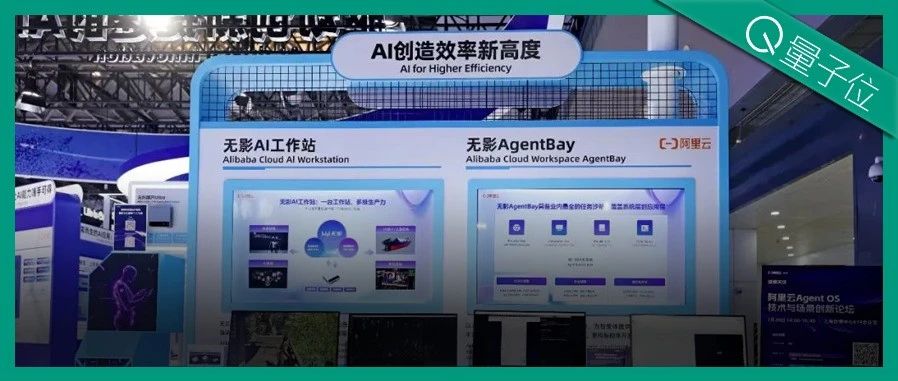
Core Viewpoint - The importance of AI infrastructure in the era of large models is increasingly recognized, with major players like Musk and Zuckerberg making significant investments in computing power and infrastructure [1][3][20]. Group 1: AI Infrastructure Developments - The concept of Agent Infrastructure has been rapidly adopted by leading companies, with AWS launching Amazon Bedrock AgentCore and investing $100 million in AI agent development [3][20]. - Alibaba Cloud has introduced the "Wuying AgentBay," a supercomputer specifically designed for AI agents, which allows developers to easily create and deploy agents with minimal coding [3][7][20]. Group 2: Features of Wuying AgentBay - Wuying AgentBay supports multiple mainstream environments, including Linux, Windows, and Android, providing comprehensive support for automation applications [9]. - It offers various interaction methods, including visual understanding and natural language control, enhancing automation efficiency [11]. - The platform features an upgraded cross-platform data roaming system, ensuring persistent data storage and seamless task switching [12]. - Wuying AgentBay provides enterprise-level security with a secure sandbox environment, preventing unauthorized access to local systems [13]. Group 3: Challenges in Agent Development - The development environment and computing power remain significant challenges for the deployment of AI agents, as local hardware often cannot meet the high demands for concurrent processing and GPU power [15][16]. - The introduction of cloud-based solutions like Wuying AgentBay addresses these challenges by allowing tasks to be executed in high-performance cloud environments, significantly lowering deployment barriers [17][18]. Group 4: Market Position and Future Outlook - Alibaba Cloud's rapid deployment of Agent Infrastructure, with over 1,000 initial testing customers, indicates strong market interest and potential for growth [20]. - The ongoing expansion of AI infrastructure is crucial for the large-scale adoption of AI agents, similar to how mobile applications drove the cloud computing era [20][23]. - According to IDC, Alibaba Cloud is expected to maintain its leading position in China's public cloud service market into the second half of 2024 [22].

我不给人做产品,给 Agent 做 | 42章经
42章经· 2025-06-29 14:48
Core Insights - The current trend in the AI space is driven by the rise of Agents, with a potential next hotspot being Agent Infrastructure [1][3] - The number of Agents is expected to increase significantly, potentially reaching thousands of times the current number of SaaS applications [2] - The collaboration between Agents and humans is anticipated to shift, with Agents becoming more autonomous and capable of processing information at a higher bandwidth than humans [4][5] Group 1 - Agent Infrastructure represents a substantial market opportunity due to the need for restructured internet infrastructure to accommodate AI [3] - The interaction methods between humans and Agents differ significantly, with Agents capable of multi-threaded tasks and learning simultaneously while executing tasks [5][6] - A new mechanism is required to manage the state of multiple tasks executed by Agents, as they can handle numerous tasks concurrently [8][10] Group 2 - The concept of a "safety fence" is crucial for AI operations, ensuring that the impact of AI actions is contained within a controlled environment [10][11] - E2B is highlighted as a popular product providing a secure and efficient sandbox for code execution, significantly influenced by the Manus project [12][14] - Cloud service providers are expected to benefit from the increased demand for resources as more Agents operate in cloud environments [15][16] Group 3 - Browserbase is identified as a leading product designed specifically for AI, with a valuation of $300 million within a year [22] - The design of AI-specific browsers must consider continuous operation, feedback loops, and security measures to protect user information [24][27] - The architecture of AI browsers includes a Runtime layer and an Agentic layer, which are essential for effective interaction between AI and web content [32][33] Group 4 - The Agent Infrastructure market is expected to grow significantly, with opportunities in both environmental setups and tools for Agents [36][40] - The potential for AI to enhance efficiency in various sectors, such as sales and recruitment, indicates a large market for Browser Use applications [48] - Differentiation in Agent Infrastructure products is crucial, with a focus on finding unique scenarios and deepening product offerings rather than competing for a small market share [55][56]

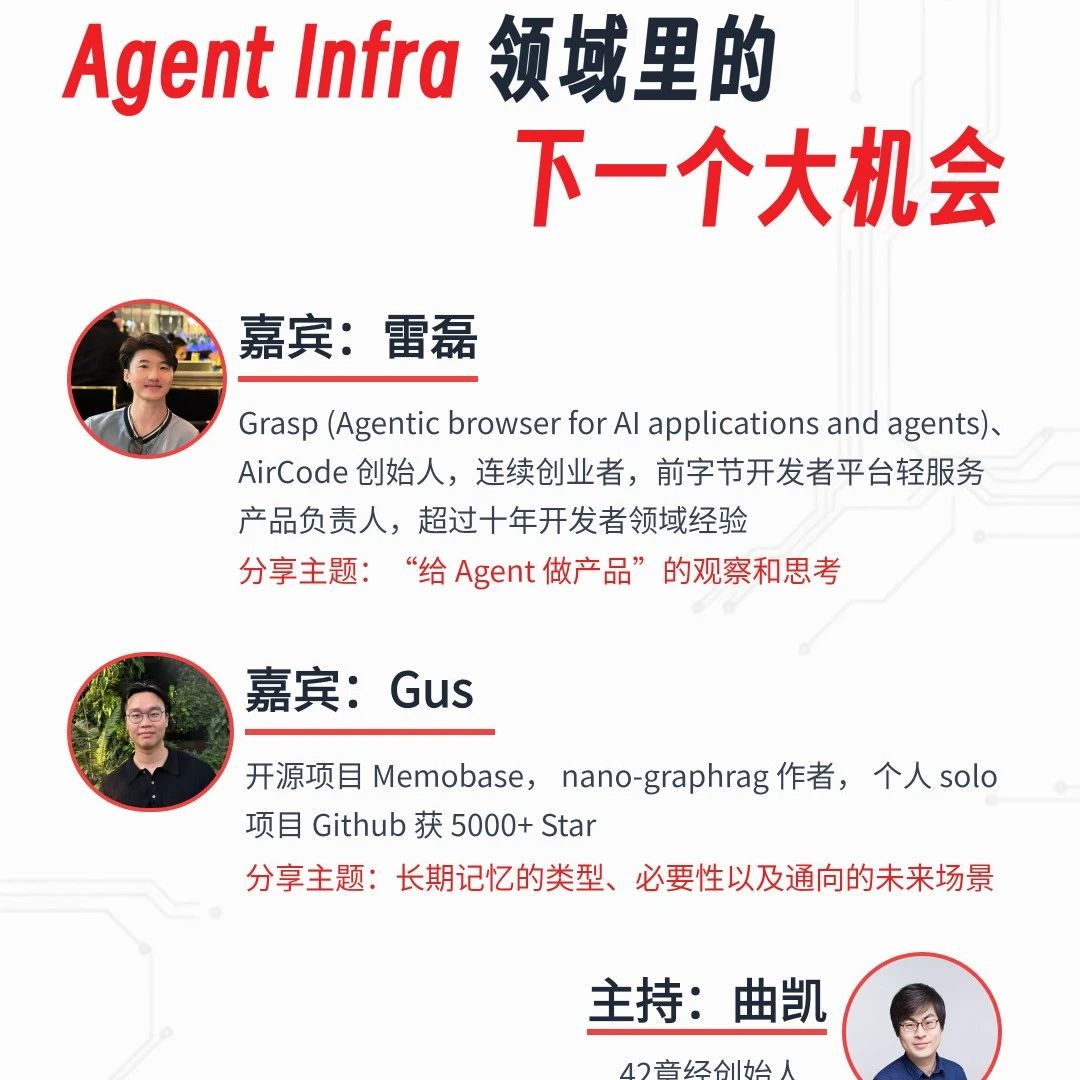
活动报名:Agent Infra 领域里的下一个大机会 | 42章经
42章经· 2025-06-15 13:57
Core Insights - The article discusses the rising interest in the Agent sector, particularly focusing on the emerging opportunities within Agent Infrastructure (Agent Infra) [1] - It highlights a podcast featuring Lei Lei, the founder of Grasp, who shares insights on the potential of Agent Infra and the latest trends in the industry [1] - An upcoming offline event in Beijing is announced, where industry practitioners will delve deeper into the evolution from "products for people" to "products for agents" [2] Group 1 - The Agent sector has seen sustained interest since the beginning of the year, with numerous projects securing funding [1] - Agent Infra is identified as a new opportunity area, prompting discussions about its potential and specific opportunities within this space [1] - The podcast features discussions on why agents need their own browsers and the methodologies for browser usage in the context of agents [2] Group 2 - The offline event will cover topics such as the evolution of product development for agents, opportunities within Agent Infra, and solutions for long-term memory issues faced by agents [2] - The event is limited to 50 participants to maintain a small and private atmosphere, prioritizing attendees who align closely with the event's focus [2] - The article expresses anticipation for engaging discussions and insights during the upcoming event [3]