GLP - 1赛道

Search documents
诺和诺德降价引发连锁反应,美团买药:节后相关药品跃居平台热搜榜前十 降糖减重GLP-1赛道竞争加剧,药企调价助推节后市场放量
Di Yi Cai Jing· 2026-03-02 08:01
Core Viewpoint - The competition in the GLP-1 diabetes and weight loss drug market is intensifying, prompting Novo Nordisk to adopt aggressive pricing strategies, including significant price adjustments in both the U.S. and China markets [1] Pricing Strategy - Novo Nordisk plans to implement substantial price changes in the U.S. market by 2027, while in China, a price reduction of approximately 20% for oral semaglutide has already been announced [1] Market Demand - The price adjustments coincide with a peak in public demand for weight management and blood sugar control post-holiday, leading to a surge in retail activity [1] - According to Meituan's latest data, the search and order volumes for related drugs have significantly increased, with semaglutide's search volume rising by 90% compared to pre-holiday levels [1] Competitive Landscape - The GLP-1 market is entering a new phase characterized by "price for volume" strategies, with online platforms emerging as a key battleground for these consumer-driven drugs [1] - This healthy competition is expected to reduce the long-term medication burden for patients and enhance the accessibility of quality drugs, driving the industry towards a more mature and inclusive direction [1]

减肥药降价50%、收购新管线,诺和诺德试图挽回投资者信心
Di Yi Cai Jing· 2026-02-26 05:29
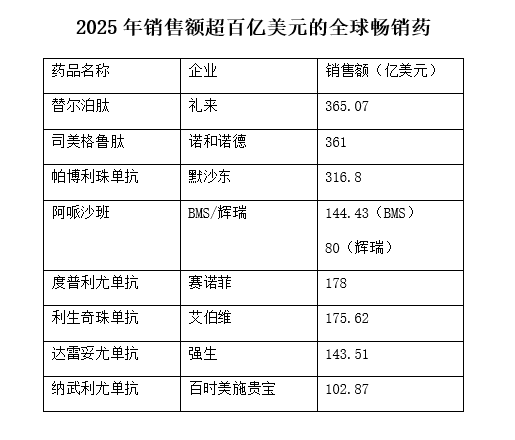
Core Viewpoint - Novo Nordisk's stock has dropped over 20% this week due to the underperformance of its new weight loss drug CagriSema compared to Eli Lilly's tirzepatide [1] Group 1: Drug Development and Collaborations - Novo Nordisk announced a collaboration with Vivtex to develop next-generation oral medications for obesity and diabetes, with potential payments totaling up to $2.1 billion [1] - The partnership aims to combine Novo Nordisk's expertise in peptide and protein drugs with Vivtex's proprietary gastrointestinal screening and formulation platform to create oral delivery options for biologics [1] - Novo Nordisk also reported successful Phase II clinical trial results for UBT251, a GLP-1/GIP/GCG triple-target drug, in overweight/obese patients in China [1] Group 2: Pricing Strategy and Market Competition - Starting January 1, 2027, Novo Nordisk will significantly reduce the official wholesale prices of its semaglutide drugs in the U.S., with a 50% reduction for the weight loss version Wegovy and approximately 35% for the diabetes version Ozempic [2] - The price reduction aims to improve drug accessibility for more patients, particularly those with high out-of-pocket costs and high-deductible insurance plans [3] - Novo Nordisk faces competition from Eli Lilly's tirzepatide, which generated $36.507 billion in sales in 2025, surpassing Novo Nordisk's semaglutide sales of $36.1 billion [3] Group 3: Patent Expiry and Future Strategies - Novo Nordisk is preparing for the patent expiry of semaglutide in March 2026 in several markets, which will expose it to generic competition [3] - The company is responding by launching oral GLP-1 weight loss medication Wegovy tablets, which were approved in December 2022, and continuing to develop new therapies like CagriSema and UBT251 [3] - Analysts predict that investor focus may shift towards the company's acquisition strategy, with expectations that Novo Nordisk could spend up to $35 billion on acquisitions this year [4]

破局商业化 先为达牵手辉瑞
Bei Jing Shang Bao· 2026-02-25 16:13
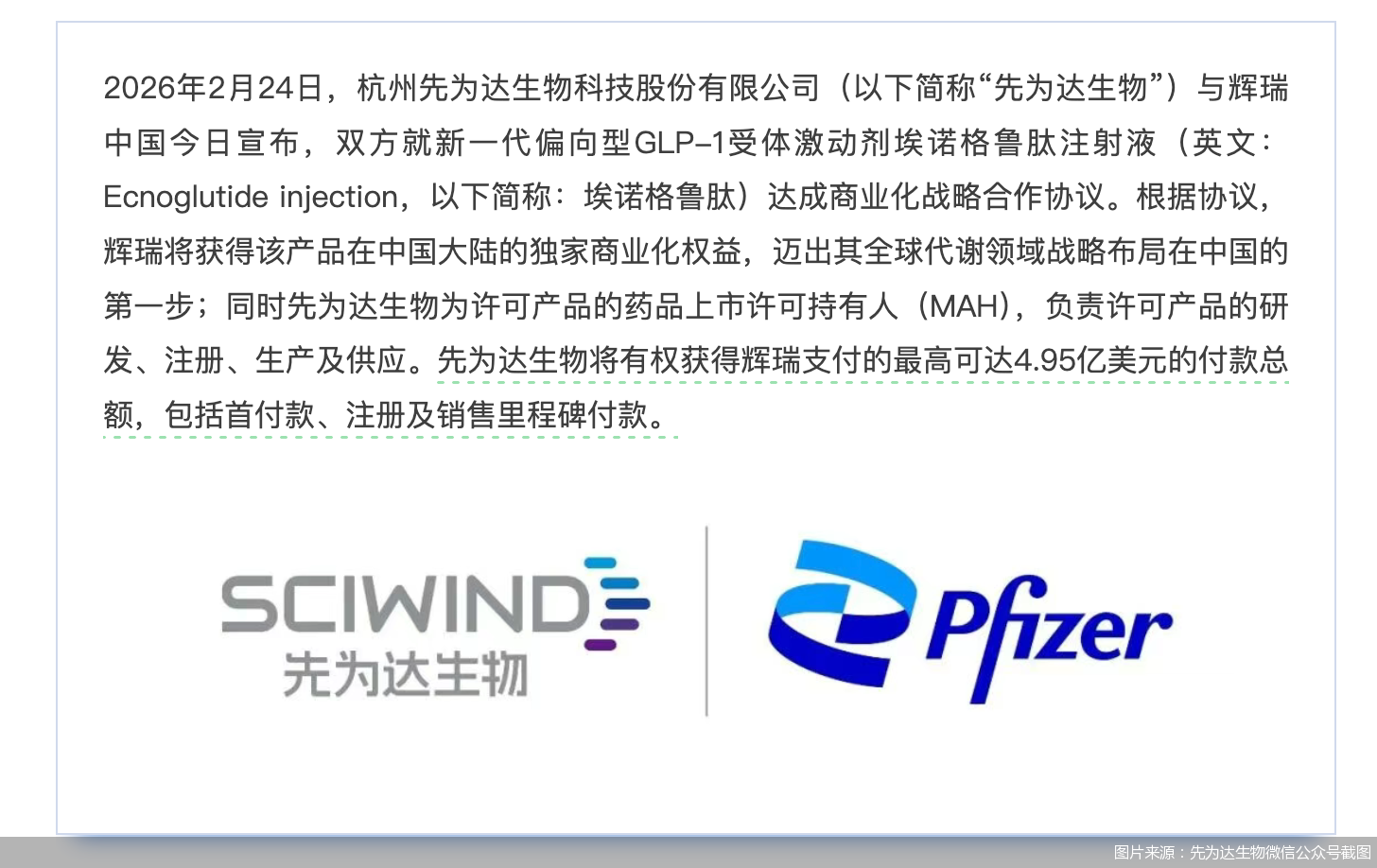
Core Viewpoint - The strategic commercialization partnership between Xianweida Biotech and Pfizer China for the GLP-1 receptor agonist, Enoglutide, marks a significant milestone for Xianweida, which has been operating at a loss due to the absence of commercialized products until now [1][2]. Group 1: Partnership Details - Xianweida and Pfizer have established a commercial cooperation agreement for Enoglutide, with a total payment potentially reaching up to $495 million, including upfront payments and milestone payments for registration and sales [2]. - Pfizer will obtain exclusive commercialization rights for Enoglutide in mainland China, while Xianweida will retain responsibilities for the product's research, registration, production, and supply [2]. Group 2: Product Information - Enoglutide is a novel long-acting GLP-1 receptor agonist with cAMP bias, designed to enhance therapeutic effects in blood sugar control and weight management without triggering excessive receptor internalization [2]. - It is the first product approved for Xianweida and was granted approval for use in adults with type 2 diabetes in January 2026, making it the first cAMP biased GLP-1 receptor agonist to be approved globally [2]. Group 3: Financial Overview - Xianweida's R&D expenditures for 2023, 2024, and the first half of 2025 are projected to be 456 million yuan, 284 million yuan, and 65 million yuan, respectively, totaling over 800 million yuan, while revenues during the same period are expected to be 0, 0, and 91 million yuan, with losses of 620 million yuan, 486 million yuan, and 108 million yuan [3]. Group 4: Market Context - The global weight management drug market is anticipated to grow from $112.8 billion in 2024 to $165.9 billion by 2029, indicating a high-growth opportunity that Xianweida aims to capitalize on [4]. - The competitive landscape includes established players like Novo Nordisk and Eli Lilly, with significant market share, alongside emerging local competitors [4]. Group 5: Future Prospects - Xianweida has initiated a global expansion strategy, including a partnership with inno.N for the development and commercialization of Enoglutide in South Korea, and plans for further collaborations in other regions [5][6]. - The upcoming IPO on the Hong Kong Stock Exchange is critical for Xianweida, as failure to complete the hearing within six months of filing could result in the application being marked as "invalid" [6].

新药上市即牵手辉瑞,持续亏损的先为达借力巨头商业化
Bei Jing Shang Bao· 2026-02-25 08:45
Core Viewpoint - Xianweida Biotech has established a commercialization partnership with Pfizer China for its first approved product, Enoglutide, with a total payment of up to $495 million, marking a significant step in its strategy to penetrate the competitive GLP-1 market [1][2]. Group 1: Partnership Details - The agreement grants Pfizer exclusive commercialization rights for Enoglutide in mainland China, while Xianweida remains the marketing authorization holder responsible for R&D, registration, production, and supply [2]. - The total payment from Pfizer includes an upfront payment and milestone payments related to registration and sales [2]. Group 2: Product Information - Enoglutide is a novel long-acting GLP-1 receptor agonist with cAMP bias, enhancing efficacy in blood sugar control and weight management without triggering excessive receptor internalization [2]. - It was approved for use in adults with type 2 diabetes for blood sugar control in January 2026, becoming the first cAMP biased GLP-1 receptor agonist globally [2]. Group 3: Financial Overview - Xianweida's R&D expenditures for 2023, 2024, and the first half of 2025 are projected to be 456 million, 284 million, and 65 million yuan respectively, totaling over 800 million yuan, while revenues during the same period are expected to be 0, 0, and 91 million yuan, with losses of 620 million, 486 million, and 108 million yuan [3]. Group 4: Market Context - The global weight management drug market is projected to grow from $112.8 billion in 2024 to $165.9 billion by 2029, indicating a high-growth opportunity for Xianweida [6]. - The competitive landscape includes established players like Novo Nordisk and Eli Lilly, as well as local competitors such as Innovent Biologics, intensifying the market rivalry [6]. Group 5: Strategic Moves - Xianweida has initiated a global strategy, having submitted its IPO application to the Hong Kong Stock Exchange in September last year, aiming to become the "first stock in weight management" [5]. - The company has also signed agreements for future development and commercialization of Enoglutide in South Korea and other regions, indicating proactive steps to enhance its market presence [6].

辉瑞中国牵手先为达生物加码GLP-1赛道
Zheng Quan Ri Bao· 2026-02-24 15:44
Core Insights - The collaboration between Xianweida Biotechnology and Pfizer China focuses on the commercialization of the next-generation GLP-1 receptor agonist, Enoglutide, with a potential total value of up to $495 million [1][2][3] Group 1: Collaboration Details - Pfizer China will obtain exclusive commercialization rights for Enoglutide in mainland China, while Xianweida will act as the marketing authorization holder (MAH) responsible for R&D, registration, production, and supply [1] - The payment structure includes an upfront payment and milestone payments, which incentivizes Xianweida to ensure successful R&D and market performance [1][3] Group 2: Product Differentiation - Enoglutide is a cAMP biased GLP-1 receptor agonist, which selectively activates specific pathways, potentially improving weight loss and glycemic control while reducing side effects compared to traditional GLP-1 agonists [2] - The product has received approval from the National Medical Products Administration (NMPA) for the treatment of adult type 2 diabetes, with a market entry expected in January 2026 [2] Group 3: Market Context - The GLP-1 market is becoming increasingly competitive, with major players like Novo Nordisk and Eli Lilly holding significant market share, while domestic companies like Innovent Biologics and Hansoh Pharmaceutical are rapidly catching up [2] - The collaboration represents a strategic move for Pfizer China to solidify its presence in the metabolic field, following its acquisition of Metsera and a global partnership with WuXi AppTec [2][3] Group 4: Strategic Implications - For Xianweida, partnering with Pfizer China enhances its commercialization capabilities and provides necessary funding for R&D, while retaining core ownership and production rights of the product [3] - The collaboration is seen as a strategic complement, allowing both companies to leverage their strengths in R&D and commercialization to maximize the product's market potential [3]
马斯克也带不动的诺和诺德,真的被礼来逼到墙角了?
和讯· 2026-02-24 12:42
Core Viewpoint - The article discusses the competitive landscape between Novo Nordisk and Eli Lilly in the GLP-1 drug market, highlighting Novo Nordisk's recent setbacks and Eli Lilly's advancements, particularly in the context of clinical trial results and market strategies [4][6][18]. Group 1: Novo Nordisk's Challenges - On February 23, 2026, Novo Nordisk's stock plummeted over 15% following disappointing results from the REDEFINE 4 clinical trial for CagriSema, which showed a weight loss of only 23.0%, compared to Eli Lilly's 25.5% with tirzepatide [4][6]. - Novo Nordisk's 2026 sales guidance indicated a projected decline of 5% to 13%, marking the first annual sales drop in nine years, attributed to unprecedented pricing pressures and increased competition [6][10]. - The FDA criticized Novo Nordisk's advertising for its oral Wegovy, labeling it misleading, which compounded the company's challenges [9][10]. Group 2: Novo Nordisk's Strategic Responses - Novo Nordisk's new CEO, Mike Doustdar, emphasized a strategic focus on diabetes and obesity, eliminating previous diversification attempts [11]. - The launch of oral Wegovy aimed to address patient fears of injections, achieving a weight loss of 16.6% with a lower discontinuation rate of 7% [11][12]. - Novo Nordisk is restructuring its distribution channels to connect directly with consumers, partnering with major retailers like Costco and Amazon [11][12]. Group 3: Competitive Landscape and Eli Lilly's Advances - Eli Lilly has made significant strides, including a $10 billion partnership with NVIDIA to enhance drug development through AI, positioning itself ahead in research efficiency [19][21]. - Eli Lilly's tirzepatide has been included in China's national insurance list, expanding its market access and competitive edge [21][22]. - The introduction of Zepbound, a multi-dose injection device, enhances user experience and accessibility, further solidifying Eli Lilly's market position [22][24]. Group 4: Market Dynamics and Future Outlook - The market is witnessing a shift, with Eli Lilly's dual-target approach in tirzepatide showing superior efficacy compared to Novo Nordisk's single-target drugs [24][30]. - Analysts have downgraded global obesity drug sales forecasts, reflecting concerns over pricing pressures and changing consumer behaviors [30][31]. - The ongoing competition suggests that while Novo Nordisk is focused on defending its current products, Eli Lilly is aggressively pursuing innovation and market expansion [31][32].

硕迪生物股价连续下跌,GLP-1赛道竞争加剧引关注
Xin Lang Cai Jing· 2026-02-14 20:15
Core Viewpoint - The stock price of Shuo Di Bio (GPCR.OQ) has been on a continuous decline over the past week, despite a recent non-exclusive patent licensing agreement with Roche and Genentech that provided $100 million in upfront payment [1][2]. Stock Performance - As of February 13, the stock closed at $70.07, down 2.73% for the day, with a cumulative decline of 6.47% over the past five days and a price range fluctuation of 14.95%, hitting a low of $69.95 [1]. - Trading volume varied, with a peak of $64.05 million on February 12 (turnover rate of 1.24%) and a decrease to $89.24 million on February 13 (turnover rate of 1.77%) [1]. - The biotechnology sector rose by 1.32% during the same period, but the individual stock underperformed compared to the Nasdaq index, which fell by 0.22% [1]. Recent Events - On December 30, 2025, Shuo Di Bio entered into a non-exclusive patent licensing agreement with Roche and Genentech, securing $100 million in upfront payment and the right to receive low single-digit royalties on future sales of the oral GLP-1 drug CT-996 [2]. - Despite this positive development, the stock price has reacted negatively due to sector rotation, technical corrections, and increased competition concerns in the GLP-1 market [2]. Financial Analysis - For the third quarter of 2025, the company reported zero revenue and a net loss of $65.8 million, with a return on equity (ROE) of -25.31% [3]. - Ongoing research and development expenditures are putting pressure on short-term profitability, but the company maintains a relatively stable financial structure with a debt-to-asset ratio of 7.47% and a current ratio of 14.15% [3]. Institutional Perspectives - Several brokerages express long-term optimism regarding Shuo Di Bio's cash flow potential from the patent collaboration and the scarcity of its oral GLP-1 pipeline [4]. - However, short-term stock performance is constrained by market sentiment fluctuations, profit-taking pressures in the sector, and a low liquidity environment that amplifies volatility [4].
硕迪生物与罗氏达成专利许可协议,股价却逆势下跌
Jing Ji Guan Cha Wang· 2026-02-12 20:28
Company Overview - Shodex Bio (GPCR.OQ) has entered into a non-exclusive patent licensing agreement with Roche and Genentech, receiving a $100 million upfront payment and future royalties from oral GLP-1 drug sales [1] - The company's Q3 2025 financial report shows zero revenue and a net loss of $65.8 million, indicating ongoing R&D investments are pressuring short-term profitability [4] Stock Performance - As of February 12, 2026, Shodex Bio's stock price fell by 3.24% to $73.52, with a cumulative decline of 12.82% over the last 20 trading days [2] - The stock price peaked at $94.90 in January 2026 due to acquisition rumors but has since experienced a pullback, with a recent volatility of 22.57% and a low of $72.10 [5] Industry Context - Since January 2026, the pharmaceutical and biotechnology sector has seen accelerated thematic rotation, with profit-taking pressures emerging in the innovative drug field [3] - Concerns about intensified competition in the GLP-1 market, particularly regarding potential impacts from generic drugs, have led to increased caution among investors [3] Market Environment - On the same day, the Nasdaq index fell by 1.84%, reflecting a general increase in market risk aversion [6] - Shodex Bio's trading volume was approximately $24.58 million, indicating that low liquidity conditions may amplify stock price volatility [6]
礼来新药在华获批及财报超预期,股价短期波动
Jing Ji Guan Cha Wang· 2026-02-12 15:16
Group 1 - Eli Lilly's GLP-1/GIP drug Tirzepatide (brand name: Mounjaro) has received approval from the National Medical Products Administration of China for use as a monotherapy in adults with type 2 diabetes, based on the SURPASS-CN-MONO study targeting early patients in China, which is expected to expand market potential in the country [1] - Eli Lilly's IL-23 monoclonal antibody, both intravenous and subcutaneous formulations, has been approved for the treatment of Crohn's disease and ulcerative colitis, enhancing its position in the immunology sector [1] Group 2 - In Q4 2025, Eli Lilly reported revenue of $19.29 billion, a 43% year-over-year increase, exceeding market expectations; adjusted earnings per share were $7.54, up 42% [2] - The Tirzepatide product line generated $36.5 billion in revenue for the year, making it the highest-selling drug globally; the company provided an optimistic revenue guidance for 2026, expecting a range of $80 billion to $83 billion, representing approximately a 25% year-over-year growth [2] Group 3 - Following the positive earnings report and product developments, Eli Lilly's stock experienced significant volatility, with a single-day increase of 10.33% on February 4, 2026, closing at $1,107.12; however, the stock closed at $1,015.21 on February 11, 2026, down 0.96%, with a total decline of 8.30% over the past five trading days, indicating a short-term market adjustment after the positive news [3] Group 4 - CICC released a report on February 10, 2026, noting that Tirzepatide has become the "king of drugs" in 2025, and Eli Lilly has a robust pipeline, with the oral GLP-1 drug Orforglipron expected to receive approval in Q2 2026, which could serve as a new growth driver; the report maintains a neutral rating with a target price of $1,107 [4] - Institutional data shows that 78% of market opinions are buy or hold, reflecting confidence in the long-term prospects of the GLP-1 sector [4]
“药王”更迭 替尔泊肽年销售额超365亿美元登顶
Xin Jing Bao· 2026-02-12 04:54
Core Insights - The global pharmaceutical industry is witnessing a significant shift in the rankings of best-selling drugs, with several products surpassing $10 billion in sales for 2025 [1][2]. Group 1: Sales Performance - Novo Nordisk's semaglutide briefly topped the sales chart in Q1 2025 but was ultimately surpassed by Eli Lilly's tirzepatide, with both drugs exceeding $30 billion in sales [1][3]. - Tirzepatide achieved a remarkable year-on-year sales growth of 121%, while semaglutide's growth was only 13% [3]. - The sales figures for semaglutide in the first half of 2025 reached $16.683 billion, maintaining its position as a top-selling drug [3]. Group 2: Competitive Landscape - The GLP-1 drug class is experiencing intense competition, with both tirzepatide and semaglutide being key players [4][5]. - The market is dominated by Novo Nordisk and Eli Lilly, but Chinese pharmaceutical companies are also making significant strides in this area [5][6]. - New GLP-1 drugs are under development, including Novo Nordisk's CagriSema and Eli Lilly's retatrutide, which shows potential for greater weight loss than tirzepatide [5]. Group 3: Oncology and Autoimmune Drugs - The PD-1 inhibitor pembrolizumab (Keytruda) remains a top seller in oncology, with sales reaching $31.68 billion in 2025, despite falling to third place [7]. - Nivolumab (Opdivo) also crossed the $10 billion mark, achieving sales of $10.29 billion [8]. - In the autoimmune disease sector, drugs like dupilumab and risankizumab achieved sales of $17.8 billion and $17.562 billion, respectively [8]. Group 4: Anticoagulants - The anticoagulant apixaban continues to show strong sales growth, with BMS reporting $14.443 billion in sales, a year-on-year increase of 8% [9]. - Pfizer's reported revenue from apixaban reached $8 billion, making it their second-largest selling product [9].