
PPI上行

Search documents
利率周度策略:输入型通胀重现,捕捉曲线陡峭化交易机会-20260320
East Money Securities· 2026-03-20 09:44
Group 1 - The report highlights the resurgence of input inflation and suggests capturing steepening curve trading opportunities in the bond market [1] - The current inflationary pressures are primarily driven by supply constraints and external shocks, particularly in the context of rising oil prices due to geopolitical tensions [5][12] - Historical analysis indicates that the causes of inflation are more critical than the inflation readings themselves, with demand-driven inflation having a more significant impact on the bond market compared to supply-driven or input-driven inflation [72] Group 2 - The report discusses the implications of the recent Middle East conflicts on inflation expectations and the bond market, noting a significant rise in oil and gas prices, with Brent crude and natural gas prices increasing by 49.90% and 66.98% respectively from February 27 to March 19, 2026 [16][19] - It emphasizes that if oil prices remain high, the Producer Price Index (PPI) could see a substantial increase, potentially elevating annual PPI growth rates to between 0.9% and 5.8% depending on the extent of oil price increases [23][24] - The analysis of past PPI uptrends reveals that the bond market typically reacts more to the underlying causes of inflation rather than the inflation figures themselves, with historical data showing that bond yields tend to rise during periods of demand-driven inflation [72][26]
PPI上行如何影响AH权益?
HTSC· 2026-03-02 05:50
Group 1: Core Insights - The report predicts that China's PPI is expected to turn positive in May-June 2026 for the first time since October 2022, with an average PPI for the year projected to rise from -2.6% to +0.1% [1] - Historical data shows that there have been seven periods of PPI increases since 2000, with the correlation between AH market performance and PPI being slightly higher in Hong Kong than in A-shares [2][7] - The report identifies five main drivers of PPI increases: input-driven inflation, demand-pull inflation, cost-push inflation, monetary-driven inflation, and mixed inflation, with historical trends indicating a shift from demand-driven to cost-push factors post-2012 [3][25] Group 2: Industry Performance During PPI Increases - During periods of PPI increases, industries such as energy metals, non-metallic materials, and steel raw materials are expected to benefit, while sectors like consumer electronics and food processing may suffer [3][31] - The report highlights that during PPI uptrends, cyclical goods, midstream manufacturing in A-shares, and certain essential consumer sectors in Hong Kong typically benefit from the rise in PPI [8][7] - The analysis indicates that the market tends to react to PPI changes approximately two quarters in advance, aligning with the timing of PPI bottoming out [7][19] Group 3: Sector-Specific Insights - The report provides a scoring model to identify industries that benefit from different types of inflation, emphasizing that sectors like photovoltaic equipment and construction materials are likely to perform well under cost-push inflation conditions [4][30] - For demand-pull inflation, industries such as passenger vehicles and other power equipment are expected to gain, while sectors like general retail and kitchen appliances may face challenges [3][31] - The report also notes that large-cap stocks tend to show higher elasticity compared to small-cap stocks during PPI increases, with value stocks outperforming growth stocks [2][7]
今年市场的主线是什么?
Sou Hu Cai Jing· 2026-02-25 11:14
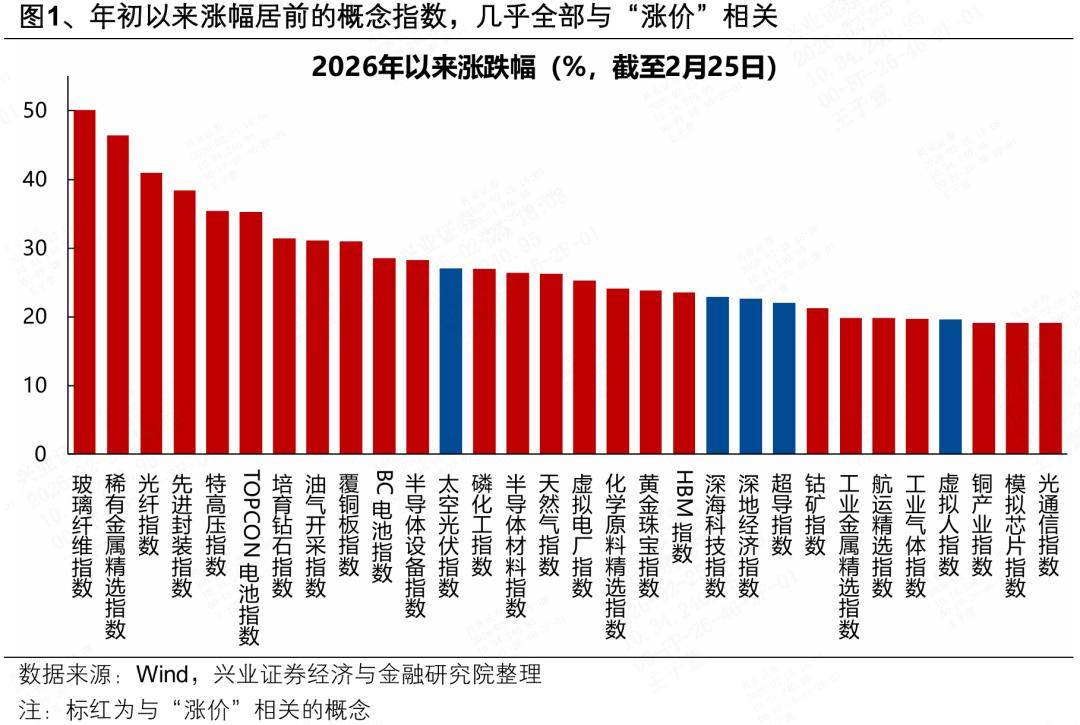
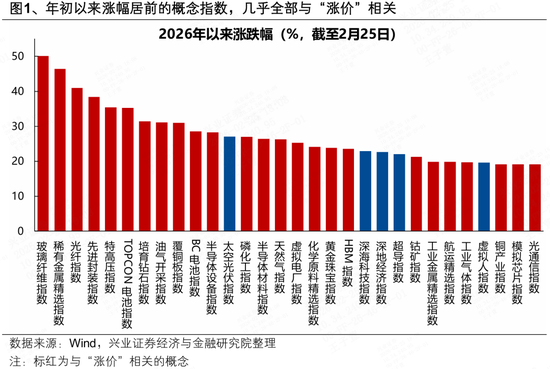
Group 1 - The core theme of the article is that "price increases" have become a significant trading signal in the capital market since the beginning of the year, affecting nearly all industries, with 25 out of the top 30 concept indices related to price increases [1][3] - Price increases are seen as a direct reflection of performance improvement and economic upturn, suggesting that trading on price increases is essentially trading on economic prosperity [3][5] - The Producer Price Index (PPI) rising is expected to influence market styles, indicating that if price recovery is validated this year, the market's focus will shift towards cyclical sectors [5][8] Group 2 - The period of March to April is identified as a critical window for validating and trading on price increases, with expectations that more sectors will show price increases, reinforcing the logic of price increases as a key trading theme [8] - Seasonally, the first quarter is typically favorable for price increases, with historical data showing a significant proportion of price rises during this period [9] - The "price increase chain" has shown excess returns relative to the overall market, indicating that trading strategies focused on price increases have historically performed well [9]

兴证策略张启尧团队:今年市场的主线是什么?
Xin Lang Cai Jing· 2026-02-25 10:57
Core Viewpoint - Since the beginning of the year, "price increases" have emerged as a crucial trading theme in the capital market, affecting nearly all industries, with 25 out of the top 30 concept indices related to price increases [1][12]. Group 1: Price Increase as a Key Theme - Price increases are no longer confined to specific sectors but are spreading across various industries, including oil and gas, chemicals, construction materials, and technology [1][12]. - The concept of "price increases" is expected to become a central theme for the year, reflecting improved performance and economic upturn, and will be treated as a core trading signal by the market [3][13]. Group 2: Economic Indicators and Market Impact - The rise in Producer Price Index (PPI) is significant for market style, as price increases signal a cyclical economic recovery, which could lead to a smoother transition of market styles towards cyclical sectors if price recovery is validated [5][14]. - The period of March to April is identified as a critical window for validating and trading on price increases, with expectations of more sectors experiencing price hikes, reinforcing the logic of price increases as a key driver for corporate profit recovery and market style expansion [6][18].
东方证券:家电中高端卡位机会显现 推荐经营稳健龙头公司
智通财经网· 2026-02-05 07:40
Core Viewpoint - Home appliance companies are announcing price increases to pass on raw material costs downstream, leading to a more stable market position for leading companies, particularly those targeting mid-to-high-end consumers [1][2]. Group 1: Price Increases and Market Dynamics - The LME copper price increased by 32% from July 1, 2025, to January 30, 2026, prompting major brands like Hisense and Midea to raise prices on their air conditioning products by 5%-10% and over 6% respectively [1]. - Historical data shows that price increases do not significantly impact overall sales volume in the home appliance sector, which is more influenced by real estate policies, replacement cycles, and external subsidy policies [2]. - Following price hikes, the industry tends to consolidate, with leading companies gaining market share, as seen in the air conditioning and refrigerator sectors during previous raw material price increases [2]. Group 2: Opportunities in Mid-to-High-End Segments - The Producer Price Index (PPI) is rising, signaling positive trends for industrial companies and economic stabilization, which presents opportunities in mid-to-high-end segments such as 3D printing and AI glasses [3]. - Mid-to-high-end brands are less sensitive to price changes, allowing them to better pass on costs during periods of rising raw material prices, thus enhancing their market share [3].

蓄力新高5:反内卷的期货映射方向
CAITONG SECURITIES· 2025-07-27 07:44
Group 1 - The report highlights a significant trend in the futures market driven by "anti-involution" strategies, with leading sectors such as polysilicon and coking coal showing substantial price increases due to production cuts and environmental regulations [4][11]. - The report indicates that there is still potential for over 15% price appreciation in leading stocks related to polysilicon, coking coal, glass, and coke, as the price trends in commodities remain upward [4][11]. - The report emphasizes the importance of monitoring the Producer Price Index (PPI), which is expected to bottom out and recover, suggesting that stock market performance is closely tied to PPI movements [5][12]. Group 2 - The report outlines a "dumbbell trading" strategy observed in fund holdings, where there is an increase in allocations to TMT sectors like telecommunications and media, while reducing exposure to consumer goods and manufacturing sectors [6][15]. - The report notes that the second quarter saw a consensus among both northbound and domestic funds to increase allocations in dividend-paying sectors and cyclical industries, while reducing exposure to consumer and manufacturing sectors [16]. - The report discusses the historical performance of PPI cycles, indicating that during PPI upturns, cyclical sectors such as coal, non-ferrous metals, and basic chemicals tend to perform strongly [5][13].