
TACO(Trump Always Chickens Out)

Search documents
特朗普总是TACO的背后是什么?世界还会好吗?
首席商业评论· 2026-01-25 04:48
Core Viewpoint - The article discusses the concept of "TACO" (Trump Always Chickens Out), highlighting how former President Trump's negotiation tactics often involve extreme threats followed by retreats, impacting global trade dynamics and U.S. foreign policy [4][10]. Group 1: TACO's Origins and Impact - TACO began with the implementation of "reciprocal tariffs" on April 2, 2025, where a 10% baseline tariff was imposed on all trade partners, escalating to higher rates for countries with significant trade deficits with the U.S. [10][12]. - The tariffs on Chinese goods peaked at 145%, leading to a significant drop in U.S. imports from China by over 40% in May 2025, indicating a temporary decoupling of U.S.-China trade [12][14]. - The average tariff rate on Chinese goods reached approximately 29.3% by November 2025, with exemptions for essential consumer goods [14]. Group 2: TACO's Predictable Cycle - Trump's TACO strategy follows a predictable cycle: extreme pressure, market panic, asset price reactions, tactical retreats, and then claiming victory [15]. - Each TACO instance serves not only as a negotiation tactic but also as a means to divert attention from domestic issues, such as the Epstein documents scandal [15][16]. Group 3: Global Reactions and Consequences - The article emphasizes that TACO has weakened the credibility of U.S. negotiations, with global markets becoming desensitized to Trump's tactics, potentially leading to more aggressive policies if left unchecked [18][20]. - European leaders express concern over their reliance on the U.S., facing a critical juncture where they must either unite or risk fragmentation under U.S. pressure [20][22]. Group 4: Future Implications of TACO - The article suggests that Trump's unpredictable nature complicates international relations, as his administration's tactics could lead to significant geopolitical shifts [22][25]. - The TACO approach reflects a broader "America First" strategy, where even allies are subjected to pressure, raising concerns about the future of U.S. foreign policy and international cooperation [25][26]. Group 5: Economic Strategies and Market Dynamics - As the 2026 midterm elections approach, Trump's administration is expected to aggressively manipulate energy prices to secure political support, aiming to lower gasoline prices significantly [27][28]. - The potential for oil price manipulation could lead to volatility in global markets, particularly affecting relationships with key allies like Saudi Arabia [31].

从4周到几天:华尔街读懂“TACO”,特朗普政策试探期明显缩短
Hua Er Jie Jian Wen· 2026-01-23 08:32
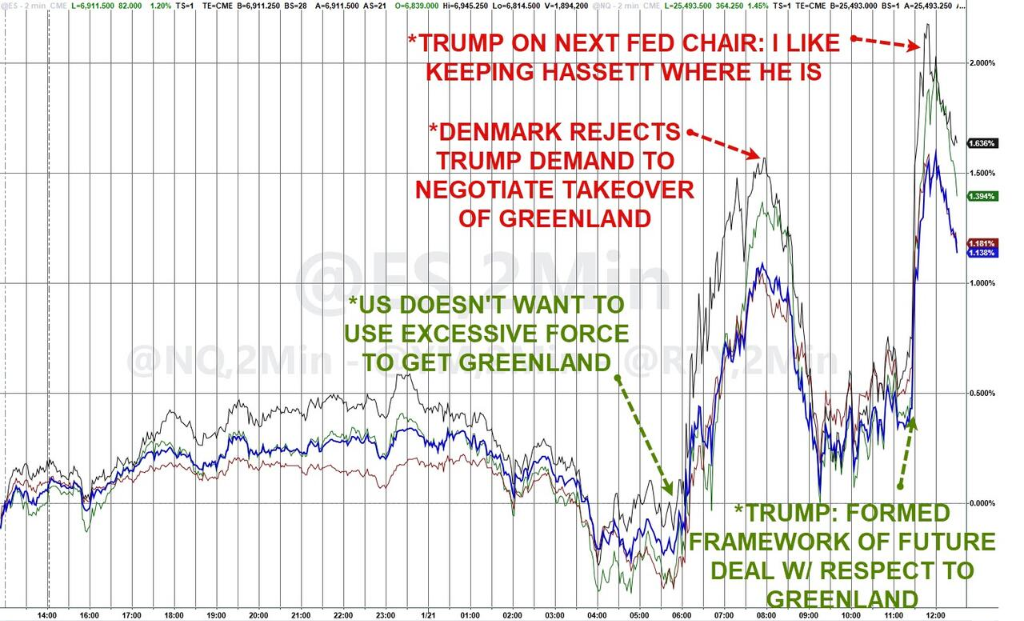
Core Insights - Investors on Wall Street are adapting to the rapid shifts in Trump's policy threats, with the "TACO" (Trump Always Chickens Out) mentality becoming embedded in market pricing mechanisms [1][3] - The recent Greenland tariff controversy saw a quick reversal in Trump's stance, highlighting the influence of market volatility on his decision-making [1][4] Group 1: Market Reactions - On January 21, Trump announced a framework agreement with NATO Secretary General Jens Stoltenberg regarding Greenland, which led to the postponement of planned tariffs on European countries [1] - Following a significant market drop where over $1 trillion was wiped off U.S. stock values, Trump’s decision to backtrack on tariffs was seen as a response to market pressures [1][3] - The rapid turnaround in policy from Trump, occurring within days rather than the typical 4-6 week cycle, indicates a heightened sensitivity to market dynamics [4] Group 2: Investor Strategies - Investors are increasingly confident that Trump will compromise under market pressure, leading to adjustments in their strategies, such as tactical reductions in exposure before high-risk events [3][6] - Some investors are opting to hold long positions in commodities like gold, which are expected to benefit from increased uncertainty, with gold prices nearing $5,000 per ounce [6][5] - The shift in investor behavior reflects a broader adaptation to the new normal of extreme policy threats from the Trump administration [3][6] Group 3: Political Context - The political capital of Trump is perceived to be lower now, especially with midterm elections approaching, which may lead to a lower threshold for pain in policy decisions [4] - The dynamics of market reactions to Trump's policies have evolved, with investors now more cautious and proactive in managing risks associated with potential policy shifts [4][5]
Dow surges 700 points after Trump announces Greenland framework, calls off tariff threat
New York Post· 2026-01-21 20:11
Market Reaction - The stock market rebounded significantly after President Trump's announcement regarding a potential deal about Greenland and the decision not to impose tariffs on several European countries, with the Dow Jones Industrial Average rising 1.2% (nearly 600 points) to 49,072, the S&P 500 gaining 1.1%, and the Nasdaq advancing over 250 points (1.2%) [1][2][10] Company Performance - Halliburton's stock increased by 2.9% following a stronger-than-expected profit report for the latest quarter [8] - United Airlines saw a 2.7% rise in its stock price after reporting better-than-expected profits for the end of 2025, with CEO Scott Kirby indicating strong revenue momentum continuing into 2026 [8] - Conversely, Netflix's stock dropped by 2.9% despite reporting a stronger profit than anticipated, as investors were concerned about slowing subscriber growth and a lower-than-expected profit forecast for the current quarter [9] - Kraft Heinz's stock fell by 6.3% after Berkshire Hathaway indicated it might sell its 325 million shares in the company [11]

美国政策追踪:一年之约,特朗普还能改变什么?
Guolian Minsheng Securities· 2026-01-20 11:45
External Factors - Trump's tariffs remain a hot topic, with a shift towards using tariffs as a negotiation tool for trade agreements and to alleviate domestic pressures[4] - In 2025, tariff revenues increased by approximately $118 billion, which could have led to a larger fiscal deficit without these tariffs[10] - The geopolitical strategy shows a tendency towards strategic withdrawal, with a focus on Latin America and limited military intervention, potentially weakening the U.S.'s global institutional advantages[8] Internal Factors - The fiscal policy is characterized by a struggle to effectively reduce the deficit, with projections indicating that the fiscal deficit for FY 2025 may expand without significant changes[6] - The 2026 fiscal year is expected to face challenges in implementing substantial fiscal tightening, with a projected deficit rate higher than in 2024[10] - Trump's policy shift towards resource redistribution may increase volatility in U.S. asset prices, particularly affecting financial and large tech companies while benefiting smaller firms[10] Market Implications - The combination of expansionary fiscal policy and a coordinated monetary policy may support global liquidity, favoring risk assets[10] - Non-U.S. assets may benefit from spillover effects, while U.S. assets could experience structural differentiation, with a tendency for the dollar to depreciate[10] - The focus on resource redistribution may lead to increased scrutiny on consumer goods and essential sectors, impacting inflation concerns among voters[8]
第二个赢得“TACO交易”的国家出现了:巴西!
Hua Er Jie Jian Wen· 2025-11-28 07:22
Core Viewpoint - Brazil has successfully negotiated a tariff exemption from the U.S. by adopting a strong stance against pressure from the Trump administration, illustrating the effectiveness of resilience over appeasement in international negotiations [1][2]. Group 1: Policy Changes and Motivations - The U.S. White House announced a modification of tariffs on Brazilian imports, maintaining a 40% tariff on some goods while eliminating additional tariffs on specific Brazilian agricultural products effective November 13 [1]. - The decision to adjust tariffs is driven by increasing concerns over domestic living costs and inflation, as consumer confidence in the U.S. declines alongside Trump's approval ratings [2]. - The exemption for Brazilian agricultural products is seen as a pragmatic adjustment by the White House to alleviate domestic inflation pressures, prioritizing political considerations over punitive measures against Brazil [2]. Group 2: Strategic Insights - Understanding the Trump administration's behavior requires distinguishing between its "goals," "strategies," and "tactics," with the overarching goal being to "Make America Great Again" [3]. - The administration's strategy involves using economic tools to reinforce U.S. hegemony, blending economic, political, and personal issues into its decision-making [3]. - Tactical maneuvers include threats, dramatic gestures, and policy fluctuations, which are designed to gain leverage in negotiations but should not be confused with deeper strategic objectives [3][5]. Group 3: Lessons from Brazil's Approach - Brazil's success in negotiating tariff exemptions serves as a critical lesson for other nations: a strong and resolute approach can be more effective than submissive tactics in dealing with aggressive policies [2]. - The contrasting strategies of Brazil and Switzerland highlight that direct resistance can yield favorable outcomes, as opposed to attempts at appeasement [2].