
关税缓和

Search documents
2026年宏观经济与资产配置展望:百炼成钢,乘势而上
East Money Securities· 2025-11-17 11:16
Group 1: Macro Economic Outlook - The report highlights a positive macroeconomic outlook for 2026, with expectations of economic recovery driven by supportive monetary and fiscal policies in the US and globally [1][3][4] - The US economy is projected to experience a soft landing as inflation expectations have improved, with CPI growth remaining below 3.0% as of September 2025 [21][34] - Global liquidity is expected to remain accommodative, with major economies shifting focus from inflation control to growth stabilization, potentially leading to a synchronized recovery in global trade [1][3][4] Group 2: Domestic Economic Resilience - The report emphasizes the resilience of the domestic economy, with internal risk management showing positive results, particularly in addressing local government debt and stabilizing small financial institutions [2][4][6] - Consumer spending is identified as a key driver of economic growth, supported by ongoing government policies aimed at boosting domestic demand [4][6][8] - Investment quality is expected to improve, transitioning from quantity-focused to quality-focused investments, with significant policy support anticipated in the "15th Five-Year Plan" [4][6][8] Group 3: Policy Environment - The macro policy outlook suggests a continuation of proactive fiscal and monetary measures, with expectations of sustained investment growth driven by major projects in 2026 [6][8][39] - Consumer subsidy policies are likely to persist, aimed at enhancing purchasing power and stimulating consumption [6][8][39] - The real estate sector is entering a monitoring phase, with potential for continued policy support if economic pressures remain [6][8][39] Group 4: Asset Allocation Strategy - The report maintains a positive outlook on equity markets, anticipating a gradual upward trend, with growth and cyclical sectors expected to perform well [4][6][8] - Bond markets may face constraints due to low interest rates, but opportunities for trading exist as rates decline [4][6][8] - Long-term prospects for gold remain favorable, with expectations of continued appreciation in the RMB exchange rate [4][6][8]
关税继续缓和叠加CPI数据弱于预期,美股回升
Xin Lang Ji Jin· 2025-10-29 02:48
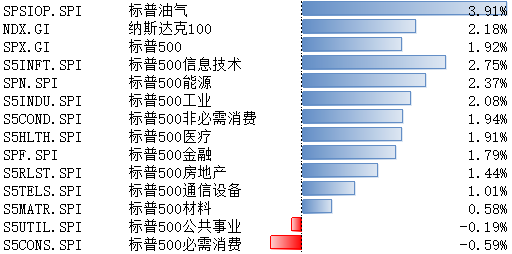
Macroeconomic Data - The US September CPI data did not exceed expectations, with core inflation slightly declining while super core inflation remained resilient. The CPI year-on-year increased by 3%, higher than the previous value of 2.9% but lower than the expected 3.1%. The core CPI year-on-year also increased by 3%, lower than both the previous and expected values of 3.1%. Month-on-month, the CPI rose by 0.3%, lower than the previous value of 0.4% and the expected 0.4%. The core CPI month-on-month increased by 0.2%, lower than the previous value of 0.3% and the expected 0.3% [1]. PMI Data - Global PMI data showed divergence, with the US PMI rebounding above expectations, while the Eurozone manufacturing returned to the growth line, and manufacturing conditions in Germany and Japan remained poor. The US October Markit Composite PMI recorded 54.8, exceeding the expected 53.5 and previous 53.9. The US October Markit Manufacturing PMI recorded 52.2, slightly above the expected and previous values of 52. The US October Markit Services PMI recorded 55.2, higher than the expected 53.5 and previous 54.2. The Eurozone October Composite PMI preliminary value was 52.2, above the expected 51.1 and previous 51.2. The Eurozone October Manufacturing PMI recorded 50, exceeding both expected and previous values of 49.8. The Eurozone October Services PMI recorded 52.6, higher than the expected 51.2 and previous 51.3. Germany's October Composite PMI recorded 53.8, better than the expected 51.5 and previous 52. The October Manufacturing PMI for Germany was 49.6, slightly above the expected and previous values of 49.5. The October Services PMI for Germany was 54.5, exceeding the expected 51 and previous 51.5. Japan's October Composite PMI recorded 50.9, lower than the previous 51.3. Japan's October Manufacturing PMI recorded 48.3, lower than the previous 48.5. Japan's October Services PMI recorded 52.4, lower than the previous 53.3 [2]. Housing Market - US September existing home sales showed a marginal recovery, meeting expectations. The total number of existing home sales annualized increased by 1.5% month-on-month, in line with expectations and higher than the previous value of -0.2%. The total number of existing home sales annualized recorded 4.06 million units, consistent with expectations and higher than the previous value of 4 million units [3]. Major Index Performance - In the week from October 20 to 24, the S&P Oil & Gas Index rose by 3.91%, the Nasdaq 100 Index increased by 2.18%, and the S&P 500 Index gained 1.92%. Among the 11 sectors covered by the S&P 500, 9 sectors rose, with Information Technology leading at 2.75%, while Consumer Staples lagged at -0.59% [4]. Market Outlook - US stocks continued to reach new highs, supported by the easing of tariffs and weaker-than-expected CPI data. The CPI's delayed release indicated a slowdown in inflation, alleviating market anxiety and increasing the probability of a Federal Reserve rate cut in October. This rate cut is expected to aid traditional private demand, such as real estate and manufacturing investments, alongside fiscal stimulus and ongoing technology investment trends, suggesting a gradual recovery in the US credit cycle. As of last week, 29% of S&P 500 constituents had reported Q3 earnings, with 84% exceeding expectations. In addition to earnings growth, close attention is being paid to corporate cash expenditure outlooks [6].

关注二季报亮点和反内卷受益
2025-07-14 00:36
Summary of Conference Call Records Industry or Company Involved - The conference call discusses various sectors including small metals, PCB storage, wind power, insurance, infrastructure, pharmaceuticals, military industry, gaming, communication equipment, and traditional defensive sectors like insurance and electricity. Core Points and Arguments 1. **Industry Recovery Indicators**: The overall industry prosperity index showed a rebound in June after declines in April and May, indicating a potential continuation of fundamental recovery in the second half of the year [1][5][19]. 2. **Focus on Specific Sectors**: Attention is drawn to sectors likely to see improved performance in Q2, including small metals, PCB storage, wind power insurance, and independent-driven cycles like pharmaceuticals and military [1][5]. 3. **Export Challenges**: The export chain faces downward pressure, particularly in appliances, engineering machinery, and consumer electronics [1][5]. 4. **Valuation and Market Strategy**: A focus on sectors with low PE/PB ratios and non-crowded public holdings is recommended, while high valuations may be tolerated in high-prosperity sectors like gaming [1][7]. 5. **Investment Strategy**: A "barbell" strategy is suggested, with offensive investments in wind power, photovoltaics, gaming, communication equipment, and small metals, while defensive investments shift towards insurance, agriculture, and electricity [1][9]. 6. **Wind Power Sector Outlook**: The wind power sector shows significant year-on-year growth in new installations, with expectations for continued growth into 2025, although a potential decline is anticipated in 2026 [1][11]. 7. **Photovoltaic Sector Concerns**: The photovoltaic sector has shown some recovery, but concerns remain regarding overseas exports and supply-side pressures, particularly with high inventory levels [1][12]. 8. **Gaming Industry Growth**: The gaming industry is experiencing an upward product cycle, with a record number of game approvals in June, indicating sustained performance growth [1][13]. 9. **Communication Equipment Performance**: The communication equipment sector is benefiting from increased AI capital expenditure, leading to improved industry conditions [1][14]. 10. **Small Metals and Aerospace**: Small metals like rare earths and tungsten are seeing price increases due to improved demand in military and new energy sectors, while aerospace equipment is also showing signs of recovery [1][15]. 11. **Traditional Defensive Sectors**: The insurance sector is evolving in both liability and investment aspects, while the electricity sector is benefiting from improved electricity consumption growth [1][16][17]. Other Important but Possibly Overlooked Content 1. **Market Sentiment and Global Factors**: Global markets are showing improved risk appetite due to a reduction in tariff concerns, which is positively impacting the A-share market [1][18][22]. 2. **Sector-Specific Trends**: The real estate sector is performing well, driven by urban renewal expectations, while the banking sector has shown volatility [1][19][21]. 3. **Funding and Leverage Trends**: There has been a significant outflow from broad-based ETFs, but leverage financing has rebounded, indicating a mixed funding environment [1][22]. 4. **Future Market Outlook**: Short-term sentiment remains positive, but potential volatility is expected due to upcoming events, with a more optimistic view for Q4 performance [1][24]. 5. **Key Themes to Watch**: The themes of anti-involution and urban renewal are highlighted as significant areas of focus, with potential benefits for related sectors [1][25].