
景气指数

Search documents
海外利率周报20260125:美债延续高位小幅波动格局-20260125
Guolian Minsheng Securities· 2026-01-25 11:32
Report Industry Investment Rating - The report does not mention the industry investment rating. Core Viewpoints - The US Treasury market remained stable this week, continuing the high - level slight fluctuation pattern. The economic data of Q3 2025 was good, and inflation was in line with expectations. The FOMC meeting next week is expected to maintain the current monetary policy [2][15]. - The US economy accelerated expansion in Q3, but there are risks of weakening growth momentum driven by consumption due to high inflation [24]. - The US labor market has strong resilience, and inflation pressure remains sticky [25][26]. - Different asset classes showed different trends this week, with some rising and some falling [11][28][29][30][31][32]. Summary by Directory 1. US Treasury Yield Review This Week 1.1 US Treasuries Continue High - Level Slight Fluctuation Pattern - Yield changes of US Treasuries from January 16th to 23rd, 2026: 1 - month (+3bp, 3.78%), 1 - year (-2bp, 3.53%), 2 - year (+1bp, 3.60%), 5 - year (+2bp, 3.84%), 10 - year (0bp, 4.24%), 30 - year (-1bp, 4.82%). The US Treasury market was stable despite geopolitical disturbances in the equity market. The economic data of Q3 2025 was good, and inflation was in line with expectations. The FOMC meeting next week is expected to maintain the current monetary policy [2][15]. 1.2 US Treasury Auctions This Week - The auction of 20 - year US notes on January 21st was weak. The auction size was $13 billion, the winning yield was 4.846%, the bid - to - cover ratio was 2.86 times (higher than the previous value), and the tail spread was - 1.025 (lower than the previous value). Indirects were allocated 64.7%, Directs 29.1%, and Primary 6.2% [20]. 2. Review of US Macroeconomic Indicators - **Business Index**: In January 2026, the preliminary data of the US S&P Global Manufacturing PMI was 51.9, slightly up from 51.8 in December, indicating a slow - down in the improvement momentum. The preliminary data of the US S&P Global Services PMI was 52.5, the same as the previous month but slightly lower than the market expectation, indicating a slow - down in the growth momentum. The US Q3 GDP (annualized quarterly - on - quarterly) reached 4.4%, higher than the forecast and the previous value, achieving the fastest growth in two years [4][24]. - **Inflation**: In November 2025, the US core PCE price index increased by 2.8% year - on - year and 0.2% month - on - month, with the year - on - year growth slightly up from 2.7% in October, in line with market expectations, showing sticky inflation pressure [5][25][26]. - **Employment**: As of the week ending January 17th, the number of initial jobless claims in the US after seasonal adjustment increased by 1,000 to 200,000, higher than the previous value but better than the market expectation, indicating strong resilience in the labor market [6][25]. 3. Review of Major Asset Classes - **Bonds**: German bond yields rose overall, and Japanese bond yields remained at a high level. The rise in German bond yields was due to the market's reaction to the marginal tightening of ECB policy and the revision of inflation/growth expectations. The significant increase in Japanese bond yields was due to concerns about large - scale bond supply and bond market liquidity [28]. - **Equities**: Asian markets performed strongly, while European and Indian markets were under pressure. The top three gainers were the Korean Composite Index, the Russian MOEX, and the A - share Shanghai Composite Index. The top three losers were the Indian Sensex30, the German DAX, and the French CAC40 [29]. - **Commodities**: Precious metals and crude oil rose due to safe - haven and geopolitical factors, while Bitcoin, live pigs, and coking coal declined. The top three gainers were London silver, London gold, and Brent crude oil. The top three losers were Bitcoin, the live pig index, and the coking coal index [30][31]. - **Foreign Exchange**: The Russian ruble led the gains, and Asian currencies were under pressure overall. The top three gainers were the Russian ruble, the Swiss franc, and the euro. The only two decliners among major global foreign exchanges were the Indian rupee and the Hong Kong dollar [32]. 4. Market Tracking - The report provides various charts to show the changes in bond yields, stock indices, commodity prices, and foreign exchange rates of major global economies this week, as well as the latest economic data panels of the US, Japan, and the eurozone [34][44][49][54].
海外利率周报20260118:Fed收到传票的多重信号-20260118
Guolian Minsheng Securities· 2026-01-18 12:27
1. Report Industry Investment Rating No information about the report industry investment rating is provided in the content. 2. Report's Core View The report analyzes the trends of the US Treasury bond market, US macro - economic indicators, and major asset classes. It shows that the US Treasury bond yields fluctuated this week due to economic data, geopolitical issues, and concerns about the Fed's independence. The US macro - economy shows mixed signals in different sectors, with some indicators improving while others still showing weakness. Major asset classes also have diverse performances across different regions and types [1][3][4]. 3. Summary by Relevant Catalogs 3.1 美债利率本周回顾 - This week (January 9 - January 16, 2026), US Treasury bond yields generally increased, with the curve rising. Except for the ultra - long - term bonds, interest rates rose significantly. In the first half of the week, yields declined due to economic data and moderate CPI. In the second half, housing sales, unemployment data, geopolitical issues, and concerns about the Fed's independence pushed yields up again [1][11]. - After the Fed received a subpoena from Trump, Powell countered, and the Fed's tough attitude eased investors' panic. The market doesn't think Trump will substantially undermine the current Fed. Trump's "pressure" is more likely a warning for the next - term chairman. However, this move may have the opposite effect, and there are also divisions within the Republican Party [2][12]. - The 3 - year US Treasury bill auction was robust, with a bid - to - cover ratio higher than the previous value. The 10 - year and 30 - year auctions were relatively weak [17]. 3.2 美国宏观经济指标点评 - **景气指数**: In 2025, the US new home sales market showed signs of recovery, but there were regional disparities and inventory pressures. The existing home sales in December 2025 reached a three - year high. Retail sales in November 2025 rebounded, mainly driven by holiday consumption. The Philadelphia Fed Manufacturing Index in January 2026 reached a new high since September last year, indicating a marginal improvement in regional manufacturing demand [3][23]. - **就业**: As of the week of January 10, 2026, the number of initial jobless claims decreased, reaching the second - lowest level in two years. However, the labor market shows a weak balance of "low lay - offs and low hiring", and the employment growth remains sluggish [24][25]. - **通胀**: In 2025, the US PPI and CPI showed different trends. The PPI was affected by energy prices and service - end price dynamics. The CPI showed a stage of stability in December 2025, with some categories' price increases slowing down and others accelerating [26]. 3.3 大类资产点评 - **债券**: German bond yields declined, while Japanese bond yields remained high due to market expectations of an interest - rate hike [4][28]. - **权益**: Asian stock markets generally strengthened, while European and American markets were under pressure [4][29]. - **大宗**: Metals and digital assets led the gains, while agricultural products and some industrial raw materials faced pressure [4][30]. - **外汇**: Asian currencies were generally under pressure, while the Russian ruble rose [4][32]. 3.4 市场跟踪 The report provides various charts to track the performance of global major economies' government bond interest rates, stock indices, commodities, and foreign exchange rates, as well as the latest economic data panels of the US, Japan, and the Eurozone [33][44][51][56].
【石油和化工行业景气指数】10月:需求持续释放 指数继续回升
Zhong Guo Hua Gong Bao· 2025-11-12 02:11
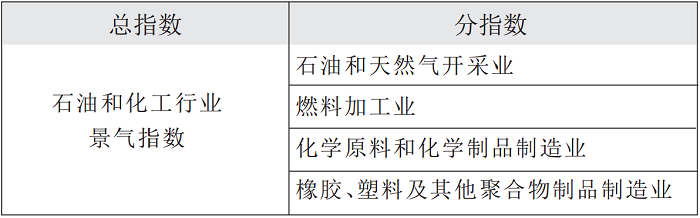
Core Insights - The oil and chemical industry prosperity index reached 99.79 in October 2025, an increase of 0.84 percentage points month-on-month, indicating a continued recovery trend [3][10] - The upstream oil and gas extraction sector is negatively impacted by weak crude oil prices, while the midstream and downstream sectors benefit from declining costs and improving demand [3][10] - The release of the "14th Five-Year Plan" provides strategic direction for the long-term development of the petrochemical industry [3][5] - The easing of China-U.S. trade tensions is expected to stabilize the export environment for petrochemical products [3][6] - The Federal Reserve's decision to cut interest rates by 25 basis points is anticipated to stimulate global demand [3][15] Industry Overview - The oil and gas extraction sector's prosperity index fell to 96.95, down 2.2 percentage points, reflecting a "price drop, profit shrink" situation due to ongoing weak crude oil prices [10][11] - The fuel processing industry saw its index rise to 105.15, up 1.25 percentage points, supported by low raw material costs and seasonal demand [11] - The chemical raw materials and products manufacturing index increased to 101.21, up 1.82 percentage points, indicating improved production heat and inventory turnover [11] - The rubber, plastic, and other polymer products manufacturing index rose to 95.34, up 2.13 percentage points, benefiting from lower raw material costs and policy support [11] Future Outlook - The "14th Five-Year Plan" aims to accelerate the high-quality and green development of the petrochemical industry over the next five years [13] - The recent U.S.-China trade negotiations are expected to enhance the competitiveness of Chinese petrochemical products in the U.S. market [14] - The Federal Reserve's interest rate cut is likely to boost investment and consumption, benefiting exports of petrochemical products [15] - The oil and chemical industry may face a decline in the prosperity index in November due to seasonal demand fluctuations, but the impact is expected to be limited by cost advantages and production inertia [17]

关注二季报亮点和反内卷受益
2025-07-14 00:36
Summary of Conference Call Records Industry or Company Involved - The conference call discusses various sectors including small metals, PCB storage, wind power, insurance, infrastructure, pharmaceuticals, military industry, gaming, communication equipment, and traditional defensive sectors like insurance and electricity. Core Points and Arguments 1. **Industry Recovery Indicators**: The overall industry prosperity index showed a rebound in June after declines in April and May, indicating a potential continuation of fundamental recovery in the second half of the year [1][5][19]. 2. **Focus on Specific Sectors**: Attention is drawn to sectors likely to see improved performance in Q2, including small metals, PCB storage, wind power insurance, and independent-driven cycles like pharmaceuticals and military [1][5]. 3. **Export Challenges**: The export chain faces downward pressure, particularly in appliances, engineering machinery, and consumer electronics [1][5]. 4. **Valuation and Market Strategy**: A focus on sectors with low PE/PB ratios and non-crowded public holdings is recommended, while high valuations may be tolerated in high-prosperity sectors like gaming [1][7]. 5. **Investment Strategy**: A "barbell" strategy is suggested, with offensive investments in wind power, photovoltaics, gaming, communication equipment, and small metals, while defensive investments shift towards insurance, agriculture, and electricity [1][9]. 6. **Wind Power Sector Outlook**: The wind power sector shows significant year-on-year growth in new installations, with expectations for continued growth into 2025, although a potential decline is anticipated in 2026 [1][11]. 7. **Photovoltaic Sector Concerns**: The photovoltaic sector has shown some recovery, but concerns remain regarding overseas exports and supply-side pressures, particularly with high inventory levels [1][12]. 8. **Gaming Industry Growth**: The gaming industry is experiencing an upward product cycle, with a record number of game approvals in June, indicating sustained performance growth [1][13]. 9. **Communication Equipment Performance**: The communication equipment sector is benefiting from increased AI capital expenditure, leading to improved industry conditions [1][14]. 10. **Small Metals and Aerospace**: Small metals like rare earths and tungsten are seeing price increases due to improved demand in military and new energy sectors, while aerospace equipment is also showing signs of recovery [1][15]. 11. **Traditional Defensive Sectors**: The insurance sector is evolving in both liability and investment aspects, while the electricity sector is benefiting from improved electricity consumption growth [1][16][17]. Other Important but Possibly Overlooked Content 1. **Market Sentiment and Global Factors**: Global markets are showing improved risk appetite due to a reduction in tariff concerns, which is positively impacting the A-share market [1][18][22]. 2. **Sector-Specific Trends**: The real estate sector is performing well, driven by urban renewal expectations, while the banking sector has shown volatility [1][19][21]. 3. **Funding and Leverage Trends**: There has been a significant outflow from broad-based ETFs, but leverage financing has rebounded, indicating a mixed funding environment [1][22]. 4. **Future Market Outlook**: Short-term sentiment remains positive, but potential volatility is expected due to upcoming events, with a more optimistic view for Q4 performance [1][24]. 5. **Key Themes to Watch**: The themes of anti-involution and urban renewal are highlighted as significant areas of focus, with potential benefits for related sectors [1][25].