航天探测

Search documents
中国航天科技集团:“羲和二号”项目启动,目标日地L5点
Bei Jing Shang Bao· 2026-02-03 13:01
北京商报讯(记者 陶凤 王天逸)2月3日,中国航天科技集团发文称,日地L5太阳探测工程"羲和二 号"项目启动会暨科学探讨会近期召开,会议宣布,我国计划在2028年至2029年间,择机向日地L5点发 射"羲和二号"探测器。 ...


中国航天,2026年日程排满
Zhong Guo Ji Jin Bao· 2026-01-01 14:17
Core Insights - In 2026, China's space program is expected to achieve significant breakthroughs, including crewed missions to the Chinese space station and the launch of new spacecraft [1][3]. Group 1: Crewed Space Missions - The Shenzhou 23 and Shenzhou 24 missions will send astronaut crews from the Jiuquan Satellite Launch Center to the Chinese space station [1]. - A crew member from the Shenzhou 23 mission will conduct a long-term stay experiment lasting over one year [3]. Group 2: New Spacecraft Developments - The new generation crewed spacecraft "Dream Boat" will make its maiden flight, designed for near-Earth space station operations and crewed lunar exploration [3]. Group 3: Lunar Exploration - The Chang'e 7 lunar probe will be launched to explore the Moon's south pole, focusing on surface environment surveys and water ice detection [5]. - If successful, China could become the first country to discover water on the Moon [5]. Group 4: Deep Space Exploration - The Tianwen-2 probe is set to reach asteroid 2016 HO3 for exploration and sample collection, with a return to Earth expected by the end of 2027 [6]. - Following this, the probe will conduct scientific exploration of main belt comet 311P [6]. Group 5: Commercial Space Development - 2026 will mark a year of accelerated development for China's commercial space sector, with the establishment of the Commercial Space Administration [8]. - New rocket developments, including Lijian-2, Tianlong-3, and Hyperbola-3, are highly anticipated [8].


中国航天2026年“大事记”值得期待 中国人的深空探测之旅正越走越远
Yang Shi Wang· 2026-01-01 02:36
Group 1 - In 2026, China's manned space program will see the launch of Shenzhou 23 and Shenzhou 24 missions, with astronauts departing from the Jiuquan Satellite Launch Center to the Chinese space station [1][3] - The new generation manned spacecraft "Dream Boat" will make its maiden flight in 2026, designed to replace Shenzhou for transporting astronauts to and from the space station and to facilitate manned lunar missions [3] - The Chang'e 7 lunar probe will be launched in 2026, targeting the lunar south pole for key scientific tasks, including the search for water ice, potentially making China the first country to discover water ice on the moon [6] Group 2 - The Tianwen-2 probe is set to reach asteroid 2016 HO3 for exploration and sample collection, with a planned return to Earth by the end of 2027, followed by scientific exploration of comet 311P [8] - 2026 will mark a significant year for China's commercial space sector, with the establishment of the Commercial Space Administration leading to increased launch activities and the debut of new rockets like Lijian-2, Tianlong-3, and Shuangquxian-3 [10] - The next five years are expected to present unprecedented development opportunities for China's space industry, contributing significantly to the peaceful use of outer space [10]

参考消息:NASA称与一火星轨道探测器失联
Xin Lang Cai Jing· 2025-12-20 11:52
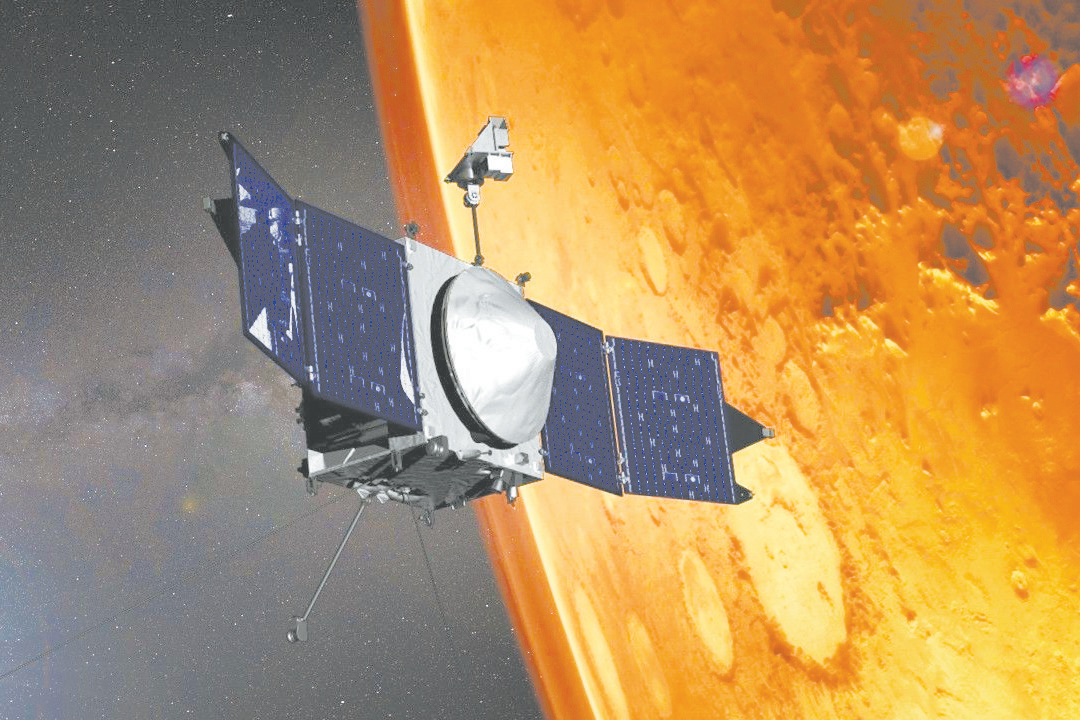
Core Viewpoint - NASA has lost contact with the Mars orbiter MAVEN, which has been operational for nearly 10 years and has provided significant data on Mars' atmosphere [1] Group 1: Communication Issues - NASA has not received any routine data from MAVEN for approximately two weeks [1] - A NASA spokesperson indicated efforts are underway to re-establish communication with the orbiter [1] Group 2: MAVEN's Mission - MAVEN was launched at the end of 2013 and has been orbiting Mars for about a decade [1] - The orbiter has been crucial in providing important research data, particularly regarding the Martian atmosphere [1] Group 3: Technical Anomalies - Earlier this month, a brief tracking data indicated that MAVEN might be rotating in an unexpected manner [1]
NASA火星探测器“失联”,暴露超期服役隐患
Huan Qiu Shi Bao· 2025-12-14 22:36
Core Viewpoint - NASA's MAVEN spacecraft has lost contact with Earth after over 10 years in Mars orbit, raising concerns about the impact on Mars atmospheric research and the overall Mars exploration program [1][3][4] Group 1: MAVEN's Mission and Importance - MAVEN was launched in November 2013 and entered Mars orbit in September 2014, with the mission focused on studying Mars' upper atmosphere, ionosphere, and interactions with solar wind [3] - The spacecraft plays a crucial role as a communication relay for other Mars rovers, including the Perseverance and Curiosity rovers [4] Group 2: Current Status and Investigation - MAVEN lost contact with Earth on December 6, with telemetry data indicating all systems were functioning normally until it passed behind Mars [3] - NASA is currently investigating the loss of contact and working on potential solutions [3] Group 3: Implications of MAVEN's Loss - The loss of MAVEN could significantly impact ongoing research into Mars' atmosphere and climate evolution, as well as the communication capabilities for other Mars missions [4][5] - MAVEN's previous issues, including a three-month safe mode in 2022 due to an inertial measurement unit failure, highlight the systemic risks within NASA's Mars exploration program [4] Group 4: Future Considerations - NASA has been exploring next-generation orbital vehicles for Mars communication, but many plans have not materialized, with a proposed Mars Communication Orbiter project being canceled in the past [4] - The urgency for a commercial relay architecture is emphasized due to the aging fleet of Mars orbiters, which poses risks for future missions [5]
香港计划2028年前后发射“月闪”探测器,观察月球上的流星
Jing Ji Guan Cha Wang· 2025-11-24 03:32
Core Viewpoint - Hong Kong will continue to deeply participate in major national space projects such as Chang'e 7, Chang'e 8, and Tianwen-3 during the 14th Five-Year Plan period [1] Group 1 - Hong Kong will launch the "Yue Shan" probe to observe meteors on the Moon around 2028 [1] - The involvement in these space missions highlights Hong Kong's commitment to advancing its role in national aerospace initiatives [1]
我国深空探测不断探索新高度 天问一号成功观测到星际天体
Yang Shi Wang· 2025-11-06 06:43
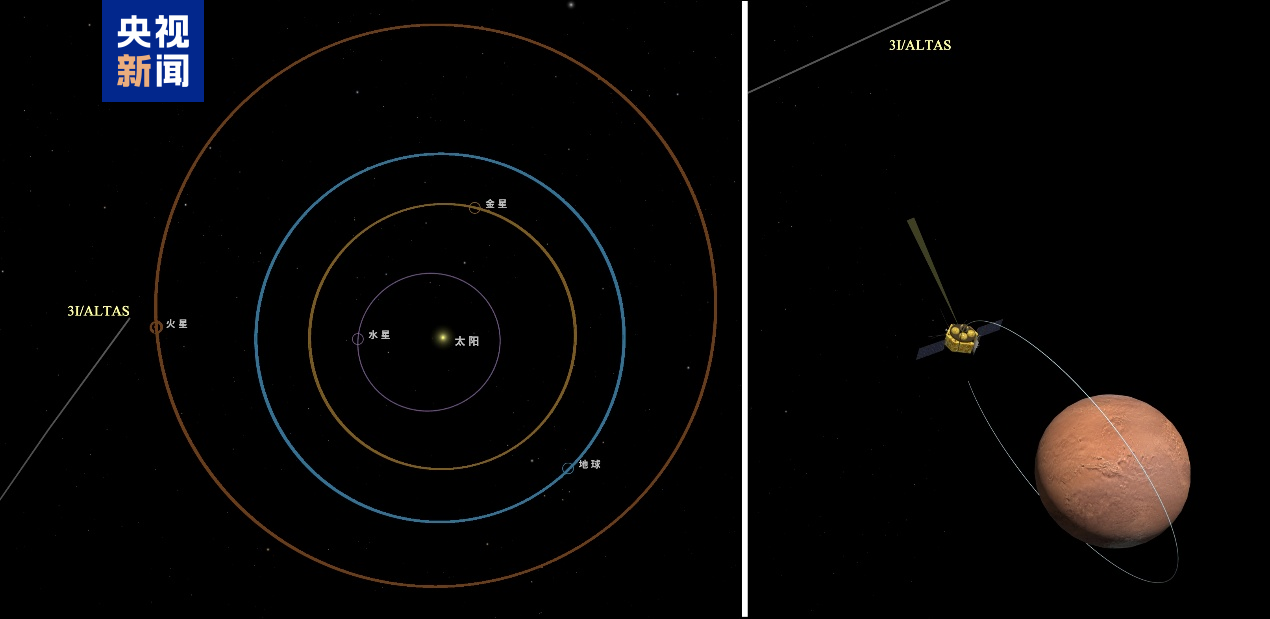
Core Insights - The Tianwen-1 mission successfully observed the interstellar comet Atlas, marking the first time a Chinese spacecraft has observed an interstellar body, which is estimated to be between 3 billion and 11 billion years old [1][3]. Group 1: Mission Details - Tianwen-1 is China's first Mars probe, originally designed to capture images of the bright Martian surface, but it has now successfully attempted to photograph a much fainter target, Atlas, which is 10,000 to 100,000 times dimmer than Mars [3]. - The probe was approximately 30 million kilometers away from Atlas during the imaging process, making it one of the closest spacecraft to observe this interstellar object [3][7]. Group 2: Scientific Significance - Atlas follows a hyperbolic trajectory, indicating it originated from outside the solar system, unlike celestial bodies within the solar system that follow elliptical orbits [5]. - Continuous imaging of Atlas allowed the research team to gather information about its flight path through the solar system and its position relative to Mars [7][9]. - The research team deduced that Atlas likely originated near an ancient star in the center of the Milky Way galaxy, with its discovery initially made by a ground-based telescope in Chile [9][11]. Group 3: Composition and Future Research - The imaging analysis revealed that Atlas has a significant tail, potentially containing water ice and carbon dioxide, which requires further confirmation [13]. - The unique nature of Atlas means that every particle of dust and ice it carries is different from those found in the solar system, providing an opportunity to compare its composition with solar system comets to gain insights into the origins of the solar system [13]. Group 4: Future Missions - The successful observation of Atlas by Tianwen-1 lays a technical foundation for the upcoming Tianwen-2 mission, which will also focus on detecting small, faint celestial bodies [15]. - The experience gained from this mission is expected to contribute to future deep space exploration efforts [15].

视频丨我国航天器首次观测到星际天体!天问一号传回新照片
Yang Shi Xin Wen Ke Hu Duan· 2025-11-06 06:18
Core Insights - The Tianwen-1 orbiter successfully observed the interstellar object Atlas (3I/ATLAS), marking the first time a Chinese spacecraft has observed such a celestial body [2][5] - Atlas was discovered on July 1, 2025, by a survey telescope in Chile and is the third known interstellar object to visit the solar system, potentially older than the solar system itself [2] - The observation was conducted from approximately 30 million kilometers away, making Tianwen-1 one of the closest spacecraft to the target [2] Group 1 - The successful observation of Atlas represents an important expansion task for Tianwen-1, serving as a technical trial for asteroid exploration in the upcoming Tianwen-2 mission [5] - The Tianwen-1 team began preparations for the Atlas observation in early September, facing challenges due to the object's distance, high speed (approximately 58 km/s), and small size (nucleus diameter of about 5.6 km) [5] - The brightness of Atlas was significantly dimmer than Mars, making it 10,000 to 100,000 times darker than the Martian surface, which posed high demands on the orbiter's attitude control and imaging strategy [5] Group 2 - The optical payload on Tianwen-1 was originally designed for capturing bright Martian surfaces, marking the first attempt to photograph such a distant and faint target [5] - The Tianwen-1 team conducted extensive simulations and feasibility assessments to adapt the high-resolution camera for this unique observation task [5] - Since entering Martian orbit in February 2021, Tianwen-1 has been operating stably for 4 years and 8 months [5]
我国航天器首次观测到星际天体:天问一号传回阿特拉斯(3I/ATLAS)新照片!该天体可能比太阳系年龄还老
Mei Ri Jing Ji Xin Wen· 2025-11-06 00:47
Core Insights - The Tianwen-1 orbiter successfully observed the interstellar object Atlas (3I/ATLAS), marking the first time a Chinese spacecraft has observed an interstellar body [1] - Atlas was discovered on July 1, 2025, by a survey telescope in Chile and is the third known interstellar object to visit the solar system, potentially older than the solar system itself [1] - The observation was conducted from approximately 30 million kilometers away, making Tianwen-1 one of the closest detectors to the object [1] Group 1 - The observation of Atlas is a significant extension of the Tianwen-1 mission, providing technical trials for future asteroid exploration with Tianwen-2 [5] - The Tianwen-1 team began preparations for the observation in early September, facing challenges due to the object's distance, speed, and small size [5][6] - The high-resolution camera on Tianwen-1 was originally designed for capturing bright Martian surfaces, making this the first attempt to photograph such a distant and faint target [5][6] Group 2 - The observation required extensive simulations and calculations to assess feasibility, leading to the successful design of a key imaging strategy [6] - Tianwen-1 has been operational since February 2021, maintaining a stable status for 4 years and 8 months [6]
天问一号成功观测到星际天体阿特拉斯
财联社· 2025-11-06 00:19
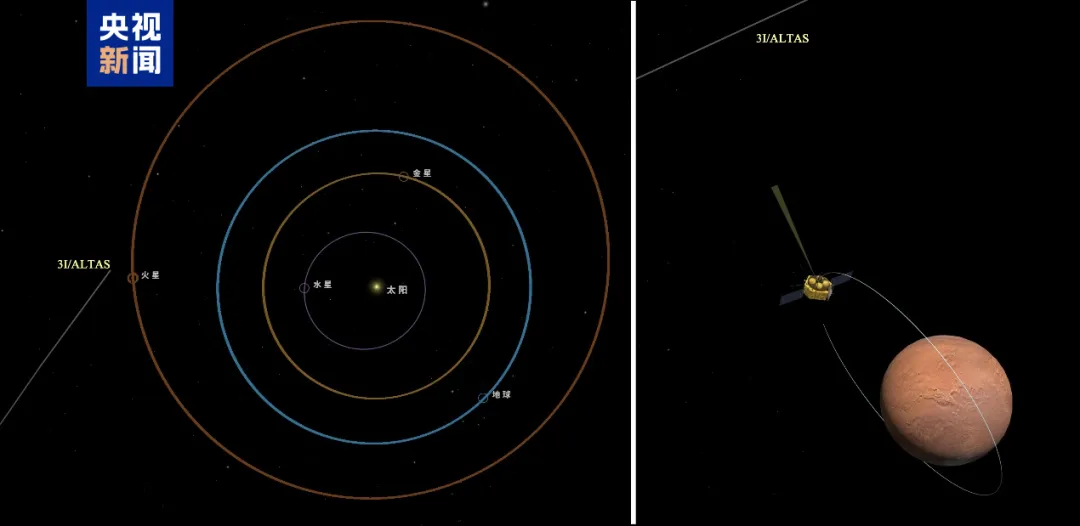
Core Viewpoint - The successful observation of the interstellar object ATLAS by the Tianwen-1 orbiter represents a significant expansion of its mission capabilities, providing valuable data for future asteroid exploration by Tianwen-2 [2][8]. Group 1: Observation Details - The Tianwen-1 orbiter utilized a high-resolution camera to observe the interstellar object ATLAS from approximately 30 million kilometers away, marking one of the closest observations of this celestial body [2][8]. - The high-resolution camera captured images that clearly displayed the comet-like features of ATLAS, which has a diameter of several thousand kilometers [4]. - A series of images taken over 30 seconds were compiled into an animation to illustrate the motion trajectory of ATLAS, aiding in further research [4]. Group 2: Scientific Significance - ATLAS, discovered on July 1, 2025, by a telescope in Chile, is the third known interstellar object to visit the solar system, traveling on a hyperbolic trajectory [9]. - The object is estimated to be between 3 billion and 11 billion years old, potentially older than the solar system itself, making it a rare sample for studying the composition and evolution of exoplanets and early stellar history [9]. - The Tianwen-1 team began preparations for observing ATLAS in early September, facing challenges due to the object's great distance, high speed (approximately 58 km/s), and small size (nucleus diameter of about 5.6 km) [9]. Group 3: Technical Challenges and Solutions - The high-resolution camera on Tianwen-1 was originally designed for capturing bright Martian surfaces, making this the first attempt to photograph such a distant and faint target, which is 10,000 to 100,000 times dimmer than Martian surfaces [13]. - The Tianwen-1 team conducted extensive simulations and feasibility assessments to adapt the camera's capabilities for this challenging observation, ultimately achieving successful imaging of ATLAS [13]. - The mission has been operational since February 2021, maintaining a stable status for over 4 years and 8 months [14].