手术机器人

Search documents
【投融资动态】敏捷医疗B轮融资,融资额数亿人民币,投资方为明熙资本、元禾控股等
Sou Hu Cai Jing· 2025-11-04 11:38
Group 1 - Agile Medical Technology (Suzhou) Co., Ltd. has completed a Series B financing round, raising hundreds of millions of RMB, with participation from several investment institutions including Mingxi Capital, Yuanhe Holdings, Licheng Investment, Nantong Technology Venture Capital, Qianji Capital, and Yuanhe Origin [1][3] - The company aims to become a leading enterprise in the global intelligent surgical field, focusing on the innovation and industrialization of surgical robots, particularly for precise diagnosis and treatment of benign and malignant diseases across multiple human systems [3] - Agile Medical is developing a product line centered around laparoscopic surgical robots and natural orifice surgical robots, with steady progress in product research and development, and a growing team dedicated to providing innovative and accessible intelligent surgical solutions for clinical applications [3]

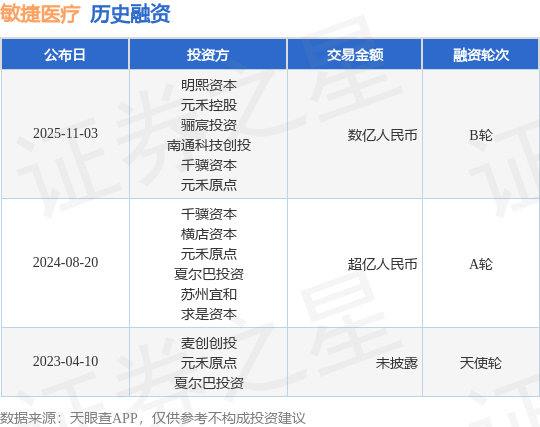
明熙资本领投,敏捷医疗完成数亿元B轮融资
Sou Hu Cai Jing· 2025-11-04 02:56
Core Insights - Agile Medical Technology (Suzhou) Co., Ltd. has recently completed a multi-hundred million RMB Series B financing round, led by Mingxi Capital, with participation from Yuanhe Holdings, Licheng Investment, and Nantong Investment Management, along with continued investment from existing shareholders Qianji Capital and Yuanhe Origin [1][2] Group 1: Financing and Investment - The funds from this financing round will be primarily used for three key areas: deepening global commercialization efforts, accelerating the research and development iteration of surgical robot product lines, and further upgrading cutting-edge technology platforms [1] Group 2: Company Background and Product Development - Founded in 2020, Agile focuses on the surgical robot industry and has completed multiple rounds of financing prior to this [2] - The core product, AGIBOT® laparoscopic surgical robot, is expected to receive approval from the National Medical Products Administration (NMPA) by March 2025 and has already been applied in over a hundred clinical cases at leading institutions such as Nanjing University Medical School Affiliated Gulou Hospital and Zhengzhou University First Affiliated Hospital [2] - Agile has established a comprehensive capability loop from research and development to market, with a production base and user training center in Suzhou, capable of producing 100 systems and 20,000 surgical instruments annually, supporting professional user training for hundreds of individuals each year [2] - The company continues to strengthen its capabilities in technology research, pipeline development, industrial operations, and commercial expansion, forming a complete system covering "R&D - certification - mass production - commercialization" [2]
敏捷医疗完成数亿元B轮融资,明熙资本领投
Sou Hu Cai Jing· 2025-11-04 01:27
Core Insights - Agile Medical Technology (Suzhou) Co., Ltd. has completed a multi-hundred million RMB Series B financing round, led by Mingxi Capital, with participation from Yuanhe Holdings, Licheng Investment, and Nantong Investment Management, along with continued investment from existing shareholders [1][2] - The funds will be primarily used for three key areas: deepening global commercialization, accelerating the R&D iteration of surgical robot product lines, and further upgrading cutting-edge technology platforms [1] Company Developments - The core product, AGIBOT® laparoscopic surgical robot, is expected to receive approval from the National Medical Products Administration (NMPA) by March 2025, and has already completed over 100 clinical applications in top-tier hospitals [1] - Agile Medical has established a comprehensive capability loop from R&D to market, with a production base in Suzhou capable of manufacturing 100 systems and 20,000 surgical instruments annually, along with professional user training for hundreds of individuals each year [1] Innovation and Market Position - As an innovator in China's surgical robot industry, Agile Medical focuses on user needs and continues to build a technological foundation based on "AGI+BOT" through independent innovation [2] - The recent financing round reaffirms the capital market's confidence in the company's development path of "innovative technology + inclusive healthcare" [2]
从“工具辅助”到“流程重构”:手术机器人重塑泌外诊疗
第一财经· 2025-10-27 15:22
Core Viewpoint - Surgical robots are reshaping the landscape of precise minimally invasive diagnosis and treatment in urology, becoming an indispensable tool in the field [3][5]. Group 1: Current Trends in Urology - The incidence of urological diseases is rising due to an aging population, with prostate cancer rates in Shanghai nearing those of developed countries [3][4]. - Key urological diseases such as prostate cancer, kidney cancer, and bladder cancer are increasingly prevalent, influenced by dietary and lifestyle factors [3][4]. Group 2: Role of Surgical Robots - Surgical robots, including both imported and domestic models, play a crucial role in urological tumor diagnosis and treatment, meeting the high precision and delicacy required in surgeries [3][5]. - In urology, robotic surgeries account for 50% of procedures at Xinhua Hospital, indicating a strong demand for robotic assistance in this specialty [5][7]. Group 3: Advantages of Robotic Surgery - Robotic systems offer enhanced flexibility and precision, allowing for 360-degree rotation and improved visualization, which is critical for delicate procedures [5][7]. - The use of robotic assistance significantly reduces surgical trauma, minimizes blood loss, shortens hospital stays, and accelerates patient recovery [7][8]. Group 4: Challenges and Opportunities - Despite the growing adoption of robotic surgery in China, there remains a significant gap compared to international standards, particularly in the availability of robotic systems in smaller hospitals [9][10]. - The rapid development of domestic surgical robots is narrowing the gap with imported models, with improvements in operational smoothness and flexibility noted [10][11]. Group 5: Future Prospects - The increasing approval rate of domestic surgical robots, which reached 81.7%, indicates a shift towards domestic production and global competitiveness [11]. - Continuous technological advancements and policy support are expected to enhance the capabilities of domestic surgical robots, making them more accessible and effective for patients [11].
金价继续大跌,高盛:技术性调整;美国芯片巨头盘前暴跌;苹果被曝大幅削减iPhone Air产量;特斯拉最新财报将公布【美股盘前】
Mei Ri Jing Ji Xin Wen· 2025-10-22 12:30
Market Overview - Dow futures decreased by 0.03%, S&P 500 futures increased by 0.03%, and Nasdaq futures fell by 0.12% [1] Chinese Stocks - Chinese concept stocks experienced a general decline, with Alibaba down 0.28%, Pinduoduo down 0.73%, NetEase down 2.5%, JD.com down 0.40%, and Baidu down 0.79% [2] Company Highlights - Beyond Meat's stock surged over 100% in pre-market trading after announcing plans to expand product supply in over 2,000 Walmart stores, following a nearly 600% increase over the previous three trading days [3] - Netflix reported a Q3 operating margin of 28.2%, below the expected 31.5%, leading to a pre-market drop of 6.33% due to a tax dispute in Brazil costing approximately $619 million [3] - Intuitive Surgical's stock rose by 16.05% in pre-market trading as Q3 profits and revenues exceeded market expectations, driven by strong demand for surgical robots [3] - Texas Instruments' Q4 guidance fell short of expectations, predicting revenue between $4.22 billion and $4.58 billion and EPS between $1.13 and $1.39, resulting in a pre-market decline of 7.86% [3] - Apple is reportedly significantly cutting production orders for the new iPhone Air model due to lower-than-expected consumer interest, leading to a pre-market drop of 0.72% [4] - Tesla's Q3 earnings report is set to be released after market close on Wednesday, with revenue expectations of $26.27 billion, a 4% increase from the previous year, and an adjusted EPS forecast of $0.53 [4] Economic Indicators - The preliminary values for the one-year inflation rate and the University of Michigan consumer confidence index for October are scheduled for release [5]




【美股盘前】人造肉第一股涨超100%,此前三个交易日涨近600%;高盛:黄金本次下跌属于技术性调整;苹果被曝大幅削减iPhone Air产量;特斯拉Q3...
Mei Ri Jing Ji Xin Wen· 2025-10-22 10:55
Market Overview - Dow futures decreased by 0.03%, S&P 500 futures increased by 0.03%, and Nasdaq futures fell by 0.12% [1] Chinese Stocks - Chinese stocks experienced a decline, with Alibaba down 0.28%, Pinduoduo down 0.73%, NetEase down 2.5%, JD.com down 0.40%, and Baidu down 0.79% [1] Beyond Meat - Beyond Meat's stock surged over 100% in pre-market trading after announcing plans to expand product supply in over 2,000 Walmart stores, following a nearly 600% increase in the previous three trading days [1] Gold Market - Goldman Sachs indicated that the recent drop in gold prices is a technical adjustment, with the long-term macro backdrop for gold remaining unchanged; gold prices fell by 1.48% to $4,064 per ounce [2] Netflix - Netflix reported a Q3 operating margin of 28.2%, below the expected 31.5%, attributing the shortfall to a tax dispute in Brazil, resulting in a pre-market drop of 6.33% [2] Intuitive Surgical - Intuitive Surgical's stock rose by 16% in pre-market trading due to strong demand for surgical robots used in minimally invasive surgeries, with Q3 profits and revenues exceeding market expectations [2] Texas Instruments - Texas Instruments projected Q4 revenue between $4.22 billion and $4.58 billion, with earnings per share expected between $1.13 and $1.39, both below market expectations, leading to a pre-market decline of 7.86% [3] Apple - Apple is reportedly significantly reducing production orders for the new iPhone Air model due to lower-than-expected consumer interest, shifting focus to other iPhone 17 series products, resulting in a pre-market drop of 0.72% [3] Tesla - Tesla's Q3 earnings report is scheduled for release after market close on Wednesday, with expected revenue of $26.27 billion, a 4% increase from the previous year, and an adjusted EPS forecast of $0.53 [3] Economic Indicators - The U.S. will release the preliminary October one-year inflation rate and the preliminary Michigan consumer sentiment index on October 22 [3]
小摩:上调微创机器人-W装机量预测 目标价升至42港元
Zhi Tong Cai Jing· 2025-10-14 09:08
Core Viewpoint - Morgan Stanley has raised the target price for MicroPort Scientific Corporation (02252) from HKD 30.9 to HKD 42, maintaining an "Overweight" rating and identifying the stock as a top choice in China's medical technology sector, indicating that the recent price pullback presents a good buying opportunity [1] Group 1: Company Performance - MicroPort's global order momentum remains strong, with over 170 surgical robot orders accumulated as of last Wednesday, up from 150 orders at the end of August [1] - The installation of the Toumai (four-arm laparoscopic surgical robot) is accelerating globally, with applications in nearly 40 countries and major hospital systems, driving strong adoption [1] Group 2: Financial Projections - Based on approximately 100 cumulative orders for Toumai, the company has revised its installation forecast for this year from 84 units to 105 units, primarily due to overseas growth and the assumption that orders can be converted to sales within less than a quarter [1] - An improved installation base and product mix, along with an expected gross margin improvement of 1 to 1.5 percentage points, are anticipated [1]

(投资中国)直观医疗全球董事会主席盖瑞·古萨特:与中国共创医疗科技新机遇
Zhong Guo Xin Wen Wang· 2025-10-12 07:07
Core Insights - The global leader in surgical robotics, Intuitive Surgical, emphasizes China's vast market potential and its ability to drive breakthroughs in medical technology [1][3]. Company Developments - Intuitive Surgical established a joint venture with Fosun Pharma in 2017, marking a significant step in aligning technology with local resources [3]. - The new headquarters and industrial base in Pudong, Shanghai, with an investment of approximately 700 million RMB, is set to become the largest integrated center for R&D, production, training, and service in the Asia-Pacific region [3][4]. - The fourth-generation Da Vinci surgical robot received regulatory approval in June 2023, achieving mass production within the same year [3][4]. Industry Trends - The Shanghai government has launched an action plan to promote the development of high-end medical device industries, with a focus on laparoscopic surgical robots, aligning with Intuitive Surgical's product development [5]. - The surgical robotics industry is at a "technological convergence inflection point," with expectations for a "doubling breakthrough" in medical technology over the next 30 years, driven by advancements in precision surgical tools, AI, and cloud computing [5][6]. Strategic Recommendations - Intuitive Surgical suggests policy trials for digital surgical technologies to enhance the integration of data, AI, and surgical robots [6]. - The company advocates for Shanghai to become an international center of excellence for surgical robotics, fostering collaboration between domestic and foreign enterprises [6]. - The focus is on achieving human-machine collaborative precision medicine, leveraging AI to reduce healthcare burdens and improve treatment outcomes [6][7].


全球商业化进入快车道!思哲睿康多机器人®SR2000迎来多国订单交付潮!
机器人圈· 2025-09-28 09:31
Core Viewpoint - The article highlights the significant global expansion of Sizeray Intelligent Medical, particularly the successful commercialization of the Kando Robot® SR2000, marking a transformative shift in minimally invasive surgery worldwide [1][9]. Group 1: Technological Advancements - The Kando Robot® SR2000 has gained international recognition due to its innovative technology and proven clinical capabilities, which are foundational for its global market expansion [2]. - It features a multi-modal high-performance imaging navigation platform that integrates real-time 4K fluorescence navigation, ultrasound positioning, and pre-operative CT/MRI data, providing robust decision support for surgeons [3]. - The design of the open multi-screen control console has won prestigious awards, including the Red Dot Award and IDEA Award, underscoring its excellence in remote surgical applications [6]. Group 2: Clinical Applications and Approvals - The Kando Robot® SR2000 has received regulatory approvals from multiple global health authorities, enabling its use in various complex minimally invasive surgeries across different specialties, including urology, general surgery, gynecology, and thoracic surgery [8]. Group 3: Global Market Presence - Sizeray Intelligent Medical has successfully expanded its market presence to nearly 40 countries across Asia, Europe, Latin America, and Africa, demonstrating the effectiveness of its overseas exclusive agency model [9]. - The ongoing delivery of orders from various countries reflects the solid implementation of its globalization strategy and the international market's recognition of the quality and value of this "Chinese-made" high-end surgical robot [9]. Group 4: Future Outlook - The company aims to continue its mission of making safer and more precise robotic surgeries accessible to healthcare institutions worldwide, transitioning from a technological pioneer to a widespread market player [10].
中国公司全球化周报|1688平台将推出全球首个跨境电商AI智能体/霸王茶姬全球最大超级茶仓落地香港
3 6 Ke· 2025-09-27 14:02
Group 1: Company Developments - Alibaba's 1688 platform is set to launch the world's first cross-border e-commerce AI product named "Ao Xia," which is currently in internal testing and expected to go live in November 2025. This AI will significantly reduce the product selection cycle from days to minutes by using visual recognition and semantic analysis [3]. - Taobao is accelerating its globalization efforts for this year's Double 11 shopping festival, investing 1 billion yuan in marketing subsidies to help 100,000 merchants double their overseas sales. The platform will operate in 20 countries and regions simultaneously, offering a "0 return and refund, 0 operational cost" model for merchants [3]. - Bawang Tea Ji has opened its largest "super tea warehouse" in Hong Kong, marking its seventh store in the region. The brand plans to open over ten new stores in Hong Kong in the coming months, aiming for rapid market expansion [4]. - Cha Baidao has opened its first store in Paris, achieving nearly 500,000 yuan in sales during its first week. The brand is also planning additional locations in the city [4]. - Pop Mart has launched its official e-commerce platform in Mexico, focusing on the Latin American market, with a significant increase in revenue from the Americas, which surged by 1142.3% year-on-year [4]. - Yadi Group is set to enter the Japanese market in November, offering electric two-wheelers at competitive prices, aiming to meet new emissions standards [7]. Group 2: Investment and Financing - Xingmai Innovation has completed a 1 billion yuan A+ round of financing, which will be used for technology development and expanding overseas markets. The company has entered 38 countries and has over 2,000 offline stores [8]. - Haiguo Tujizhi Research Institute has secured nearly 10 million yuan in angel round financing for its solar energy storage vehicle project, which has already received initial orders in Bangladesh [8]. - Yousi Animation has raised several million yuan in angel round financing to enhance its AI technology and expand into overseas markets, particularly targeting the Japanese market for its animated content [8]. - Antai Weijing has completed a several hundred million yuan B round of financing to accelerate the development of its high-precision surgical robot platform [8]. - Laisai Intelligent has raised several million yuan in Pre-B round financing to expand its 3D printing solutions for dental applications in international markets [8]. Group 3: Market Trends and Policies - Poland has emerged as one of the fastest-growing e-commerce markets in the EU, with a projected market size of 35.2 billion euros in 2024, and cross-border e-commerce transactions accounting for nearly 20% of total online sales [9]. - Vietnam is proposing a new e-commerce law focusing on regulating live-stream sales and consumer protection, with the market expected to reach 25 billion USD in 2024 [10].