
辅助生殖

Search documents
A股午评:沪指跌0.68% AI硬件板块走强 周期性板块全线下跌
Ge Long Hui· 2025-07-31 03:40
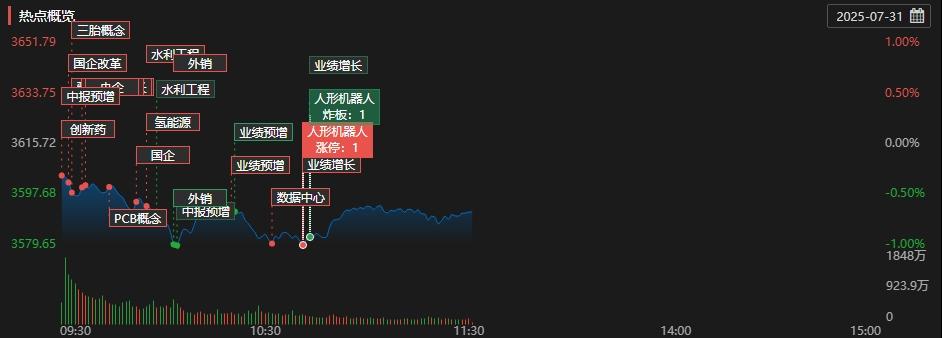
Market Overview - The three major A-share indices showed mixed results, with the Shanghai Composite Index down 0.68% at 3591.26 points, the Shenzhen Component Index down 0.45%, and the ChiNext Index up 0.43% [1] - The total trading volume in the Shanghai and Shenzhen markets reached 115.78 billion yuan, an increase of 55.6 billion yuan compared to the previous day, with over 3400 stocks declining [1] Sector Performance - The assisted reproductive technology sector saw significant gains, with companies like Gongtong Pharmaceutical and Lide Man hitting the daily limit up [1] - The liquid cooling server concept stocks performed strongly, with Suiquan New Materials hitting the daily limit up, along with Yingweike and Chunz中科技 [1] - CPO concept stocks surged, with Huilv Ecology and Cambridge Technology hitting the daily limit up, while Zhongji Xuchuang and Xinyi Sheng reached historical highs [1] - The innovative drug sector became active again, with Aoxiang Pharmaceutical and Kangyuan Pharmaceutical hitting the daily limit up [1] - The AI intelligent agent concept saw collective strength, with Yidian Tianxia, Yongyou Network, and Nanxing Shares hitting the daily limit up, and Baidu testing the opening of intelligent agent application entry on its search homepage [1] Declining Sectors - Cyclical sectors such as steel, coal, oil and gas, and non-ferrous metals experienced declines, with Anyang Steel, Baosteel, and Antai Group dropping over 5% [1]
A股午评:三大股指走势分化创业板指收涨0.43% AI硬件板块领涨大盘
news flash· 2025-07-31 03:38
金十数据7月31日讯,A股三大股指早盘分化,沪指、深证成指探底跌逾1%,创业板指水上震荡,一度 涨逾1%。截至中午收盘,沪指跌0.68%,深证成指跌0.45%,创业板指涨0.43%;沪深两市半日成交额 超1.1万亿,超3200只个股下挫。盘面上,辅助生殖、AI硬件板块走强,创新药板块延续强势;小金 属、煤炭、钢铁等周期股表现疲软领跌大盘,影视院线板块结束连涨开启回调。 A股午评:三大股指走势分化创业板指收涨0.43% AI硬件板块领涨大盘 ...

A股午评:沪指低位震荡跌0.68%,AI软硬件全线走强
news flash· 2025-07-31 03:35
A股三大指数涨跌不一,截至午盘收盘,沪指跌0.68%,深成指跌0.45%,创业板指涨0.43%,北证50指数涨0.12%,沪深京三市成交额 11578亿元,较上日放量556亿元。两市超3400只个股下跌。 【3连板】 中化装备(600579)、安正时尚(603839)。 【2连板】 德展健康(000813)、汇绿生态(001267)、胜通能源(001331)、奇正藏药(002287)、英维克、珠江股份 (600684)、南新制药。 最强风口榜: NO.1 【华为概念】 板块内11家涨停,2只连板股,最高连板数为4天2板,涨停股代表:英维克、南兴股份(002757)。 NO.2 【机器人概念】 板块内9家涨停,2只连板股,最高连板数为9天8板,涨停股代表:南方路机、中化装备。 NO.3 【创新药】 板块内8家涨停,5只连板股,最高连板数为3天2板,涨停股代表:德展健康、奇正藏药。 板块题材上,智谱AI、液冷服务器、辅助生殖板块走高,钢铁、煤炭板块调整。 盘面上,智谱AI板块震荡走强,易点天下(301171)20CM涨停。液冷服务器板块全线走强,思泉新材(301489)20CM涨停,英维克 (002837)、淳中 ...

1秒钟,涨停!
Zhong Guo Ji Jin Bao· 2025-07-31 03:34
Market Overview - The A-share market opened with mixed performance on July 31, with the Shanghai Composite Index slightly lower while the Shenzhen Component and ChiNext Index showed gains [1] - The market experienced volatility, with the Shanghai Composite Index dropping over 1% at one point, leading to all three major indices being in the red by the time of reporting [1] Sector Performance - The cyclical sectors such as steel, precious metals, coal, and real estate saw significant declines, while sectors like communication and computer technology showed strength [2] - The communication equipment sector rose by 1.98%, and electronic components increased by 1.87%, indicating a positive trend in these areas [3] Stock Highlights - CPO concept stocks were notably active, with Cambridge Technology hitting the daily limit and Lian Te Technology rising over 10% [4][5] - Liquid cooling server stocks also performed well, with Siquan New Materials reaching the daily limit and Yingweike hitting a historical high shortly after opening [6][7] - The assisted reproductive sector saw strong performance, with stocks like Gongtong Pharmaceutical and Lide Man hitting the daily limit, and Han Shang Group also experiencing significant gains [10] Notable Companies - Industrial Fulian reached a new historical high with a market capitalization exceeding 700 billion yuan, reflecting strong investor interest in the Nvidia supply chain [8][9] - Nan Fang Road Machinery achieved a remarkable performance with a stock price increase of 91% since July 18, marking a significant rise in market sentiment despite warnings of potential overheating [11][12] Policy Impact - A report from the Beijing Municipal Government highlighted measures to enhance reproductive health services and include suitable assisted reproductive technology projects in medical insurance coverage, which is expected to benefit the assisted reproductive sector [10]




辅助生殖概念崛起,共同药业、利德曼20%涨停,广生堂等大涨
Zheng Quan Shi Bao Wang· 2025-07-31 03:17
Group 1 - The core viewpoint of the news is the introduction of a nationwide childcare subsidy program aimed at supporting families with eligible infants born after January 1, 2022, which is expected to stimulate consumption in the maternal and infant sectors [1][2] - The central government has allocated an initial budget of approximately 90 billion yuan for the childcare subsidy program, with the central finance covering about 90% of the funding needed for the basic standard subsidy [2] - The announcement has led to a significant increase in stock prices of companies in the assisted reproduction and maternal-infant sectors, with companies like Gongtong Pharmaceutical and Lide Man reaching a 20% limit-up [1] Group 2 - The subsidy program is described as a major initiative for public welfare, providing direct cash benefits to families regardless of urban or rural status, ethnicity, or the number of children [1] - Short-term effects of the subsidy are expected to directly stimulate consumption in related sectors such as baby care, dairy products, toys, and children's clothing [2] - Long-term implications include an increase in birth rates and improved willingness to have children, which may benefit the entire maternal and infant industry chain, including assisted reproduction, genetic testing, childcare services, and education [2]


1秒钟,涨停!
中国基金报· 2025-07-31 03:14
Market Overview - On July 31, A-shares opened mixed, with the Shanghai Composite Index slightly lower and the Shenzhen Component and ChiNext indices in the green [2] - By midday, the Shanghai Composite Index had dropped over 1%, while all three major indices were collectively in the red [2][3] Sector Performance - The cyclical sectors such as steel, precious metals, coal, and real estate experienced significant declines, while sectors like communication and computer technology showed strength [4] - The communication equipment sector rose by 1.98%, and electronic components increased by 1.87% [5] Hong Kong Market - The Hong Kong market also saw declines, with the Hang Seng Index and the Hang Seng China Enterprises Index dropping over 1% [6][7] - Longfor Group led the decline among Hang Seng constituents, falling over 5% [6] CPO and Liquid Cooling Server Stocks - CPO concept stocks were notably active, with Cambridge Technology hitting the daily limit and Lian Te Technology rising over 10% [10] - Liquid cooling server stocks also performed well, with Siquan New Materials hitting the daily limit and Yingweike reaching a new historical high shortly after opening [12] Assisted Reproductive Technology Sector - The assisted reproductive sector saw strong performance, with stocks like Gongtong Pharmaceutical and Lide Man hitting the daily limit, and other stocks like Anke Bio and Guangsheng Tang experiencing significant gains [17] - A new policy from the Beijing government aims to enhance reproductive health services and include assisted reproductive technology in medical insurance coverage, which is expected to boost the sector [19] South Road Machinery - South Road Machinery opened high and reached the daily limit, achieving a remarkable performance of "9 days 8 boards," with its stock price doubling since the beginning of the current rally [21] - The company announced a cumulative increase of 91% in its stock price since July 18, indicating potential market overheating despite no significant changes in its fundamentals [21]


A股辅助生殖板块持续走强,福元医药盘中创历史新高,共同药业、汉商集团、利德曼涨停,安科生物涨超15%,广生堂涨超10%,新光药业、达嘉维康、贝因美、星昊医药、贝瑞基因跟涨。
news flash· 2025-07-31 02:25
Core Viewpoint - The A-share assisted reproductive sector is experiencing significant growth, with multiple companies reaching new highs and notable stock price increases [1] Company Performance - Fuyuan Pharmaceutical reached an all-time high during trading [1] - Gongtong Pharmaceutical, Hanshang Group, and Lide Man all hit the daily limit up [1] - Anke Bio increased by over 15% [1] - Guangshengtang rose by over 10% [1] - Other companies such as Xinguang Pharmaceutical, Dajia Weikang, BeiYinMei, Xinghao Pharmaceutical, and Beirui Gene also saw price increases [1]


港股异动 | 锦欣生殖(01951)盘中涨超8% 政策红利逐步释放 公司为民营辅助生殖龙头
智通财经网· 2025-07-31 02:21
Group 1 - The core viewpoint of the article highlights the positive impact of government policies on the reproductive health industry, particularly in assisted reproductive technology (ART) [1] - Jin Xin Reproductive (01951) saw a significant stock price increase, rising over 8% during trading, indicating strong market sentiment towards the company amid favorable policy announcements [1] - The National Medical Insurance Administration announced that all 31 provinces in China will include ART in insurance reimbursement, with over 1 million people expected to benefit by 2024, which is anticipated to boost demand for reproductive services [1] Group 2 - The report from Haitong International suggests that the domestic demand for assisted reproduction is expected to reach a turning point, with policy benefits gradually being realized [1] - The average age of childbirth in China is approaching 30, with an increasing proportion of older mothers, leading to a significant rise in demand for assisted reproductive technologies [1] - From 2023 to 2025, ART will be included in national health insurance, expanding from regional trials, which is expected to release pent-up demand in the market [1] - The supply-side landscape of the industry is stabilizing, with tighter issuance of licenses, positioning Jin Xin Reproductive as a leading private player to capture incremental demand through its technological advantages and accumulated case studies [1]
锦欣生殖盘中涨超8% 政策红利逐步释放 公司为民营辅助生殖龙头
Zhi Tong Cai Jing· 2025-07-31 02:19
Core Viewpoint - The stock of Jinxin Fertility (01951) has seen a significant increase, attributed to favorable government policies regarding reproductive health and financial support for families [1] Group 1: Government Policies - The State Council's press conference on July 30 announced that all 31 provinces and regions in China will include assisted reproductive technology in medical insurance reimbursement, benefiting over 1 million people by 2024 [1] - The Ministry of Finance plans to establish a "Childcare Subsidy Fund" with an initial budget of approximately 90 billion yuan for this year [1] Group 2: Industry Outlook - Haitong International's recent research indicates that the demand for assisted reproduction in China is expected to reach a turning point, with policy benefits gradually being realized [1] - The average age of childbirth in China is approaching 30, with an increasing proportion of older mothers, leading to a significant rise in demand for assisted reproductive technology [1] - From 2023 to 2025, the inclusion of assisted reproduction in medical insurance will expand from regional trials to nationwide implementation, suggesting a potential release of pent-up demand [1] - The supply-side landscape of the industry is stabilizing, with tighter regulations on license issuance, positioning the company as a leading private player to capture incremental demand through its technological advantages and accumulated case studies [1]
辅助生殖概念大涨 共同药业20%涨停
Zheng Quan Shi Bao Wang· 2025-07-31 01:47
Core Viewpoint - The assisted reproductive industry has experienced significant growth, with several companies seeing substantial stock price increases, indicating a bullish market sentiment towards this sector [1] Company Performance - Joint Pharmaceutical (300966) and Lide Man (300289) both reached a 20% limit up in stock price [1] - Anke Biotechnology (300009) saw an increase of over 12% in its stock price [1] - Han Commercial Group (600774) also hit the limit up [1] - Dajia Weikang (301126) and Guangshengtang (300436) experienced notable stock price increases as well [1]