
采矿业

Search documents
广东明珠集团股份有限公司关于2025年半年度业绩预告的公告
Shang Hai Zheng Quan Bao· 2025-07-14 19:28
Core Viewpoint - Guangdong Mingzhu Group Co., Ltd. is expected to achieve significant growth in net profit for the first half of 2025, with projections indicating an increase of 242.82% to 319.00% compared to the same period last year [2][4]. Group 1: Performance Forecast - The company anticipates a net profit attributable to shareholders of the parent company between 102.04 million yuan and 125.94 million yuan for the first half of 2025, representing an increase of 72.98 million yuan to 95.88 million yuan year-on-year [2][4]. - The projected net profit, excluding non-recurring gains and losses, is expected to be between 105.90 million yuan and 129.43 million yuan, reflecting a year-on-year increase of 54.88 million yuan to 78.41 million yuan [2][4]. Group 2: Previous Year’s Performance - In the same period last year, the total profit was 57.27 million yuan, with a net profit attributable to shareholders of the parent company at 30.06 million yuan [6]. - The net profit, excluding non-recurring gains and losses, was recorded at 51.02 million yuan, with earnings per share of 0.04 yuan [6]. Group 3: Reasons for Performance Increase - The increase in performance is primarily attributed to the significant growth in the operating results of the wholly-owned subsidiary, Guangdong Mingzhu Mining Co., Ltd., which is expected to see iron concentrate sales rise by approximately 108.24% due to new mining operations and technical upgrades [7]. - The subsidiary is projected to achieve a net profit attributable to the parent company between 128.91 million yuan and 157.56 million yuan, marking an increase of 59.15 million yuan to 87.80 million yuan year-on-year [7]. Group 4: Non-Operating Gains and Losses - The company has completed the amortization of unrecognized financing income related to the equity transfer of a subsidiary, resulting in no such income for the current period, which has led to an increase in financial expenses compared to the previous year [8]. - The company expects a decrease in compensation payments related to securities false statement liability disputes compared to the previous year [8]. - The fair value changes of stock investments are projected to result in a gain of 1.61 million yuan for the first half of 2025 [8].

宁德时代、比亚迪,同日签约世界巨头
DT新材料· 2025-07-14 15:56
Group 1 - Ningde Times and BHP will collaborate on product development, focusing on battery solutions for heavy mining equipment and railway locomotives, along with fast-charging infrastructure [1] - BHP, headquartered in Melbourne, Australia, is the world's largest diversified resources company, operating in 25 countries with various metal mining businesses [2] - BYD's subsidiary, Fudi Battery, has also signed a memorandum of understanding with BHP to explore battery systems for heavy mining equipment and vehicles [4][5] Group 2 - The collaboration aims to leverage BYD's expertise in electric vehicle solutions to assess the applicability and potential of such technologies in mining operations [5][6] - BHP's procurement officer highlighted that partnering with BYD is a significant step towards achieving ambitious decarbonization goals, injecting new momentum into the global resource industry's transformation [6]




爱建集团: 爱建集团关于2024年年度报告的信息披露监管问询函的回复公告
Zheng Quan Zhi Xing· 2025-07-14 15:07
Core Viewpoint - The company received an inquiry letter from the Shanghai Stock Exchange regarding its 2024 annual report, specifically focusing on the acquisition of a 60% stake in Shanghai Pu Jing Enterprise Management Center (Limited Partnership) and the related financial implications [1][2]. Group 1: Acquisition Details - The company acquired a 60% stake in Shanghai Pu Jing for a cash consideration of 90 million yuan, with the identifiable net assets of the acquired entity showing a book value of -942 million yuan and a fair value of 135 million yuan, resulting in an assessment increment of 1.076 billion yuan [1][2]. - The acquisition was driven by the need to stabilize control and management of the acquired entity due to financial difficulties faced by one of its partners, Shanghai Jing Rui Investment Co., Ltd. [2][3]. Group 2: Financial Impact - The acquisition led to an increase in the book value of intangible assets by 1.929 billion yuan, primarily due to mining rights, and an increase in investment property by 483 million yuan [1][2]. - The total assets of the acquired entity amounted to 3.032 billion yuan, with a net profit of -325.6 million yuan for the year 2024 [5][6]. Group 3: Management and Operational Strategy - Post-acquisition, the company plans to appoint a senior management team to enhance governance and operational efficiency, focusing on cost reduction and revenue enhancement through improved sales and marketing efforts [6][7]. - The company aims to leverage its experience in mining rights management to mitigate potential impairment risks associated with the acquired assets [1][3]. Group 4: Asset Valuation and Assessment - The identifiable assets and liabilities of the acquired company were assessed using various valuation methods, including the discounted cash flow method for mining rights, which were valued at 2.0009436 billion yuan [7][8]. - The fair value of investment properties was determined to be 452 million yuan, reflecting a 17.82% increase from the book value [7][8].

近代化的中国“弹性”——对弹性社会与超稳定结构的一种解读
Jing Ji Guan Cha Bao· 2025-07-14 07:52
Core Viewpoint - The article discusses the concepts of "elastic society" and "ultra-stable structure" to explain the long-term stability and stagnation of traditional Chinese society, highlighting their differences in perspective, methodology, and conclusions [1][4]. Group 1: Elastic Society - The "elastic society" theory defines traditional Chinese society as having a "premature yet immature" elastic structure, capable of absorbing transformative energy through its diverse economic base and complex control systems, but unable to break free from established frameworks [1][3]. - This theory emphasizes the resilience of the multi-faceted structure, where new and old factors coexist, showcasing class conflicts and interactions between local gentry and state power, as well as the interplay of economic drivers and extra-economic forces [1][3]. - The theory also points out that while there are gradual internal adjustments, the society remains locked within its original structure, unable to achieve a fundamental transformation [4][22]. Group 2: Ultra-Stable Structure - The "ultra-stable structure" concept posits that traditional Chinese society, from the Qin to the Qing dynasties, exhibited a system characterized by periodic oscillations, where upheavals like dynastic changes and peasant uprisings occurred frequently but did not disrupt the deep structural stability [1][3]. - This structure is marked by a self-repair mechanism, where each upheaval leads to a restoration of the old political, economic, and ideological order, indicating a resistance to fundamental change [3][4]. - The theory highlights the rigidity of the system, where ideological and technological stagnation, along with policies that suppress commercial capital accumulation, hinder social progress [3][4]. Group 3: Comparison of Theories - Both theories differ in their historical explanatory focus, with the "elastic society" emphasizing micro-level resilience and adaptability, while the "ultra-stable structure" underscores macro-level systemic rigidity [4][5]. - The theories are complementary, with the "elastic society" providing a micro-foundation for the "ultra-stable structure," illustrating the tension between dynamic adjustments and systemic locks [4][5]. - The "elastic society" reveals the contradictions of absorbing transformative energy while being constrained by traditional norms, while the "ultra-stable structure" explains the deep mechanisms resisting qualitative change [4][5]. Group 4: Urban Types and Historical Context - The article contrasts two types of cities: "Su-Hang" and "Kaifeng," interpreting them through the lenses of the two theories, where "Su-Hang" embodies characteristics of an elastic society and "Kaifeng" exemplifies an ultra-stable structure [6][7]. - "Su-Hang" cities experienced economic expansion and a flexible interaction between local autonomy and central authority, while "Kaifeng" cities maintained a singular economic structure, lacking elasticity and remaining dependent on agricultural foundations [6][7]. - The geographical and historical contexts of these cities illustrate the broader dynamics of Chinese civilization, with the Jiangnan region favoring an elastic society and the Central Plains leaning towards an ultra-stable structure [7][8]. Group 5: Industrial Revolution and Response - The article discusses how the Industrial Revolution posed a challenge to the ultra-stable structure, leading to a breakdown of traditional systems through external and internal forces [11][12]. - The response to this disruption was marked by the "Self-Strengthening Movement," which emerged from the elastic society's resilience, indicating a shift towards modernization despite the constraints of the ultra-stable structure [12][14]. - The movement highlighted the tension between traditional structures and emerging capitalist dynamics, revealing the limitations of the elastic society in achieving a comprehensive transformation [21][24].
宁德时代与必和必拓(BHP)签署合作备忘录,加速全球采矿业电动化转型
鑫椤锂电· 2025-07-14 01:15
Core Viewpoint - CATL and BHP have signed a memorandum of cooperation to promote the electrification of mining operations and create a replicable model for green transformation in the mining industry [1][2]. Group 1: Partnership Details - The collaboration will focus on electric mining equipment, fast-charging infrastructure, energy storage, and battery recycling [1][2]. - Both companies aim to develop battery solutions for heavy mining equipment and railway locomotives, along with corresponding fast-charging infrastructure [2]. Group 2: Industry Context - The demand for critical minerals like lithium and nickel is increasing due to the rise of renewable energy technologies, driving the mining industry towards expansion [2]. - BHP has set a goal to achieve net-zero greenhouse gas emissions by 2050, positioning itself as a leader in the low-carbon transition [2]. Group 3: Future Outlook - The partnership aims to optimize battery recycling processes and promote a circular economy, establishing a more sustainable value chain in the mining industry [2]. - Continuous technological innovation is expected to create long-term value and drive the transformation of resource-based industries [3].

智利铜出口或因美国关税决定遭受重创
Wen Hua Cai Jing· 2025-07-11 03:27
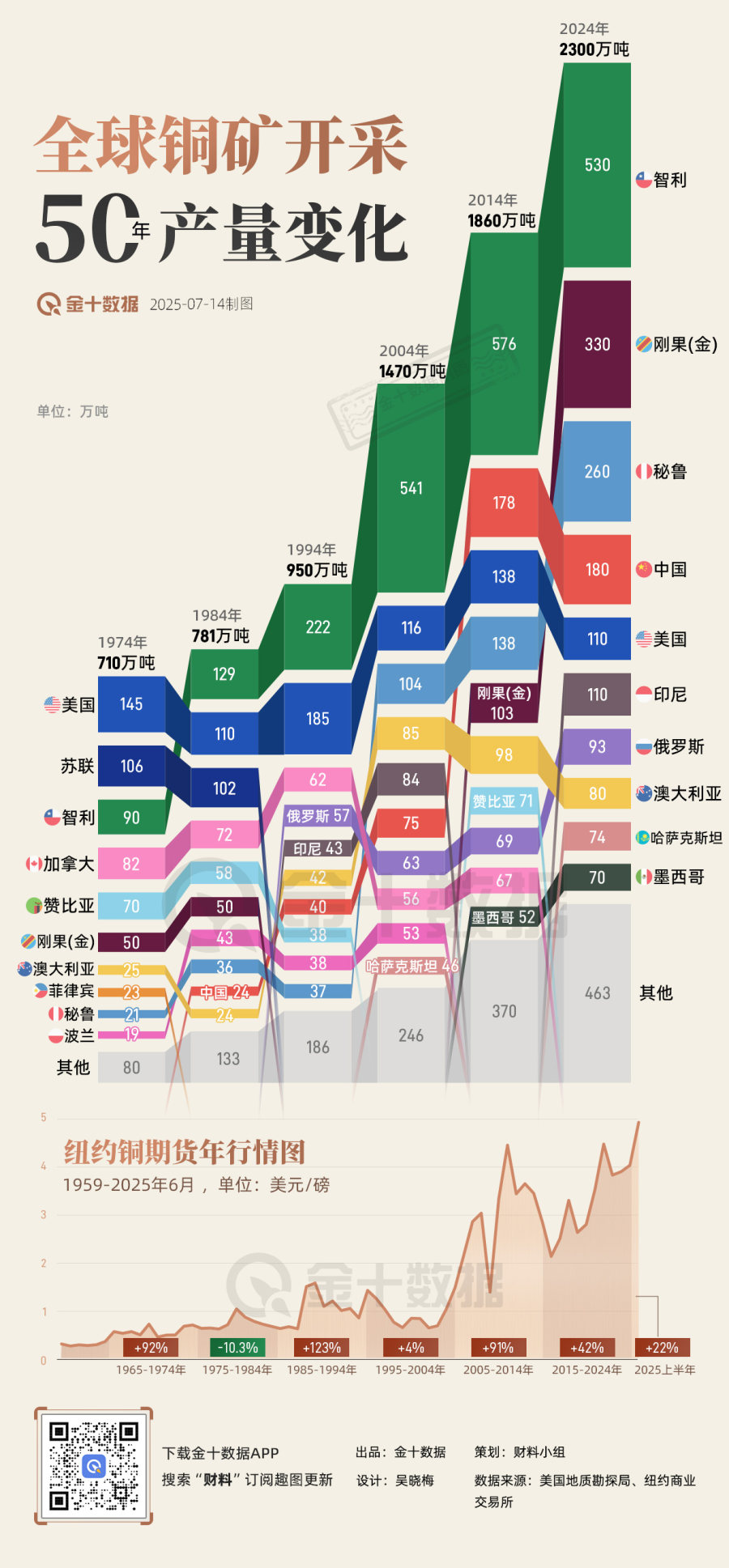
Group 1 - The U.S. will impose a 50% tariff on copper imports starting August 1, 2025, which is expected to have severe impacts on the copper market and Chilean exporters [1] - Chile is a major supplier of copper to the U.S., accounting for approximately 70% of U.S. copper imports in 2024, with exports valued at over $6 billion in 2023 [1] - The new tariffs have already driven copper prices to historical highs, influenced by both actual supply shortages and speculative trading [1] Group 2 - Although the U.S. market accounts for less than 13% of Chile's total copper exports, the tariff's impact extends beyond trade volume, potentially weakening the Chilean peso and increasing local costs [2] - A decline in copper export revenues could exacerbate Chile's public finance pressures, as public debt was 42% of GDP and the fiscal deficit was 2.9% in the previous year [2] - Chilean officials and industry leaders face strategic decisions on whether to risk losing the U.S. market or to explore opportunities in other markets, particularly in Asia and Europe [2]

【8点见】兰州人才引进20岁女硕士?官方回应
Yang Shi Wang· 2025-07-11 00:08
Group 1 - The Ministry of Commerce has initiated a special action to combat the smuggling and illegal export of strategic minerals such as antimony and gallium, which have significant military and civilian applications [1] - In the first half of the year, China's automobile production and sales both exceeded 15 million units for the first time [1] - The number of newly discovered mineral sites in the first half of the year reached 38, a year-on-year increase of 31%, with significant breakthroughs in finding important mineral types [1] Group 2 - The Ministry of Human Resources and Social Security and the Ministry of Finance announced a 2% increase in basic pensions for retirees by 2025 [1] - The transportation sector reported an addition of 149.3 kilometers of urban rail transit operating mileage in June, with four new operating lines [1] Group 3 - The "North Gas Southward" project has achieved a gas transmission volume exceeding 100 billion cubic meters [2]

网络零售成亮点,实现71.45亿元同比增六成
Nan Fang Du Shi Bao· 2025-07-10 23:18
Economic Overview - The economic performance of Huicheng District remains stable under pressure, with industrial output value reaching 35.128 billion yuan, a year-on-year increase of 11.7% [1] - The industrial production accelerated, with a monthly output value of 7.833 billion yuan, showing a year-on-year growth of 16.9% [1] Industrial Performance - The value added in the mining industry increased by 26.9% year-on-year, while the manufacturing sector grew by 13.2% [1] - The electricity, heat, gas, and water production and supply industry saw a decline of 1.8% year-on-year [1] Fixed Asset Investment - Fixed asset investment decreased by 14.7% year-on-year, with the decline slightly widening compared to the previous month [1] - Construction and installation investment fell by 19.5% year-on-year, but the decline narrowed by 0.8 percentage points [1] Trade and Consumption - The total foreign trade import and export value reached 16.97 billion yuan, growing by 43.8% [3] - Imports surged by 111.3% to 8.78 billion yuan, while exports increased by 7.1% to 8.18 billion yuan [3] Retail Sales - Total retail sales of consumer goods amounted to 35.619 billion yuan, with a year-on-year growth of 9.1% [2] - Online retail sales through public networks reached 7.145 billion yuan, marking a significant increase of 66.2% [2]