电信广播电视及卫星传输服务

Search documents
4月制造业PMI回落至49% 东方金诚王青:二季度“适时降准降息”的时机已趋于成熟
Mei Ri Jing Ji Xin Wen· 2025-04-30 06:01
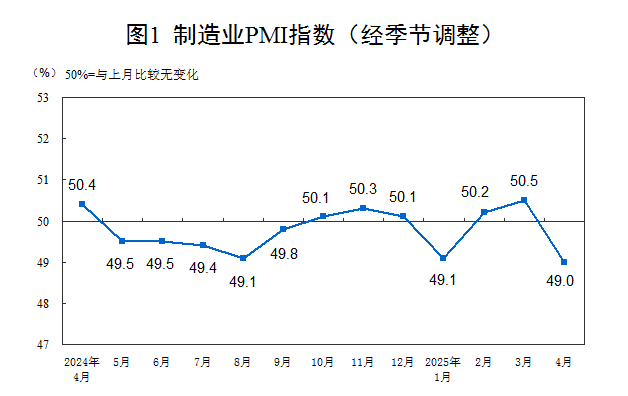
Core Viewpoint - The April PMI data indicates a decline in manufacturing while the service sector remains in expansion, suggesting a mixed economic outlook for China [1][10]. Manufacturing Sector - The manufacturing PMI for April is reported at 49.0%, a decrease of 1.5 percentage points from the previous month, falling below the critical threshold [1][6]. - The decline in manufacturing PMI is attributed to two main factors: significant changes in the external environment due to increased tariffs from the U.S. and seasonal factors, as April typically sees a drop following the peak in March [5][11]. - High-tech manufacturing continues to show resilience, with a PMI of 51.5%, indicating ongoing expansion despite a slight decline [7]. Service Sector - The service sector PMI stands at 50.1%, down 0.2 percentage points from March, but still within the expansion range [1][10]. - The service sector's performance is supported by seasonal factors such as the Qingming holiday, which boosted tourism and related services [10]. - Certain high-growth industries within the service sector, such as telecommunications and IT services, maintain strong activity levels, with indices above 55.0% [10]. Economic Policy Outlook - Analysts suggest that the likelihood of policy rate cuts increases after two consecutive months of manufacturing PMI in contraction, with expectations for timely adjustments in the second quarter [3][12]. - The construction sector's PMI is at 51.9%, reflecting a decline due to reduced real estate investment, but infrastructure-related activities show promise with a business activity index of 60.9% [10]. - The government is expected to implement more aggressive macroeconomic policies to stimulate demand and support infrastructure investment, as indicated by recent political meetings [10].

2025年4月中国采购经理指数运行情况
Guo Jia Tong Ji Ju· 2025-04-30 01:31
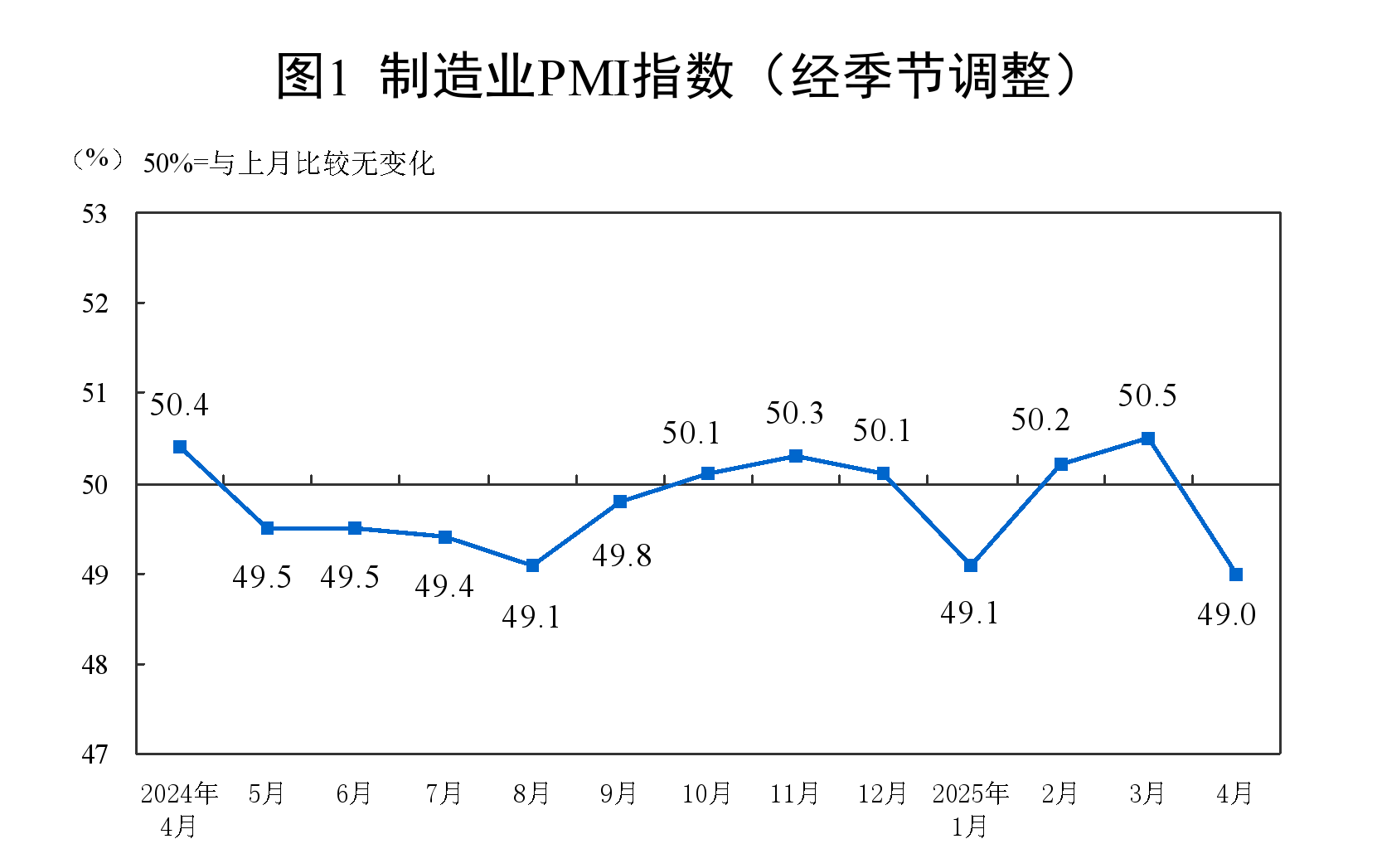
国家统计局服务业调查中心 中国物流与采购联合会 一、中国制造业采购经理指数运行情况 4月份,制造业采购经理指数(PMI)为49.0%,比上月下降1.5个百分点,制造业景气水平有所回落。 从企业规模看,大、中、小型企业PMI分别为49.2%、48.8%和48.7%,比上月下降2.0、1.1和0.9个百分点,均低于临界点。 从分类指数看,在构成制造业PMI的5个分类指数中,供应商配送时间指数高于临界点,生产指数、新订单指数、原材料库存指数和从业人员指数均低于临 界点。 生产指数为49.8%,比上月下降2.8个百分点,表明制造业企业生产略有放缓。 新订单指数为49.2%,比上月下降2.6个百分点,表明制造业市场需求有所回落。 原材料库存指数为47.0%,比上月下降0.2个百分点,表明制造业主要原材料库存量较上月下降。 从业人员指数为47.9%,比上月下降0.3个百分点,表明制造业企业用工景气度有所回落。 | | | | | | | | | 单位:% | | --- | --- | --- | --- | --- | --- | --- | --- | --- | | | 新出口 | 进口 | 采购量 | 主要原材 ...
周报:2025年2月官方PMI数据总体表现中性
AVIC Securities· 2025-03-03 07:36
Manufacturing PMI Insights - The official manufacturing PMI for February 2025 is recorded at 50.2%, an increase of 1.1 percentage points from the previous month, indicating a return above the growth threshold[1] - The average manufacturing PMI for the first two months of 2025 is 49.7%, lower than the average of 50.2% in the last quarter of 2024, suggesting a weaker manufacturing sentiment compared to seasonal norms[1] - The production index and new orders index for February are 52.5% and 51.1%, respectively, indicating that production is expanding faster than demand[2] Economic Trends and Risks - The new export orders index stands at 48.6%, reflecting a slight recovery but still indicating potential risks in external demand due to uncertainties in trade policies[2] - There is a notable divergence in sentiment among manufacturing enterprises, with large enterprises showing a PMI of 52.5%, while medium and small enterprises are at 49.2% and 46.3%, respectively, highlighting a reliance on large firms for recovery[2] - The manufacturing price indices indicate a potential narrowing of PPI declines, with the output price index at 48.5% and the main raw material purchase price index at 50.8%[2] Overall Economic Outlook - The comprehensive PMI average for the first two months of 2025 is 50.6%, down from 51.3% in the last quarter of 2024, suggesting a slower economic recovery trajectory[6] - The construction PMI for February is 52.7%, showing a strong recovery post-holiday, while the service sector PMI is at 50.0%, indicating a decline[5] - The overall economic sentiment remains cautious, with the need for further policy support for small and medium enterprises highlighted as crucial for sustained recovery[2]
中采PMI|制造业景气保持较好状态(2025年2月)
中信证券研究· 2025-03-02 11:02
Core Viewpoint - The manufacturing PMI for February returned above the threshold, indicating a relatively good state of manufacturing prosperity, with the average PMI for January and February overall better than in 2024 [1][3] Manufacturing PMI Analysis - The manufacturing PMI for February is 50.2%, an increase of 1.1 percentage points from the previous month, and 0.1 percentage points lower than the average of the past five years [2][3] - The average PMI for January and February is 49.65%, which is higher than the 49.15% in the same period of 2024, reflecting a better recent manufacturing climate [3] Economic Supply and Demand - Both supply and demand sides of the economy are performing well in the short term, with a potential short-term rebound in PPI readings [4] - The production index for February is 52.5%, up 2.7 percentage points from last month, and the average operating rate for six major industrial sectors is 71.0%, which is 2.0 percentage points higher than the same period in 2024 [4] Sector Performance - Among 15 major manufacturing industries, 7 have PMIs above the threshold, with the equipment manufacturing sector performing relatively well, such as electrical machinery at 57.1% and automotive manufacturing at 53.1% [5] - Conversely, some low-value-added industries are underperforming, such as non-metallic mineral products at 43.4% and petroleum processing at 42.6% [5] Non-Manufacturing PMI Insights - The non-manufacturing PMI for February is 50.4%, an increase of 0.2 percentage points from the previous month, driven mainly by seasonal recovery in the construction industry [6] - The service sector PMI decreased to 50.0%, while the construction PMI increased to 52.7%, indicating a seasonal rebound in construction activities post-Spring Festival [6] Future Economic Outlook - The overall economic performance is benefiting from previous consumption-boosting policies, tariff expectations, and the concentrated issuance of special bonds in the fourth quarter [7] - Future attention should be paid to the details of macro policies from the Two Sessions, the effects of consumption promotion on large items, and the impact of tariffs on exports [7]