电信广播电视及卫星传输服务

Search documents
2026年3月PMI数据点评
Ping An Securities· 2026-04-01 02:33
Group 1: PMI Overview - The comprehensive PMI for March 2026 in China rose to 50.5%, an increase of 1.0 percentage points from the previous month[3] - The manufacturing PMI improved to 50.4%, up 1.4 percentage points, indicating a return to the expansion zone[3] - The service sector's business activity index reached 50.2%, rising by 0.5 percentage points[3] Group 2: Manufacturing Sector Insights - Manufacturing production index increased by 1.8 percentage points to 51.4%, while new orders index rose by 3.0 percentage points to 51.6%[3] - New export orders index saw a significant increase of 4.1 percentage points, reaching 49.1%[3] - The purchasing price index for raw materials surged to 63.9%, up 9.1 percentage points, indicating a notable rise in manufacturing costs[3] Group 3: Service and Construction Sector Analysis - The construction sector's business activity index improved by 1.1 percentage points to 49.3%, with new orders index increasing by 1.3 percentage points[3] - Service sector new orders index and business activity expectations both declined slightly, by 0.4 and 1.0 percentage points respectively[3] - The service sector's input and sales price indices both increased by 1 percentage point, reflecting rising costs[3]
兼评3月PMI数据:PMI重回扩张,预计Q1GDP同比约5.0%
KAIYUAN SECURITIES· 2026-03-31 12:16
Manufacturing Sector - March manufacturing PMI improved to 50.4%, up 1.4 percentage points month-on-month, indicating a return to expansion[3] - The production index rose by 1.8 percentage points to 51.4%, while new orders increased by 3.0 percentage points to 51.6%[14] - Industrial raw material prices have rebounded significantly, with March PPI expected to rise by approximately 0.3% year-on-year[20] Non-Manufacturing Sector - Construction PMI increased by 1.1 percentage points to 49.3%, benefiting from the gradual resumption of projects post-holiday[22] - Service sector PMI rose to 50.2%, a 0.5 percentage point improvement, although new orders remain weak[30] Economic Outlook - Q1 GDP is projected to grow by approximately 5.0% year-on-year, supported by AI demand and fiscal spending[6] - The growth forecast includes primary, secondary, and tertiary industries at approximately 3.5%, 5.2%, and 5.0% respectively[34] - Input inflation may pressure profits in downstream enterprises, necessitating timely policy responses to support economic recovery[33] Risks - Potential risks include unexpected policy changes and a possible recession in the U.S. economy impacting domestic exports[35]
2026年3月PMI分析:需求回暖强于生产,价格波动明显放大
Yin He Zheng Quan· 2026-03-31 11:39
Economic Indicators - The manufacturing PMI for March 2026 is 50.4%, up 1.4 percentage points from the previous month, indicating expansion[1] - The production index recorded 51.4%, an increase of 1.8 percentage points, while the new orders index reached 51.6%, up 3.0 percentage points, marking the first time in 23 months that new orders exceeded production[3] Demand and Supply Dynamics - Demand recovery is stronger than production, with new orders showing significant improvement driven by high-tech manufacturing, equipment manufacturing, and consumer goods[1][4] - New export orders increased by 4.1 percentage points to 49.1%, the highest since May 2024, indicating resilient external demand despite geopolitical tensions[3] Price Trends - The main raw materials purchase price index rose to 63.9%, a significant increase of 9.1 percentage points, while the factory price index increased to 55.4%, up 4.6 percentage points[4][6] - Brent crude oil averaged $98.71 per barrel in March, up 42% month-on-month, contributing to rising costs in logistics and raw materials[6] Inventory and Procurement - The procurement index rose to 50.9%, indicating a return to expansion, while raw materials inventory index remained at 47.7%, indicating a cautious approach to inventory replenishment[7] - Finished goods inventory index decreased to 46.7%, reflecting limited recovery in stock levels despite improved procurement activities[7] Sector Performance - The PMI for high-tech manufacturing reached 52.1%, while equipment manufacturing and consumer goods sectors recorded PMIs of 51.5% and 50.8%, respectively, indicating broad-based sectoral recovery[4][8] - Small and medium enterprises showed marginal improvement, with PMIs of 49.3% and 49.0%, respectively, still below the expansion threshold[8]
2026年3月PMI点评:制造业供需两旺,价格指数加速上行
EBSCN· 2026-03-31 11:06
Manufacturing Sector - The manufacturing PMI for March 2026 is reported at 50.4%, an increase of 1.4 percentage points from the previous month, indicating a return to the expansion zone[2][4] - The production index rose by 1.8 percentage points, while the new orders index increased by 3.0 percentage points, reflecting a positive trend in manufacturing activities[4][12] - The proportion of companies reporting insufficient demand decreased to 48.5%, down 6.6 percentage points from the previous month, marking the first drop below 50% since July 2022[12] External Demand and Trade - The new export orders index surged to 49.1%, up 4.1 percentage points from the previous month, indicating a significant improvement in external demand[18] - The import orders index also rose to 49.8%, reflecting a synchronized recovery in trade activities[18] Price Trends - The raw material purchase price index increased by 9.1 percentage points to 63.9%, outpacing the factory price index, which rose by 4.8 percentage points to 55.4%, indicating rising cost pressures for businesses[21] - Both raw material and finished goods inventory indices saw a slight increase, with raw material inventory rising to 47.7% and finished goods inventory to 46.7%[22] Service Sector - The service sector PMI improved to 50.2%, a 0.5 percentage point increase from the previous month, driven by post-holiday resumption of work[24] - Key sectors such as transportation and financial services showed strong business activity indices above 55.0%, while retail and hospitality sectors experienced a decline[24]
2026年3月PMI点评:“反内卷”初现成效
CMS· 2026-03-31 08:33
Group 1: PMI Overview - In March, the manufacturing PMI recorded 50.4%, up 1.25 percentage points from the average of January-February[2] - The services PMI reached 50.2%, increasing by 0.6 percentage points compared to the January-February average[2] - The construction PMI rose to 49.3%, up 0.8 percentage points from the January-February average[2] Group 2: Demand and Supply Dynamics - Manufacturing PMI returned above the threshold, indicating improved supply and demand post-Spring Festival[5] - New orders and new export orders indices increased to 51.6% and 49.1%, respectively, both up by 2.7 percentage points from January-February[5] - Manufacturing production index rose to 51.4%, up 1.3 percentage points from January-February[5] Group 3: Price Trends - Raw material purchase prices index and factory prices index reached 63.9% and 55.4%, respectively, both hitting new highs for 2023[5] - Raw material prices saw a significant increase, with the monthly rise being the second highest since 2005[5] Group 4: Sector-Specific Insights - The construction sector showed signs of recovery, with the business activity index for March at 49.3%, indicating a rise in infrastructure investment activities[5] - The services sector's business activity index was 50.2%, with certain industries like telecommunications and finance showing strong growth, while retail and hospitality lagged[5] Group 5: Risks and Outlook - Risks include slower-than-expected domestic demand recovery, changes in domestic policies, and fluctuations in the international trade environment[3]
服务业优质高效发展
Jing Ji Ri Bao· 2026-01-19 22:21
Group 1 - The service industry in China experienced rapid growth in 2025, with a notable contribution to national economic growth, achieving a value-added of 808,879 billion yuan, a 5.4% increase from the previous year [1] - The contribution rate of the service industry to national economic growth reached 61.4%, an increase of 3.7 percentage points year-on-year, and it contributed 3.0 percentage points to GDP growth, up by 0.1 percentage points [1] - The proportion of service industry value-added in GDP rose to 57.7%, an increase of 0.9 percentage points from the previous year [1] Group 2 - Service consumption expanded steadily, with service retail sales increasing by 5.5%, outpacing the growth rate of goods retail sales by 1.7 percentage points [2] - Modern service industries such as information technology, business services, and finance showed robust growth, with value-added in information transmission, software, and IT services growing by 11.1% and business services by 10.3% [2] - Strategic emerging service industries and high-tech service industries saw revenue growth of 9.9% and 8.6% respectively from January to November 2025 [2] Group 3 - The overall business activity index for the service industry averaged 50.1% in 2025, indicating continued expansion, with certain sectors like postal, telecommunications, and financial services maintaining indices above 55.0% [3]
权威数读丨“十四五”胜利收官,中国经济迈上140万亿元台阶!
Xin Hua Wang· 2026-01-19 08:16
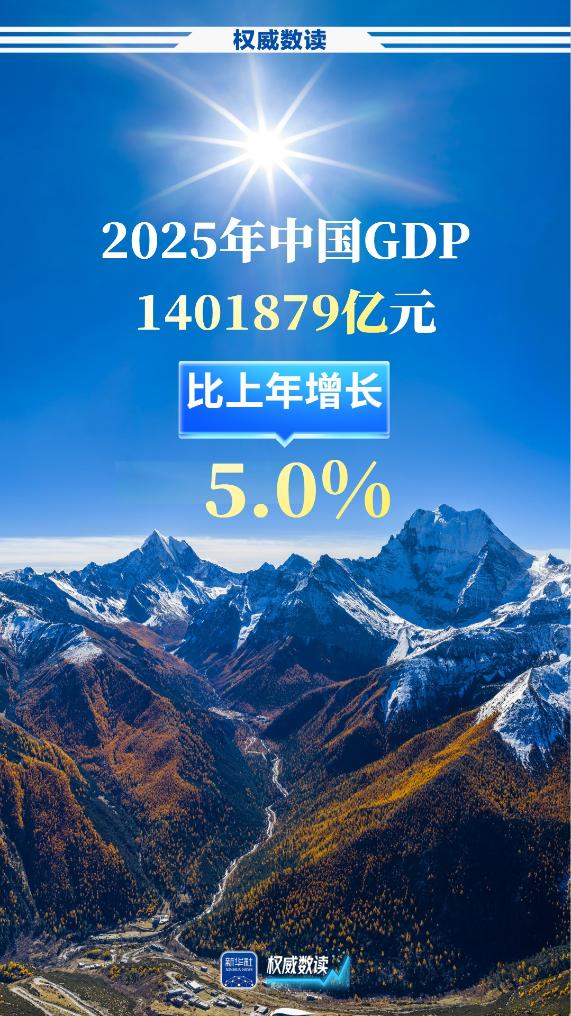
Economic Overview - In 2025, China's GDP surpassed 140 trillion yuan, reaching 1401879 billion yuan, with a year-on-year growth of 5.0% at constant prices [1][3][5] - The economic performance in 2025 indicates a successful conclusion to the "14th Five-Year Plan" [1] Agricultural Sector - The total grain production in China for the year was 71488 million tons, reflecting a year-on-year increase of 1.2% [8] - The total output of pork, beef, mutton, and poultry reached 10072 million tons, marking a 4.2% increase and exceeding 100 million tons for the first time [8] Industrial Sector - The industrial added value for large-scale industries grew by 5.9% year-on-year [9] - The added value of the equipment manufacturing industry increased by 9.2%, while the high-tech manufacturing industry saw a growth of 9.4% [9] Service Sector - The added value of the service industry grew by 5.4% compared to the previous year [11] - Key sectors such as telecommunications, financial services, and capital market services reported business activity indices above 60.0%, indicating a high level of economic activity [11] Retail and Consumption - The total retail sales of consumer goods reached 501202 billion yuan, with a year-on-year growth of 3.7% [13] - Online retail sales increased by 8.6%, and service retail sales grew by 5.5% compared to the previous year [13] Trade Performance - The total value of goods import and export was 454687 billion yuan, reflecting a year-on-year increase of 3.8% [14] - Exports amounted to 269892 billion yuan, growing by 6.1%, while imports reached 184795 billion yuan, with a modest increase of 0.5% [15] Price Stability - The overall consumer price index (CPI) remained stable compared to the previous year, while the core CPI rose by 0.7%, an increase of 0.2 percentage points from the previous year [16] Employment Situation - The average urban survey unemployment rate for the year was 5.2% [18] - The total number of migrant workers reached 30115 million, an increase of 142 million or 0.5% from the previous year [19]

彭永涛:服务业经济稳定增长 转型升级步伐加快
Guo Jia Tong Ji Ju· 2026-01-19 03:35
Group 1 - The service industry in 2025 showed a significant growth, with a value added of 808,879 billion yuan, representing a 5.4% increase from the previous year. The contribution rate of the service industry to national economic growth was 61.4%, up by 3.7 percentage points from the previous year [2] - In the fourth quarter of 2025, the service industry added value reached 215,948 billion yuan, with a year-on-year growth of 5.2%, contributing 63.2% to economic growth [2] - The revenue of large-scale service enterprises increased by 7.8% year-on-year from January to November 2025, with notable growth in cultural arts, research and development, and business services [2] Group 2 - Service consumption expanded steadily, with service retail sales growing by 5.5% year-on-year in 2025, outpacing the growth of goods retail sales by 1.7 percentage points. Per capita service consumption expenditure increased by 4.5% [3] - The modern service industry, including information technology and business services, continued to thrive, with value added in information transmission and software services growing by 11.1% and 10.3%, respectively [4] - Emerging service industries showed enhanced leadership, with strategic emerging services and high-tech services seeing revenue growth of 9.9% and 8.6%, respectively, from January to November 2025 [5] Group 3 - The service industry maintained a high level of openness, with service trade imports and exports totaling 72,023.7 billion yuan from January to November 2025, a year-on-year increase of 7.1%. Travel service exports surged by 51.3% [6] - The business activity index for the service industry averaged 50.1 in 2025, indicating continued expansion. The index for postal, telecommunications, and financial services remained above 55.0, reflecting robust growth [7] - Market expectations improved, with the business activity expectation index for December rising to 56.4, indicating increased confidence among service enterprises [7]
国家统计局:2025年服务业增加值比上年增长5.4%
Zhong Guo Jing Ji Wang· 2026-01-19 03:17
Core Insights - The core viewpoint of the article highlights the growth of China's service industry, with a projected increase in value added by 5.4% in 2025 compared to the previous year [1] Group 1: Service Industry Growth - The value added in the information transmission, software, and IT services sector is expected to grow by 11.1% [1] - The leasing and business services sector is projected to increase by 10.3% [1] - The transportation, warehousing, and postal services sector is anticipated to grow by 5.2% [1] - The wholesale and retail sector is expected to see a growth of 5.0% [1] - The accommodation and catering sector is projected to grow by 4.9% [1] Group 2: Production and Business Activity Indices - In December, the service production index increased by 5.0% year-on-year [1] - The production indices for the information transmission, software, and IT services sector, leasing and business services sector, and financial sector grew by 14.8%, 11.3%, and 6.5% respectively [1] - From January to November, the operating revenue of large-scale service enterprises increased by 7.8% year-on-year [1] Group 3: Business Activity Indices - The business activity index for the service industry in December was 49.7%, up by 0.2 percentage points from the previous month [1] - The business activity expectation index for the service industry rose to 56.4%, an increase of 0.5 percentage points [1] - Industries such as telecommunications, broadcasting, television, satellite transmission services, monetary financial services, and capital market services all had business activity indices above 60.0%, indicating a high level of prosperity [1]
【宏观经济】一周要闻回顾(2025年12月31日-2026年1月6日)
乘联分会· 2026-01-06 09:07
Group 1: Manufacturing PMI Overview - In December, the Manufacturing Purchasing Managers' Index (PMI) was 50.1%, an increase of 0.9 percentage points from the previous month, indicating a return to the expansion zone [3] - Large enterprises had a PMI of 50.8%, up 1.5 percentage points; medium-sized enterprises at 49.8%, up 0.9 percentage points; and small enterprises at 48.6%, down 0.5 percentage points, all below the critical point [3] - The production index was 51.7%, up 1.7 percentage points, indicating accelerated production activities; the new orders index was 50.8%, up 1.6 percentage points, showing improved market demand [5] Group 2: Non-Manufacturing PMI Overview - In December, the Non-Manufacturing Business Activity Index was 50.2%, an increase of 0.7 percentage points, returning to the expansion zone [6] - The construction industry index was 52.8%, up 3.2 percentage points; the service industry index was 49.7%, up 0.2 percentage points [6] - The new orders index was 47.3%, up 1.6 percentage points, indicating a slight recovery in market demand for non-manufacturing sectors [6] Group 3: Comprehensive PMI Output Index - The comprehensive PMI output index for December was 50.7%, an increase of 1.0 percentage points, indicating overall expansion in production and business activities [6] Group 4: Service Trade Growth - From January to November 2025, China's service trade totaled 720.24 billion yuan, a year-on-year increase of 7.1% [10] - Service exports reached 319.80 billion yuan, up 13.4%, while imports were 400.44 billion yuan, up 2.5%, resulting in a service trade deficit of 80.64 billion yuan, reduced by 27.96 billion yuan year-on-year [11] Group 5: Trade in Knowledge-Intensive Services - Knowledge-intensive service trade reached 273.06 billion yuan from January to November, a year-on-year increase of 5.6% [11] - Notably, telecommunications and information services saw growth rates of 8.3% and 4.1%, respectively [11] Group 6: Consumption and Economic Impact - In 2025, the sales of products related to the "trade-in" policy exceeded 2.6 trillion yuan, benefiting over 360 million people [14] - The retail sales of consumer goods increased by 4.0% year-on-year, with the "trade-in" policy contributing over 1 percentage point to this growth [14] - The automotive trade-in program saw over 11.5 million vehicles exchanged, with nearly 60% being new energy vehicles [14]