
信托

Search documents
中信信托总经理涂一锴董事任职资格获批
Jing Ji Guan Cha Bao· 2025-08-27 02:00
Core Insights - The Beijing Financial Regulatory Bureau has officially approved Tu Yikai's qualification as a director of CITIC Trust as of August 22 [1] - CITIC Trust, a leading trust company in the industry, reported a revenue of 5.379 billion yuan in 2024, with a net profit of 2.653 billion yuan [1] - As of the end of 2024, CITIC Trust's total trust assets reached 26.244 trillion yuan, with 15.3 trillion yuan in asset service trusts and 10 trillion yuan in asset management trusts [1] Company Overview - Tu Yikai has been with CITIC Bank since April 2002 and has held various positions within CITIC Trust since December 2008, currently serving as the Deputy Secretary of the Party Committee, General Manager, and Secretary of the Board [1] - CITIC Trust was established on March 1, 1988, with a registered capital of 11.276 billion yuan, and is a subsidiary of China CITIC Financial Holdings [1] Financial Performance - In the first half of 2025, CITIC Trust achieved a total revenue of 2.916 billion yuan, with net commission income of 1.005 billion yuan, both showing growth compared to the same period in 2024 [1] - The company reported a total profit of 1.682 billion yuan in the first half of 2025, representing a year-on-year increase of 3.6%, while net profit rose by 13.5% to 1.567 billion yuan [1]

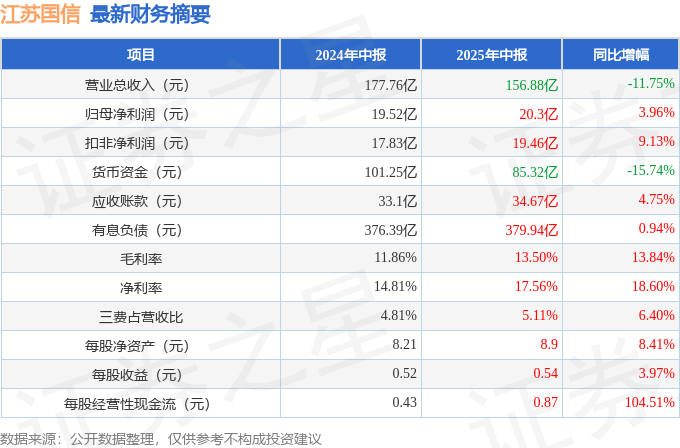
江苏国信2025年中报简析:净利润同比增长3.96%,盈利能力上升
Zheng Quan Zhi Xing· 2025-08-26 22:39
Core Insights - Jiangsu Guoxin (002608) reported a total revenue of 15.688 billion yuan for the first half of 2025, a year-on-year decrease of 11.75%, while the net profit attributable to shareholders increased by 3.96% to 2.03 billion yuan [1][2] - The company's gross margin improved by 13.84% year-on-year, reaching 13.5%, and the net margin increased by 18.6% to 17.56% [1][2] - The company experienced a significant increase in operating cash flow per share, which rose by 104.51% to 0.87 yuan [1][2] Financial Performance - Total revenue for 2024 was 17.776 billion yuan, compared to 15.688 billion yuan in 2025, reflecting an 11.75% decline [1] - Net profit attributable to shareholders increased from 1.952 billion yuan in 2024 to 2.03 billion yuan in 2025, marking a 3.96% increase [1] - The gross margin improved from 11.86% in 2024 to 13.5% in 2025, while the net margin rose from 14.81% to 17.56% [1] - Total expenses (selling, administrative, and financial) amounted to 802 million yuan, accounting for 5.11% of revenue, a 6.4% increase year-on-year [1] - Earnings per share increased from 0.52 yuan to 0.54 yuan, a 3.97% rise [1] Cash Flow Analysis - The net cash flow from operating activities increased by 104.51%, attributed to a reduction in borrowed funds repayment by Jiangsu Trust [2] - The net cash flow from investing activities saw a drastic decline of 10,889.04%, due to increased capital expenditures in power infrastructure and reduced redemptions of trust products [2] - The net cash flow from financing activities increased by 35.01%, linked to a decrease in repayments to the trust industry liquidity support fund [2] Debt and Asset Management - The company maintains a healthy cash position, with cash assets covering 93.83% of current liabilities [3] - The interest-bearing debt ratio stands at 38.29%, indicating a moderate level of debt [3] - Accounts receivable have reached 107.07% of profit, suggesting potential concerns regarding cash collection [3] Future Outlook - Analysts project the company's performance for 2025 to reach 3.326 billion yuan, with an average earnings per share estimate of 0.88 yuan [3] - The company has several new power generation units scheduled for commissioning, including two units at Guoxin Binhai Port Power Plant and two units at Guoxin Shazhou Power Plant expected to be operational soon [3]

陕国投A: 关于2025年半年度利润分配预案的公告
Zheng Quan Zhi Xing· 2025-08-26 19:10
Group 1 - The company announced a profit distribution plan for the first half of 2025, with a net profit of approximately 723.16 million yuan and undistributed profits of about 5.25 billion yuan as of June 30, 2025 [1][2] - The board of directors proposed a cash dividend of 0.10 yuan per 10 shares, amounting to a total cash distribution of approximately 51.14 million yuan [2][3] - The profit distribution plan was approved by the board with a vote of 10 in favor, and it complies with relevant laws and regulations, ensuring the interests of all shareholders are considered [2][3] Group 2 - The profit distribution plan was authorized by the shareholders' meeting on April 9, 2025, allowing the board to determine the specific mid-term dividend plan based on profit distribution conditions [2] - The plan is in line with the company's development strategy and profit distribution policy, ensuring it meets legal and regulatory requirements [3]

五矿资本: 五矿资本股份有限公司2025年半年度报告
Zheng Quan Zhi Xing· 2025-08-26 16:57
Core Points - The company reported a net profit of 34.77 million yuan for the first half of 2025, with a total distributable profit of 300.71 million yuan by the end of June 2025 after accounting for dividends paid [2][3] - The proposed cash dividend for the first half of 2025 is 0.06 yuan per share, amounting to a total of 26.99 million yuan, which represents 5.14% of the net profit attributable to shareholders [3] - The company’s total revenue for the first half of 2025 was 3.33 billion yuan, a decrease of 14.11% compared to the previous year, while the net profit attributable to shareholders decreased by 41.47% to 525.45 million yuan [6][19] Financial Performance - The total operating income for the first half of 2025 was 3,330,247,455.83 yuan, down from 3,877,202,735.45 yuan in the same period last year, reflecting a decline of 14.11% [6] - Interest income decreased by 26.44% to 1,646,826,829.46 yuan, while commission income fell by 23.39% to 1,060,076,439.76 yuan [6][7] - The total profit for the first half of 2025 was 759,048,496.43 yuan, a significant drop of 48.80% compared to the previous year [6] Industry Overview - The trust industry is experiencing a phase of stabilization and transformation, with total trust assets reaching 29.56 trillion yuan by the end of 2024, a year-on-year increase of 23.58% [9][10] - The financial leasing industry has entered a phase of steady development, with total assets growing by 16.51% to 4.87 trillion yuan by the end of 2024 [11][12] - The securities industry maintained a stable growth trend, with total assets reaching 12.93 trillion yuan, a year-on-year increase of 9.30% [12][13] Business Operations - The company operates through its wholly-owned subsidiary, Minmetals Capital Holdings, which manages various financial licenses including Minmetals Trust, Foreign Trade Financial Leasing, Minmetals Securities, and Minmetals Futures [15][16] - Minmetals Trust focuses on trust business and proprietary business, with total assets of 33.92 billion yuan and a net profit of -2.67 million yuan for the reporting period [23][24] - Foreign Trade Financial Leasing reported total assets of 52.94 billion yuan and a net profit of 50.48 million yuan, with a focus on financing leasing projects [26] Strategic Focus - The company is committed to transforming its business model towards "industrial finance, technology finance, and green finance," aiming to enhance its service capabilities for the real economy [19][20] - The company emphasizes the importance of governance and compliance, continuously improving its operational efficiency and market recognition [21] - The company actively engages in green finance initiatives, with Minmetals Trust managing 28 green trust projects totaling 5.34 billion yuan [22]

五矿资本: 五矿资本股份有限公司第九届董事会第二十六次会议决议公告
Zheng Quan Zhi Xing· 2025-08-26 16:57
Core Viewpoint - The board of directors of Wumart Capital has approved several key resolutions during its 26th meeting, including the approval of the 2025 semi-annual report, amendments to the company's articles of association, and the cancellation of the supervisory board [1][2][6]. Group 1: Meeting Resolutions - The board meeting was held on August 26, 2025, with all nine directors present, and all resolutions were passed unanimously with 100% approval [1][2]. - The 2025 semi-annual report and its summary were approved, with the audit committee providing a favorable review [2]. - The company will revise its articles of association in accordance with the updated laws and regulations, with the revised version effective upon approval by the shareholders' meeting [2][3]. Group 2: Governance Changes - The supervisory board will be abolished, and its functions will be transferred to the audit committee of the board, with the relevant rules being repealed [6]. - Amendments to the shareholders' meeting rules and the board meeting rules were approved, with the new rules taking effect after shareholder approval [3][5]. Group 3: Financial Matters - A cash dividend of RMB 0.06 per share will be distributed to shareholders, totaling approximately RMB 26.99 million, based on the current share capital of 4,498,065,459 shares [7]. - The company approved the reversal of asset impairment and credit impairment provisions totaling RMB 20.84 million for the first half of 2025 [8]. - The subsidiary Wumart International Trust will recognize an estimated liability of RMB 78.10 million for the first half of 2025 [8]. Group 4: Risk Assessment and Management - The board approved a risk assessment report related to Wumart Group Financial Limited Liability Company, which constitutes a related party transaction [9]. - The board also approved the performance evaluation results for the leadership team and senior executives for the year 2024 and the term from 2022 to 2024 [10]. Group 5: Future Meetings - The company plans to hold its second extraordinary shareholders' meeting of 2025 on September 12, 2025, combining in-person and online voting [11].
五矿资本: 五矿资本股份有限公司关于五矿信托计提2025年半年度预计负债的公告
Zheng Quan Zhi Xing· 2025-08-26 16:56
Group 1 - The company announced a provision for estimated liabilities amounting to 78.10 million yuan for the first half of 2025, aimed at enhancing risk resistance and reflecting accounting prudence [1][2] - The provision is based on the asset balance of ongoing trust projects, categorized into actively managed and transaction management projects, with a requirement to set aside 5% of the risk capital for trust business reserves [1][2] - The Supervisory Board approved the provision, stating that the decision complies with relevant laws and regulations, and accurately reflects the company's asset status [2] Group 2 - The provision does not require approval from the company's shareholders' meeting, as it was passed by the Supervisory Board [2] - The decision aligns with the guidelines from the China Banking Regulatory Commission regarding risk management for trust companies [1][2] - The cumulative provision for trust business reserves will cease once it reaches 20% of the risk capital [1]
五矿资本:8月26日召开董事会会议
Mei Ri Jing Ji Xin Wen· 2025-08-26 13:53
2024年1至12月份,五矿资本的营业收入构成为:租赁公司占比39.12%,信托公司占比23.33%,期货公 司占比21.06%,证券公司占比14.49%,其他业务占比2.0%。 每经AI快讯,五矿资本(SH 600390,收盘价:6.44元)8月26日晚间发布公告称,公司第九届第二十六 次董事会会议于2025年8月26日在北京市东城区朝阳门北大街3号五矿广场C1119会议室以现场会议及视 频会议的方式召开。会议审议了《关于 <公司2025年半年度报告> 及其摘要的议案》等文件。 每经头条(nbdtoutiao)——能给主人"打电话"的宠物智能手机也来了!宠物产业3000亿元市场大爆 发,行业上市公司"涨"声一片 截至发稿,五矿资本市值为290亿元。 (记者 王晓波) ...
券商资管研究总监,重回卖方
中国基金报· 2025-08-26 11:17
Group 1 - Wang Song, former director of research at the Federal Reserve Asset Management, has joined Founder Securities as the chief researcher for the real estate sector [2] - Wang has over ten years of experience in real estate and urban investment bond research, previously holding positions at Minsheng Securities and Zhongjian Investment Trust [2] - He believes that opportunities in the real estate sector still exist, particularly in niche markets and under specific policy catalysts, which require immediate research to uncover [2] Group 2 - Founder Securities has been actively recruiting talent, with several key hires including Yan Xiang as chief economist and Li Qinghe as head of fixed income [3] - The company's half-year earnings forecast for 2025 predicts a net profit of between 2.296 billion and 2.432 billion yuan, representing a year-on-year growth of 70% to 80% [3] - The overall number of analysts in the securities industry has been increasing despite a decrease in total industry personnel, indicating a shift in the labor market dynamics [4] Group 3 - The securities research sector is undergoing significant personnel changes, with analysts moving to various roles, including positions in listed companies and private equity [4] - There is a pressing need for transformation within securities research institutions to enhance their research capabilities and brand influence in a competitive market [4]


江苏国信(002608):2Q25扣非归母净利两位数增长,主营业务盈利向好
Huafu Securities· 2025-08-26 08:49
Investment Rating - The report maintains a "Buy" rating for Jiangsu Guoxin, expecting a relative price increase of over 20% compared to the market benchmark index within the next six months [5][15]. Core Insights - In 1H2025, Jiangsu Guoxin achieved a revenue of 15.688 billion yuan, a year-on-year decrease of 11.75%, while the net profit attributable to shareholders increased by 3.96% to 2.03 billion yuan [2][3]. - The company's core profit showed improvement, with the net profit excluding non-recurring items growing by 9.13% in 1H2025, and a significant 16.03% increase in 2Q2025 [3]. - The energy segment's revenue decreased by 12% in 1H2025, but the segment's profit increased by 16% due to lower coal prices [4]. - Jiangsu Trust, a subsidiary, reported a revenue of 1.837 billion yuan in 1H2025, with stable investment income from its stakes in Jiangsu Bank and Lian'an Life [4]. Financial Performance Summary - The company forecasts net profits of 3.326 billion yuan, 3.394 billion yuan, and 3.483 billion yuan for 2025, 2026, and 2027 respectively, with corresponding P/E ratios of 8.8, 8.6, and 8.4 [5][6]. - The financial data indicates a projected revenue growth rate of 6% for 2025, with a net profit growth rate of 3% [6][10]. - The report highlights a stable financial position with a debt-to-asset ratio of 52.5% and a current share price of 7.77 yuan [6].
东莞控股(000828):坏账冲回等增厚利润 拟中期分红回报股东
Xin Lang Cai Jing· 2025-08-26 08:34
Core Viewpoint - Dongguan Holdings reported a mixed performance in its 2025 H1 financial results, with a decline in revenue but an increase in net profit and cash flow, indicating potential resilience in profitability despite revenue challenges [1][2][3][4] Financial Performance - In H1 2025, the company achieved operating revenue of 766 million yuan, a year-on-year decrease of 8.57% [1] - The net profit attributable to shareholders was 532 million yuan, reflecting a year-on-year increase of 20.51% [1] - The net cash flow from operating activities was 931 million yuan, showing a significant year-on-year increase of 332.74% [1] - Basic earnings per share were 0.5122 yuan, up 23.45% year-on-year [1] - The weighted average return on equity was 5.33%, an increase of 0.79 percentage points year-on-year [1] Quarterly Performance - In Q2 2025, the company reported operating revenue of 400 million yuan, a year-on-year decrease of 6.28% but a quarter-on-quarter increase of 9.41% [1] - The net profit for Q2 was 313 million yuan, a substantial year-on-year increase of 699.24% and a quarter-on-quarter increase of 43.02% [1] Revenue Breakdown - Revenue from toll fees, financing leasing, factoring business, and new energy vehicle charging business were 627 million, 10 million, 71 million, and 42 million yuan respectively, with year-on-year changes of -0.37%, -71.52%, -40.66%, and +10.86% [1][2] Traffic and Infrastructure - The traffic volume on the Dongguan-Shenzhen Expressway remained stable year-on-year, with a mixed traffic volume of 60.09 million vehicles, a slight decrease of 0.26% [2] - The company is undertaking expansion and renovation projects on the Dongguan-Shenzhen Expressway, with H1 2025 investments amounting to 863 million yuan, totaling 3.536 billion yuan, which is 20.11% of the total investment [2] Profitability Factors - The company recorded credit impairment losses of 63 million yuan in H1 2025, a significant change from -174 million yuan in the same period last year, primarily due to the recovery of previously impaired receivables [3] - Financial expenses were -11 million yuan, down from 36 million yuan year-on-year, attributed to reduced interest expenses and increased interest income [3] - The company acquired a 7.1% stake in Dongguan Securities, increasing its total holding to 27.1%, and recognized investment income from joint ventures and associates of 111 million yuan, up 26.22% year-on-year [3] Shareholder Returns - The company plans to distribute a cash dividend of 1.5 yuan per 10 shares, totaling approximately 156 million yuan, pending approval from the shareholders' meeting [4] - The future three-year shareholder return plan (2025-2027) aims for a minimum cumulative cash dividend of 0.475 yuan per share annually, translating to an estimated dividend yield of about 4.1% based on the closing price of 11.55 yuan on August 25, 2025 [4] Earnings Forecast - The company forecasts net profits attributable to shareholders of 881 million, 893 million, and 931 million yuan for 2025, 2026, and 2027 respectively, with corresponding earnings per share of 0.85, 0.86, and 0.90 yuan [4] - The price-to-earnings ratios based on the closing price on August 25 are projected to be 13.6X, 13.5X, and 12.9X for the respective years [4]
