进出口贸易

Search documents
商务部:中国有信心推动外贸稳量提质|快讯
Sou Hu Cai Jing· 2025-08-21 17:47
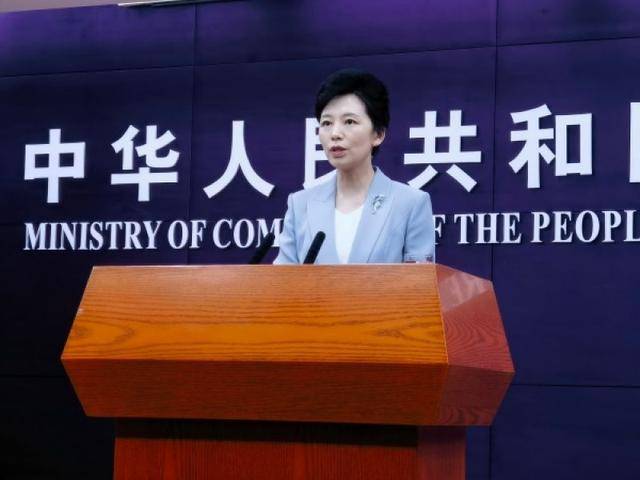
Group 1 - The core viewpoint is that China's foreign trade has maintained a steady growth amidst a complex international backdrop, with a cumulative import and export growth rate of 3.5% in the first seven months of the year, indicating both quantity and quality improvements [2] - The growth is attributed to effective policies implemented by the Ministry of Commerce and related departments, which have focused on stabilizing foreign trade, supporting enterprises, and enhancing public services [2] - In the first seven months, the export of mechanical and electrical products increased by 9.3%, accounting for 60% of total exports, with high-tech and high-value-added products like smart home devices and electric vehicles showing significant growth [3] Group 2 - The number of foreign trade enterprises with actual import and export activities reached 654,000, with nearly 90% being private enterprises, indicating a robust participation from the private sector [3] - China's trade with emerging and other markets grew by 5% in the first seven months, making up 65.5% of total trade, with notable increases in trade with ASEAN and Africa at 9.4% and 17.2% respectively [2] - The Ministry of Commerce emphasizes the commitment to high-level opening up and high-quality development to address uncertainties in global trade, aiming to stabilize and enhance foreign trade [3]

财经夜行线0821|A股三大指数冲高回落 日本7月出口创2021年2月最大降幅
Di Yi Cai Jing· 2025-08-21 14:16
MACD金叉信号形成,这些股涨势不错! A股市场方面,今天三大指数早盘横盘震荡,午后集体回落,尾盘指数再度反弹,沪指成功翻红。对于 后市,东北证券首席投资顾问郭峰表示,A股板块分化或进一步加剧,建议投资者适当获利回吐。全球 市场方面,最新的数据显示,日本7月出口总额约为9.3万亿日元,同比下降2.6%,创下自2021年2月以 来的最大降幅。这一降幅超过了分析师此前预测的2.1%,也远超6月0.5%的降幅。目前,日本单月对外 出口已连续4个月呈下滑态势。面对全球贸易保护主义升温与主要经济体需求变化,日本出口还能撑多 久?又该如何寻找新的增长支点?《财经夜行线》邀请到上海社会科学院国际问题研究所助理研究员王 梦雪共同讨论。 ...
2025年上半年 四川攀枝花实现外贸进出口总额16.37亿元
Sou Hu Cai Jing· 2025-08-21 13:07
Core Insights - In the first half of 2025, Panzhihua City, Sichuan Province, achieved a total foreign trade import and export value of 1.637 billion yuan, completing 104.27% of its "over half" target, with exports at 1.035 billion yuan and imports at 602 million yuan [1][1][1] - The export of mechanical castings reached over 17 million yuan, marking a growth of 27.4% [1][1] Trade Initiatives - Panzhihua's Commerce Bureau organized enterprises to participate in the "Chuanxing Tianxia" international exhibition, conducted training on trade friction response, and optimized the export tax rebate process, successfully connecting with over 80 overseas clients [1][1][1] - Panzhihua Customs introduced a "customs head delivers policies" service, reducing customs clearance time to 1.2 hours [1][1][1] - The Foreign Exchange Administration innovated a "cross-border financial blockchain platform," providing low-cost financing of 20 million yuan for enterprises [1][1][1] Future Plans - In the second half of the year, Panzhihua aims to stabilize its foreign trade fundamentals, enhance tracking services and operational monitoring for key foreign trade enterprises, and focus on solidifying industrial support [1][1][1] - The city will promote the integration of trade and industry, enhance the import and export scale of traditional industries like vanadium-titanium, and strengthen competitiveness [1][1][1] - Panzhihua will focus on expanding foreign trade entities, implement the "Hundred Enterprises Leading, Thousand Enterprises Upgrading" initiative, attract quality entities using import special policies, and support enterprises in participating in international market expansion activities [1][1][1]
外贸运行持续向好 中国将继续同各国共享发展机遇
Yang Shi Wang· 2025-08-21 09:22
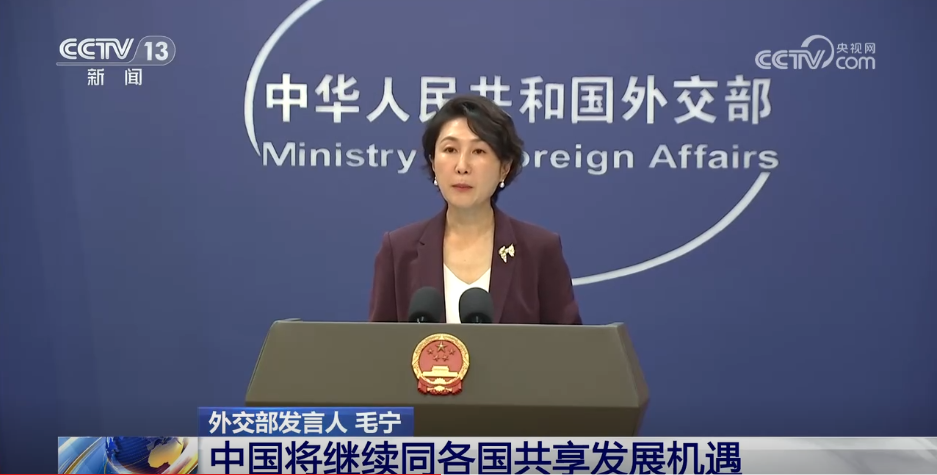
外交部发言人 毛宁:面对复杂多变的外部环境,中国外贸运行持续向好,展现出中国经济的强大韧性和全球市场对中国产品的 旺盛需求,这是中国扩大高水平对外开放,推动高质量发展,促进产业优化升级等因素共同作用的结果。事实证明,基于比较优势开 展国际贸易,实现共同发展,各方都会从中受益。中国的优质产品享誉世界,多元稳定的市场广受青睐,这是关税战贸易战改变不了 的。中国将继续同各国共享发展机遇,坚持开放合作,互利共赢。 央视网消息:日前,我国公布了7月份经济数据,其中外贸数据尤为亮眼,货物进出口总额创今年来新高。有评论认为,中国外 贸持续增长凸显全球对中国商品的广泛认可,这将继续成为中国经济的重要驱动力。但也有分析称,关税战等外部风险冲击全球贸 易,让中国出口市场持续承压。对此,外交部发言人毛宁在8月21日举行的例行记者会上表示,中国将继续同各国共享发展机遇。 ...
商务部:中国外贸前7个月实现3.5%的增长 量质齐升
Yang Shi Xin Wen Ke Hu Duan· 2025-08-21 09:13
Core Viewpoint - The Chinese foreign trade has shown a steady growth of 3.5% in the first seven months of the year, despite increasing risks and challenges in international economic and trade development [1] Group 1: Trade Performance - In the first seven months, China's imports and exports to emerging and other markets increased by 5%, accounting for 65.5% of total trade [1] - Exports to ASEAN and Africa grew by 9.4% and 17.2% respectively, both significantly higher than the overall growth rate [1] Group 2: Product Export Growth - Mechanical and electrical products saw a 9.3% increase in exports, making up 60% of total exports, which is a 1.1 percentage point increase year-on-year [1] - High-tech and high-value-added products such as smart home devices, electric vehicles, industrial robots, and ships maintained a high export growth rate [1] Group 3: Policy and Future Outlook - The Ministry of Commerce has been reinforcing policy support to help foreign trade enterprises stabilize orders and employment since the fourth quarter of last year [1] - The Ministry expressed confidence in continuing to promote stable and quality growth in foreign trade while expanding high-level opening-up and collaborating with more trade partners to face challenges and share development opportunities [1]
外交部:开展国际贸易实现共同发展 各方都从中受益
Yang Shi Xin Wen· 2025-08-21 08:30
Core Viewpoint - China's foreign trade continues to show strong growth, highlighting global recognition of Chinese goods, which remains a significant driver of the Chinese economy [1] Group 1: Economic Performance - In July, China's total goods import and export volume reached a new high for the year, indicating robust foreign trade performance [1] - The ongoing growth in foreign trade reflects the strong resilience of the Chinese economy and the high demand for Chinese products in the global market [1] Group 2: External Environment - Despite external risks such as tariff wars impacting global trade, China's foreign trade remains resilient [1] - The analysis suggests that the trade environment is complex, but China's comparative advantages in international trade continue to yield mutual benefits for all parties involved [1] Group 3: Future Outlook - China aims to continue sharing development opportunities with other countries, emphasizing open cooperation and mutual benefit [1] - The country is committed to high-level opening up, promoting high-quality development, and optimizing industrial upgrades [1]
前7个月安徽省经济运行总体平稳
Xin Hua Wang· 2025-08-21 01:31
Economic Performance - The province's industrial added value increased by 8.5% year-on-year from January to July, with manufacturing growing by 10.3% [1] - The production of industrial robots surged by 46.4%, while the output of laptops and lithium-ion batteries rose by 22.7% and 15.4%, respectively [1] - In July, the industrial added value grew by 9.0% year-on-year [1] Investment Trends - Fixed asset investment in the province decreased by 3.7% from January to July, with the first industry increasing by 5.5% and the third industry declining by 6.5% [2] - High-tech service industry investment grew by 25.3%, with information services up by 78.2% and R&D services increasing by 85.7% [2] - Investment in green energy saw significant growth, with hydropower and solar power investments rising by 113.8% and 84.6%, respectively [2] Trade and Export - The province's total import and export volume reached 5434.1 billion yuan, a year-on-year increase of 14.1%, with exports growing by 13.8% [2] - Private enterprises accounted for 51.7% of total imports and exports, marking a 1.1 percentage point increase year-on-year [2] Financial Sector - By the end of July, the province's financial institutions had a total RMB deposit balance of 96,387.9 billion yuan, up 10.5% year-on-year [3] - The RMB loan balance reached 91,648.7 billion yuan, with corporate loans increasing by 12.0% [3]
【环球财经】巴西出口投资促进局推动金融援助与市场拓展
Xin Hua Cai Jing· 2025-08-20 05:21
Group 1 - Brazil's government is increasing support for companies affected by the 50% tariffs imposed by the US on certain Brazilian exports through financial aid, overseas expansion, and market diversification [1] - The Brazilian government has allocated 30 billion reais under the "Brazil Sovereignty Plan" to provide insurance, loans, and tax reductions for impacted businesses [1] - The Brazilian Export and Investment Promotion Agency is enhancing its presence in the US, with plans to establish an office in Washington and an existing branch in New York [1] Group 2 - Brazil has established cooperation with the US Chamber of Commerce and companies importing Brazilian products to advocate for the exclusion of more products from the tariff list [1] - The demand for Brazilian products, particularly coffee and beef, remains strong in the US market, and Brazil aims to maintain a mutually beneficial trade relationship with US importers [1] - The Brazilian Export and Investment Promotion Agency has identified 72 countries with potential to absorb exports affected by tariffs, based on research conducted in over 100 markets [1][2] Group 3 - Brazil's trade cooperation with multiple countries is thriving, and the BRICS mechanism offers more opportunities for Brazilian companies [2] - In the first quarter of 2025, Brazil's export value reached 77.3 billion USD, with significant exports to China (19.8 billion USD), the EU (11.1 billion USD), the US (9.7 billion USD), and the Southern Common Market (5.8 billion USD) [2] - Key export products include crude oil, soybeans, iron ore, and coffee, with an increase in industrial manufactured goods exports [2]
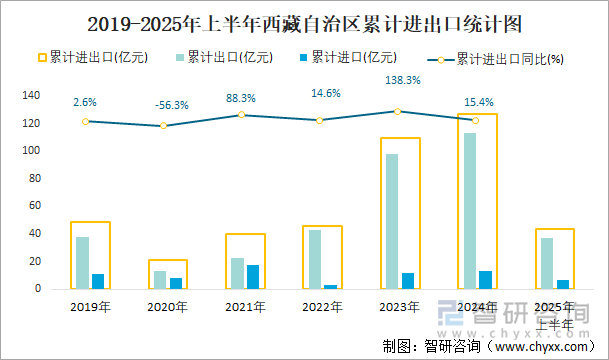
2025年上半年西藏自治区贸易统计分析:西藏自治区进出口总额为43.4亿元,同比增长14.1%
Chan Ye Xin Xi Wang· 2025-08-20 03:27
上市企业:中成股份(000151),远大控股(000626),厦门信达(000701),凯瑞德(002072),江 苏国泰(002091),怡亚通(002183),鹏都农牧(002505),五矿发展(600058),苏豪弘业 (600128),东方创业(600278),江苏舜天(600287),ST沪科(600608),苏美达(600710), 云维股份(600725),汇鸿集团(600981),中信金属(601061) 相关报告:智研咨询发布的《2025-2031年中国数字贸易行业竞争策略研究及未来前景展望报告》 知前沿,问智研。智研咨询是中国一流产业咨询机构,十数年持续深耕产业研究领域,提供深度产业研 究报告、商业计划书、可行性研究报告及定制服务等一站式产业咨询服务。专业的角度、品质化的服 务、敏锐的市场洞察力,专注于提供完善的产业解决方案,为您的投资决策赋能。 数据来源:海关总署,智研咨询整理 2025年上半年,西藏自治区进出口总额(海关口径)为43.4亿元,比上年同期增长14.1%,其中出口额 为37.03亿元,同比增长15.4%,进口额为6.36亿元,同比增长7%,贸易顺差为30.67亿元。 ...
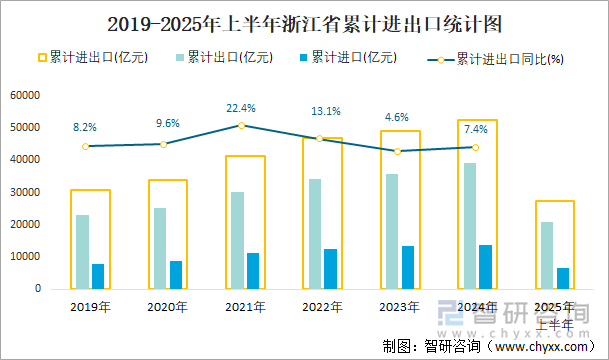
2025年上半年浙江省贸易统计分析:浙江省进出口总额为27326.9亿元,同比增长6.6%
Chan Ye Xin Xi Wang· 2025-08-20 03:27
相关报告:智研咨询发布的《2025-2031年中国数字贸易行业竞争策略研究及未来前景展望报告》 数据来源:海关总署,智研咨询整理 2025年上半年,浙江省进出口总额(海关口径)为27326.9亿元,比上年同期增长6.6%,其中出口额为 20734.24亿元,同比增长9.1%,进口额为6592.66亿元,同比下滑0.4%,贸易顺差为14141.58亿元。 上市企业:中成股份(000151),远大控股(000626),厦门信达(000701),凯瑞德(002072),江 苏国泰(002091),怡亚通(002183),鹏都农牧(002505),五矿发展(600058),苏豪弘业 (600128),东方创业(600278),江苏舜天(600287),ST沪科(600608),苏美达(600710), 云维股份(600725),汇鸿集团(600981),中信金属(601061) 知前沿,问智研。智研咨询是中国一流产业咨询机构,十数年持续深耕产业研究领域,提供深度产业研 究报告、商业计划书、可行性研究报告及定制服务等一站式产业咨询服务。专业的角度、品质化的服 务、敏锐的市场洞察力,专注于提供完善的产业解决方案,为您的投 ...