
化妆品

Search documents
防晒霜六项检测项目不合格,广州泊美合计被罚没1.08万元
Xi Niu Cai Jing· 2025-12-02 06:34
公告显示,2024年6月12日,广州泊美生产"韩熙美白防晒霜SPF50+PA+++(批号:CM20240612E01、限期使用日期:20270611、包装规格:50g)"384盒, 其中留样3盒,自检使用3盒,剩余378盒于2024年6月22日以2元/盒的单价销售给了陈伟坚。 上海市食品药品检验研究院在广州市江哲秀贸易有限公司抽检并出具《检验报告》,报告显示广州泊美生产的"韩熙美白防晒霜SPF50+PA+++",按相关规定 检验发现,甲氧基肉桂酸乙基己酯、水杨酸乙基己酯、苯基苯并咪唑磺酸(以酸记)、双-乙基己氧苯酚甲氧苯基三嗪、乙基己基三嗪酮、胡莫柳酯项目不 符合规定,检验结论为不合格。 广州泊美对上述3盒留样自行销毁,被查处后立即发出召回公告,但未能成功召回涉案产品。经查,广州泊美未按照化妆品注册资料载明的技术要求生产化 妆品的货值金额为768元,违法所得为756元。 依据相关规定,广州市市场监督管理局对广州泊美处以没收违法所得756元、罚款10000元,合计罚没款10756元的处罚,以及责令其改正未按照化妆品注册 资料载明的技术要求生产化妆品的违法行为。 信用中国(广东广州)官网显示,广州市泊美化妆品有限 ...

丸美生物实控人分红8亿,公司陷违规风波
Guo Ji Jin Rong Bao· 2025-12-02 06:05
Group 1 - The core issue revolves around the significant dividend payout of 800 million yuan to the controlling shareholder of Marubi Biotechnology, while the company faces allegations of regulatory violations [1] - Marubi Biotechnology's financial performance has been strong, with a reported revenue increase of 20% year-on-year, reaching 2 billion yuan in the last fiscal year [1] - The company has been under scrutiny for potential violations related to its financial disclosures and corporate governance practices, raising concerns among investors [1] Group 2 - The controlling shareholder's substantial dividend raises questions about the company's commitment to reinvestment and long-term growth strategies [1] - Analysts are divided on the implications of the dividend payout, with some viewing it as a sign of financial health, while others see it as a red flag for governance issues [1] - The ongoing regulatory scrutiny could impact Marubi's market reputation and investor confidence, potentially affecting its stock performance in the near future [1]

广州俪妍因生产未经注册的特殊化妆品和标签虚假化妆品 被罚没超10万元
Xi Niu Cai Jing· 2025-12-02 05:57
广州俪妍能提供上述涉案化妆品的《特殊化妆品注册证》,但上述产品成分与注册批件的配方不一致,因此广州市市场监督管理局认定其存在生产未经注册 的特殊化妆品的违法行为,认定其生产未经注册的特殊化妆品的货值为7226.95元,违法所得为7024.01元。 2025年8月20日,在广州市市场监督管理局对广州俪妍现场检查时,还发现其生产车间里的一条化妆品生产线正在生产标签虚假的化妆品的违法行为。上述 化妆品还没有销售就被查获、没有定价,按成本价计算下来,被扣押的504盒成品货值为970.2元,违法所得为0元。 据公告来看,上述问题产品分别为LAENNA莱也纳美白隔离防晒乳、韩方五谷双抗紧致焕亮精华面膜+韩方五谷双抗紧致焕亮精华液。基于上述违法行为, 广州俪妍合计被罚没超10万元。 | 第二 四 信用中国 (厂乐厂州) | | 长者助手 无障碍浏览 台员 信用信息 站内文章 | | --- | --- | --- | | | | 请输入法人组织名称或统一社会信用代码查询 | | 首 | 页 服务大厅 信用公示 | 行业信用 信用研究 信用创新 诚信文化 | | 详细信息 | | 信源单位:广州市市场监督管理局(广州市知识产 ...

查处各类侵权假冒违法案件10805件
Mei Ri Shang Bao· 2025-12-02 05:43
Core Points - The Zhejiang Province has launched a "Double Strike Protection for Enterprises" campaign, resulting in the investigation of 10,805 cases of infringement and counterfeiting since July, with a total amount involved of 361 million yuan [1][2] - The campaign focuses on key areas such as digital economy, artificial intelligence, and emerging industries, emphasizing the importance of intellectual property protection for innovation [1] - A new mechanism has been established to address cross-regional illegal enforcement, enhancing the protection of local enterprises and optimizing the business environment [3] Group 1 - The "Double Strike Protection for Enterprises" campaign has been organized for the third consecutive year, involving 15 member units and leading to significant enforcement actions [1][2] - The campaign has resulted in the seizure of over 2,500 counterfeit "Zhengtai" dual power conversion switches and related equipment, with an involved amount exceeding 2 million yuan [2] - The campaign has also targeted various well-known brands, including "Huawei," "Moutai," and "Chanel," to strengthen trademark protection [3] Group 2 - The Zhejiang Provincial Market Supervision Administration has introduced eight measures to standardize cross-regional enforcement actions, aiming to prevent illegal practices and improve the regional business environment [3] - The provincial authorities are committed to enhancing the enforcement of intellectual property rights and fostering a collaborative environment between government and enterprises [4] - Continuous efforts will be made to strengthen the crackdown on infringement and counterfeiting, with a focus on optimizing the business environment for enterprises [4]
长沙旺轩化妆品有限公司成立 注册资本20万人民币
Sou Hu Cai Jing· 2025-12-02 05:27
天眼查App显示,近日,长沙旺轩化妆品有限公司成立,法定代表人为穰梅旺,注册资本20万人民币, 经营范围为一般项目:化妆品批发;化妆品零售;个人卫生用品销售;卫生用品和一次性使用医疗用品 销售;国内贸易代理;保健食品(预包装)销售;日用百货销售;日用品销售;厨具卫具及日用杂品零 售;家居用品销售;橡胶制品销售;日用杂品销售;日用化学产品销售;互联网销售(除销售需要许可 的商品);食品销售(仅销售预包装食品)(除依法须经批准的项目外,自主开展法律法规未禁止、未 限制的经营活动)。 ...
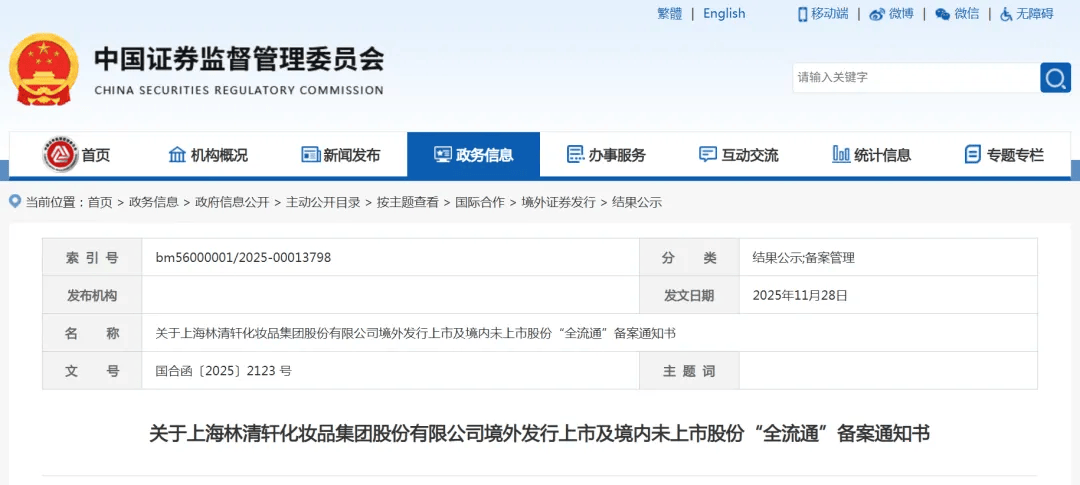
林清轩完成港股上市备案,冲击港股“国货高端护肤第一股”
Sou Hu Cai Jing· 2025-12-02 04:31
Core Viewpoint - The China Securities Regulatory Commission has issued a notice regarding the overseas issuance and listing of Shanghai Linqingxuan Cosmetics Group Co., Ltd., which plans to issue up to 16,061,400 overseas listed ordinary shares and list them on the Hong Kong Stock Exchange [2] Company Overview - Linqingxuan is a leading high-end domestic skincare brand in China, focusing on anti-wrinkle and firming skincare products, known for its flagship brand "Linqingxuan" which offers high-end skincare solutions based on natural camellia flower ingredients [3][4] - The company has pioneered the "oil-based skincare" concept since 2012, launching its first camellia essence oil in 2014, which has become a core product line [3][5] Market Position - Linqingxuan ranks first among all domestic high-end skincare brands in China by retail sales in 2024 and is the only domestic brand among the top 15 high-end skincare brands, including both domestic and international brands [3][4] - The high-end skincare market in China is rapidly growing, projected to increase from RMB 749 billion in 2019 to RMB 1,144 billion in 2024, with expectations to reach RMB 2,185 billion by 2029 [4] Financial Performance - The company's revenue increased from RMB 6.91 billion in 2022 to RMB 8.05 billion in 2023, and is expected to further rise to RMB 12.10 billion in 2024, reflecting a compound annual growth rate of 32.3% from 2022 to 2024 [8] - In 2024, the total profit and comprehensive income amounted to RMB 1.87 billion, with a net profit margin of 15.4% [8] Product Development and R&D - Linqingxuan emphasizes independent development of core ingredients and technologies related to camellia flower for anti-wrinkle and skin repair, with R&D costs of RMB 21.1 million, RMB 19.7 million, and RMB 30.4 million for 2022, 2023, and 2024 respectively [7] - The company offers a full range of high-end skincare solutions, including essence oils, creams, toners, and masks, with a total of 188 SKUs as of December 31, 2024 [5] Production Capacity - Linqingxuan operates two production bases in Shanghai, with a total building area of 49,120 square meters and an annual designed production capacity of 365 tons of raw materials and 40,700 thousand skincare products [7]
郑州草本十二化妆品有限公司成立 注册资本10万人民币
Sou Hu Cai Jing· 2025-12-02 04:15
天眼查App显示,近日,郑州草本十二化妆品有限公司成立,法定代表人为李博,注册资本10万人民 币,经营范围为一般项目:化妆品零售;化妆品批发;个人卫生用品销售;日用百货销售;日用品销 售;日用杂品销售;日用化学产品销售;互联网销售(除销售需要许可的商品);食品互联网销售(仅 销售预包装食品);技术服务、技术开发、技术咨询、技术交流、技术转让、技术推广(除依法须经批 准的项目外,凭营业执照依法自主开展经营活动)。 ...
三角防务、巨子生物实控人严建亚入股三人行,斥资超4.51亿成第二大股东
2 1 Shi Ji Jing Ji Bao Dao· 2025-12-02 02:35
Core Viewpoint - The announcement by Sanrenxing (605168.SH) regarding the transfer of shares to Yan Jianya highlights a significant change in the company's ownership structure, with Yan becoming the second-largest shareholder after the transaction [1] Group 1: Share Transfer Details - Yan Jianya acquired approximately 16,865,359 shares for a total of about 451 million yuan, representing 8.00% of the company's total equity [1] - The share transfer price was set at 26.76 yuan per share, based on the closing price of the trading day prior to the signing and aligned with the lower limit of block trading prices [1] - Post-transaction, Yan Jianya will become the controlling shareholder and the second-largest shareholder outside of the company's concerted actions [1] Group 2: Yan Jianya's Background - Yan Jianya is a well-known entrepreneur and seasoned industry investor, currently serving as the chairman of listed company Triangle Defense and the chairman of the board of Juzhi Biotechnology [1] - His business interests span multiple sectors, including aerospace and military, advanced manufacturing, new materials, and biotechnology [1] - Yan and his concerted actions hold a total of 15.18% of shares in Triangle Defense and 55.34% in Juzhi Biotechnology, indicating significant equity stakes [1]


高嵩出任捷豹路虎中国市场“新帅” 负责品牌战略与全域营销
Zhong Guo Jing Ying Bao· 2025-12-02 01:56
Group 1 - Jaguar Land Rover China has appointed Gao Song as the new Executive Vice President of Marketing, effective December 1, signaling a strategic shift towards brand rejuvenation and market expansion in China [2][3] - Gao Song brings nearly 20 years of experience in marketing and business management from top companies such as Procter & Gamble, Clarins, and Michelin, with expertise in brand building, e-commerce operations, product innovation, and business transformation [2][3] - During his tenure at Michelin, Gao transformed the traditional dealer collaboration model and established a consumer-driven marketing system, accumulating 12 million precise user leads and over 1 million members within five months [2] Group 2 - Gao's previous achievements include a 5.5 times increase in sales for Clarins in the Chinese high-end skincare market and successful brand launches at Procter & Gamble, showcasing his strong brand management and cross-department collaboration skills [3] - The Chief Commercial Officer of Jaguar Land Rover China, Wu Chen, emphasized Gao's diverse industry experience and innovative thinking as essential for expanding the market and solidifying brand value [3] - Gao expressed his commitment to enhancing user experience and innovation for luxury brands, aiming to maintain the unique identities of the four brands under Jaguar Land Rover and lead the company in the modern luxury market [3]
晶采观察丨六部门划定三大万亿级消费赛道 带来哪些利好?
Yang Guang Wang· 2025-12-02 01:29
Core Viewpoint - The implementation plan aims to enhance the adaptability of supply and demand in the consumer goods sector to address pain points in consumption [1][2] Group 1: Goals and Targets - The plan sets a target to cultivate three trillion-level consumption sectors and ten hundred-billion-level consumption hotspots by 2027 [2] - The three trillion-level sectors include elderly products, smart connected vehicles, and consumer electronics [2] - The ten hundred-billion-level hotspots focus on specific categories such as baby products, smart wearable devices, cosmetics, fitness equipment, outdoor products, pet food, civilian drones, trendy toys, jewelry, and national trend clothing [2] Group 2: Targeted Consumer Groups - For the young demographic, the plan emphasizes "individual expression" and "fashion leadership," supporting the development of culturally rich and fashionable products like national trend clothing and designer collaborations [2][3] - In addressing the needs of infants and students, the plan promotes the integration of traditional toys and stationery with smart technology, aiming for products that facilitate personalized interaction and learning [3] - For the elderly, the focus is on practical convenience and quality of life, with plans to enhance the development of products like elderly care robots, suitable clothing, and easy-to-swallow foods [3] Group 3: Market Dynamics - The plan anticipates the creation of a new consumption market worth trillions in key sectors by 2027, driven by both "stock optimization" and "incremental creation" [3] - Stock optimization refers to the growing popularity of culturally significant domestic products, while incremental creation involves developing new products and services for emerging demographics and scenarios [3] Group 4: Economic Impact - The multi-faceted approach is expected to significantly enhance the resilience and vitality of the domestic consumer market, providing solid support for the construction of a new development pattern [4] - The goal is to achieve a dynamic balance of supply and demand at a higher level within approximately five years, allowing consumers to enjoy higher quality products and services [4]