Cloud Computing

Search documents
未知机构:长江计算机金山云金山生态唯一战略云平台AI与生态协同重构业务边界与价值上-20260203
未知机构· 2026-02-03 01:50
Summary of Key Points from Conference Call Company and Industry Overview - The focus is on **Kingsoft Cloud**, which is positioned as the only strategic cloud platform within the Kingsoft ecosystem, emphasizing the synergy between AI and the ecosystem to redefine business boundaries and value limits [1] Core Insights and Arguments - The company's growth logic is clear: 1. **Short-term Growth**: Reliance on the rigid spending on AI budgets from Xiaomi and Kingsoft Office is expected to generate a certain increase in revenue [1] 2. **Long-term Growth**: Anticipation of a demand explosion in AI is expected to further open up growth opportunities [1] - Recent trends indicate a resurgence in downstream demand, with a clear logic for price increases, presenting further benefits for the company [1] - In North America, the market has entered a phase of application realization, where demand sensitivity to price has decreased, indicating that applications are becoming essential, leading to a smooth transmission of price inflation [1] - Future applications may also see price increases or accelerated monetization [1] Additional Important Insights - The recent popularity of overseas applications like **Clawdbot** has directly stimulated cloud demand internationally [2] - Domestically, there is an accelerated competition for application entry points, with scenarios gradually being implemented [3] - Major players like **Alibaba Cloud** and **Volcano** have reduced discounts, indicating a tightening market. The recent competition for traffic during the Spring Festival, driven by demand for red envelopes, live streaming, and other services, is expected to push up short-term traffic and lead to potential price increases in domestic CDN services, marking a reversal in trends [4]

计算机行业周报:北美云服务局部涨价,AI应用按下加速键
CHINA DRAGON SECURITIES· 2026-02-03 00:45
Investment Rating - The report maintains a "Recommended" investment rating for the computer industry [2] Core Insights - The North American cloud service market has recently experienced localized price increases, breaking the long-standing trend of only decreasing prices. This price hike is primarily led by Amazon Web Services (AWS) and Google Cloud, with AWS raising its EC2 machine learning capacity block prices by an average of approximately 15% [4][13] - The fundamental reasons for this price increase include a significant surge in AI application demand, leading to a supply-demand imbalance in computing resources, particularly high-performance GPUs. Additionally, cloud providers are investing heavily in infrastructure to support AI development, resulting in rising hardware and energy costs [4][14] - The emergence of Clawdbot (now OpenClaw) as a popular open-source AI project signifies a shift in AI applications from "conversational Q&A" to "agent-based execution," transforming AI into a "digital employee" capable of executing tasks autonomously [5][15][16] Summary by Sections Recent Market Trends - The computer industry index fell by 4.77% from January 26 to January 30, 2026, with notable stock performances among various companies [7] AI Infrastructure and Applications - The report emphasizes the growing trend of AI "cloud-edge-end" collaboration, with an accelerated iteration of AI application products. It suggests monitoring price fluctuations among domestic cloud service providers while maintaining the "Recommended" rating for the computer industry [18] - Key companies to watch in AI infrastructure include Haiguang Information, Cambricon Technologies, and Inspur Information, while AI application companies of interest include Kingsoft Office and iFlytek [18] Company Performance Forecasts - The report provides earnings forecasts for several companies, indicating expected growth in net profits for 2025, with some companies projecting increases of over 50% [11][12]
金山云取得账号登录方法专利
Jin Rong Jie· 2026-02-03 00:37
Group 1 - The State Intellectual Property Office of China has granted a patent to Jingjinshan Cloud Network Technology Co., Ltd. for a method, device, electronic equipment, and storage medium for account login, with the authorization announcement number CN115879090B [1] - The patent application was filed on August 2021 [1]
Google Cloud, Liberty Global strike five-year AI partnership
Reuters· 2026-02-03 00:05
Core Insights - Google Cloud and Liberty Global have established a five-year strategic partnership to implement Google's Gemini AI models and other cloud tools within Liberty Global's cable operations [1] Group 1 - Google Cloud is recognized as one of Alphabet's fastest-growing businesses, indicating strong market demand and growth potential [1] - The partnership aims to enhance Liberty Global's operational capabilities through advanced AI and cloud technologies [1]



Shareholder Rights Law Firm Robbins LLP Urges CRWV Investors to Contact the Firm About Leading the CoreWeave, Inc. Class Action Lawsuit
Globenewswire· 2026-02-02 21:46
Core Points - A class action has been filed on behalf of investors who purchased CoreWeave, Inc. (NASDAQ: CRWV) securities between March 28, 2025, and December 15, 2025 [1] - CoreWeave is described as an artificial intelligence cloud computing company and a "Hyperscaler," which delivers computing infrastructure and services at a massive scale [1] Allegations - The complaint alleges that CoreWeave misled investors by overstating its ability to meet customer demand for its services [2] - It is claimed that the company materially understated the risks associated with its reliance on a single third-party data center supplier, which could negatively impact revenue [2] Stock Performance - Following a series of disclosures, CoreWeave's stock price fell from a high of $183.58 on June 20, 2025, to $69.50 per share by December 16, 2025 [3]


What Snowflake's deal with OpenAI tells us about the enterprise AI race
TechCrunch· 2026-02-02 19:09
Core Insights - Snowflake has entered into a $200 million multi-year AI deal with OpenAI, indicating a growing competition in enterprise AI [1] - The partnership allows Snowflake's 12,600 customers to access OpenAI models across major cloud providers, enhancing their AI capabilities [1][2] - Snowflake's CEO emphasized the importance of combining enterprise knowledge with OpenAI's intelligence to create powerful and trustworthy AI agents [2] Partnership Details - The deal with OpenAI is part of a broader strategy, as Snowflake had previously announced a similar $200 million deal with Anthropic [3] - Snowflake aims to remain model-agnostic, providing customers with choices among various AI providers, including OpenAI, Anthropic, Google, and Meta [4] - The focus of the partnership is on reliability, performance, and real customer usage [4] Industry Trends - Other enterprises, such as ServiceNow, are also forming multi-year deals with AI companies like OpenAI and Anthropic, reflecting a trend towards offering customers model choices [7] - Surveys indicate conflicting results regarding which AI companies are leading in enterprise adoption, with both Anthropic and OpenAI being highlighted [8][9] - The current trend suggests that enterprises will continue to partner with multiple AI providers to leverage different strengths and weaknesses of their models [10][12]


Nvidia and Oracle put a price tag on AI — and OpenAI
Yahoo Finance· 2026-02-02 19:03
Core Insights - The proposed $100 billion investment in OpenAI is not a firm commitment but an invitation to invest incrementally, highlighting the need for sustainable funding in the AI sector [1][4] - The narratives surrounding Nvidia and Oracle emphasize the high costs associated with AI development and the necessity for substantial financial backing [2][3] Nvidia's Position - Nvidia's CEO stated that the company will make a significant investment in OpenAI, but clarified that the $100 billion figure should not be viewed as a literal amount [4] - Nvidia's role in the AI ecosystem is crucial as it provides the necessary compute power, positioning itself as a key player in the ongoing AI arms race [5][10] - The investment in OpenAI transforms Nvidia's image from a mere supplier to a strategic partner, as it seeks to maintain demand for its chips [6][8] Oracle's Strategy - Oracle plans to raise $45 billion to $50 billion by 2026 to expand its cloud infrastructure, with a mix of equity and bonds, addressing market concerns about its financial health [3][14] - The company's strategy aims to reassure investors and credit markets that it is not over-leveraging while trying to meet the growing demand for AI-related services [15][16] - Analysts view Oracle's funding plan as a necessary step to maintain investment-grade status and manage balance sheet concerns amid rising leverage [16][17] Market Dynamics - The AI market is experiencing a shift from a focus on rapid software development to the need for substantial infrastructure investments, which require careful financial planning [4][20] - Companies in the AI space are increasingly looking to diversify their supply chains and reduce dependence on Nvidia, which could impact Nvidia's market position in the long term [11][12] - The interconnected nature of funding and demand among major players raises questions about the sustainability of growth in the AI sector, as companies may prioritize cost optimization over expansion [18][19]


Following a $750 Million Deal with Perplexity, Is Microsoft Stock a Buy, Sell, or Hold?
Yahoo Finance· 2026-02-02 18:49
Core Viewpoint - Microsoft has secured a significant $750 million cloud deal with AI search startup Perplexity, which is seen as a potential boost for its Azure cloud business, despite a negative market reaction following its latest earnings report [1][2]. Financial Performance - Microsoft reported revenue of $81.27 billion, surpassing the consensus estimate of $80.27 billion, and adjusted earnings per share of $4.14, exceeding expectations of $3.97 [7]. - Azure cloud revenue growth was 39%, which fell short of the 39.4% consensus forecast, raising concerns among investors [7]. - Guidance for the More Personal Computing segment, which includes Windows, was approximately $12.6 billion, significantly below the expected $13.7 billion [7]. Market Reaction - Following the earnings report, Microsoft's stock dropped 10%, marking its worst single-day performance since March 2020, and erasing $357 billion from its market capitalization, which now stands at $3.22 trillion [6]. Strategic Moves - The deal with Perplexity diversifies its cloud infrastructure beyond its primary partner, Amazon Web Services [2]. - CFO Amy Hood indicated that Azure's performance could have been better if more data center capacity had been allocated to external customers instead of internal projects like Microsoft 365 Copilot and GitHub Copilot [8]. Infrastructure Investment - Microsoft invested $37.5 billion in data centers and equipment during the quarter, a 66% increase from the previous year, exceeding analyst expectations of $34.31 billion [9]. - The company added nearly 1 gigawatt of total capacity in the quarter, but customer demand continues to outpace supply, creating challenges for capacity management [9].

Stock Market Today: Love is in the air as market rebounds from rocky overnight trading; Dow, Russell rise
Yahoo Finance· 2026-02-02 18:13
Market Overview - The U.S. markets closed with the Dow increasing by 1.05%, Russell 2000 by 1.02%, Nasdaq by 0.56%, and S&P 500 by 0.54% [2] Nvidia and OpenAI - Nvidia's CEO Jensen Huang indicated that the company would not proceed with a $100 billion investment in OpenAI due to concerns about the latter's business model [2] - OpenAI is reportedly dissatisfied with the performance of Nvidia's hardware in responding to complex queries and is exploring alternative chip options [3] Oracle's Involvement - Oracle is financing a significant portion of OpenAI's data centers and is expected to raise up to $50 billion this year through a mix of debt and equity [4] - Analysts suggest that Oracle may consider layoffs to meet the financial demands associated with its data center projects [4] SpaceX and Xai Merger - SpaceX is set to merge with Xai, which may impact its plans for a potential IPO in 2026 or 2027 [5] - The combined valuation of SpaceX and Xai is estimated at $1.25 trillion, raising questions about the financial strategies employed by CEO Elon Musk [6] Amazon Layoffs - Amazon plans to cut approximately 2,200 jobs in Washington, with a significant portion being software engineers [6] - This follows previous layoffs of 14,000 jobs in October and another 16,000 jobs cut recently [6]

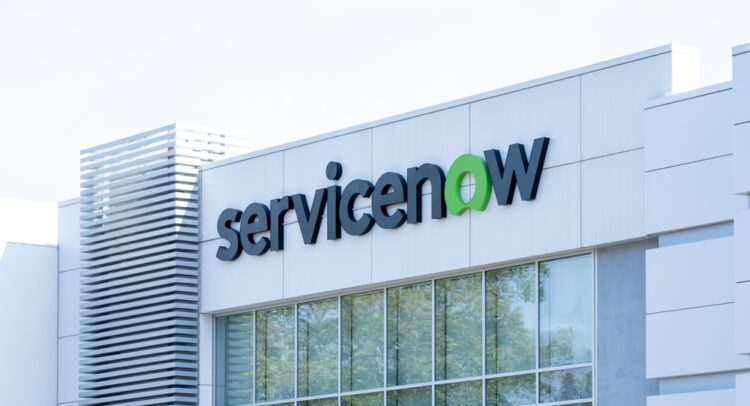
ServiceNow (NYSE:NOW) Sees Promising Future Despite Valuation Concerns
Financial Modeling Prep· 2026-02-02 17:03
Group 1 - ServiceNow is a significant player in the cloud computing industry, specializing in digital workflows to help businesses streamline operations [1] - The company competes with major tech firms like Salesforce and Microsoft in the enterprise software market [1] - Despite facing valuation concerns in 2025, ServiceNow is viewed as having a promising future [1] Group 2 - Goldman Sachs has set a price target of $216 for ServiceNow, indicating a potential price increase of approximately 84.6% from its current price of $117.01 [2][6] - The stock's addition to the US Conviction List by Goldman Sachs emphasizes its growth potential [2][6] Group 3 - ServiceNow's recent Q4 release confirmed its strengths, with a market capitalization of approximately $122.39 billion [3][6] - The stock price saw a slight increase of 0.28, or 0.24%, indicating potential for a rebound in 2026 [3] Group 4 - The stock has experienced fluctuations, with a daily low of $115.89 and a high of $118.83, and over the past year, it reached a high of $211.48 and a low of $113.13 [4] - This volatility presents a potential buying opportunity for investors, especially given the positive outlook from Goldman Sachs [4] Group 5 - Today's trading volume for ServiceNow is 28.05 million shares, reflecting strong investor interest [5] - The company is well-positioned for growth in the competitive cloud computing market as it addresses valuation concerns [5]