
医疗保险

Search documents
2018—2025年中央财政累计为医疗保障投入超3万亿元,惠及超180亿人次看病报销
Zheng Quan Shi Bao Wang· 2025-12-17 02:11
Core Insights - The central government has invested over 3 trillion yuan since 2018 to enhance the security of health insurance for residents and improve the convenience of medical services [1] - From 2018 to 2025, the central government has allocated a total of 2.87 trillion yuan for subsidies to urban and rural residents' basic medical insurance [1] - By 2025, the average total funding for urban and rural residents' basic medical insurance is projected to be 1,100 yuan per person, with a fiscal subsidy standard of 700 yuan and a personal contribution of 400 yuan, resulting in a fiscal subsidy accounting for over 60% [1] - Over 18 billion instances of medical insurance benefits have been enjoyed by residents from 2018 to 2025 [1]
【省医保局】陕西城乡居民医保集中缴费期12月25日截止
Shan Xi Ri Bao· 2025-12-16 22:46
Group 1 - The concentrated payment period for the 2026 urban and rural residents' basic medical insurance in Shaanxi will end on December 25, 2025, urging residents to pay on time to avoid affecting their medical benefits for the next year [1] - The personal contribution standard for the 2026 medical insurance is set at 400 yuan per person per year, with a financial subsidy increased to 700 yuan, indicating ongoing policy benefits [1] - Continuous contributors will enjoy full medical benefits from January 1 to December 31, 2026, while those who do not meet the continuous contribution criteria will face a 3-month waiting period for benefits [1] Group 2 - A fixed waiting period will be strictly enforced for those who do not contribute during the concentrated payment period, with no reimbursement for medical expenses incurred during this time [2] - For every year of non-continuous contribution, an additional 1-month variable waiting period will be added to the fixed waiting period, with a minimum 6-month wait for those who have been non-contributory for 4 years or more [2] - The provincial medical insurance bureau emphasizes the importance of timely contributions to protect personal rights, with a comprehensive five-level service network established for convenient payment [2]
全国7省份率先实现生娃基本不花钱
21世纪经济报道· 2025-12-15 13:38
Core Viewpoint - The article discusses the key focus areas for the national medical insurance system in China for 2026, emphasizing the goal of making childbirth essentially free nationwide and enhancing the overall management and efficiency of medical insurance funds [1][4]. Group 1: Key Focus Areas for 2026 - The national medical insurance system will focus on consolidating universal coverage and improving the basic medical insurance system [1]. - There will be support for the development of commercial health insurance to establish a multi-tiered medical security system [1]. - Strengthening the management of medical insurance funds to ensure their safety is a priority [1]. Group 2: Childbirth Cost Reduction - The initiative aims for childbirth to be essentially free across the country by 2026, with specific measures to include flexible employment workers and migrant workers in maternity insurance coverage [4]. - Seven provinces, including Jilin, Jiangsu, and Shandong, have already achieved the goal of making childbirth free [4]. - The plan includes enhancing prenatal care coverage and ensuring direct payment of maternity benefits to insured individuals [4]. Group 3: Long-term Care Insurance Development - The long-term care insurance system currently covers approximately 300 million insured individuals and has benefited over 3.3 million disabled individuals [5]. - The focus will be on optimizing long-term care services and encouraging commercial insurance institutions to develop related products [5]. Group 4: Fund Management and Efficiency - The article highlights the importance of the proper use of medical insurance funds, which are crucial for public health [8]. - Measures have been taken to combat fraud, with approximately 120 billion yuan recovered over five years [8]. - The implementation of a new payment system and the promotion of real-time settlement of medical insurance funds are planned for 2026 [10]. Group 5: Drug Procurement and Innovation - The national centralized drug procurement has become a regular practice, with the latest round including 55 drugs aimed at stabilizing clinical use and ensuring quality [12]. - The introduction of a commercial insurance drug directory aims to cover innovative drugs that exceed basic insurance coverage [13]. - The focus on digitalization and artificial intelligence in medical insurance governance is expected to enhance policy implementation and industry vitality [14][15].


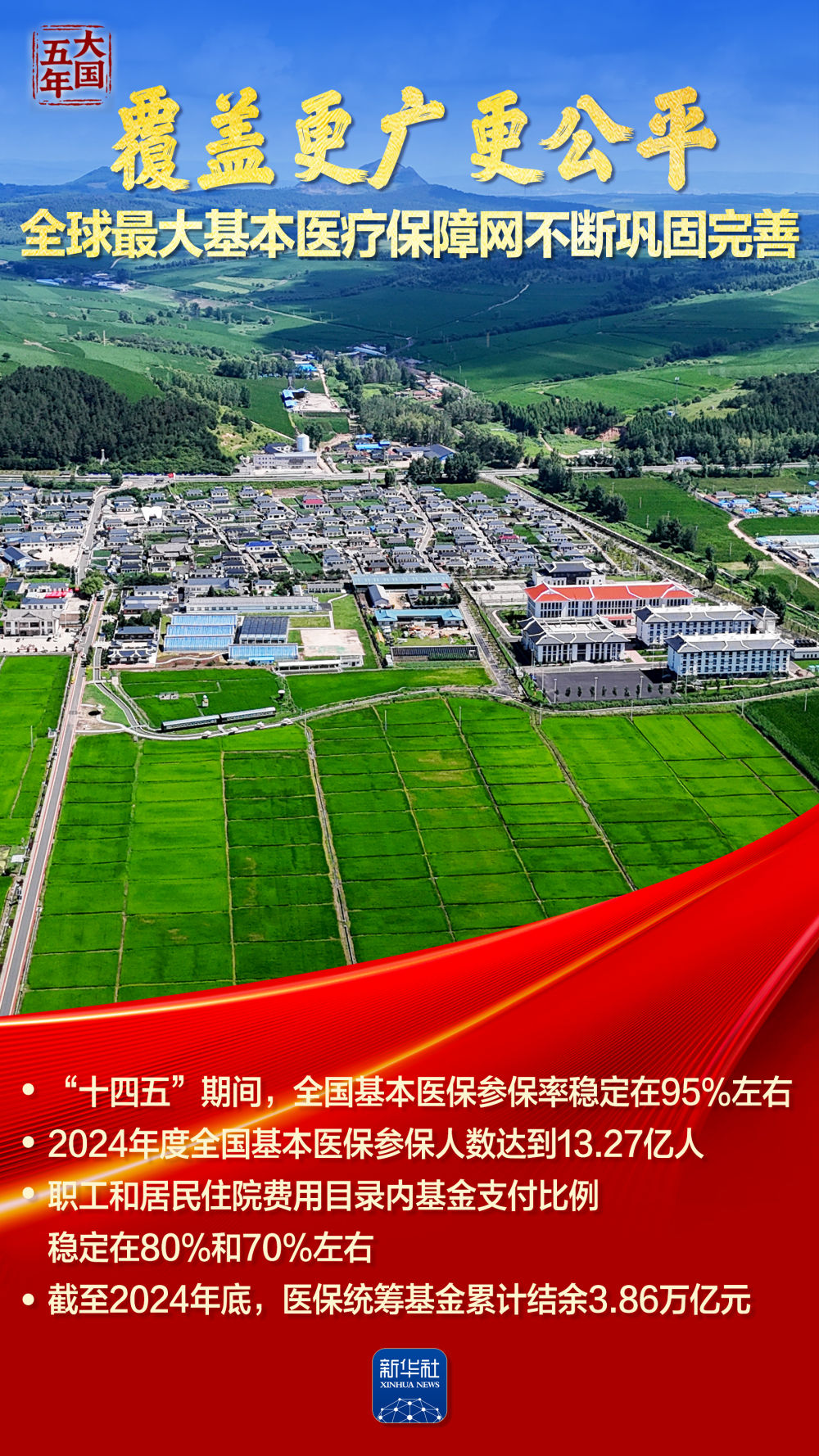
大国五年丨最大医保网,筑牢“健康中国”底盘
Xin Hua She· 2025-12-15 07:33
Core Insights - The article highlights the advancements and stability of China's healthcare insurance system during the "14th Five-Year Plan" period, emphasizing the establishment of a more equitable and efficient national healthcare network. Group 1: Healthcare Coverage - The national basic healthcare insurance coverage rate remains stable at around 95% during the "14th Five-Year Plan" period, with the number of insured individuals reaching 1.327 billion by 2024 [3] - The payment ratio for inpatient expenses is maintained at approximately 80% for employees and 70% for residents [3] Group 2: Financial Stability - By the end of 2024, the cumulative balance of the healthcare insurance fund is projected to reach 3.86 trillion yuan [4] - The basic healthcare insurance fund expenditure for 2024 is estimated at 2.98 trillion yuan, with a year-on-year decrease of about 5% in patient out-of-pocket expenses [16] Group 3: Long-term Care and Support - Over 8,800 long-term care service institutions have been established, with 300,000 care service personnel available [7][9] - The long-term care insurance system has expanded to cover 190 million people, benefiting over 2 million disabled individuals and reducing their care service costs by more than 50 billion yuan [9] Group 4: Drug Accessibility and Innovation - A total of 402 new drugs have been added to the healthcare insurance directory since the beginning of the "14th Five-Year Plan," with spending on innovative drugs in 2024 being 3.9 times that of 2020 [14] - More than 100 drugs are currently under application for inclusion in the innovative drug directory [14] Group 5: Service Improvement and Accessibility - The initiative to create a "15-minute healthcare service circle" has led to over 1.236 billion people using healthcare codes by June 2025 [24] - The online handling rate of healthcare administrative services has increased from 55% in 2020 to 92% in 2024 [24] - Cross-province direct settlement services for medical treatment have exceeded 500 million instances during the "14th Five-Year Plan" period [24] Group 6: Support for Vulnerable Populations - Since 2018, healthcare assistance has supported 350 million instances for low-income individuals, maintaining a 99% insurance coverage rate for rural low-income and poverty-stricken populations [25] - The reimbursement ratio for rural low-income individuals under the three-tiered support system exceeds 90% [25]
异地就医费用清算周期将逐步缩短
Xin Hua Wang· 2025-12-15 04:40
Core Viewpoint - The National Healthcare Security Administration (NHSA) has released a three-year action plan aimed at improving the efficiency of medical insurance fund settlement, with a target to complete annual settlements by March 31 of the following year starting in 2028, and to include various funding sources in the settlement process [1][2]. Group 1: Action Plan Overview - The action plan encourages localities to explore the inclusion of critical illness insurance funds and medical assistance funds in the settlement process to shorten the reimbursement cycle for cross-regional medical expenses [1]. - By 2026, all regions are required to complete the 2025 fund settlement, with pilot areas finishing by March 31, 2026, and the settlement funds should account for approximately 5% of the annual medical insurance fund disbursement [1]. - The plan outlines a phased approach, with specific deadlines for each stage of implementation, including a focus on data preparation and comprehensive assessment [2]. Group 2: Phased Implementation - In the acceleration phase, all regions must complete the 2026 fund settlement by April 30, 2027, with pilot areas finishing by March 31, 2027, and the settlement funds should range between 3% to 5% of the fund disbursement [1]. - The comprehensive implementation phase requires all regions to complete the 2027 fund settlement by March 31, 2028, maintaining the settlement funds at around 3% of the disbursement [2]. - The plan emphasizes the importance of developing clear guidelines for the settlement process, including data preparation and financial auditing [2].
国家医保局印发医保基金清算提质增效三年行动计划
Zheng Quan Shi Bao Wang· 2025-12-15 00:28
人民财讯12月15日电,国家医疗保障局办公室发布关于印发医保基金清算提质增效三年行动计划的通 知,工作目标是,在高质量完成医保基金结算的基础上,推进清算提速,自2028年起,实现每年3月底 前完成上年度清算,清算资金占年度医保基金拨付的3%左右,推进季度清算等创新模式。鼓励有条件 的地方,探索将大病保险资金和医疗救助基金等纳入清算提速范围,逐步缩短异地就医费用清算周期。 ...
国家医保局:对倒卖“回流药”等违法违规使用医保基金行为零容忍
Ren Min Wang· 2025-12-13 11:51
人民网北京12月13日电 (记者乔业琼)据国家医保局官网消息,今日,全国医疗保障工作会议在 北京召开,总结"十四五"时期医保工作,部署2026年工作。 会议要求,2026年,将持续加大飞行检查力度,实现全国所有统筹地区及各类基金使用主体全覆 盖,对患者自费率畸高且排名全国前列的统筹地区和定点医疗机构开展"点穴式"飞行检查,坚决维护人 民群众健康权益。坚决支持定点医疗机构根据诊疗需要对必需的医保目录内药品应配尽配。对倒卖"回 流药"等违法违规使用医保基金行为零容忍,坚决从严处罚。 会议指出,"十四五"时期,积极推进医药领域腐败以及群众身边不正之风和腐败问题集中整治,扎 实开展医保基金管理突出问题专项整治。全面开展"四不两直"飞行检查,实现全国所有省份全覆盖。5 年来共追回医保资金约1200亿元。创新开展药品追溯码采集和监管应用,累计归集追溯码超1000亿条, 有力打击通过倒卖"回流药"骗取医保基金等违法违规行为。 ...
国家医保局:5年追回医保资金约1200亿元
Zhong Guo Jing Ying Bao· 2025-12-13 10:45
2025年12月13日,全国医疗保障工作会议在北京召开。国家医保局方面披露,5年来共追回医保资金约 1200亿元。 国家医保局积极推进医药领域腐败以及群众身边不正之风和腐败问题集中整治,扎实开展医保基金管理 突出问题专项整治。全面开展"四不两直"飞行检查,实现全国所有省份全覆盖。5年来共追回医保资金 约1200亿元。创新开展药品追溯码采集和监管应用,累计归集追溯码超1000亿条,有力打击通过倒 卖"回流药"骗取医保基金等违法违规行为。 国家医保局方面表示,2026年,要进一步加强医保基金运行管理,守牢医保基金安全底线。持续加大飞 行检查力度,实现全国所有统筹地区及各类基金使用主体全覆盖,对患者自费率畸高且排名全国前列的 统筹地区和定点医疗机构开展"点穴式"飞行检查,坚决维护人民群众健康权益。坚决支持定点医疗机构 根据诊疗需要对必需的医保目录内药品应配尽配。对倒卖"回流药"等违法违规使用医保基金行为零容 忍,坚决从严处罚。 (文章来源:中国经营报) "十四五"时期,医保事业发展取得积极成效。 ...
国家医保局最新会议透露关键信号
21世纪经济报道· 2025-12-13 07:44
Core Viewpoint - The National Medical Insurance Administration summarized the achievements of the "14th Five-Year Plan" period and outlined key tasks for 2026, emphasizing the importance of healthcare reform and innovation to support public health and economic development [1][2]. Achievements of the "14th Five-Year Plan" - Standardized and unified the medical insurance system, enhancing the mutual assistance and protection functions of medical insurance [5]. - Strengthened the foundation for universal coverage, improving the quality and scope of insurance for flexible employment workers and migrant workers [6]. - Expanded the scope of benefits, with over 90% reimbursement for rural low-income individuals and the inclusion of assisted reproductive projects in insurance coverage [6]. - Optimized the payment mechanism, with 949 new drugs added to the insurance directory, totaling 3,253 drugs [6][7]. - Deepened drug price governance, promoting a unified national market for pharmaceuticals and medical supplies [7]. - Enhanced fund management, recovering approximately 120 billion yuan in misused funds over five years [8]. - Promoted digital empowerment in medical insurance, achieving over 600 million cross-province direct settlements [8]. - Emphasized the importance of party leadership in ensuring the stability and development of the medical insurance sector [8]. Key Tasks for 2026 - Consolidate the achievements of universal coverage and improve the basic medical insurance system [11]. - Support the development of commercial health insurance to create a multi-tiered medical security system [11]. - Strengthen fund management to ensure the safety and rational use of medical insurance funds [12]. - Adapt to population development strategies, promoting maternity and long-term care insurance [12]. - Optimize payment and settlement mechanisms to support the healthy development of the healthcare sector [13]. - Leverage strategic purchasing to support innovation in the pharmaceutical industry [13]. - Promote scientific approaches to medical insurance, enhancing the digital platform for universal coverage [14]. - Continuously improve service management to enhance the quality and efficiency of medical insurance services [14].

国家医保局最新部署:明年力争实现全国生娃基本不花钱
Di Yi Cai Jing· 2025-12-13 04:51
Group 1 - The core objective is to achieve "no out-of-pocket" expenses for childbirth within the policy scope nationwide by next year [1][2] - The National Medical Insurance Administration has been enhancing the coverage of maternity medical expenses, with seven provinces already achieving full coverage for childbirth costs [1] - By 2025, all provinces and regions will include eligible assisted reproductive projects in medical insurance, with 95% of areas directly providing maternity allowances to insured individuals [1] Group 2 - The National Medical Insurance Administration aims to improve the maternity insurance system by including flexible employment workers, migrant workers, and new employment forms in the coverage [2] - There is a focus on increasing the coverage level for prenatal examination medical expenses and exploring a basic service package that includes prenatal checkups [2] - All provinces are required to include suitable childbirth pain relief projects in the insurance payment scope and improve the management of medical insurance payments for assisted reproductive technology projects [2]