
医疗服务

Search documents
白沙医院首次“零关税”进口医疗设备
Hai Nan Ri Bao· 2026-01-09 02:48
Core Viewpoint - The introduction of the "zero tariff" policy in Hainan Free Trade Port has enabled the BaiSha Hospital to import advanced medical equipment, enhancing local healthcare services and reducing costs for patients [2][3]. Group 1: Medical Equipment Import - BaiSha Hospital successfully imported its first surgical microscope under the "zero tariff" policy, which arrived on December 29, 2025, and is set to improve surgical capabilities [2]. - The surgical microscope can magnify the surgical site by 1.2 to 12.8 times, allowing for precise observation of fine structures during complex surgeries [2]. - The cost of the surgical microscope was reduced from 930,000 yuan to 796,000 yuan due to the exemption from import duties, VAT, and consumption tax [3]. Group 2: Policy Impact - The "zero tariff" policy has expanded the eligibility for public medical institutions to benefit from reduced import costs, facilitating easier access to advanced medical equipment [3]. - The BaiSha Hospital has expressed its commitment to leveraging the benefits of the Hainan Free Trade Port policies to provide high-quality medical services locally [3]. - The collaboration between various local government departments, including the BaiSha Finance Bureau and Customs, was crucial in navigating the new import processes [3].
利好来袭!刚刚,突破4100点
Zhong Guo Ji Jin Bao· 2026-01-09 02:32
Market Overview - The A-share market is experiencing fluctuations with the Shanghai Composite Index rising above 4100 points, indicating a positive trend in major indices [1][2] - As of January 9, the Shanghai Composite Index increased by 0.54%, the Shenzhen Component Index rose by 0.80%, and the ChiNext Index saw a slight increase of 0.21% [2] Sector Performance - The healthcare sector, particularly stocks related to medical insurance payment reform, is showing strong performance, with significant gains in various stocks [3][4] - Key stocks in the healthcare sector include: - Jiahe Meikang (20.01% increase) - Di'an Diagnosis (20.00% increase) - Weining Health (12.95% increase) - Chuangye Huikang (10.23% increase) - Guoxin Health (10.01% increase) [4][3] Policy Impact - The National Healthcare Security Administration and the Ministry of Finance have issued a notice to optimize the personal account mutual aid policy for basic medical insurance, expanding the mutual aid scope from provincial to national levels [5][3] - The policy allows mutual aid relationships to be established voluntarily among close relatives of insured individuals, enhancing the support system for medical expenses [5] Stock Highlights - Zhite New Materials has seen a significant rise, achieving a 20% increase and maintaining a 5-day consecutive limit up, marking it as the first "doubling stock" of 2026 [7] - The company has stated that its core business remains unchanged, focusing on the research, production, and sales of aluminum molds and prefabricated components [7] Company Challenges - Meike Home experienced a sharp decline, hitting the daily limit down with a 10.07% drop, following a period of significant stock price increase due to acquisition plans [8][10] - The company reported a loss in the first three quarters of 2025, with a revenue of 2.223 billion yuan, down 10.10% year-on-year, and a net profit attributable to shareholders of -220 million yuan [10]


家庭医生“找不到、约不上”咋办?
Hang Zhou Ri Bao· 2026-01-09 02:32
Core Insights - The article discusses the evolution of family doctor services in China, emphasizing the transition from passive signing to proactive service delivery through the "Family Doctor Appointment" platform, leveraging the "Internet + Healthcare" model [3][4]. Group 1: Online Interaction and Accessibility - Residents can now interact with their family doctors through WeChat, allowing for easy access to health consultations and services, with over 1.22 million residents engaging in this manner and more than 34.42 million health interactions recorded [4]. - The platform supports various forms of online consultations, including text, voice, and video, enabling residents to receive guidance for common health issues [4]. - The system generates personalized health profiles based on residents' health records, providing targeted health reminders and preventive care information [4]. Group 2: AI Integration in Healthcare - The introduction of the "Anzhener 3.0" AI family doctor assistant offers 24/7 online consultations, capable of multi-turn interactions and basic medical reasoning, while also facilitating referrals to human doctors for complex cases [5]. - This AI integration aims to enhance the efficiency and professionalism of healthcare responses, making family doctors more accessible to residents [5]. Group 3: Home Care Services - The article highlights the importance of providing tangible services, particularly for vulnerable populations such as the elderly and those with chronic illnesses, through home visits by healthcare professionals [7]. - Family doctors can issue long prescriptions for chronic conditions and utilize internet hospital services for home delivery of medications, ensuring continuous care for patients with mobility issues [7]. - Mobile medical units and smart diagnostic equipment are deployed to deliver healthcare services directly to remote areas, with over 93,300 visits conducted in the past year, serving approximately 132,400 residents [7]. Group 4: Referral and Coordination - Family doctors can initiate "cloud referrals" for patients needing specialist care, facilitating priority appointments and insurance benefits, thereby promoting a habit of seeking care through family doctors first [8]. - The "Family Doctor Appointment" platform ensures a closed-loop service process, coordinating care among various healthcare professionals, including nurses and pharmacists, to provide integrated and continuous care [8]. - The increasing engagement metrics suggest a trend towards family doctors becoming an integral part of residents' daily lives, addressing previous challenges in accessibility and appointment scheduling [8].

新华时评·民生无小事|把好事办好,让少排队成常态
Xin Hua Wang· 2026-01-09 02:19
Group 1 - The core viewpoint emphasizes the need to improve the medical payment experience by reducing waiting times and implementing convenient payment systems such as facial recognition and mobile payments within three years [1] - The initiative aims to alleviate common issues faced by the public in medical settings, including long queues for payments and services, by optimizing payment processes and enhancing data sharing across different medical services [1] - A combination of efforts from various sectors, including healthcare, finance, and insurance, is necessary to create a seamless payment system and improve overall patient experience [1] Group 2 - Addressing long queues at payment windows is just the first step; there is a need to ensure that other areas, such as medication pick-up, do not become bottlenecks [2] - The focus on solving existing pain points in the healthcare system should also include preventive measures against new challenges that may arise, requiring a coordinated approach tailored to each hospital's circumstances [2] - There is an expectation for further reforms in various sectors to enhance the quality of life for citizens, emphasizing the importance of practical and effective measures [3]
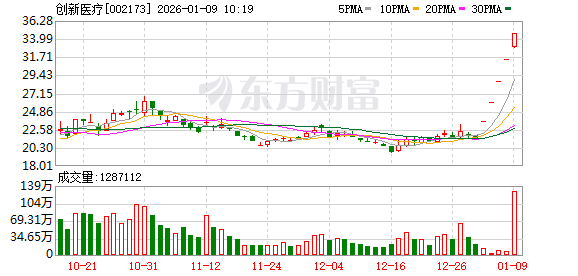
创新医疗连收5个涨停板
Zheng Quan Shi Bao Wang· 2026-01-09 02:18
Group 1 - The stock of Innovation Medical has reached a trading limit increase for five consecutive days, with a current price of 34.64 yuan and a turnover rate of 29.19% [2] - During the consecutive limit-up period, the stock has accumulated a total increase of 61.04% and a cumulative turnover rate of 38.57% [2] - The latest total market capitalization of A-shares is 152.86 billion yuan, with a circulating market capitalization of 144.21 billion yuan [2] Group 2 - As of January 8, the margin trading balance for the stock is 298 million yuan, with a financing balance of 297 million yuan, reflecting an increase of 7.13 million yuan or 2.46% compared to the previous trading day [2] - Over the past five days, the margin trading balance has decreased by 61.66 million yuan, representing a decline of 17.19% [2] - The stock has appeared on the Dragon and Tiger list once due to a cumulative deviation in the increase of 20% over three consecutive trading days, with a net sell-off of 7.94 million yuan from the Shenzhen Stock Connect [2] Group 3 - Recent performance data shows significant daily fluctuations in stock price and turnover rates, with the highest daily increase recorded at 10.02% on January 6 [2] - The net inflow of main funds has varied, with a notable inflow of 14.87 million yuan on January 8 [2] - The stock has experienced both positive and negative daily changes, indicating volatility in investor sentiment and trading activity [2]

脑机接口概念5连板!创新医疗9:43再度涨停,背后逻辑揭晓
Sou Hu Cai Jing· 2026-01-09 02:15
Group 1 - The core viewpoint of the article highlights that Innovation Medical has achieved a five-day consecutive limit-up trading, indicating strong market interest and momentum [1] - The stock reached a trading halt at 9:43 AM with a transaction volume of 4.293 billion yuan and a turnover rate of 30.37% [1] - The brain-computer interface concept continues to generate market enthusiasm, with Innovation Medical investing in cutting-edge technology through its affiliated companies [1] Group 2 - The affiliated company of Innovation Medical has collaborated with Huawei Ascend to launch AI medical products, further enhancing its market position [1] - The operational success of its elderly care facilities has contributed to the company's positive market perception and interest [1] - Multiple factors, including technological advancements and operational performance, have created a resonance of market interest around Innovation Medical [1]
AI医疗概念表现活跃 美年健康涨停
Mei Ri Jing Ji Xin Wen· 2026-01-09 01:44
每经AI快讯,1月9日,AI医疗概念表现活跃,美年健康(002044)涨停,迪安诊断(300244)涨停, 华人健康(301408)、安必平涨超9%,塞力医疗(603716)、国新健康(000503)跟涨。 ...


泰格医药1月8日获融资买入5628.18万元,融资余额7.24亿元
Xin Lang Zheng Quan· 2026-01-09 01:23
Group 1 - The core viewpoint of the news is that Tiger Med's stock performance and financing activities indicate a stable yet cautious market position, with a slight increase in stock price and a low financing balance relative to market capitalization [1][2]. Group 2 - On January 8, Tiger Med's stock rose by 0.51%, with a trading volume of 645 million yuan. The net financing purchase was 4.74 million yuan, with a total financing and securities balance of 727 million yuan [1]. - The financing balance of Tiger Med is 724 million yuan, accounting for 1.62% of its circulating market value, which is below the 30th percentile level over the past year, indicating a low financing position [1]. - In terms of securities lending, on January 8, Tiger Med repaid 24,100 shares and sold 300 shares, with a selling amount of 18,200 yuan. The securities lending balance is 2.78 million yuan, which is above the 60th percentile level over the past year, indicating a relatively high position [1]. Group 3 - Tiger Med, established on December 15, 2004, and listed on August 17, 2012, provides professional clinical research services for domestic and international pharmaceutical and health-related products. Its main business revenue composition includes 52.60% from clinical trial-related services and 45.21% from clinical trial technical services [2]. - As of September 30, 2025, Tiger Med reported a revenue of 5.026 billion yuan, a year-on-year decrease of 0.82%, while the net profit attributable to shareholders increased by 25.45% to 1.020 billion yuan [2]. - The company has distributed a total of 2.458 billion yuan in dividends since its A-share listing, with 1.154 billion yuan distributed in the last three years [3].

万亿级AI医疗市场,科技巨头接连出手(附概念股)
Zheng Quan Shi Bao Wang· 2026-01-09 01:03
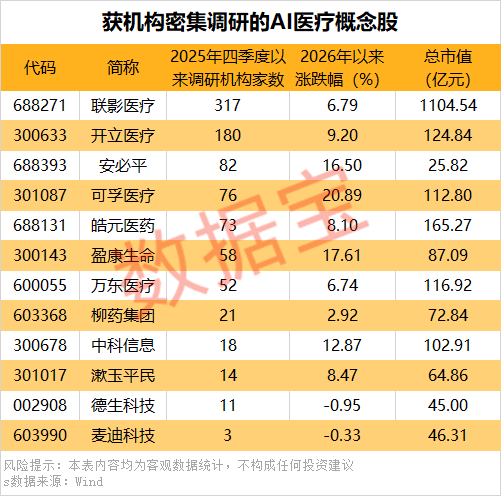
Group 1 - Major tech companies are increasingly focusing on the AI healthcare sector, with OpenAI launching the ChatGPT Health feature to address health-related inquiries and connect with smart devices, aiming to create a safer environment for health discussions [2] - Alibaba's Ant Group has also made significant strides in AI healthcare, with its AI health assistant "Antifor" connecting to 5,000 hospitals and 300,000 real doctors for online consultations, achieving 30 million monthly active users shortly after launch [2] - The AI healthcare market is projected to grow significantly, with a global market size expected to reach approximately $50.56 billion by 2033, reflecting a compound annual growth rate (CAGR) of 38.8% from $2.665 billion in 2024 [4] Group 2 - The Chinese government is actively promoting AI healthcare applications, with policies aimed at establishing over 100 typical application scenarios by 2027 and ensuring widespread adoption of AI products in healthcare institutions by 2027 [3] - Companies like Zhongke Information and Anbiping are receiving attention from institutional investors, with Anbiping's AI-assisted diagnostic tools currently in the registration process, indicating a growing market for AI applications in healthcare [6][7] - Recent data shows that 12 AI healthcare-related stocks have been under institutional research, with companies like Lianying Medical and Kailing Medical seeing significant interest and investment [5][7] Group 3 - The commercial aerospace sector is facing challenges, as evidenced by LeKai Film's announcement of a potential annual loss despite a recent stock price surge driven by speculation in the commercial aerospace market [9] - LeKai Film reported a revenue of 960 million yuan and a net loss of 86 million yuan for the first three quarters of 2025, highlighting the risks associated with speculative trading in the commercial aerospace sector [9]
持续提高全民健康水平
Ren Min Ri Bao· 2026-01-08 23:09
Group 1 - The core message emphasizes the importance of health in promoting comprehensive human development and economic growth, highlighting recent advancements in health policies and systems in China [1][2] - The "Healthy China 2030" initiative aims to improve the health system, promote healthy lifestyles, and enhance health service quality by 2030, addressing current imbalances and chronic disease prevalence [2][3] - The government is prioritizing health in all policies, integrating health indicators into performance assessments, and increasing investment in health sectors, including public hospitals and disease prevention [3][4] Group 2 - Continuous optimization of health services is essential to reduce severe illnesses and improve recovery rates, focusing on major diseases and enhancing diagnostic capabilities [4] - The strategy includes the establishment of national medical centers and regional healthcare systems to ensure that patients receive appropriate care at the right level [4] - The commitment to a people-centered development approach aims to mobilize societal efforts to safeguard public health and achieve significant progress in modernizing healthcare [4]