
运输

Search documents
中国神华(601088) - 中国神华2025年10月份主要运营数据公告
2025-11-14 09:46
证券代码:601088 证券简称:中国神华 公告编号:临 2025-068 中国神华能源股份有限公司 2025 年 10 月份主要运营数据公告 中国神华能源股份有限公司("本公司")董事会及全体董事保证本公告内 容不存在任何虚假记载、误导性陈述或者重大遗漏,并对其内容的真实性、准确 性和完整性承担法律责任。 注:本公司收购国家能源集团杭锦能源有限责任公司("杭锦能源")100%股权的交 易已完成。自 2025 年 2 月起,本公司主要运营指标包含杭锦能源相关业务量,并对上年同 期本公司主要运营指标进行了重述。 2025 年 10 月,本公司天津煤码头装船量同比增长的主要原因,是上年同期 港口设备检修等导致基数较低;航运周转量同比下降的主要原因,是业务结构调 整、航线结构变化;聚丙烯销售量同比增长的主要原因,是聚丙烯产量增长及本 月消化部分库存。 以上主要运营数据来自本公司内部统计。运营数据在月度之间可能存在较大 差异,其影响因素包括但不限于天气变化、设备检修、季节性因素和安全检查等。 运营数据可能与相关期间定期报告披露的数据有差异。投资者应注意不恰当信赖 或使用以上信息可能造成投资风险。 1 承中国神华能源股 ...

防御板块投资!交通运输ETF(159666)冲击三连阳
Mei Ri Jing Ji Xin Wen· 2025-11-14 01:59
交通运输ETF(159666)及其联接基金(019405/019404)是全市场唯一跟踪中证全指运输指数的ETF基 金,其涵盖了A股市场包括物流、铁路公路、航运港口、机场等,能够充分反映出A股运输行业上市公 司的整体表现。 11月14日,交通运输ETF(159666)上涨0.28%,冲击三连阳,持仓股招商轮船、海汽集团、海峡股份 涨超3%。 交通运输板块的防御属性,体现在市场震荡、经济下行等不确定环境中股价和业绩波动较小,能为投资 者提供稳定回报与风险对冲,核心源于多方面支撑:作为经济中游基础设施,其公路铁路客货运输、港 口装卸、快递配送等业务存在刚性需求,抗周期波动能力突出;板块内不少重资产运营的龙头或垄断性 基础设施运营商,长期低估值且现金流稳定、分红属性,高股息带来安全边际;叠加国家战略层面的政 策扶持与资金支持,有效降低行业经营风险、平滑波动;且细分领域分化,公路、铁路、快递等内需敞 口板块防御性更优,航空、航运等板块波动也低于多数高成长、高波动板块,整体防御特质显著。 (文章来源:每日经济新闻) ...
俄哈签署,普京:重要成果
中国能源报· 2025-11-13 09:13
Core Points - The declaration signed by Russian President Putin and Kazakh President Tokayev establishes a comprehensive strategic partnership between the two countries, marking a significant elevation in their bilateral relations [1][2] - The agreement includes a series of intergovernmental and departmental agreements focusing on long-term cooperation in security policy, trade investment, and cultural-humanitarian fields [1] - Energy cooperation is a key focus, particularly in oil, gas, coal, and electricity sectors, with an emphasis on natural gas transportation to third countries and the protection of critical cross-border energy infrastructure [1][2] Group 1 - The declaration emphasizes the commitment to building a more representative and just multipolar world order based on international law [1] - Both countries will collaborate to maintain international security and stability, supporting the Collective Security Treaty Organization in regional stability efforts [1] - The declaration reiterates the principle of no foreign armed forces being allowed in the Caspian Sea, highlighting regional security concerns [2] Group 2 - The partnership aims to enhance trade liberalization among Eurasian member states and improve the capacity of the International North-South Transport Corridor [2] - The establishment of a UN Sustainable Development Regional Center for Central Asia and Afghanistan in Kazakhstan is welcomed by both parties [2] - The importance of the signed document is underscored by the Kremlin, indicating high-level attention to the partnership [2]


摩洛哥推出中小微企业扶持机制
Shang Wu Bu Wang Zhan· 2025-11-13 03:29
Core Viewpoint - Morocco's Prime Minister Akhannouch announced a support mechanism for small and medium-sized enterprises (SMEs), providing subsidies of up to 30% of investment amounts to stimulate economic growth and job creation [1] Group 1: Support Mechanism Details - The subsidy is categorized into three types: long-term employment creation subsidies, regional subsidies, and sector-specific subsidies, which can be combined [1] - The entire process for the support mechanism, including project application, review and approval, investment agreement signing, and financial disbursement, is managed through the Regional Investment Centers (CRI) [1] Group 2: Economic Impact and Employment - SMEs represent over 90% of all enterprises in Morocco and are crucial for wealth generation and job opportunities [1] - Since the implementation of the new investment law in March 2023, the National Investment Committee has approved 250 investment projects totaling $41.4 billion, expected to create 179,000 direct and indirect jobs [1] Group 3: Broader Economic Initiatives - The Moroccan government is implementing various measures to optimize the business environment through the 2023-2026 roadmap, including simplifying investment processes, promoting online business registration, activating the "CRI-Invest" digital platform, and enacting structural tax reforms [1]
中国神华(601088):煤电化工港口业务毛利率均有提升,构建成长+红利双重价值
Dongxing Securities· 2025-11-12 08:27
Investment Rating - The report maintains a "Strong Buy" rating for China Shenhua [5][9]. Core Views - The report highlights that the company's coal, power, chemical, and port businesses have all seen improvements in gross profit margins, indicating a dual value of growth and dividends [5][9]. - Despite a decline in revenue and net profit for the first three quarters of 2025, the company is expected to recover due to its cost advantages and integrated coal-power operations [5][9]. Summary by Sections Financial Performance - For the first three quarters of 2025, the company achieved revenue of 213.15 billion yuan, a year-on-year decrease of 16.6%, and a net profit of 39.05 billion yuan, down 15.24% [1]. - The operating cash flow net amount was 65.25 billion yuan, a decline of 11.7% year-on-year [1]. Coal Division - The coal division's gross profit margin increased to 30.4%, up 2.01 percentage points year-on-year, despite a 21.1% drop in revenue to 159.10 billion yuan [2]. - In Q3 2025, coal production reached 85.50 million tons, a 2.3% increase year-on-year, marking the first quarter of positive growth in 2025 [2]. Power Division - The gross profit margin for the power division improved to 19.2%, up 3.5 percentage points year-on-year, with total profit increasing by 20.4% to 10.14 billion yuan [3]. - Total power generation for the first three quarters was 162.87 billion kWh, down 5.4% year-on-year [3]. Transportation and Chemical Division - The transportation division saw a profit increase to 10.31 billion yuan, while the port business experienced gross profit growth due to reduced costs [4]. - The chemical products segment reported a revenue increase of 6.1% to 4.35 billion yuan, with a gross profit margin of 7.1%, up 0.2 percentage points year-on-year [4]. Profit Forecast - The company is projected to achieve net profits of 51.35 billion yuan, 53.51 billion yuan, and 54.57 billion yuan for 2025, 2026, and 2027 respectively, with corresponding EPS of 2.58, 2.69, and 2.75 yuan [9][10].
大众公用股价跌5.29%,南方基金旗下1只基金位居十大流通股东,持有1736.27万股浮亏损失625.06万元
Xin Lang Cai Jing· 2025-11-12 02:58
Group 1 - The core point of the news is that Shanghai Dazhong Public Utilities (Group) Co., Ltd. experienced a decline in stock price by 5.29%, with the current share price at 6.45 CNY and a total market capitalization of 19.043 billion CNY [1] - The company's main business revenue composition includes gas sales at 89.67%, wastewater treatment at 4.17%, construction at 1.80%, transportation at 1.75%, commerce at 1.38%, other (supplementary) at 0.90%, municipal tunnel operations at 0.29%, and finance at 0.05% [1] Group 2 - Among the top ten circulating shareholders of Dazhong Public Utilities, a fund under Southern Fund holds a significant position. The Southern CSI 1000 ETF (512100) reduced its holdings by 516,400 shares in the third quarter, now holding 17.3627 million shares, which accounts for 0.59% of the circulating shares [2] - The Southern CSI 1000 ETF (512100) has a current scale of 76.63 billion CNY, with a year-to-date return of 28.07% and a one-year return of 16.08% [2]

中新互联互通项目为构建周边命运共同体注入新动能
Xin Hua Wang· 2025-11-10 12:54
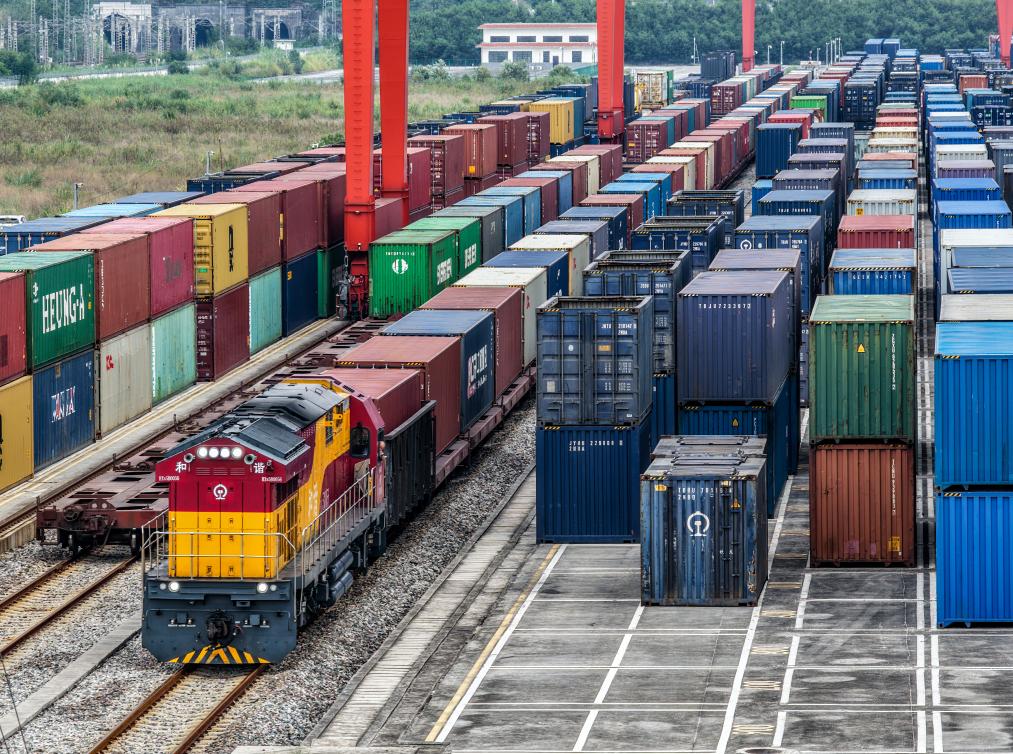
Core Insights - The China-Singapore (Chongqing) Strategic Connectivity Demonstration Project has achieved significant milestones over the past decade, including 347 signed government and commercial cooperation projects worth $26 billion and a cumulative cross-border financing amount of $21.7 billion [1] Group 1: Project Achievements - The project has successfully established a new cooperation framework between China (Chongqing) and Singapore, facilitating direct connections and enhancing regional economic development [1] - The Western Land-Sea New Corridor, initiated under this project, has become a vital trade route connecting the Silk Road Economic Belt and the 21st Century Maritime Silk Road, significantly reducing shipping times to Southeast Asia [2] - The range of goods transported via the Western Land-Sea New Corridor has expanded to 1,316 categories, reaching 577 ports in 127 countries and regions, with a total volume nearing 5 million TEUs [2] Group 2: Financial Cooperation - Over the past ten years, diverse cross-border financing channels have been established, including the first real estate investment trust in Asia and the first digital RMB cross-border settlement [3][5] - A total of 74 innovative open policies have been implemented to enhance financial cooperation between China and Singapore [3] Group 3: Broader Impacts - The project has facilitated cultural exchanges and tourism, with a significant increase in Chinese tourists visiting Singapore, reaching 2.5 million in the first nine months of the year [7] - The mutual visa exemption policy has enhanced travel convenience and cultural interactions between the two nations, contributing to growth in retail and service sectors [7] - Future plans include expanding cooperation in green finance, digital connectivity, and other forward-looking areas to better serve the real economy [5][8]
暂停收费!交通运输ETF(159666)上涨1.45%,海航科技涨停
Mei Ri Jing Ji Xin Wen· 2025-11-10 06:17
Core Viewpoint - The announcement from the Ministry of Transport regarding the suspension of special port fees for U.S. vessels and the USTR's decision to pause the 301 investigation into China's maritime, logistics, and shipbuilding industries are expected to reduce trade friction and boost market confidence, leading to a recovery in booking volumes on China-U.S. shipping routes [1]. Group 1: Market Performance - On November 10, the Transportation ETF (159666) rose by 1.45%, with HNA Technology hitting the daily limit, and stocks such as Xiamen Port Authority, Shanghai Port Group, and Liaoning Port Group showing strong performance [1]. - The Transportation ETF and its linked funds (019405/019404) are the only ETFs tracking the CSI Transportation Index, reflecting the overall performance of listed companies in the transportation sector in A-shares [1]. Group 2: Industry Impact - The suspension of tariffs and port fee exemptions is expected to eliminate uncertainties in trade friction, enhancing the stability of global supply chains and improving market sentiment [1]. - Companies within the transportation sector are characterized by high dividends, low valuations, and stable performance, covering logistics, railways, highways, shipping ports, and airports [1].



Brookfield Infrastructure Partners(BIP) - 2025 Q3 - Earnings Call Transcript
2025-11-07 15:02
Financial Data and Key Metrics Changes - Brookfield Infrastructure Partners generated third quarter Funds from Operations (FFO) of $654 million or $0.83 per unit, a 9% increase compared to the previous year, driven by strong organic growth [3][4] - The company maintained a well-capitalized balance sheet with liquidity totaling $5.5 billion at the end of the third quarter [8] Segment Performance Changes - Utilities segment generated FFO of $190 million, slightly ahead of the prior year, benefiting from inflation indexation and over $450 million of capital added to the rate base [3][4] - Transport segment's FFO was $286 million, lower than last year due to asset sales, but slightly ahead when adjusted for capital recycling initiatives [4] - Midstream segment generated FFO of $156 million, a 6% increase over the same period last year, driven by strong customer activity levels [5] - Data segment's FFO was $138 million, representing a more than 60% increase compared to the prior year, driven by strong organic growth and contributions from acquisitions [6] Market Data and Key Metrics Changes - The company completed a $700 million corporate issuance of medium-term notes at a weighted average interest rate of approximately 4%, priced at the tightest credit spreads in its history [7] - The company is on track to achieve $3 billion in asset sale proceeds over the next 12-18 months, with significant sales already completed [11] Company Strategy and Development Direction - The company has secured six new investments totaling over $1.5 billion, including a $1.3 billion New Zealand natural gas infrastructure operation and a $1 billion South Korean industrial gas business [9][10] - The company is focusing on AI-related infrastructure, expecting to deploy up to $500 million annually into this sector [14] - The outlook for Brookfield Infrastructure remains favorable, with expectations for FFO per unit growth to inflect higher due to new investments and macroeconomic trends [12][14] Management's Comments on Operating Environment and Future Outlook - Management noted a significant increase in capital deployment opportunities, particularly in the data sector, despite rising competition [17] - The company remains confident in its ability to source the best opportunities due to its global franchise and access to significant capital [17] - Management highlighted the potential for substantial growth in AI infrastructure, which is seen as a $7 trillion opportunity [14] Other Important Information - The company is contemplating an ATM program for BIPC shares to increase liquidity, with a focus on avoiding dilution to existing shareholders [21][22] - The company is exploring public market exits for its assets, depending on market conditions [26] Q&A Session Summary Question: Thoughts on rising competition for capital deployment opportunities - Management acknowledged increased competition but emphasized their distinct advantage due to global reach and capital access [17] Question: Timing and success metrics for LP unit repurchases - Management indicated that the program is still under consideration, focusing on increasing liquidity without diluting existing shareholders [21][22] Question: Future public market exits for assets - Management confirmed that public markets remain a potential exit strategy, contingent on favorable market conditions [26] Question: Investment thesis for CenterSquare - Management expressed optimism about continued growth and expansion opportunities within the CenterSquare platform [28][29] Question: Organic growth rates in data businesses - Management reported that organic growth in data businesses is tracking slightly ahead of underwriting assumptions, with significant future project potential [46][47]

皖能电力:11月6日召开董事会会议
Mei Ri Jing Ji Xin Wen· 2025-11-07 08:41
Group 1 - The core point of the article is that WanNeng Power announced the results of its board meeting held on November 6, 2025, which included discussions on the 2024 annual salary for management and the performance assessment results for the incentive income for the 2022-2024 term [1] - For the first half of 2025, WanNeng Power's revenue composition was as follows: 79.28% from the power generation industry, 17.97% from the coal industry, 1.52% from the transportation industry, 1.09% from waste treatment, and 0.14% from other sources [1] - As of the time of reporting, WanNeng Power had a market capitalization of 19 billion yuan [1]
