信托

Search documents
金融业正进入AI时刻!陈文辉重磅发声
Zhong Guo Ji Jin Bao· 2025-07-20 13:41
Core Insights - The core viewpoint is that 2025 will mark a pivotal year for the application of AI in the financial industry, driven by a digital transformation wave that is revolutionizing various sectors [1][6]. Group 1: Digital Transformation and AI Impact - The digital economy represents the fourth industrial revolution, with rapid advancements in computing power, storage capacity, and communication speed, making data a primary production factor [1]. - The cost of digital technologies is decreasing, leading to increased penetration in traditional industries, with digitalization becoming the main theme of the latter stage of the digital economy [2]. - AI technology is the core driver of a new round of transformation in the economy and society, enabling paradigm shifts rather than just incremental improvements [2]. Group 2: Current AI Applications in Finance - Financial institutions are primarily using AI for internal empowerment, with cautious approaches to customer-facing services, often starting with pilot projects [3][5]. - Different sectors within finance are adopting AI at varying rates, with banks leading in investment and application across various business functions [4][5]. - The application of AI in finance is accelerating, particularly in areas such as investment research, operational management, and compliance [4]. Group 3: Recommendations for Financial Institutions - Financial institutions should implement comprehensive digital transformation strategies, requiring leadership commitment and a long-term vision [8]. - There is a need to enhance the cultivation and utilization of AI talent, particularly at senior management levels, to effectively integrate AI into financial operations [9]. - Institutions must be vigilant about the risks associated with AI, establishing robust governance frameworks to maintain human oversight over critical processes [10]. - Financial resources should be directed more towards AI initiatives to support high-quality economic development [11][12].
金融业正进入AI时刻!陈文辉重磅发声
中国基金报· 2025-07-20 13:35
Core Viewpoint - The digital transformation in the financial industry is crucial, with 2025 expected to be a pivotal year for AI applications in finance [6][9]. Group 1: Digital Transformation and AI Impact - The digital wave is revolutionary, significantly impacting various industries and continuing to transform them comprehensively [3]. - The digital economy represents the fourth industrial revolution, with rapid growth in computing power, storage capacity, and communication speed, making data a primary production factor [3]. - The core business logic change driven by the digital wave allows new forces to disrupt traditional enterprises, exemplified by the electric vehicle industry's impact on the automotive sector [3]. Group 2: AI Applications in Finance - AI technology is widely applied in the financial sector, primarily for internal empowerment, with cautious direct customer service applications [7]. - Current AI applications in finance focus on internal operations, with a trend of pilot testing before broader implementation [7]. - Different financial sub-sectors exhibit unique characteristics in AI application, with banks leading in investment and implementation [8]. Group 3: Recommendations for Financial Institutions - Financial institutions should implement a comprehensive digital transformation strategy, led by top management, to ensure long-term investment and avoid traditional path dependencies [13]. - There is a need to enhance the cultivation and utilization of AI talent, particularly at senior management levels, to improve the effectiveness of AI in financial services [14]. - Financial institutions must pay close attention to potential risks associated with AI applications, establishing robust governance frameworks to maintain human oversight [15]. - Financial resources should be directed more towards AI fields to support high-quality economic development [16].


离岸家族信托为何频频“翻车”?这些细节你必须知道
Di Yi Cai Jing· 2025-07-20 12:35
Core Viewpoint - Offshore family trusts have faced significant challenges due to various pitfalls, including retaining control, neglecting tax compliance, unclear asset sources, improper timing of establishment, and unprofessional trust terms [1][7]. Group 1: Offshore Family Trust Overview - Offshore family trusts are commonly used by high-net-worth individuals, particularly entrepreneurs and wealthy individuals, to achieve legal, tax, inheritance, and asset protection goals by transferring assets to trustees in offshore jurisdictions such as BVI, Cayman Islands, Jersey, and Singapore [2]. - There have been numerous cases where trust funds were withdrawn by non-trustees or beneficiaries, often linked to poorly structured trusts, particularly those set up as share trusts in BVI [2][3]. Group 2: Trust Types and Control Issues - Cash trusts involve direct deposits in trustee accounts, requiring trustee consent for fund movement, thus ensuring asset isolation and compliance [2]. - Share trusts involve assets held in offshore companies, where if the original owner retains control, it can lead to legal risks and potential breaches of trust objectives [3][8]. Group 3: Legal and Tax Considerations - The legal framework and asset location are crucial; mismatches can lead to trust arrangements failing or being "pierced" [8]. - Tax optimization through offshore family trusts is possible but must be compliant; U.S. tax residents face significant risks if not properly structured, potentially triggering high tax liabilities [5][6]. Group 4: Common Pitfalls - Common pitfalls leading to failures in offshore family trusts include retaining actual control, ignoring tax compliance, unclear asset origins, improper timing of establishment, and unprofessional trust terms [7]. - The case of Zhang Lan illustrates how retaining control over trust assets can lead to legal challenges, resulting in the trust structure being invalidated [7][8]. Group 5: Future Considerations - As older generations of high-net-worth individuals in China approach the end of their careers, a rational and philanthropic approach to family wealth management and inheritance will be crucial for societal development [9].
陕国投A: 2025年半年度业绩快报
Zheng Quan Zhi Xing· 2025-07-20 08:22
Financial Performance Summary - Total operating revenue for the first half of 2025 was 136,680.12 million yuan, a decrease of 2.95% compared to the same period last year [1] - Operating profit reached 96,872.54 million yuan, reflecting a year-on-year increase of 5.81% [2] - Total profit amounted to 96,764.02 million yuan, also showing a growth of 5.80% year-on-year [2] - Net profit attributable to shareholders was 72,346.65 million yuan, up 7.10% from the previous year [2] - Basic earnings per share increased to 0.1419 yuan, a rise of 5.74% compared to the same period last year [1] - The weighted average return on equity was 3.99%, an increase of 0.04 percentage points from the previous year [1] Asset and Equity Overview - Total assets at the end of the reporting period were 2,678,983.30 million yuan, representing a growth of 5.26% from the beginning of the period [2] - Net assets attributable to shareholders were 1,835,742.30 million yuan, which is a 2.63% increase from the start of the period [2] - Net asset value per share for shareholders was 3.59 yuan, reflecting a growth of 2.57% compared to the beginning of the period [2] Operational Insights - The increase in net profit was primarily due to the company's enhanced focus on business transformation and innovation, along with adjustments in business structure to improve quality and efficiency [2]

陕国投A:2025年上半年净利润同比增长5.74%
news flash· 2025-07-20 07:44
Group 1 - The company reported a total operating revenue of 1.367 billion yuan for the first half of 2025, representing a year-on-year decrease of 2.95% [1] - The net profit for the same period was 726 million yuan, showing a year-on-year increase of 5.74% [1]
六轮审判官司未了 中融信托8550万元“咨询服务费”究竟如何界定
Jing Ji Guan Cha Wang· 2025-07-19 12:31
Core Points - The case involves a trust loan of 15.5 billion yuan provided by Zhongrong International Trust Co., Ltd. to Shanxi Transportation Investment Group, facilitated by Minsheng Bank's Taiyuan branch, with allegations of bribery and money laundering [2][4][5] - The court has gone through multiple rounds of trials, with the latest ruling resulting in prison sentences for the involved parties, including Liu Yang receiving 11 years for bribery [2][13][14] Group 1: Case Background - In 2013, Shanxi Provincial Transportation Department initiated a financing project through Shanxi Transportation Investment Group, using Minsheng Bank for loans [4] - Liu Yang, the general manager of Minsheng Bank's Taiyuan branch investment banking department, facilitated the introduction of trust loans totaling 23.47 billion yuan [4] - Zhongrong Trust was involved in setting up 12 trust products to provide 15.5 billion yuan in loans to Shanxi Transportation Investment Group [4] Group 2: Allegations and Charges - Liu Yang allegedly received 85.5 million yuan as a "consulting service fee," which prosecutors claim was a bribe [2][5] - The prosecution accused Liu Yang of non-state staff bribery, while Gai Qijun was charged with money laundering, and Zhou Bailin with bribery [8][9] - Liu Yang argued that the funds were legitimate service fees, not bribes, and claimed the bank's role was as an intermediary [3][8] Group 3: Judicial Proceedings - The case has undergone six rounds of trials, with the latest ruling affirming the sentences for Liu Yang (11 years), Gai Qijun (5 years and 6 months), and Zhou Bailin (3 years and 7 months) [2][13][14] - The court's decisions have been challenged multiple times, with Liu Yang planning to apply for a retrial based on his defense that the funds were not illegal [3][15] - The latest ruling increased Liu Yang's sentence by 2 years compared to the initial judgment [13]

51家信托公司披露2025年上半年业绩
Zheng Quan Ri Bao· 2025-07-18 16:10
Core Insights - The financial performance of trust companies in the first half of 2025 shows significant revenue differentiation, with 9 companies exceeding 1 billion yuan in revenue and 36 companies generating between 100 million to 1 billion yuan [1][2] - Among the top-performing trust companies, CITIC Trust leads with a revenue of 2.916 billion yuan, followed by Yingda Trust and Huaxin Trust with revenues of 1.941 billion yuan and 1.634 billion yuan respectively [1] - In terms of net profit, CITIC Trust, Jiangsu Trust, and Yingda Trust each surpassed 1 billion yuan, with net profits of 1.567 billion yuan, 1.398 billion yuan, and 1.362 billion yuan respectively [1] Revenue and Profit Analysis - The trust companies reported a clear revenue split, with 6 companies earning below 100 million yuan, while 36 companies fell within the 100 million to 1 billion yuan range [1] - The top three companies in terms of net profit are CITIC Trust, Jiangsu Trust, and Yingda Trust, with additional 7 companies reporting net profits between 500 million to 1 billion yuan [1] Fee and Commission Income - Fee and commission income is a crucial revenue source for trust companies, with Yingda Trust and CITIC Trust both exceeding 1 billion yuan in this category, and Yingda Trust leading with 1.444 billion yuan [2] - Other companies such as Huaxin Trust, Jianxin Trust, and others also reported fee and commission incomes exceeding 500 million yuan [2] Industry Trends and Strategies - The trust industry is undergoing a transformation, requiring companies to enhance their competitiveness and adapt to new business models [2] - Leading trust companies can leverage their resources, brand, and operational management to develop differentiated services, such as "trust + industry" models or focusing on specific sectors like pension services [3]
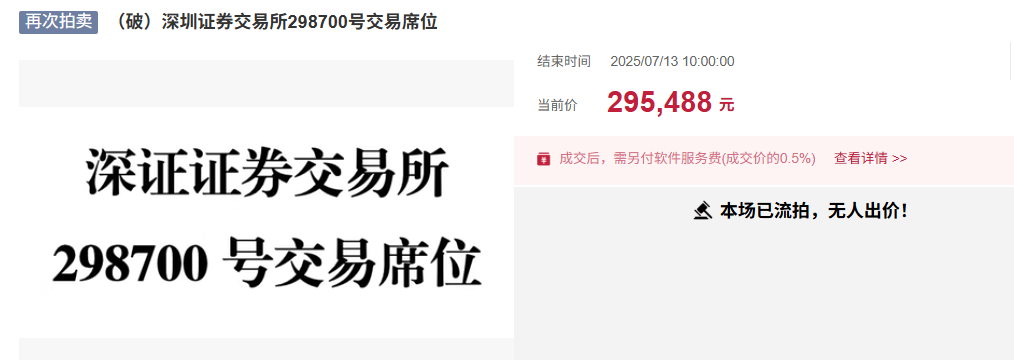
60万元降至29.55万元,深交所交易席位“半价”起拍仍遭流拍,市场为何不买账?
Mei Ri Jing Ji Xin Wen· 2025-07-18 15:51
Core Viewpoint - The auction of four trading seats on the Alibaba asset platform by the Shenzhen Stock Exchange failed to attract any bids, despite a significantly reduced starting price of 29.55 million yuan, down from an initial price of 60 million yuan in 2020, indicating a lack of interest in these trading seats [1][5][6]. Group 1: Auction Details - The four trading seats were auctioned with a starting price of 29.55 million yuan each, but all went unsold due to no bids [1][5]. - The trading seats are owned by Sichuan Financial Leasing Co., Ltd., and were originally awarded to Zhuhai Zhongye Trust Investment Co., Ltd. as compensation in a civil ruling by the Chengdu Intermediate People's Court in September 2009 [5][6]. - The auction process has seen multiple price reductions, with the next auction scheduled for August 3, where the starting price will drop further to 23.6 million yuan per seat [5][6]. Group 2: Market Context - Trading seats are essentially "entry credentials" for members to participate in trading activities on the exchange, but with the shift to electronic trading, physical seats have become less relevant [6][7]. - The Shenzhen Stock Exchange currently charges 60 million yuan for a new trading seat, making the auction price of 29.55 million yuan appear attractive, yet it still failed to generate interest [6][7]. - Securities firms typically have sufficient trading seats, as they apply for them through designated channels, and advancements in technology have reduced the reliance on the number of physical seats for trading efficiency [6][7].
拆解物业服务信托:账户不独立、账目不透明?这个小区的业主没有炒掉物业,而是用信托换回小区安宁
Mei Ri Jing Ji Xin Wen· 2025-07-18 09:28
Core Viewpoint - The introduction of a trust structure in a Beijing residential community has successfully addressed dissatisfaction with property management services, providing a model for enhancing transparency and accountability in property management [1][4]. Group 1: Issues with Traditional Property Management - Homeowners in the Zhongjun Tianchen community expressed dissatisfaction with the property management services, citing issues such as lack of transparency in financial accounts and inadequate service quality [2][3]. - The property management company, being affiliated with the developer, lacked independent financial oversight, leading to concerns about the safety of property funds [3][6]. Group 2: Implementation of Trust Structure - The homeowners' committee established a trust-managed account for property fees, overcoming the challenge of not having the legal status to open a bank account directly [4][5]. - The trust, named "Foreign Trade Trust - Jinnuo No. 10 Property Service Trust," was set up to ensure the separation of property funds from the management company's finances, enhancing risk isolation [4][5]. Group 3: Benefits of the Trust Model - The trust structure has improved transparency in property fee management, allowing homeowners to directly deposit fees into the trust account, which is managed independently from the property management company [6][7]. - The trust model has led to better communication and relationship-building between the property management and residents, resulting in improved service quality [5][6]. Group 4: Industry Trends and Future Outlook - The application of property service trusts is gaining traction in the industry, with several trust companies exploring this model as a new growth area amid declining traditional financing business [7][8]. - Despite the potential benefits, the profitability of property service trusts remains uncertain, with trust companies currently not charging management fees but focusing on promoting the model [8].
独家|世茂239亿拿的地王或被68亿回收,中信信托深圳龙岗项目打折兑付计划起风波
Di Yi Cai Jing· 2025-07-18 08:02
Core Viewpoint - Shimao Group is facing significant challenges with its Shenzhen Longgang project, where a land recovery compensation plan has been proposed at a price of 6.8 billion yuan, approximately 30% of the original land acquisition cost of 23.9 billion yuan, leading to potential financial implications for investors and the trust involved [1][7][10]. Group 1: Compensation and Voting Process - The compensation for the land recovery is set at 6.8 billion yuan, which is significantly lower than the original acquisition cost, raising concerns among investors [1][10]. - Investors in the CITIC Longgang project can vote on the proposed compensation plan starting from July 18, with a beneficiary meeting scheduled for the end of the month [1][2]. - If the compensation plan is approved, a "discounted repayment" scheme will be implemented, with investors expected to recover approximately 85% of their principal by January 2027 [2][3]. Group 2: Project Background and Financial Implications - The Longgang project was initially a high-profile development, with plans for a skyscraper over 600 meters tall, but has faced delays and planning issues, leading to halted progress [1][11][12]. - The trust project was originally set to mature in August 2022, but has experienced liquidity issues since early 2022, resulting in payment delays [3][6]. - The project involves around 800 individual investors, with the trust principal balance currently at 5.679 billion yuan [6]. Group 3: Legal and Regulatory Challenges - Shimao Group has initiated legal proceedings against the Shenzhen government regarding the land transfer contract, claiming that the government has failed to provide necessary construction height approvals [12]. - The recovery plan requires approval from both the CITIC Longgang project and another related project, indicating a complex interdependency [7][8]. - The proposed compensation plan has been criticized for being insufficient and having a lengthy payment timeline, which could lead to further financial strain on the involved parties [10][12].