石油加工

Search documents
淡季影响需求提振 预计沥青盘面短期内窄幅震荡
Jin Tou Wang· 2026-01-19 01:19
Core Viewpoint - The asphalt futures market is experiencing a slight decline in prices, with a weekly drop of 1.11% and a significant reduction in open interest, indicating a potential shift in market dynamics [1]. Market Overview - As of January 15, the spot price of asphalt was reported at 3140 yuan/ton, reflecting a daily increase of 6.67 yuan/ton, or 0.21%. Over the past week, asphalt prices have risen by 40 yuan/ton, a 1.29% increase, and over the past month, prices have increased by 193.33 yuan/ton, or 6.56% [2]. - During the week of January 7 to January 13, the total shipment volume from 54 domestic asphalt manufacturers was 317,000 tons, representing a 1.0% increase compared to the previous week. The capacity utilization rate for 69 sample modified asphalt enterprises was 6.8%, up 0.1% week-on-week and 2.6% year-on-year [2]. Institutional Insights - Dayue Futures notes that recent production cuts by refineries have reduced supply pressure, but overall demand remains weak and below expectations. Inventory levels are stable, and weakening crude oil prices are diminishing cost support in the short term. The market is expected to experience narrow fluctuations, with asphalt prices projected to oscillate between 3138 and 3196 yuan/ton [3]. - Haitong Futures emphasizes that the absolute price trends of asphalt will continue to be influenced by geopolitical developments, particularly regarding the U.S. and Iran. The uncertain situation in Iran is likely to cause volatility in oil prices, which will subsequently affect asphalt prices. The short-term outlook suggests a focus on geopolitical risks, with strategies indicating a preference for buying low in the near term [3].
原油周报:伊朗风险仍是左右油价的重要因素-20260118
Xinda Securities· 2026-01-18 13:01
Investment Rating - The industry investment rating is "Positive" [1] Core Insights - The report highlights that geopolitical tensions, particularly regarding Iran, are significant factors influencing oil prices. The Brent and WTI oil prices were reported at $64.13 and $59.34 per barrel, respectively, as of January 16, 2026 [2][9]. Oil Price Overview - As of January 16, 2026, Brent crude futures settled at $64.13 per barrel, up $0.79 (+1.25%) from the previous week. WTI crude futures settled at $59.34 per barrel, up $0.22 (+0.37%). The Urals crude price remained stable at $65.49 per barrel, while ESPO crude rose by $0.49 (+0.98%) to $50.39 per barrel [2][26]. Offshore Drilling Services - As of January 12, 2026, the global number of offshore self-elevating drilling platforms was 377, an increase of 1 from the previous week. The number of floating drilling platforms was 130, also up by 1 [2][35]. U.S. Oil Supply - As of January 9, 2026, U.S. crude oil production was reported at 13.753 million barrels per day, a decrease of 58,000 barrels from the previous week. The number of active drilling rigs in the U.S. was 410, with an increase of 1 rig [2][49]. U.S. Oil Demand - U.S. refinery crude processing was 16.958 million barrels per day as of January 9, 2026, an increase of 49,000 barrels from the previous week. The refinery utilization rate was 95.30%, up 0.6 percentage points [2][57]. U.S. Oil Inventory - As of January 9, 2026, total U.S. crude oil inventories were 836 million barrels, an increase of 3.605 million barrels (+0.43%) from the previous week. Strategic oil inventories were 414 million barrels, up 214,000 barrels (+0.05%) [2][67]. Related Companies - Key companies mentioned include China National Offshore Oil Corporation (CNOOC), China Petroleum & Chemical Corporation (Sinopec), and PetroChina [2][3].




燃料油、低硫燃料油周度报告:国泰君安期货·能源化工-20260118
Guo Tai Jun An Qi Huo· 2026-01-18 08:30
1. Report Industry Investment Rating - No information provided in the report 2. Core Views of the Report - Recent price fluctuations of domestic and international fuel oils have continued to widen, with the up - down trends reversing frequently. High - sulfur fuel oil may return to a weak situation in the short term, but there may still be support at the bottom due to the decline in Russian high - sulfur exports. Low - sulfur fuel oil has some positive factors, and there is support at the bottom, making it difficult to show a significant weakening. The estimated value range for FU is 2400 - 2590, and for LU is 2900 - 3150. In the short term, fuel oil prices enter a high - volatility environment with an unclear direction. The FU and LU monthly spread structures have returned to backwardation and may return to contango after the geopolitical issues cool down. The FU/LU crack spreads have reached a short - term low, and the LU - FU spread will enter a short - term oscillation [4] 3. Summary by Directory Supply - The report presents data on the capacity utilization rates of Chinese refineries (including overall, independent, and major refineries), and the maintenance volumes of global hydrocracking units, CDU units, FCC units, and coking units from 2018 - 2026. It also shows the monthly production and commercial volume of domestic refinery fuel oil from 2018 - 2025 [6][7][8][10][17] Demand - The report provides monthly data on fuel oil demand, including Singapore's bunker sales, China's apparent consumption, and China's actual consumption of marine fuel oil from 2018 - 2025 [22][23][24] Inventory - The report shows the spot inventory data of global fuel oil from 2018 - 2026, including Singapore's heavy oil inventory, Fujeirah's heavy distillate inventory, European ARA fuel oil inventory, and the weekly residual fuel oil inventory in the US [26] Price and Spread - **Regional Spot FOB Prices**: It presents the spot FOB prices of fuel oil in the Asia - Pacific region (Singapore, Fujeirah), Europe (Northwest Europe, Mediterranean), and the US (Gulf of Mexico, New York Harbor) from 2018 - 2026 [30][34][38] - **Paper and Derivative Prices**: It includes the prices of swaps and continuous contracts of high - sulfur and low - sulfur fuel oils in Northwest Europe and Singapore from 2024 - 2026, as well as the prices of domestic FU and LU contracts from 2021 - 2024 [39][40][43] - **Fuel Oil Spot Spreads**: It shows the Singapore high - low sulfur spread and the Singapore viscosity spread from 2019 - 2026 [46][49] - **Global Fuel Oil Crack Spreads**: It presents the crack spreads of high - sulfur and low - sulfur fuel oils in Singapore and Northwest Europe from 2019 - 2026 [50][52][54] - **Global Fuel Oil Paper Month Spreads**: It shows the month spreads of high - sulfur and low - sulfur fuel oils in Singapore and Northwest Europe [59][60][61] Import and Export - **Domestic Fuel Oil Import and Export Data**: It shows the monthly import and export volumes of Chinese fuel oil (excluding biodiesel) from 2018 - 2025 [64][66] - **Global High - Sulfur Fuel Oil Import and Export Data**: It presents the weekly import and export volume changes of global high - sulfur fuel oil in different regions from 2018 - 2026 [67] - **Global Low - Sulfur Fuel Oil Import and Export Data**: It shows the weekly import and export volume changes of global low - sulfur fuel oil in different regions from 2018 - 2026 [69] Futures Disk Indicators and Internal - External Spreads - **Review**: During the week, the fuel oil prices in the Asia - Pacific region fluctuated greatly, and the Zhoushan market moved in sync. The impact of geopolitical issues on the spot price of the outer market gradually subsided, and the spread between domestic futures prices and overseas spot prices gradually repaired as the number of warehouse receipts decreased [72] - **Logic**: In the short term, due to the cooling of geopolitical events, the strength of the outer - market spot market has declined. At the same time, the number of warehouse receipts for FU and LU has started to decrease, and it is expected that the spreads between FU, LU and the Singapore market will increase in the short term [72] FU, LU Position and Trading Volume Changes - The report shows the trading volume and position data of fuel oil main contracts, continuous contracts, and first - month contracts (including high - sulfur and low - sulfur) from 2020 - 2026 [86][88][92] FU, LU Warehouse Receipt Quantity Changes - The report shows the quantity changes of FU and LU warehouse receipts from 2020 - 2026 [99][100][101]
每周股票复盘:国际实业(000159)股东户数增22.09%至4.68万户
Sou Hu Cai Jing· 2026-01-17 18:28
Core Viewpoint - As of January 16, 2026, International Industry (000159) closed at 6.36 yuan, a decrease of 3.64% from the previous week's closing price of 6.6 yuan [1] Market Performance - The highest intraday price for International Industry on January 12 was 6.57 yuan, while the lowest intraday price on January 15 was 6.16 yuan [1] - The current total market capitalization of International Industry is 3.057 billion yuan, ranking 62 out of 64 in the photovoltaic equipment sector and 4614 out of 5183 in the A-share market [1] Shareholder Changes - As of January 9, 2026, the number of shareholders for International Industry was 46,800, an increase of 22.09% compared to the previous period [1] - The number of shareholders increased by 8,461 from December 31, leading to a decrease in the average shareholding from 12,500 shares to 10,300 shares [1] - The average market value of shares held by each shareholder is 67,800 yuan [1]

沥青日报:震荡下行-20260116
Guan Tong Qi Huo· 2026-01-16 13:02
Report Industry Investment Rating - Not provided in the given content Report's Core View - The asphalt market is expected to oscillate. It is recommended to focus on the situation in Venezuela and adopt a reverse spread strategy. The supply and demand of asphalt are affected by factors such as refinery production adjustment, downstream construction, and the geopolitical situation in Venezuela [1]. Summary by Relevant Catalogs Market Analysis - **Supply Side**: This week, the asphalt operating rate increased by 1.8 percentage points to 27.2% week - on - week, 0.2 percentage points higher than the same period last year, at a relatively low level in recent years. In January 2026, the domestic asphalt production is expected to be 2 million tons, a decrease of 158,000 tons (7.3%) month - on - month and 276,000 tons (12.1%) year - on - year. Next week, Shandong Shengxing Petrochemical will switch to asphalt production, while Qilu Petrochemical and Dongming Petrochemical plan to stop production, keeping the asphalt operating rate low [1]. - **Demand Side**: This week, the operating rates of most downstream asphalt industries declined. The road asphalt operating rate decreased by 2 percentage points to 15% week - on - week, restricted by funds and weather. A new round of rain and snow is coming, with northern road construction gradually ending and southern projects also entering the final stage, and the subsequent rigid demand will further slow down [1]. - **Inventory**: The asphalt refinery inventory rate continued to rise week - on - week and remained near the lowest level in recent years [1]. - **Geopolitical Impact**: The US military action in Venezuela may affect the production and cost of domestic asphalt. Although the possibility of domestic refineries obtaining Venezuelan crude oil has increased, it is still expected to be significantly lower than before the US intervention. It is necessary to pay attention to the shortage of raw materials in domestic refineries [1]. Futures and Spot Market - **Futures**: Today, the asphalt futures 2603 contract fell 1.48% to 3,130 yuan/ton, below the 5 - day moving average, with a minimum price of 3,123 yuan/ton, a maximum price of 3,154 yuan/ton, and the open interest decreased by 5,652 to 193,865 lots [2]. - **Basis**: The mainstream market price in Shandong region dropped to 3,090 yuan/ton, and the basis of the asphalt 03 contract rose to - 40 yuan/ton, at a relatively low - to - neutral level [4]. Fundamental Tracking - **Supply - Side Fundamentals**: Refineries such as Liaoning Zhende resumed production, and the asphalt operating rate increased by 1.8 percentage points to 27.2% week - on - week, 0.2 percentage points higher than the same period last year, at a relatively low level in recent years. From January to November, the national highway construction investment decreased by 5.9% year - on - year, and the cumulative year - on - year growth rate increased by 0.1 percentage points month - on - month compared with January - October 2025 but was still negative. From January to November 2025, the cumulative year - on - year growth rate of the actual completed fixed - asset investment in the road transport industry was - 4.7%, a slight decline from - 4.3% in January - October 2025. From January to November 2025, the cumulative year - on - year growth rate of the completed fixed - asset investment in infrastructure construction (excluding electricity) was - 1.1%, a further decline from - 0.1% in January - October 2025. As of the week of January 16, the operating rates of most downstream asphalt industries declined, and the road asphalt operating rate decreased by 2 percentage points to 15% week - on - week, restricted by funds and weather. From the perspective of social financing stock, from January to December 2025, the year - on - year growth rate of social financing stock was 8.3%, a decrease of 0.2 percentage points compared with January - November, and the recovery of enterprises' medium - and long - term financing demand was still weak [5]. - **Inventory Fundamentals**: As of the week of January 16, the asphalt refinery inventory rate increased by 0.7 percentage points to 14.1% compared with the week of January 9, and was near the lowest level in recent years [5].
博汇股份:1月16日召开董事会会议
Mei Ri Jing Ji Xin Wen· 2026-01-16 11:53
Group 1 - The company announced that its fifth board meeting will be held on January 16, 2026, to discuss the appointment of the board secretary and other documents [1] Group 2 - Silver prices have surged over 80% in the last 50 days, indicating a level of speculation that surpasses gold, which historically suggests that a bull market in precious metals may be reaching its peak [1]

博汇股份发预亏,预计2025年度归母净亏损4800万元至7000万元
Zhi Tong Cai Jing· 2026-01-16 11:45
Core Viewpoint - The company, Bohui Co., Ltd. (300839.SZ), forecasts a net loss attributable to shareholders of the listed company for the year 2025, estimated between 48 million to 70 million yuan [1] Group 1: Financial Performance - The expected net loss for 2025 represents a significant narrowing of losses compared to the previous year [1] - The company is implementing measures to improve operational efficiency and financial condition [1] Group 2: Strategic Initiatives - The company is optimizing existing facilities and processes, as well as adjusting product structure [1] - Bohui Co. aims to achieve large-scale production of bonded high-sulfur fuel oil to seize opportunities in the international ship refueling market [1] - The company is also focused on stabilizing its supply structure and building an integrated industrial development ecosystem [1]
博汇股份:预计2025年净利润为负
Ge Long Hui A P P· 2026-01-16 11:34
Core Viewpoint - The company, Bohui Co., Ltd., has announced an expected negative net profit for the fiscal year 2025, indicating significant financial challenges ahead [1] Financial Performance Summary - The projected net profit attributable to shareholders is expected to be between -70 million yuan and -48 million yuan, representing a year-on-year increase of 77.19% to 84.36% [1] - The net profit after excluding non-recurring gains and losses is anticipated to be between -150 million yuan and -117 million yuan, showing a year-on-year growth of 51.02% to 61.80% [1] - The expected operating revenue is projected to be between 2.73 billion yuan and 2.92 billion yuan, reflecting a year-on-year increase of 19.76% to 28.10% [1]
博汇股份(300839.SZ):预计2025年净亏损4800万元-7000万元
Ge Long Hui A P P· 2026-01-16 11:22
Core Viewpoint - The company, Bohui Co., Ltd. (300839.SZ), expects a significant reduction in net losses for 2025, with projected losses between 70 million to 48 million yuan, while revenue is anticipated to grow by 19.76% to 28.10% year-on-year [1] Financial Performance - The company forecasts a net profit attributable to shareholders will increase by 77.19% to 84.36% year-on-year, indicating a substantial narrowing of losses [1] - Expected operating revenue for the period is projected to be between 2.73 billion to 2.92 billion yuan [1] Strategic Initiatives - The company has implemented measures to improve operational efficiency and financial health, including optimizing existing facilities and processes, and adjusting product structure [1] - Bohui Co. aims to achieve large-scale production of bonded high-sulfur fuel oil to capture opportunities in the international ship refueling market and expand its international presence [1] - The company is focused on stabilizing its supply structure and building an integrated industrial development ecosystem [1] Non-Recurring Gains - Non-recurring gains are expected to impact net profit by approximately 60 million to 85 million yuan, primarily due to hedging activities to mitigate market price volatility risks [1]
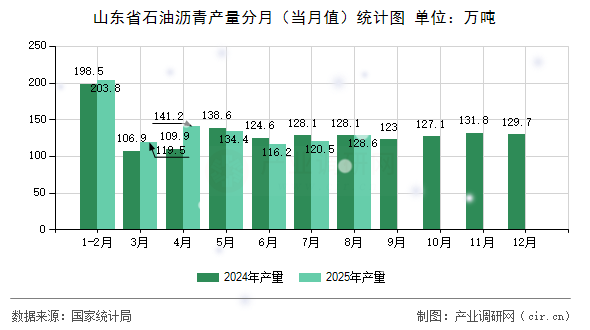
【图】2025年8月山东省石油沥青产量数据分析
Chan Ye Diao Yan Wang· 2026-01-16 04:54
Group 1 - The core viewpoint of the articles indicates that Shandong Province's petroleum asphalt production has shown a modest increase in August 2025, with a total output of 128.6 million tons, reflecting a year-on-year growth of 0.3% and a significant acceleration of 20.2 percentage points compared to the previous year [1] - In the cumulative data from January to August 2025, Shandong's petroleum asphalt production reached 964.2 million tons, marking a year-on-year increase of 3.2%, with an acceleration of 21.1 percentage points compared to the previous year [2] - The production growth rate in Shandong for August 2025 was lower than the national average by 18.0 percentage points, while the cumulative growth rate from January to August was lower by 6.4 percentage points compared to the national average [1][2] Group 2 - Shandong Province accounted for approximately 39.4% of the national petroleum asphalt production in August 2025, which totaled 326.5 million tons [1] - For the period from January to August 2025, Shandong's share of the national petroleum asphalt production was about 39.7%, with the national total being 2,427.9 million tons [2] - The data presented pertains to large-scale industrial enterprises, defined as those with an annual main business income of 20 million yuan or more [3]