
水泥

Search documents
申万宏源25H1建材行业中报综述:水泥盈利弹性逐步释放 玻纤多数实现营利双增
智通财经网· 2025-09-24 08:59
Core Viewpoint - The construction materials industry is expected to see a narrowing revenue decline and profit improvement in the first half of 2025, with notable performances in the cement and fiberglass sectors [1] Group 1: Cement Industry - The cement industry achieved a total revenue of 118.8 billion yuan in the first half of 2025, a year-on-year decline of 7.5%, but with a net profit of 5.4 billion yuan, reflecting a significant year-on-year increase of 1110.5% [2][1] - The improvement in cement industry profits is partly due to a low base from the previous year and better pricing conditions, along with a decrease in coal costs compared to the same period last year [2] Group 2: Fiberglass Industry - The fiberglass sector reported a total revenue of 31.1 billion yuan in the first half of 2025, representing a year-on-year growth of 20.9%, with a net profit of 3.29 billion yuan, up 127.0% year-on-year [3] - The profit improvement in the fiberglass industry is attributed to the pricing recovery initiated by leading companies since 2024, which is now beginning to show results [3] Group 3: Consumer Building Materials - The consumer building materials segment recorded a revenue of 68.76 billion yuan in the first half of 2025, down 2.7% year-on-year, with a net profit of 4.35 billion yuan, a decline of 13.2% [4] - Companies like Keda Manufacturing and Sankeshu are showing strong performance due to overseas market strategies and unique channel advantages, respectively [4] Group 4: Glass Industry - The glass industry faced challenges, achieving a revenue of 24.6 billion yuan in the first half of 2025, down 17.0% year-on-year, with a net profit of 1 billion yuan, a decline of 60.3% [5] - The photovoltaic glass sector experienced temporary recovery, but overall profitability is under pressure due to high base effects from the previous year and weak demand in the construction glass market [5] Group 5: Early Cycle Industries - Early cycle sectors remain under pressure, with profitability constrained by cement price recovery, although leading companies like Subote have reported revenue and profit growth [6] - Subote has expanded its efforts in major engineering projects in the western regions, achieving significant results in water, nuclear power, and railway sectors [6] Group 6: Investment Recommendations - Investment opportunities are suggested in the fiberglass and cement sectors, focusing on companies with strong profit recovery and growth expectations [7] - Recommended companies include leading players in the cement sector such as Huaxin Cement, Conch Cement, and Shangfeng Cement, as well as fiberglass companies like China Jushi and Zhongcai Technology [7]

水泥板块9月24日跌0.63%,三和管桩领跌,主力资金净流出9401.35万元
Zheng Xing Xing Ye Ri Bao· 2025-09-24 08:46
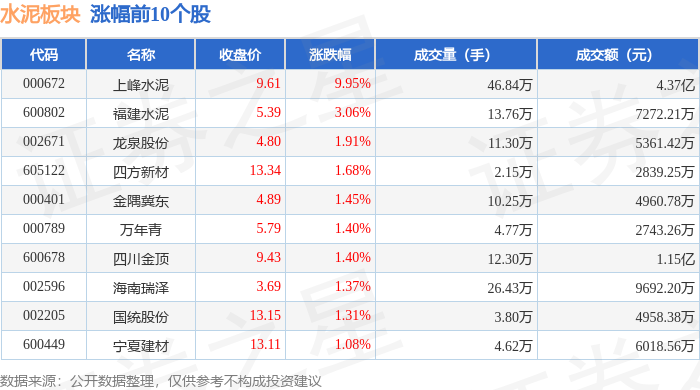
Market Overview - On September 24, the cement sector declined by 0.63% compared to the previous trading day, with Sanhe Pile leading the decline [1] - The Shanghai Composite Index closed at 3853.64, up 0.83%, while the Shenzhen Component Index closed at 13356.14, up 1.8% [1] Individual Stock Performance - Top gainers in the cement sector included: - Shangfeng Cement (000672) with a closing price of 9.61, up 9.95% on a trading volume of 468,400 shares and a turnover of 437 million yuan [1] - Fujian Cement (600802) closed at 5.39, up 3.06% with a trading volume of 137,600 shares and a turnover of 72.72 million yuan [1] - Longquan Co. (002671) closed at 4.80, up 1.91% with a trading volume of 113,000 shares and a turnover of 53.61 million yuan [1] - Notable decliners included: - Sanhe Pile (003037) closed at 8.67, down 4.73% with a trading volume of 342,600 shares and a turnover of 296 million yuan [2] - Tianshan Co. (000877) closed at 6.15, down 3.15% with a trading volume of 972,000 shares and a turnover of 591 million yuan [2] - Qingsong Jianhua (600425) closed at 4.43, down 2.21% with a trading volume of 847,100 shares and a turnover of 372 million yuan [2] Capital Flow Analysis - The cement sector experienced a net outflow of 94.01 million yuan from institutional investors, while retail investors saw a net inflow of 91.34 million yuan [2] - Key capital flows for selected stocks included: - Shangfeng Cement had a net inflow of 1.30 billion yuan from institutional investors, but a net outflow of 57.59 million yuan from retail investors [3] - Fujian Cement saw a net inflow of 16.88 million yuan from institutional investors, with a net outflow of 5.86 million yuan from retail investors [3] - Huaxin Cement (600801) had a net inflow of 16.56 million yuan from institutional investors, while retail investors had a net outflow of 27.86 million yuan [3]


建材行业 2025 年中报综述:周期建材有贝塔,消费建材看阿尔法
Shenwan Hongyuan Securities· 2025-09-24 08:14
Investment Rating - The report suggests focusing on investment opportunities in the fiberglass and cement industries due to improving profitability, while selecting stocks with alpha characteristics in the consumer building materials and early-cycle sectors [2][5]. Core Insights - The building materials industry has seen a narrowing revenue decline and notable profit improvements, particularly in the cement and fiberglass sectors, with overall revenue for sample companies decreasing by 4.1% year-on-year to 277.57 billion yuan, while net profit increased by 38.9% to 14.82 billion yuan [11][12]. - The cement industry has shown significant recovery, with a revenue of 118.8 billion yuan, a decline of 7.5%, and a net profit of 5.4 billion yuan, reflecting a year-on-year increase of 1110.5% [24][29]. - The fiberglass sector reported a revenue of 31.1 billion yuan, up 20.9%, and a net profit of 3.29 billion yuan, up 127.0%, indicating a strong recovery driven by price improvements and growth in special fabric business [6][38]. Summary by Sections 1. Industry Revenue Decline Narrowing, Cement and Fiberglass Perform Well - Sample companies in the building materials sector achieved a total revenue of 277.57 billion yuan in the first half of 2025, with a year-on-year decline of 4.1%, a significant improvement compared to a 10.7 percentage point decline in 2024 [11][12]. - The overall net profit for the industry turned positive, reaching 14.82 billion yuan, compared to a 50.8% decline in 2024 [11][12]. 2. By Sector: Cement and Fiberglass Recovery, Consumer Building Materials Seek Alpha 2.1 Cement: Bottom Recovery Becoming Certain - The cement industry has shown a significant improvement, with a revenue of 118.8 billion yuan and a net profit of 5.4 billion yuan, reflecting a year-on-year increase of 1110.5% [24][29]. - The demand for cement remains in a declining trend, but the rate of decline has slowed [24]. 2.2 Fiberglass: Profitability Out of Undervaluation, Steady Recovery Expected - The fiberglass sector reported a revenue of 31.1 billion yuan, up 20.9%, and a net profit of 3.29 billion yuan, up 127.0%, with most companies in the sector achieving double-digit revenue growth [6][38]. 2.3 Consumer Building Materials: Revenue Decline Narrowing, Some Companies Show Strong Alpha - The consumer building materials sector saw a revenue of 68.76 billion yuan, down 2.7%, and a net profit of 4.35 billion yuan, down 13.2%, with some companies like Keda Manufacturing and Three Trees showing strong performance [6][12]. 2.4 Glass: Photovoltaic Glass Experiences Phase Recovery, Building Glass Still Under Pressure - The glass industry faced challenges, with a revenue of 24.6 billion yuan, down 17.0%, and a net profit of 1 billion yuan, down 60.3%, indicating ongoing pressure from weak real estate completions [6][12]. 2.5 Early Cycle: Overall Pressure, Leading Companies Recover First - The early-cycle sector remains under pressure, but leading companies like Subote have achieved revenue and profit growth, focusing on major projects in the western regions [7][12].


六部门:严禁新增水泥熟料、平板玻璃产能
第一财经· 2025-09-24 07:59
Core Viewpoint - The "Work Plan for Stabilizing Growth in the Building Materials Industry (2025-2026)" aims to enhance profitability, technological innovation, and the scale of green building materials, with a target of exceeding 300 billion yuan in revenue from green building materials by 2026 [1][8]. Group 1: Key Tasks - Strengthening industry management by prohibiting new cement clinker and flat glass production capacity, requiring capacity replacement plans for new and renovated projects, and promoting unified actual and registered capacity [2][10]. - Enhancing technological innovation in the industry by expanding advanced inorganic non-metallic materials, accelerating the development of advanced ceramics and superhard materials, and cultivating key resource industries such as graphite and fluorite [2][12]. - Expanding effective investment through digital and green transformation, promoting the establishment of "zero" factories in the cement and flat glass industries, and revising national standards for safety glass and insulation materials [2][14][20]. Group 2: Consumption Demand Expansion - Continuously promoting green building materials in rural areas and implementing government procurement policies to support green materials, thereby enhancing building quality [2][23]. - Encouraging local governments to create directories of green building materials that suit local consumption habits and establishing experience centers for green materials [2][23]. Group 3: Open Cooperation - Strengthening international cooperation with countries along the Belt and Road Initiative, promoting the export of building materials, technologies, and standards [3][26]. - Enhancing overseas project contracting services by leveraging green and low-carbon technology advantages in cement and flat glass [3][26].

建材行业稳增长工作方案来了,涉及水泥、玻璃等行业
Di Yi Cai Jing· 2025-09-24 07:33
Core Viewpoint - The Ministry of Industry and Information Technology, along with five other departments, has issued a work plan for the construction materials industry for 2025-2026, focusing on capacity management, technological innovation, investment expansion, demand stimulation, and international cooperation [1][2]. Group 1: Industry Management - New capacity for cement clinker and flat glass is strictly prohibited, and any new or modified projects must develop capacity replacement plans [2]. - The plan aims to unify actual cement production capacity with registered capacity and enhance risk warnings for photovoltaic glass production [2]. Group 2: Technological Innovation - The plan emphasizes strengthening the advanced inorganic non-metallic materials industry and accelerating the development of advanced ceramics and superhard materials [2]. - It aims to cultivate industries based on unique resources such as graphite, fluorite, and magnesite to improve effective supply capacity [2]. Group 3: Investment Expansion - The plan encourages digital and green transformation in the industry, promoting the development of "zero" factories in cement and flat glass sectors [2]. - It includes the revision of national standards for safety glass and insulation materials, as well as industry standards for green building materials [2]. Group 4: Demand Stimulation - Continuous efforts will be made to promote green building materials in rural areas and support government procurement policies that enhance building quality [2]. - The establishment of cooperation mechanisms between upstream and downstream enterprises in the inorganic non-metallic materials sector is encouraged [2]. Group 5: International Cooperation - The plan aims to strengthen industrial cooperation with countries and regions involved in the Belt and Road Initiative, promoting the export of construction materials, technologies, and standards [2].
六部门:严格水泥玻璃产能调控
Xin Hua Cai Jing· 2025-09-24 07:25
Core Viewpoint - The Ministry of Industry and Information Technology, along with other departments, has issued a work plan for the construction materials industry aimed at stabilizing growth from 2025 to 2026, emphasizing strict control over cement and glass production capacity [1] Group 1: Capacity Control Measures - New production capacity for cement clinker and flat glass is strictly prohibited, and any new or modified projects must develop capacity replacement plans [1] - The transfer of cement clinker and flat glass production capacity from non-key air pollution prevention areas to key areas is strictly forbidden [1] - Cement companies are required to formulate capacity replacement plans by the end of 2025 for any capacity exceeding project filings, ensuring alignment between actual and filed capacities [1] Group 2: Environmental and Quality Standards - The plan aims to eliminate outdated production capacities for cement and flat glass through legal and regulatory means, focusing on quality, environmental protection, energy consumption, and safety standards [1] - Enterprises with low environmental performance are encouraged to gradually exit the market [1] Group 3: Industry Transformation Initiatives - The transition of risk warning for photovoltaic glass production capacity from project management to planning guidance is to be accelerated [1] - Leading companies are encouraged to collaborate with social capital to explore the establishment of green low-carbon transformation funds, promoting the exit of inefficient production capacities through market-oriented operations [1]
工信部等六部门:严禁新增水泥熟料、平板玻璃产能 新建改建项目须制定产能置换方案
Di Yi Cai Jing· 2025-09-24 07:12
Core Viewpoint - The Ministry of Industry and Information Technology, along with five other departments, has issued the "Building Materials Industry Stabilization and Growth Work Plan (2025-2026)", aiming for recovery and growth in the building materials sector, with a projected revenue of over 300 billion yuan from green building materials by 2026 [1][2]. Group 1: Key Tasks - Strengthening industry management by prohibiting new cement clinker and flat glass production capacity, requiring capacity replacement plans for new projects, and enhancing regulatory standards for cement and flat glass [2]. - Enhancing industrial technological innovation by expanding the advanced inorganic non-metallic materials industry and improving supply capabilities in key resource sectors such as graphite and magnesium [2]. - Expanding effective investment through digital and green transformation initiatives, including the development of digital transformation solutions and the establishment of "zero" factories in the cement and flat glass industries [2]. - Expanding consumer demand by promoting green building materials in rural areas and supporting the establishment of cooperation mechanisms between upstream and downstream enterprises in the inorganic non-metallic materials sector [2]. - Deepening open cooperation by strengthening industrial collaboration with countries along the Belt and Road Initiative and promoting the internationalization of building materials products, technologies, and standards [2].
六部门:严禁新增水泥熟料、平板玻璃产能,新建改建项目须制定产能置换方案
Zheng Quan Shi Bao Wang· 2025-09-24 07:10
Core Viewpoint - The Ministry of Industry and Information Technology, along with five other departments, has issued a work plan for the construction materials industry aimed at stabilizing growth from 2025 to 2026, emphasizing strict control over cement and glass production capacity [1] Group 1: Capacity Control Measures - New production capacity for cement clinker and flat glass is strictly prohibited, and any new or modified projects must develop capacity replacement plans [1] - The transfer of cement clinker and flat glass production capacity from non-key air pollution prevention areas to key air pollution prevention areas is strictly forbidden [1] - Cement companies are required to formulate capacity replacement plans by the end of 2025 for any capacity exceeding project filings, ensuring alignment between actual and filed capacities [1] Group 2: Environmental and Quality Standards - The plan emphasizes the role of comprehensive standards related to quality, environmental protection, energy consumption, and safety in phasing out outdated cement and flat glass production capacities [1] - Enterprises with low environmental performance are encouraged to gradually exit the market [1] Group 3: Industry Transformation Initiatives - The transition of risk warning for photovoltaic glass production capacity is shifting from project management to planning guidance [1] - Key enterprises are encouraged to collaborate with social capital to explore the establishment of green low-carbon transformation funds, utilizing market-oriented operations to accelerate the exit of inefficient capacities [1]
六部门:严禁新增水泥熟料、平板玻璃产能 新建改建项目须制定产能置换方案
Mei Ri Jing Ji Xin Wen· 2025-09-24 07:06
Core Viewpoint - The Ministry of Industry and Information Technology, along with other governmental departments, has issued a work plan for the construction materials industry aimed at stabilizing growth from 2025 to 2026, with strict controls on cement and glass production capacity [1] Group 1: Capacity Control Measures - New production capacity for cement clinker and flat glass is strictly prohibited, and any new or modified projects must include capacity replacement plans [1] - The transfer of cement clinker and flat glass production capacity from non-key air pollution prevention areas to key areas is strictly forbidden [1] - Cement companies are required to develop capacity replacement plans for any production capacity exceeding project filings by the end of 2025, ensuring alignment between actual and registered capacity [1] Group 2: Environmental and Quality Standards - The plan emphasizes the importance of quality, environmental protection, energy consumption, and safety standards in phasing out outdated cement and flat glass production capacities [1] - Companies with low environmental performance are encouraged to gradually exit the market [1] Group 3: Industry Transformation Initiatives - There is a push to transition risk warnings for photovoltaic glass production capacity from project management to planning guidance [1] - Leading companies are encouraged to collaborate with social capital to explore the establishment of green low-carbon transformation funds, facilitating the exit of inefficient production capacities through market-oriented operations [1]
建材行业2025年中报综述:周期建材有贝塔,消费建材看阿尔法
Shenwan Hongyuan Securities· 2025-09-24 06:43
Investment Rating - The report maintains a "Positive" outlook on the building materials industry for 2025, highlighting investment opportunities in the fiberglass and cement sectors, while suggesting stock selection in consumer building materials and early-cycle segments [2][3]. Core Insights - The building materials industry has shown signs of recovery, with a narrowing revenue decline and improved profitability in the cement and fiberglass sectors. The overall revenue for sample companies in the first half of 2025 was 277.57 billion yuan, a year-on-year decline of 4.1%, which is a 10.7 percentage point improvement compared to the entire year of 2024. Net profit attributable to shareholders reached 14.82 billion yuan, a year-on-year increase of 38.9% [5][15]. - The cement industry is experiencing a gradual recovery, with significant profit improvements. In the first half of 2025, the cement sector achieved a revenue of 118.8 billion yuan, down 7.5% year-on-year, but net profit surged by 1110.5% to 5.4 billion yuan. This recovery is partly due to a low base effect from 2024 and favorable pricing conditions [6][28]. - The fiberglass sector reported robust growth, with sample companies generating a total revenue of 31.1 billion yuan, a 20.9% increase year-on-year, and net profit rising by 127.0% to 3.29 billion yuan. The recovery in pricing and the growth in specialty fabric business are contributing factors [7][19]. - Consumer building materials showed a smaller revenue decline of 2.7%, with total revenue of 68.76 billion yuan and net profit down 13.2% to 4.35 billion yuan. Companies like Keda Manufacturing and Sankeshu are demonstrating strong alpha characteristics due to their unique market positions [6][7]. - The glass sector remains under pressure, with a revenue decline of 17.0% to 24.6 billion yuan and a net profit drop of 60.3% to 1 billion yuan, primarily due to high base effects and weak demand in the construction sector [5][19]. - Early-cycle industries are still facing challenges, but leading companies like Subote have reported revenue and profit growth by expanding into major engineering projects [8][19]. Summary by Sections 1. Industry Revenue Decline Narrowing, Cement and Fiberglass Perform Well - The building materials industry is categorized into six segments: cement, glass, fiberglass, early-cycle, consumer building materials, and new materials. The overall revenue decline has narrowed, and profitability has improved, particularly in the cement and fiberglass sectors [15][19]. 2. By Industry: Cement and Fiberglass Recovery, Consumer Building Materials Seek Alpha 2.1 Cement: Recovery Certainty Gradually Realized - The cement industry is showing signs of recovery with improved profitability. The first half of 2025 saw a revenue of 118.8 billion yuan, down 7.5% year-on-year, and a net profit of 5.4 billion yuan, up 1110.5% [28][34]. 2.2 Fiberglass: Profitability Out of Undervaluation, Steady Recovery Expected - The fiberglass sector has shown significant growth, with a total revenue of 31.1 billion yuan, a 20.9% increase year-on-year, and net profit rising by 127.0% [7][19]. 2.3 Consumer Building Materials: Revenue Stabilizing, Some Companies Show Profit Alpha - The consumer building materials segment experienced a revenue decline of 2.7%, totaling 68.76 billion yuan, with net profit down 13.2% to 4.35 billion yuan. Certain companies are demonstrating strong alpha characteristics [6][7]. 2.4 Glass: Photovoltaic Glass Phase Improvement, Building Glass Still Under Pressure - The glass industry is under pressure, with a revenue decline of 17.0% to 24.6 billion yuan and a net profit drop of 60.3% to 1 billion yuan [5][19]. 2.5 Early Cycle: Overall Pressure, Leading Companies Recover First - Early-cycle industries are still facing challenges, but leading companies like Subote have reported revenue and profit growth by expanding into major engineering projects [8][19].
