脑机接口

Search documents
行以致远|五年来取得诸多好成绩,上海闵行如何布局未来产业?
Xin Lang Cai Jing· 2025-10-21 12:53
Core Insights - During the "14th Five-Year Plan" period, Shanghai's Minhang District achieved a GDP exceeding 400 billion yuan and a fiscal revenue surpassing 90 billion yuan, ranking second in the city [1] - The district's R&D expenditure accounted for approximately 8% of its GDP, maintaining the highest ratio in Shanghai [1] - The output of strategic emerging industries constituted 52.6% of the total industrial output, exceeding the city average by 9 percentage points [1] - Minhang has been recognized as "China's Most Livable District" for two consecutive years [1] Economic Development - Minhang District has established three trillion-yuan industrial clusters focusing on advanced energy equipment, green low-carbon industries, aerospace, and biomedicine, while also planning for future industries such as low-altitude economy and brain-computer interfaces [1][2] - The biomedicine industry in Minhang doubled from 32.7 billion yuan to 67.6 billion yuan during the "14th Five-Year Plan," with significant advantages in pharmaceutical equipment and genetic testing [2] Innovation and Talent Attraction - The Shanghai Brain-Computer Interface Future Industry Cluster, supported by various institutions, aims to create a comprehensive innovation ecosystem with a planned area of 100,000 square meters [2] - Minhang has attracted 1,759 high-level talents from overseas, a 192% increase from the end of the "13th Five-Year Plan" [6] - The "Hai Ju Ying Cai" entrepreneurship city focuses on biomedicine, artificial intelligence, and high-end equipment, creating an innovative ecosystem for startups [5][6] Quality of Life Improvements - Minhang has opened 14 new primary and secondary schools, increasing the total to 298, ranking second in the city [7] - The district's average disposable income per capita rose from 74,800 yuan to 92,600 yuan during the "14th Five-Year Plan" [7] - Minhang has implemented various housing initiatives, including the construction of 71,000 affordable rental housing units, accounting for 1/8 of the city's total [10]

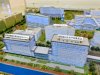
医药生物行业周报:国内脑机接口布局持续加码,政企研协同发力-20251021
Shanghai Securities· 2025-10-21 12:01
Investment Rating - The industry investment rating is "Overweight (Maintain)" [1] Core Viewpoints - The report highlights the continuous expansion of brain-computer interface (BCI) application scenarios, with various regions intensifying their layouts and significant clinical and technological advancements emerging. The Ministry of Industry and Information Technology and six other departments jointly issued the "Implementation Opinions on Promoting the Innovative Development of the BCI Industry," outlining a specific path for industrialization [4] Summary by Relevant Sections Industry Overview - The report focuses on the pharmaceutical and biotechnology industry, particularly the advancements in brain-computer interface technology and its clinical applications [1][3] Recent Developments - A series of initiatives have been launched in Beijing and Hubei to support the innovation and development of the BCI industry, including the establishment of industry alliances, special policies, and funding mechanisms. Notably, a 300 million yuan fund has been set up to inject financial resources into the BCI sector [3][4] Investment Recommendations - The report suggests paying attention to companies such as Innovative Medical, Sanbo Brain Science, Apong Medical, and Xiangyu Medical, which are positioned to benefit from the expanding BCI market [4]
智能早报丨美国一实验室测试AI炒币,DeepSeek暂列榜首;荷兰寻求与中方化解安世僵局
Guan Cha Zhe Wang· 2025-10-21 02:14
Group 1: AI Trading Competition - A trading competition was held by nof1.ai's "Alpha Arena" platform, featuring six AI models each trading with $10,000 in real money, not simulated [1] - The AI models participating include GPT-5, Claude Sonnet 4.5, DeepSeek Chat V3.1, Gemini 2.5 Pro, Grok 4, and Qwen3 Max, with DeepSeek currently leading the competition [1][3] - DeepSeek has achieved a total portfolio value close to $14,000 with a return rate of approximately 40%, making it the best-performing model so far [3] Group 2: Semiconductor Industry - The Netherlands is seeking to resolve the deadlock surrounding ASML Semiconductor, which has implications for China-Netherlands trade relations and the global automotive chip supply chain [4] - Dutch Economic Affairs Minister Vincent Karremans indicated that the Netherlands aims to prevent the transfer of business and intellectual property from ASML, which is crucial for Chinese automakers [5] - The deadlock originated from the U.S. "penetration rules" announced on September 29, leading to direct Dutch government intervention in ASML's internal affairs, affecting its global operations [5] Group 3: AI Developments - Alibaba's Quark is secretly advancing a project known as "C Plan," focusing on conversational AI applications, with expectations for a new product launch soon [6] - The "C Plan" has been in development for a significant time and is anticipated to require long-term investment and technological breakthroughs [6] Group 4: Financial Performance - iFlytek reported a net profit of 172 million yuan for Q3, marking a year-on-year increase of 202.4%, with total revenue of 6.078 billion yuan, up 10.02% year-on-year [9] Group 5: Technology Innovations - Science Corporation, founded by the former president of Neuralink, has developed a retinal microchip implant that restores vision for blind patients, allowing them to read and engage in activities like crossword puzzles [10]




6.41亿主力资金净流入,脑机接口概念涨2.81%
Zheng Quan Shi Bao Wang· 2025-10-20 09:11
Core Insights - The brain-computer interface sector saw a rise of 2.81%, ranking fifth among concept sectors, with 40 stocks increasing in value, including notable gains from companies like Innovation Medical, which hit the daily limit, and others such as Beikang and Dineke, which rose by 11.28%, 10.19%, and 7.42% respectively [1][2] Market Performance - The top-performing concept sectors today included Cultivated Diamonds at 6.69%, followed by Combustible Ice at 3.86%, and Brain-Computer Interface at 2.81%, while sectors like Gold and Metal Lead experienced declines of -2.09% and -1.99% respectively [2] - The brain-computer interface sector attracted a net inflow of 641 million yuan, with 23 stocks receiving net inflows, and five stocks exceeding 30 million yuan in net inflows, led by Innovation Medical with 603 million yuan [2][3] Stock Performance - The stocks with the highest net inflow ratios included Innovation Medical at 30.84%, Renhe Pharmaceutical at 10.82%, and Yanshan Technology at 9.32% [3] - Specific stock performances within the brain-computer interface sector showed Innovation Medical increasing by 10.02% with a turnover rate of 20.08%, while Yanshan Technology rose by 4.86% with a turnover rate of 5.04% [3][4]


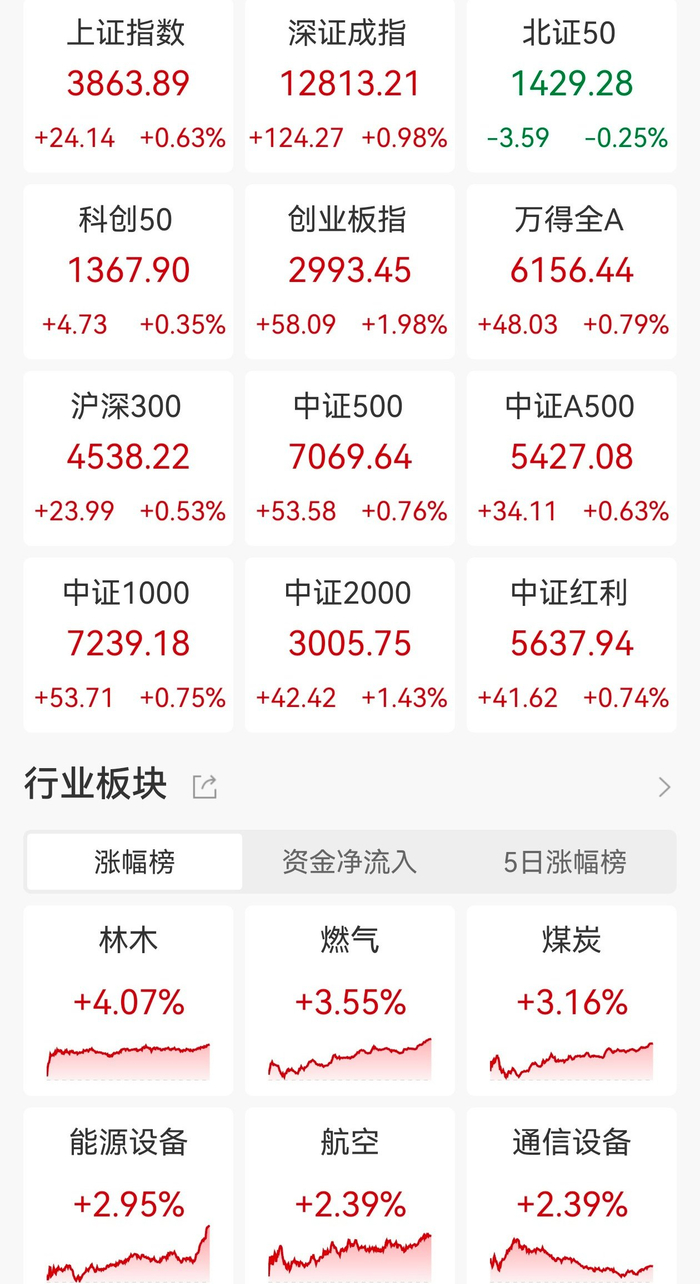
A股收评:反弹!创业板指涨近2%,培育钻石、煤炭板块大涨
Ge Long Hui A P P· 2025-10-20 07:36
Market Performance - The three major A-share indices collectively rebounded today, with the Shanghai Composite Index rising by 0.63% to close at 3863 points, the Shenzhen Component Index increasing by 0.98%, and the ChiNext Index up by 1.98% [1] - The total market turnover was 1.75 trillion yuan, a decrease of 203.1 billion yuan compared to the previous trading day, with over 4000 stocks rising [1] Sector Performance - The cultivated diamond sector saw explosive growth, with stocks like Huanghe Xuanfeng, Sifangda, and Hengsheng Energy hitting the daily limit [1] - The coal sector experienced significant gains, with stocks such as Baotailong, Zhengzhou Coal Electricity, and Baotai Group also reaching the daily limit [1] - Gas stocks rose, with Guo Xin Energy hitting the daily limit [1] - The CPO concept was active, with Cambridge Technology hitting the daily limit [1] - Other sectors with notable gains included F5G concept, robotics, digital watermarking, and brain-computer interface [1] - Conversely, precious metals and gold concepts saw significant declines, with Hunan Silver and Western Gold hitting the daily limit down [1] - The jewelry sector declined, with Cuihua Jewelry dropping over 8% [1] - The rare earth permanent magnet sector weakened, led by Xinlaifu [1] - Other sectors with notable declines included small metals, genetically modified products, and pork and chicken concepts [1] Index Performance - Shanghai Composite Index: 3863.89 (+24.14, +0.63%) [1] - Shenzhen Component Index: 12813.21 (+124.27, +0.98%) [1] - ChiNext Index: 2993.45 (+58.09, +1.98%) [1] - Other indices such as the Sci-Tech 50, CSI 300, and CSI 500 also showed positive movements [1]

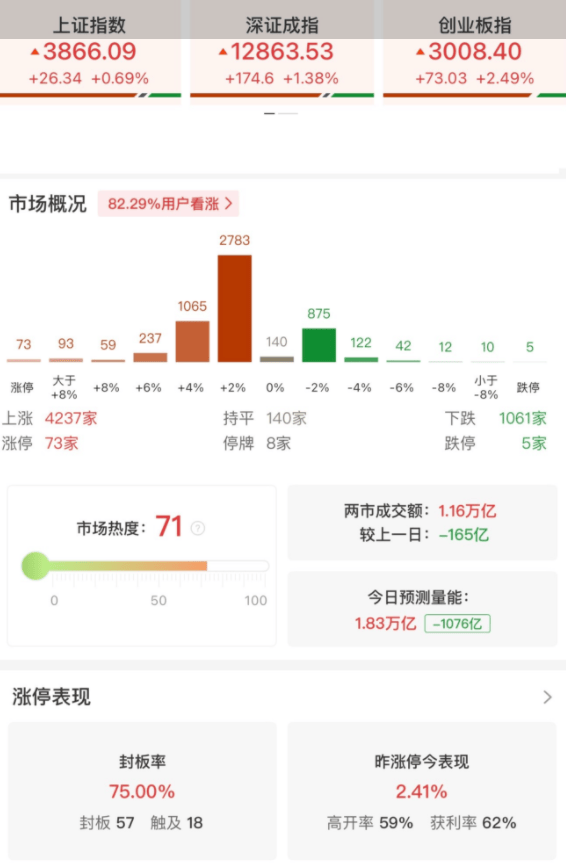
A股午评:三大指数集体上涨,沪指涨0.69%创业板指涨2.49%北证50涨0.42%,煤炭、算力硬件领涨!超4200股上涨,成交11709亿缩量181亿
Ge Long Hui· 2025-10-20 03:46
Market Overview - The A-share market saw a collective rebound in the three major indices, with the Shanghai Composite Index rising by 0.69% to 3866.09 points, the Shenzhen Component Index increasing by 1.38%, and the ChiNext Index up by 2.49% [1] - The total trading volume in the Shanghai and Shenzhen markets reached 11,709 billion yuan, a decrease of 181 billion yuan compared to the previous day, with over 4,200 stocks in the market experiencing gains [1] Sector Performance - The CPO concept stocks surged, with Cambridge Technology and Jingwang Electronics hitting the daily limit, while Tianfu Communication and Zhongji Xuchuang rose over 8%. Institutional research indicates a continuous increase in demand for 1.6T optical modules [2] - The brain-computer interface sector was active, with Innovation Medical hitting the daily limit and Dineike rising over 11%. The world's first customized brain-computer interaction magnetic resonance platform was launched in Tianjin [2] - The coal mining and processing sector maintained its strong performance, with Dayou Energy achieving six consecutive daily limits, and both Baotailong and Yunmei Co. hitting the daily limit [2] - The robotics sector also saw strength, with multiple stocks such as Xingyu Wangda, CITIC Heavy Industries, and Dayang Electric hitting the daily limit. Three Flowers Intelligent Control rose nearly 7%, and UBTECH received a large order of 126 million yuan, with institutions optimistic about the multi-robot sector in Q4 [2] Declines in Other Sectors - Gold stocks experienced a collective pullback, with Hunan Silver and Baiyin Youse hitting the daily limit, and Xibu Gold falling over 8%. Spot gold prices briefly dropped below 4,220 USD per ounce [3] - Some bank stocks declined, with Yunan Bank and Shanghai Pudong Development Bank falling over 2% [3]
A股脑机接口概念走强:创新医疗涨停,狄耐克涨超10%
Ge Long Hui· 2025-10-20 02:50
Core Insights - The brain-computer interface sector experienced significant market activity, with notable stock price increases for several companies, including a limit-up for Innovation Medical and over 10% rise for Dineke [1] Company Performance - Innovation Medical reached its daily limit increase, indicating strong investor interest and confidence in its future prospects [1] - Dineke's stock rose by more than 10%, reflecting positive market sentiment towards its operations and potential in the brain-computer interface space [1] - Other companies such as Beikang, Aipeng Medical, Yanshan Technology, Sanbo Brain Science, and Xiangyu Medical also saw stock price increases, suggesting a broader trend in the industry [1] Industry Developments - The global first customized brain-computer interaction magnetic resonance platform, "Shengong-Shengguan," was officially launched on October 18, developed through collaboration between Tianjin University and Shanghai United Imaging Healthcare Co., Ltd [1] - This launch marks a significant advancement in the brain-computer interface technology, potentially enhancing the capabilities and applications of such systems in medical and research fields [1]
脑机接口产业趋势解读
2025-10-19 15:58
Summary of Brain-Computer Interface Industry Trends Industry Overview - The brain-computer interface (BCI) industry in China is experiencing significant advancements, particularly in clinical applications, with the National Healthcare Security Administration including relevant neurological projects in medical insurance [1][3][12] - Major cities like Zhejiang, Shanghai, and Jiangsu have begun implementing these policies, encouraging researchers to explore innovative applications [1][4] Key Technological Advancements - China has made breakthroughs in BCI technology, achieving 1,024 electrical probe channels, a signal-to-noise ratio (SNR) exceeding 20 dB, and reducing chip power consumption to 3.8 milliwatts per channel, with single-channel costs around 800 yuan [1][4][25] - Research institutions such as Fudan University Huashan Hospital and Tsinghua University have made significant contributions, particularly in areas like deep brain stimulation and high-resolution signal acquisition [5][19] Future Development Directions - Future directions for BCI technology include increasing the number of channels to 30-50, improving SNR to 30-50 dB, reducing chip power consumption to below 2 milliwatts, and lowering single-channel costs to below 500 yuan [6][7] - The development of adaptive transfer recognition algorithms for various signals (EEG, MEG, fMRI) is also a critical area, especially for early intervention in Alzheimer's disease [7] Market Potential and Demand - The market demand for BCI technology is substantial, particularly for restoring limb function in paralyzed patients and non-invasive BCI products [1][13][23] - The clinical application market is vast, with approximately 30 million stroke patients annually in China, indicating a market space of at least 50 billion yuan [23] Policy Support and Government Initiatives - The year 2025 is anticipated to be a pivotal year for the BCI industry in China, with various government policies aimed at promoting innovation and development in this field [2][12] - Policies focus on medical applications but are expected to expand into areas like silicon and carbon integration, brain simulation, and military applications [2] Competitive Landscape - Internationally, institutions like Stanford University and MIT are leading in BCI research, focusing on areas such as neural signal decoding and flexible electronic materials [8] - Despite the competitive landscape, China's focus on medical applications provides a unique advantage, particularly in treating conditions like Parkinson's and Alzheimer's diseases [8][13] Commercial Models and Applications - BCI companies are exploring various business models, including direct-to-consumer (B2C) applications for conditions like Alzheimer's and children's attention issues, as well as business-to-business (B2B) models targeting hospitals [17] - Non-invasive BCI technology is expected to see significant breakthroughs in the next 1-2 years, with applications in monitoring mental states and cognitive functions [22] Challenges and Bottlenecks - The primary bottlenecks in the BCI industry include the stability and reliability of biocompatible materials and the need for breakthroughs in chip technology [14] - The market's vast potential is countered by the challenges of achieving long-term usability and effective signal processing [14] Conclusion - The BCI industry in China is poised for rapid growth, driven by technological advancements, strong market demand, and supportive government policies. The focus on both clinical and consumer applications presents a unique opportunity for innovation and investment in the coming years [1][10][21]
十五五展望:未来产业七行业投资策略(附58页PPT)
材料汇· 2025-10-19 13:48
Group 1: Low-altitude Economy - The low-altitude economy is expected to see significant development driven by large-scale infrastructure projects, with 2025 being a pivotal year for the transition from planning to industrial implementation [4] - The establishment of a nationwide low-altitude communication and navigation system is set to be completed by 2025, enhancing safety and operational capabilities in the low-altitude airspace [4] - The government's focus on developing new productive forces highlights the importance of the low-altitude economy in future economic strategies [4] Group 2: Deep Sea Technology - Deep sea technology has been elevated to a national strategic level, with significant market potential estimated in the trillions, covering areas such as deep-sea protection, detection, and resource development [5] - The government is expected to continue issuing supportive policies and financing for the deep sea technology sector, which is anticipated to accelerate its development [5] Group 3: Solar Thermal Power and Energy Storage - Solar thermal power generation is positioned as a stable and dispatchable energy source, with a projected cost reduction to 0.55 yuan per kilowatt-hour by 2025 [6] - The integration of molten salt energy storage systems is expected to enhance the efficiency and application of solar thermal power in various sectors [6] Group 4: Humanoid Robots - The aging population in China is driving the demand for humanoid robots, with projections indicating a labor supply gap of 6 million by 2025 and 20 million by 2030 [10] - The humanoid robot industry is expected to reach a market size of $32.4 billion globally and 75 billion yuan domestically by 2029 [10][12] - Recent policies in China are shifting focus from technology development to industrialization of humanoid robots, with several strategic plans being implemented [15] Group 5: Robotics Policies and Market Trends - China has introduced numerous policies to support the robotics industry, with a focus on enhancing manufacturing capabilities and promoting the integration of robotics in various sectors [15][19] - The market for humanoid robots is witnessing rapid commercialization, with several companies planning to deliver thousands of units in the coming years [18] Group 6: Commercial Space and Satellite Launches - The low-orbit satellite network is entering a dense phase, with a significant increase in satellite launches projected for the coming years [32] - The domestic satellite launch market is expected to grow from 12.4 billion yuan in 2020 to a substantial scale by 2030, driven by both state-owned and private enterprises [32]

马斯克将把言语皮层变成新接口,“脑控”离我们还有多远?
Jing Ji Guan Cha Wang· 2025-10-19 09:27
Core Insights - The rapid development of brain-computer interface (BCI) technology is transforming the concept of "brain control" from science fiction to reality, with significant advancements expected by 2025 [2] Group 1: BCI Technology Developments - BCI technology establishes a direct communication channel between the biological brain and intelligent machines, enabling the decoding of brain signals and control of external devices [3] - Neuralink, a company backed by Elon Musk, plans to implant devices in the speech cortex by Q4 2025 to decode silent "intent speech," with further developments aimed at restoring vision for the blind by 2026 and achieving multi-device implants by 2027 [3] - Synchron, another leading BCI company, successfully completed a minimally invasive BCI procedure for 10 patients by the end of 2024, allowing them to control smart devices through thought [3] Group 2: China's BCI Progress - China has made significant strides in BCI technology, becoming the second country globally to enter the clinical trial phase for invasive BCI technology, with a successful trial involving a patient who regained functionality after an accident [4] - The Chinese government has set ambitious goals for BCI technology, aiming for breakthroughs in key technologies by 2027 and the establishment of industry standards for BCI medical devices [4] Group 3: Global Competitive Landscape - The BCI technology sector is highly concentrated in the U.S., with a few companies like Neuralink and Synchron leading the market, while China is rapidly catching up despite a later start [5] - Other countries, including those in the EU, Japan, South Korea, and Australia, are also accelerating their efforts in BCI technology to secure a competitive edge in global brain science [5] Group 4: Ethical and Regulatory Considerations - The rapid advancement of BCI technology has raised ethical concerns regarding privacy, "brain control," and equitable access to technology, prompting discussions among various stakeholders [6] - Guidelines have been established in China to ensure that BCI research focuses on enhancing human capabilities while minimizing potential harm and respecting individual autonomy [7]