
私募

Search documents
又有私募自购!
Zhong Guo Ji Jin Bao· 2026-01-19 09:30
Core Viewpoint - Multiple private equity firms in China have actively engaged in self-purchase actions, indicating confidence in the market and their own products [1][3]. Group 1: Self-Purchase Actions - Jiu Yang Run Quan Capital announced that its chairman and fund manager, Hu Jun Cheng, personally subscribed to new fund shares worth RMB 10 million [1]. - Yuan Fang Fund announced a self-purchase of no less than RMB 4 million for its Yuan Fang Han Ze Growth No. 1 private equity securities investment fund [1][3]. - Hu Jun Cheng expressed that personal investment in the fund demonstrates confidence in the market, despite concerns about potential market corrections [3]. Group 2: Market Confidence and Trends - The private equity confidence index for A-shares recorded 124.94 in January 2026, a slight increase of 0.48% from December 2025, indicating improved confidence among private equity managers [5]. - The average position of subjective long-biased private equity funds remained at 78% as of December 2025, with 93.8% of funds maintaining positions above 50%, reflecting stable market sentiment [5]. - Analysts suggest that the current market liquidity is relatively abundant, and the combination of policy support and improved fundamentals presents numerous investment opportunities [6]. Group 3: Investment Focus Areas - Resource and technology sectors are highlighted as key investment areas for many private equity firms, with a focus on scarce resources and high-quality companies in technology and brand expansion [7]. - Investment strategies include maintaining high positions in cyclical industries, benefiting from rapid AI development, and focusing on monopolistic industries with high dividend rates [7].

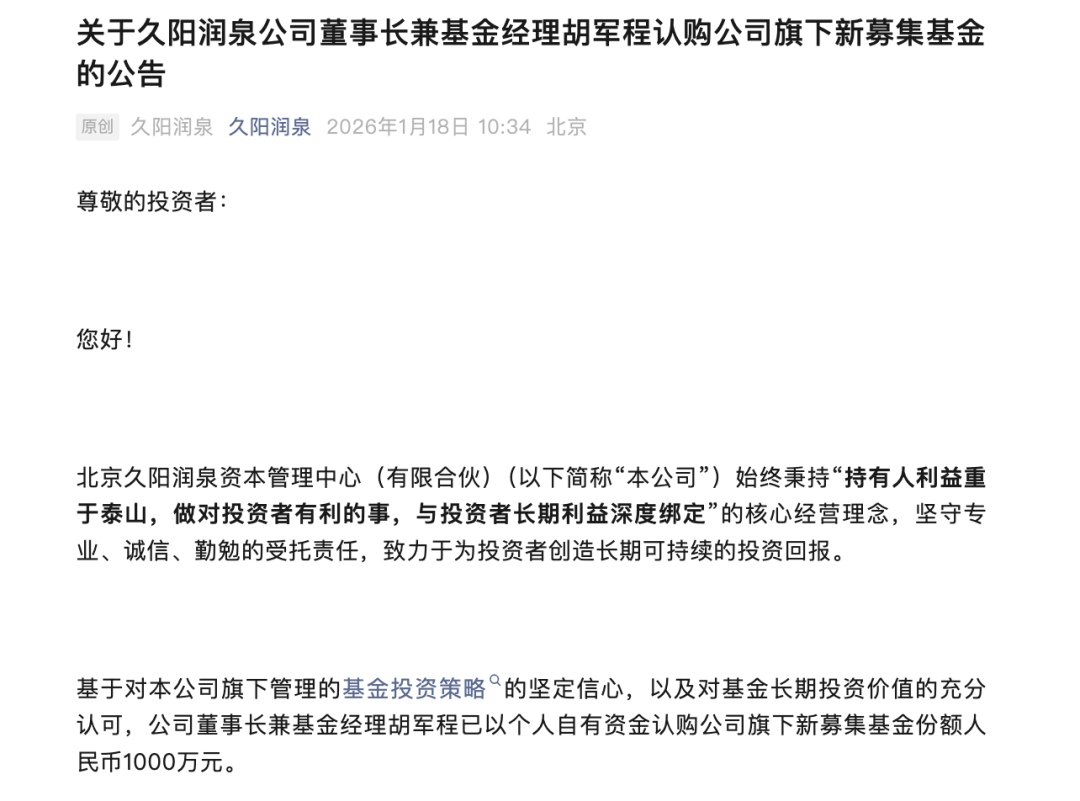
又有私募自购!
中国基金报· 2026-01-19 09:27
Core Viewpoint - Multiple private equity firms in China have initiated self-purchase actions, indicating confidence in the market and their own products [2][4][6]. Group 1: Self-Purchase Actions - Jiu Yang Run Quan Capital announced that its chairman and fund manager, Hu Jun Cheng, personally subscribed to new fund shares worth RMB 10 million [2][5]. - Yuan Fang Fund declared a self-purchase of no less than RMB 4 million for its Yuan Fang Han Ze Growth No. 1 private equity fund [2][5]. - Self-purchase actions by private equity firms are seen as a way to align the interests of managers and investors, alleviating investor concerns and enhancing product competitiveness [6]. Group 2: Market Confidence - The A-share confidence index for hedge fund managers recorded 124.94 in January 2026, a slight increase of 0.48% from December 2025, indicating improved confidence in the market [8]. - The average position of subjective long-bull strategy private equity funds was 78% as of December 2025, with 93.8% of funds maintaining positions above 50%, reflecting stable market engagement [8]. - Analysts expect a continuation of the spring market rally due to increased market activity and improved liquidity [8]. Group 3: Investment Focus - Resource and technology sectors are highlighted as key investment areas for many private equity firms, with a focus on scarce resources and high-quality companies expanding globally [10]. - Investment strategies include maintaining high positions in cyclical industries, benefiting from AI advancements, and focusing on monopolistic industries with high dividend rates [10].

幻方量化与它的“杭州效应”,悄悄赢了北上广深!2025中国私募地区榜揭晓!
私募排排网· 2026-01-19 03:20
Core Insights - The article highlights the performance of private equity firms in China, particularly focusing on the returns of private equity products in major cities by the end of 2025, with a notable emphasis on the strong performance of firms in Hangzhou [2][3]. Group 1: Overall Market Performance - As of December 2025, there are 7,518 private equity firms in China, with 5,422 located in first-tier cities (Beijing, Shanghai, Guangzhou, Shenzhen, Hangzhou), accounting for 72.12% of the total [2]. - The average returns for private equity products in first-tier cities for 2025 are as follows: Beijing 31.81%, Shanghai 31.98%, Guangzhou 33.56%, Shenzhen 34.22%, and Hangzhou 42.46% [3]. Group 2: Hangzhou Private Equity Performance - Hangzhou's private equity products have an impressive average return of 42.46%, with a high positive return rate of 98.70% among 307 products [3][6]. - The top three private equity firms in Hangzhou for 2025 are: Nongfu Private Equity, Haokun Shengfa Asset, and Yunqi Quantitative, with Nongfu leading the pack [6][12]. Group 3: Beijing Private Equity Performance - In Beijing, there are 1,242 private equity firms, with an average return of 31.81% for 679 products [13][14]. - The top three private equity firms in Beijing for 2025 are: Beijing Xiyue Private Equity, Qiaogeli Capital, and Huacheng Private Equity [14][19]. Group 4: Shanghai Private Equity Performance - Shanghai hosts 2,012 private equity firms, with an average return of 31.98% for 1,428 products [20][21]. - The leading private equity firms in Shanghai for 2025 are: Shanghai Hengsui Asset, Shanghai Yixin Private Equity, and Haiseng Fund [21][26]. Group 5: Guangzhou Private Equity Performance - Guangzhou has 441 private equity firms, with an average return of 33.56% for 275 products [27][28]. - The top three private equity firms in Guangzhou for 2025 are: Jingyan Private Equity, Hainan Xiangyuan Private Equity, and Sanhe Chuangying [28][32]. Group 6: Shenzhen Private Equity Performance - Shenzhen has 1,256 private equity firms, with an average return of 34.22% for 843 products [33][34]. - The leading private equity firms in Shenzhen for 2025 are: Qiantou Investment, Fuyuan Capital, and Zhongying Investment [34][39]. Group 7: Other Regions Private Equity Performance - Outside the major cities, there are 2,096 private equity firms, with an average return of 28.52% for 1,213 products [40][41]. - The top three private equity firms in other regions for 2025 are: Luyuan Private Equity, Lanbaoshi Fund, and Zhihua Asset Management [41][45].
1.19犀牛财经早报:首批新能源主题基金四季报解密基金经理布局运作
Xi Niu Cai Jing· 2026-01-19 01:39
Group 1 - The first batch of new energy theme funds has reported that investment strategies are shifting from traditional lithium batteries to advanced technologies such as smart driving, artificial intelligence, and controllable nuclear fusion, indicating strong confidence in the structural market for new energy in 2026 [1] - The public fund issuance market has seen a significant increase in activity, with many new products being oversubscribed and some sold out in a single day, reflecting a recovery in market confidence and changes in product strategies and investor allocation [1] - Over 10 private equity firms have been penalized for regulatory violations, including issues related to fund pools and guaranteed returns, indicating a push for compliance and internal control improvements in the private equity industry [1] Group 2 - Three securities investment consulting firms have been penalized and ordered to stop accepting new clients due to regulatory issues, highlighting ongoing scrutiny in the investment advisory sector [2] - Several small and medium-sized banks have raised deposit rates by up to 20 basis points as part of a strategy to attract deposits amid a competitive market environment, reflecting a cautious approach to managing their funding needs [2] - The S transaction market has gained traction with increased activity in the transfer of shares from popular companies in sectors like humanoid robotics and commercial aerospace, driven by renewed confidence in the primary market for unprofitable companies [3] Group 3 - The People's Bank of China has announced a structural interest rate cut, reducing the re-lending and rediscount rates by 0.25 percentage points, which is expected to encourage lending in key sectors and support economic transformation [4] - The bond market is anticipated to experience increased volatility in 2026, with a focus on capturing short-term opportunities rather than long-term trends, as investors navigate the balance between strong expectations and weak realities [4] - The Hong Kong stock market has seen a surge in refinancing activities, with nearly 30 companies raising over HKD 26 billion, a significant increase compared to the previous year, indicating a robust environment for capital raising [4] Group 4 - Insurance companies are optimistic about the equity market in 2026, planning to enhance their asset allocation strategies to capitalize on favorable macroeconomic trends and potential profit opportunities [5] - Morgan Stanley has projected significant price increases for DDR4 and NOR Flash memory chips in the first quarter of 2026, driven by supply constraints and strong demand for advanced storage products [5] - The commercial aerospace sector has shown signs of market enthusiasm, although recent price corrections suggest a need for careful evaluation of long-term trends versus short-term adjustments [6] Group 5 - Porsche's global sales fell to approximately 279,000 units in 2025, a decline of 10% year-on-year, with a significant drop in the Chinese market, reflecting challenges in supply and a strategic shift towards prioritizing profit margins over volume [7] - The Beijing Yiren Angel Children's Hospital is facing operational challenges due to rental debts, prompting public donations that have exceeded 15 million yuan, highlighting community support for healthcare initiatives [7] - Ningbo Ronbay New Energy Technology Co., Ltd. is under investigation by the China Securities Regulatory Commission for misleading statements regarding a major contract, which could impact its market reputation and operations [8][9]


2026 权益资产成配置香饽饽!复胜资产单日吸金 10 亿;灵均、幻方、诚奇私募、稳博投资、进化论资产等入围百亿量化十强榜单|私募透视镜
Jin Rong Jie· 2026-01-18 10:31
Group 1 - The private equity market in China is experiencing a surge, with a notable single-day fundraising of 1 billion yuan by a hundred billion private equity firm, indicating a continuation of the active issuance trend from 2025 [1] - In 2025, over 12,000 new private securities investment funds were registered, nearly doubling from 2024, with more than 60% of these funds focusing on stock strategies [1] - Nearly 90% of private equity products achieved positive returns in 2025, with an impressive average return rate [1] Group 2 - The A-share and commodity markets performed well in 2025, leading to an average return of approximately 29.38% for macro strategy private equity products [2] - Among private equity firms with over 5 billion yuan in scale, top performers included products managed by Jiuxian Investment and Honghu Liang Wentao, with returns exceeding 136.14% [2] - The top private equity firms in the subjective stock category achieved an average return of over 60% in the past three years, with Dongfang Gangwan leading at 147.27% [2] Group 3 - Quantitative private equity firms saw an average return of about 39% in 2025, with Lingjun Investment topping the performance rankings [3] - The average return for index-enhanced products under Huansheng Quantitative was approximately 56.55%, showcasing strong performance in the quantitative sector [3] Group 4 - The incentive mechanisms in quantitative private equity firms have come under public scrutiny, with reports of year-end bonuses reaching 10 million yuan for researchers [4] - The average return for quantitative long strategies was 39.51%, with some top products exceeding 50%, justifying high bonuses [4] - The competition for talent in the industry has intensified, with salaries for PhDs reaching 1 million yuan and internships at 1,000 yuan per day [4] Group 5 - Goldman Sachs predicts that the Hong Kong capital market will remain active in 2026, with IPO and refinancing volumes above historical averages, particularly in the AI sector, which is considered "bubble-free" [5] - The return of international long-term capital to the market is significant, with participation in IPOs by US funds increasing from 10%-15% to 85%-90% [5] Group 6 - The recent increase in the minimum margin ratio for financing aims to cool market sentiment without altering the long-term positive trend, as the A-share market approaches a transaction volume of 4 trillion yuan [7] - The current market is not exhibiting systemic risks, and the regulatory framework for leverage is more mature compared to previous years [7] Group 7 - The insurance capital long-term investment pilot program has expanded, with 11 funds now operational, focusing on high-dividend stocks in sectors like industrials and utilities [8] - The total scale of the funds under the Honghu Fund series has reached 92.5 billion yuan, with significant participation from various insurance companies [8] Group 8 - CITIC Securities reported a record net profit of 30.051 billion yuan for 2025, marking a year-on-year growth of 38.46%, driven by active capital market conditions [11] - The company served over 17 million clients, with total client assets around 1.5 trillion yuan, reflecting strong growth in brokerage and investment banking services [11]

幻方、明汯、泓湖等12家百亿私募全部产品创新高!量化多头霸榜创新高产品20强!
私募排排网· 2026-01-18 03:04
Market Overview - In December 2025, A-shares showed a strong performance with the Shanghai Composite Index achieving an 11-day consecutive rise, resulting in a monthly increase of 2.06% [2] - Major commodities such as gold, silver, copper, aluminum, and lithium carbonate also experienced significant price increases during the same month [2] Private Equity Performance - Over 51% of the 352 private equity products under billion-yuan private equity firms reached historical net value highs in December 2025 [3] - Among these, stock strategy products were the most prevalent, with 249 products, accounting for over 70% of the total [3] Quantitative Products - Quantitative products dominated the landscape, with 307 products (including 180 index-enhanced products), making up nearly 90% of the total [4] - The strong performance of quantitative strategies is attributed to their disciplined trading and ability to adapt to market conditions, leading to higher stability in returns [4] Top Performing Private Equity Firms - Twelve billion-yuan private equity firms had all their products reach historical net value highs in December 2025, including firms like Lingjun Investment and Ningbo Huafang Quantitative [5] - The ranking of these firms is based on the average returns of their products for 2025, with eight out of twelve being quantitative private equity firms [5] Notable Products and Returns - The top five products based on 2025 returns include those from Yuanxin Investment and Lingjun Investment, with the threshold for inclusion in the top 20 being close to ***% [16] - The top-performing products over the past three years and five years also predominantly belong to quantitative strategies, with firms like Abama Investment and Honghu Private Equity leading the rankings [21][25] Conclusion - The private equity market in December 2025 showcased a robust performance, particularly in quantitative strategies, indicating a favorable environment for investment opportunities in this sector [2][4][5]

最新研判!仁桥资产夏俊杰:2026年有五大投资机遇 但要警惕这一最大的潜在风险
Zhong Guo Ji Jin Bao· 2026-01-17 23:58
Core Insights - The article discusses the investment outlook for 2026 as presented by Xia Junjie, founder and investment director of Renqiao Asset, highlighting five major investment opportunities and three significant risks [1][2]. Investment Opportunities - **Systematic Revaluation of Low-Valuation Stocks**: The article notes that low-valuation stocks are expected to undergo a systematic revaluation due to the rapid decline in China's risk-free interest rates over the past three years. With a significant amount of residents' fixed deposits maturing in 2026, some funds may flow into low-valuation sectors, similar to the valuation recovery seen in the South Korean stock market [2]. - **AI Sector Transition**: The AI sector is anticipated to shift from a focus on computing power to applications and edge computing. The article suggests that while the computing power segment may face performance and cash flow pressures, opportunities in autonomous driving and AI healthcare will be pursued [2][3]. - **Stabilization of Consumer Spending**: Consumer spending is expected to stabilize in 2026 as the impact of real estate declines diminishes. The growth in deposits and other asset classes is projected to offset wealth losses in real estate, with signs of recovery in high-end consumption and luxury goods [2]. - **Selective Opportunities in "Anti-Competition" Trends**: The article emphasizes the need to select industries with simple competitive landscapes and fewer players, as opposed to sectors with many competitors and significant cost differences, where "anti-competition" effects may lag [3]. - **Local Market Development for Export Companies**: Companies that focus on local market service and job creation in regions like Southeast Asia are expected to achieve sustainable growth, given the demographic and cost advantages of these markets [3]. Risks - **Reversal of AI Trends**: The article identifies the potential reversal of trends in the AI industry as the largest risk for 2026. If application development does not progress, the investment logic in computing power may collapse, leading to significant volatility in global tech stocks [3]. - **Valuation Reversion in Small and Micro-Cap Stocks**: There is a risk of valuation reversion in small and micro-cap stocks, which currently have a transaction share far exceeding international norms. This could lead to concentrated releases of valuation pressure in the future [3]. - **Exchange Rate Fluctuation Risks**: The article warns of potential increases in exchange rate volatility among major global currencies in 2026, which could erode returns from overseas investments due to currency losses [3]. Investment Strategy Evolution - **Balanced Investment Approach**: The company emphasizes a balanced approach between "logic-driven" and "bottom-up" investment strategies to enhance portfolio resilience amid market fluctuations [4]. - **Revised Evaluation of State-Owned Enterprises**: The evaluation criteria for state-owned enterprises are being adjusted to prioritize companies with reasonable valuations and better governance, particularly distinguishing between strong and weak cyclical assets [5]. - **Commitment to Contrarian Investment**: The company remains committed to contrarian investment strategies, focusing on uncovering mispriced opportunities while avoiding sectors that may face disruption or high leverage risks [5].
2025年十佳私募创始人揭晓!谢晓阳、王一平位居前二!但斌领衔近3年!
私募排排网· 2026-01-17 07:59
Core Insights - The top ten private equity founders of 2025 include Xie Xiaoyang and Wang Yiping, with a focus on stock strategies and an average return of 27.10% across 460 products managed by these founders [2][5] - The article highlights the performance of private equity founders over the past three years and five years, showcasing their resilience through market fluctuations [7][11] 2025 Top Founders - The top private equity founders for 2025 are Xie Xiaoyang from Tianyan Capital and Wang Yiping from Evolutionary Asset, both employing stock strategies [2][3] - Xie Xiaoyang's Tianyan Capital managed 12 products with an average return of ***%, while Wang Yiping's Evolutionary Asset managed 15 products with an average return of ***% [5][9] - Notable mentions include Zhou Yili from Minority Investment and other founders from various private equity firms, all focusing on stock strategies [2][4] Three-Year Performance - The top private equity founders over the past three years include Dan Bin from Dongfang Gangwan, who achieved an average return of ***% across 68 products [7][9] - Other notable founders include Xie Xiaoyang and Liang Yong, with their respective firms also showing strong performance [7][10] - The average return for 273 products managed by these founders over three years was 24.10% [7] Five-Year Performance - The top private equity founder over the past five years is Lu Hang from Fusheng Asset, with an average return of ***% across 5 products [11][12] - The average return for 327 products managed by these founders over five years was 80.16% [11] - Other notable founders include He Wenling and Du Xiaodong, showcasing strong performance in their respective strategies [11][13]

平方和、鸣石领衔!云起、倍漾争锋…谁是量化多头年度“领跑者”?
私募排排网· 2026-01-17 05:32
Core Viewpoint - The A-share market showed a fluctuating upward trend in 2025, with major indices recording significant gains, including an 18.41% increase in the Shanghai Composite Index and a 49.57% rise in the ChiNext Index [2] Group 1: Market Performance - By the end of 2025, the Shanghai Composite Index rose by 18.41%, the Shenzhen Component Index increased by 29.87%, and the ChiNext Index surged by 49.57% [2] - The CSI 2000 Index and the Micro-cap Index, representing small and micro-cap stocks, performed exceptionally well, with increases of over 36% and 80% respectively [2] Group 2: Quantitative Strategies - In the context of deepening artificial intelligence and quantitative technologies, quantitative long strategies achieved impressive returns by systematically identifying investment opportunities in small and mid-cap stocks [2] - As of the end of 2025, there were 705 quantitative long strategy products that met ranking criteria, with an average annual return of 45.77%, significantly outperforming other secondary strategies [3] Group 3: Performance of Private Equity Strategies - The top-performing private equity strategies in 2025 included: - "Xi Ni Duo Sha" with 45.77% average return - "Subjective Long" with 37.78% - "Subjective CTA" with 34.50% [3][4] - The total number of products in the private equity secondary strategy category was 4,745, with an overall average return of 32.24% [4] Group 4: Leading Private Equity Firms - In the category of private equity firms managing over 100 billion, the top three firms were Lingjun Investment, Square and Investment, and Ming Stone Fund, with their average returns exceeding a certain threshold [5] - For firms managing between 20-100 billion, the leaders were Luxiu Investment, Yunqi Quantitative, and Beiyang Quantitative, with their average returns also surpassing a specific level [9] - In the 5-20 billion category, the top three firms were Longyin Huxiao, Zhongmin Huijin, and Shanghai Zijie Private Equity [12][14] Group 5: Emerging Private Equity Firms - Guangzhou Chuan Shan Private Equity led the 0-5 billion category, with its top product achieving a remarkable return [16][17] - The firm was established in 2022 and focuses on quantitative investment, aiming for absolute returns through diversified strategies and strict risk control [17]

头部虹吸、尾部出清,2026量化私募将突围策略、比拼AI
Di Yi Cai Jing· 2026-01-16 12:48
Core Insights - The private equity industry is experiencing a significant shift towards quantitative strategies, with over 50 billion quantitative private equity firms surpassing subjective strategy firms for the first time in 2025, achieving an average return of 37.61% [1][3] - The focus of the industry is shifting from rapid scale expansion to strategy depth, technical barriers, and diversification capabilities as competition intensifies [1][2] - The average return of index-enhanced products reached 45.08% in 2025, with a high percentage of positive excess return products, indicating strong performance in the quantitative sector [4][5] Performance Metrics - In 2025, 75 billion private equity firms achieved an average return of 32.77%, with 98.67% of them reporting positive returns [1] - Among the billion quantitative private equity firms, 75.56% had returns between 20% and 49.99%, and 63.64% had returns exceeding 50% [3] - The average excess return for index-enhanced products was 16.75%, with 88.02% of products showing positive excess returns [4] Market Dynamics - The 2025 market conditions favored quantitative strategies due to structural market trends, including active mid and small-cap stocks, which allowed for efficient short-term opportunity capture [5][6] - The application of AI technology has become essential in quantitative strategies, enhancing data processing, factor discovery, and trade execution [7] - The industry is witnessing a concentration of resources towards leading quantitative firms, with a significant number of smaller firms exiting the market due to regulatory pressures [6] Future Outlook - The quantitative private equity industry is expected to continue its rapid development, but challenges such as strategy homogenization and market adaptability will need to be addressed [8][10] - Diversification of strategies and sources of returns is seen as a critical direction for future growth, with an emphasis on multi-asset and cross-market strategies [10] - The competition among quantitative managers will increasingly focus on model iteration capabilities and engineering implementation, with AI playing a central role in enhancing research efficiency and creating innovative investment strategies [10]