
Securities

Search documents
新《反洗钱法》—携手共筑安全防线 合力打击洗钱犯罪
申万宏源证券上海北京西路营业部· 2025-07-09 02:45
免责声明 投资有风险,入市需谨慎!本栏目内容不构成对投资者的任何投资建议。最终解释权归申万宏源证券有限 公司所有。 ...

金元顺安基金管理有限公司旗下部分基金增加 中信建投证券股份有限公司为销售机构并参与费率优惠的公告
Zhong Guo Zheng Quan Bao - Zhong Zheng Wang· 2025-07-08 23:09
Group 1 - The company has signed a sales service agreement with CITIC Securities, allowing CITIC to sell certain funds managed by the company starting from July 10, 2025 [1] - Investors will be able to perform various fund-related transactions such as account opening, subscription, redemption, and regular investment through CITIC Securities [1] - The company will not issue separate announcements for other open-end funds launched in the future; all will be subject to the same business processes [1] Group 2 - The company has agreed to offer fee discounts for its funds sold through CITIC Securities, with specific discount rates and procedures to be published on CITIC's platform [2] - Any new fund products or changes to existing fund categories sold through CITIC will also be eligible for the same fee discount activities starting from the date of their subscription opening [2] Group 3 - The regular investment business allows investors to set up automatic deductions for fund purchases, with a minimum investment limit of 10 yuan per period [3] - Investors can inquire about details through CITIC Securities or the company's customer service channels [4]

上半年深圳存续科创债372亿元
Shen Zhen Shang Bao· 2025-07-08 18:12
Group 1 - The central bank and the China Securities Regulatory Commission (CSRC) jointly issued an announcement to support the issuance of technology innovation bonds, proposing measures to enrich the product system and improve supporting mechanisms for these bonds [1] - Shenzhen, recognized as a national highland for technological innovation and a pioneer in capital market reform, has a strong technological industry foundation and an active capital market system [1] - In 2024, Shenzhen's strategic emerging industries are expected to achieve an added value of over 1.5 trillion yuan, accounting for nearly 45% of its GDP, with R&D investment reaching 6.46% of GDP, ranking among the top in the country [1] Group 2 - Following the new policy for technology innovation bonds, 12 brokerages disclosed bond issuance announcements on May 8, with a total proposed issuance scale of 17.7 billion yuan, marking the first response from institutions after the policy's implementation [2] - Among these, four brokerages in Shenzhen issued bonds totaling 8.5 billion yuan, representing 50% of the national issuance total [2] - From May 7 to June 30, Shenzhen issued 17 technology innovation bonds with a total issuance scale of 13.777 billion yuan, including 10 bonds from securities companies and venture capital institutions totaling 11.5 billion yuan [2]




债市日报:7月8日
Xin Hua Cai Jing· 2025-07-08 12:53
Core Viewpoint - The bond market continues to show weakness due to a lack of downward pressure on short-term funding rates and the strength of the A-share market, leading to a slight increase in yields on major interbank bonds and a decline in government bond futures [1] Market Performance - Government bond futures closed lower across the board, with the 30-year main contract down 0.22% at 120.920, the 10-year main contract down 0.08% at 109.020, the 5-year main contract down 0.08% at 106.135, and the 2-year main contract down 0.03% at 102.466 [2] - Major interbank bond yields increased, with the 30-year government bond yield rising by 0.55 basis points to 1.8605%, the 10-year policy bank bond yield rising by 0.55 basis points to 1.7220%, and the 10-year government bond yield rising by 0.3 basis points to 1.6430% [2] Funding Conditions - The central bank conducted a 690 billion yuan reverse repurchase operation at a fixed rate of 1.40%, with a net withdrawal of 620 billion yuan for the day, as 1,310 billion yuan in reverse repos matured [4] - Short-term Shibor rates mostly declined, with the overnight rate unchanged at 1.312%, the 7-day rate down 0.3 basis points to 1.455%, and the 1-month rate down 1.1 basis points to 1.546%, marking a new low since September 2022 [4] Institutional Insights - Citic Securities noted that while there is a certain degree of preemptive positioning in the bond market, the overall trading congestion has decreased compared to June, although institutions maintain a high duration preference [5] - Guosheng Fixed Income pointed out that the current 50-30 year bond yield spread is at a neutral level, with limited room for further compression, but also minimal adjustment pressure [5] - Changjiang Fixed Income suggested that the credit bond market is driven by ample liquidity and incremental funds, recommending investors to focus on opportunities in 5-year AA+ credit bonds while controlling risk levels [5]
X @Bloomberg
Bloomberg· 2025-07-08 03:30
Jane Street told its employees that India’s securities regulator made “many erroneous or unsupported assertions” about its trading activity in the country, and the firm intends to defend itself against the accusations https://t.co/9kdWcG8qOf ...
冯艺东:关于促进量化交易健康发展的路径研究丨资本市场
清华金融评论· 2025-07-07 11:37
Core Viewpoint - The article emphasizes the importance of regulating quantitative trading to enhance market liquidity and reduce volatility, while balancing market efficiency and fairness [3][4][5]. Summary by Sections Overview of Quantitative Trading - Quantitative trading refers to the use of mathematical models, statistical analysis, and computer technology for securities investment, aiming to reduce emotional interference and improve trading efficiency [7]. - The development of quantitative trading in China has been driven by policy evolution and technological breakthroughs over the past two decades, with significant milestones including the introduction of futures and regulatory frameworks [8][9]. Impact of Quantitative Trading on the Market - Positive impacts include increased market liquidity, reduced volatility, and improved pricing efficiency. Quantitative trading generates numerous orders, enhancing market depth and narrowing bid-ask spreads [15][16][17]. - Negative impacts may involve market manipulation, exacerbation of volatility during extreme conditions, and potential fairness issues due to the speed of high-frequency trading [18][19][20]. Regulatory Framework for Quantitative Trading - China's regulatory approach focuses on automated and programmatic aspects of quantitative trading, with specific regulations for high-frequency trading established under the "Securities Market Programmatic Trading Management Measures" [21][22]. - Internationally, the U.S. and Germany have implemented strict regulations to prevent market disruption and ensure fair trading practices, with specific measures for high-frequency trading [23][24][25]. Recommendations for Healthy Development of Quantitative Trading - Suggestions include optimizing the regulatory framework with differentiated access for high-frequency and other quantitative institutions, enhancing risk control measures, and balancing market efficiency with fairness [26][27][28].


一周流动性观察 | 季初效应仍存 税期扰动未至 资金价格有望维持低位运行
Xin Hua Cai Jing· 2025-07-07 08:41
Group 1 - The People's Bank of China (PBOC) conducted a 7-day reverse repurchase operation of 106.5 billion yuan at a stable interest rate of 1.40%, resulting in a net liquidity withdrawal of 225 billion yuan due to 331.5 billion yuan of reverse repos maturing on the same day [1] - The central bank's net liquidity withdrawal in the previous week was 1.3753 trillion yuan, with daily net withdrawals exceeding 250 billion yuan, indicating a tightening of the funding environment [1] - Despite the accelerated pace of net withdrawals by the central bank, the funding market is showing a seasonal trend of easing, with overnight and 7-day funding rates hitting new lows for the year [1] Group 2 - The upcoming week (July 7-11) will see a decrease in the scale of reverse repos maturing to 652.2 billion yuan, with government bond net payments expected to rise to 251.1 billion yuan, primarily concentrated on Monday [2] - The market is anticipated to experience a "stable period" in funding prices, with overnight rates expected to fluctuate around the OMO ±5 basis points range and 7-day funding rates likely to remain below 1.5% [2] - The central bank has not announced any buyout reverse repos or government bond trading operations for June, with 1.2 trillion yuan of buyout reverse repos maturing in July, creating a potential funding gap [3] Group 3 - The market may face a 1.3 trillion yuan medium- to long-term funding gap until the MLF renewal on July 25, making the central bank's decision on whether to conduct buyout reverse repo auctions a key variable for the funding market [3] - The expectation is that the supply of government bonds in July will not significantly increase compared to June, and the central bank's desire to prevent long-term yields from declining unilaterally remains [3] - The central bank's proactive stance on liquidity and the continued decline in money market rates are seen as the most certain factors, with short-term rates potentially having further room to decline [4]
十年国债ETF(511260)持续吸金,当前规模近150亿元,三季度债市或有行情
Sou Hu Cai Jing· 2025-07-07 07:51
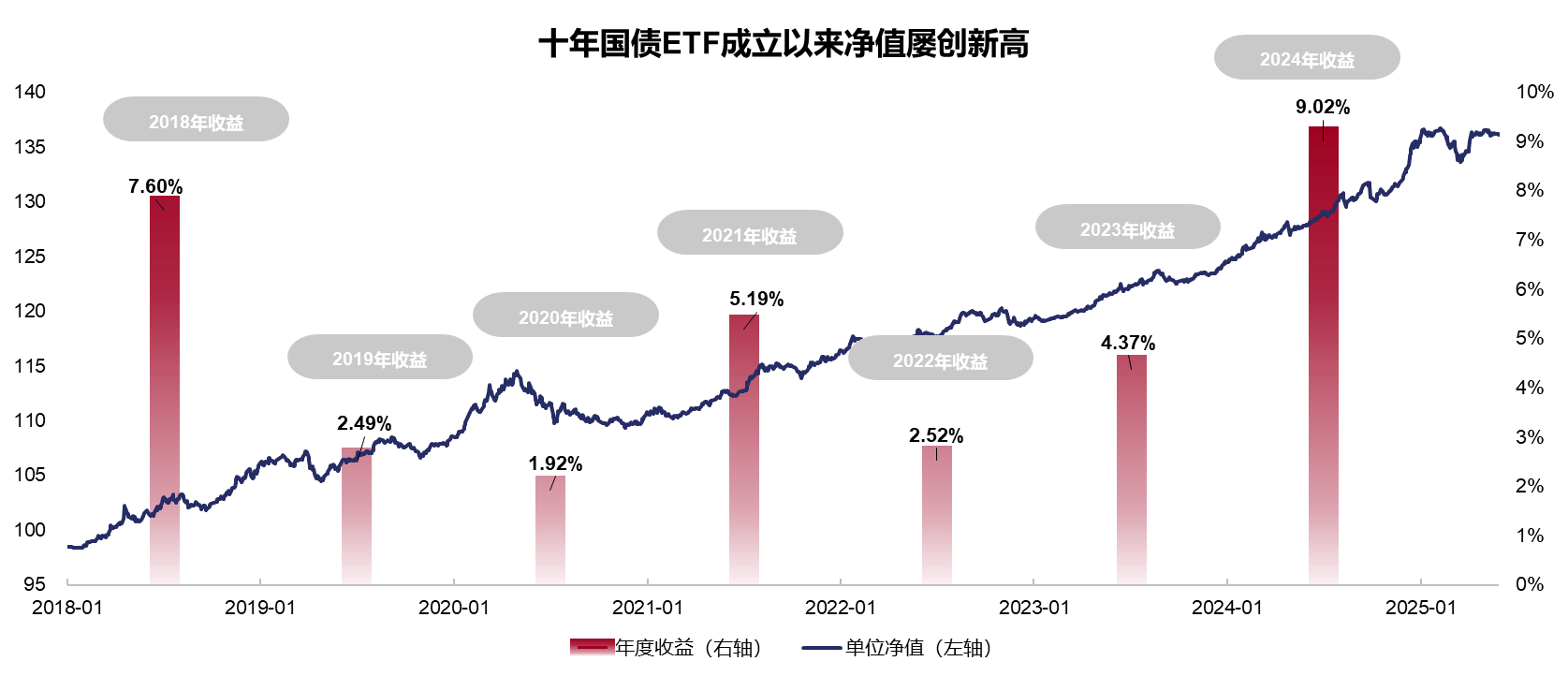
Core Viewpoint - Since 2025, the decline in fixed deposit rates has led investors to seek more stable and competitive returns, making the bond market a popular choice again [1]. Group 1: Bond Market Dynamics - Bond ETFs have seen significant growth, increasing from 174 billion to over 380 billion since the beginning of the year, with the ten-year government bond ETF (511260) attracting nearly 10 billion in net inflows [1]. - The macroeconomic environment shows continued weakness in domestic demand, with slow recovery in consumption and real estate investment, leading to persistent capital inflows into the bond market [1]. - The easing of the economic cycle between China and the U.S. and strengthened expectations for U.S. Federal Reserve rate cuts may open up space for domestic monetary policy easing, making bonds a favorable choice during this economic transition [1]. Group 2: Ten-Year Government Bonds - The ten-year government bond, backed by national credit, has a relatively low default risk and is directly linked to monetary policy adjustments, making it a preferred choice for many investors [1]. - The current yield on the ten-year government bond is approximately 1.65%, significantly higher than short-term bonds, providing better coupon protection [2]. - The ten-year government bond is positioned as a balance between short-term and long-term bonds, offering lower volatility risk and a smoother investment experience [2]. Group 3: Ten-Year Government Bond ETF (511260) - The ten-year government bond ETF tracks the Shanghai Stock Exchange 10-year government bond index, with an average duration of 7.6 years [3]. - Since its inception, the ten-year government bond ETF has consistently achieved positive returns each year, with a one-year return of 6.02%, a three-year return of 15.04%, and a five-year return of 19.26% [3][6]. - The ETF offers unique advantages such as T+0 trading, low transaction fees, transparent holdings, and the ability to pledge for repurchase, enhancing liquidity and investment flexibility [6][7][8]. Group 4: Market Outlook - Analysts from招商证券 expect that the economic fundamentals will not pose substantial risks to the bond market in the second half of the year, with GDP growth expected to stabilize [8]. - 信达证券 is optimistic about the bond market in July, anticipating a transition from quantitative to qualitative changes, which may lead to new lows in yields [8].
国投资本人事“巨震”,70后女董事长挑大梁!
Sou Hu Cai Jing· 2025-07-07 02:47
Core Points - National Investment Corporation (国投资本) has undergone significant leadership changes, with General Manager Lu Jun resigning on July 2, 2024, and Chairman Cui Hongqin taking over his responsibilities temporarily [2][3] - The company has four major financial segments: securities, trust, fund, and futures, with National Investment Securities (国投证券) reversing a two-year profit decline due to strong proprietary trading performance [2][11] - The trust and futures segments continue to face profit declines, while the fund business is experiencing both scale and performance pressures [2][11] Leadership Changes - Lu Jun, who served as General Manager for only 1 year and 2 months, has left for a work transfer, and Cui Hongqin has been elected as the new Chairman [3][24] - Cui Hongqin has extensive financial management experience and previously held various senior positions within the National Development Investment Group [3][24] - The former Chairman, Duan Wenwu, has transitioned to a role at China Minmetals and is expected to resign from his position as Chairman of National Investment Securities soon [5][24] Business Performance - National Investment Securities reported a revenue of 10.78 billion yuan in 2024, a 1.95% increase year-on-year, with a net profit of 2.53 billion yuan, up 30.49% [11][23] - The significant profit increase is attributed to a remarkable 834.62% rise in proprietary trading income, while other business segments like brokerage and asset management saw declines [11][12] - The overall revenue for National Investment Corporation in 2024 was 15.06 billion yuan, a decrease of 13.76%, marking the lowest level in four years [23] Segment Analysis - National Investment Securities accounts for over 71.62% of National Investment Corporation's revenue, highlighting its critical role in the overall business [11][23] - The trust segment, National Investment Taikang Trust, reported a revenue decline of 22.17% to 1.466 billion yuan, and net profit fell by 29.75% [16][23] - National Investment Futures has faced a continuous decline in net profit for three consecutive years, with a reported net profit of 215 million yuan in 2024, down 15.69% [20][21] Market Environment - The performance of National Investment Corporation's various segments reflects the broader market conditions, with the securities sector benefiting from a recovering market while trust and futures face challenges [23][24] - The recent leadership changes may impact the company's strategic direction and operational stability, raising concerns about team cohesion and market confidence [23][24]


【财经分析】北交所程序化交易新规生效 从速度竞争到策略创新成共识
Xin Hua Cai Jing· 2025-07-07 02:33
7日,北京证券交易所发布的《北京证券交易所程序化交易管理实施细则》(以下简称"《实施细 则》")正式实施。业内人士认为,对于程序化交易细则实施新规,市场前置应对充分,无需担忧其实 际的边际影响;细则实施有助于提升监管能力,推动量化行业从单纯的速度竞争转向策略创新,长期来 看有利于行业的健康可持续发展。 市场对新规实施影响已平滑 值得一提的是,《实施细则》对高频交易实施差异化收费预留下政策空间。财经评论员郭施亮表示,程 序化交易新规的实施,主要强调的是规范,并且对高频交易有一个明确的认定标准。可以预期,未来高 频交易的量化机构交易成本将会大幅增加,套利空间也会因交易成本增加而显著下降,这也有助于进一 步加强高频交易监管和引导量化机构规范运作。 《实施细则》是北交所针对中国证监会2024年5月发布的《证券市场程序化交易管理规定(试行)》制 定的业务规则和具体举措,对程序化交易报告管理、交易行为管理、信息系统管理、高频交易管理、监 督检查等事项作出细化规定。该细则于2024年6月开始征求意见,在2025年4月正式发布,自2025年7月7 日起施行。 《实施细则》对中国证监会上述管理规定规定的四类程序化异常交易行为作 ...