
生猪养殖

Search documents
牧原股份(002714) - 002714牧原股份调研活动信息20250821
2025-08-21 01:34
Financial Performance - In the first half of 2025, the company achieved a revenue of 76.463 billion yuan, a year-on-year increase of 34.46% [4] - The net profit attributable to shareholders reached 10.530 billion yuan, a staggering year-on-year growth of 1,169.77% [4] - The net cash flow from operating activities was 17.351 billion yuan, up 12.13% year-on-year [4] - As of the end of Q2 2025, the company's debt-to-asset ratio was 56.06%, a decrease of 3.14 percentage points from the end of Q1 [5] Debt Management - The company aims to reduce its overall debt by 10 billion yuan this year, having already decreased its total debt by 5.6 billion yuan by the end of Q2, achieving over half of its target [5] Livestock Production - In the first half of 2025, the company sold 46.91 million pigs, including 38.39 million market pigs, 8.29 million piglets, and 225,000 breeding pigs [5] - The number of breeding sows as of June 2025 was 3.431 million, with plans to reduce this to 3.3 million by year-end [7][8] - The cost of pig farming has decreased to approximately 11.8 yuan/kg as of July, with a target of an average cost of 12 yuan/kg for the year [5][14] Slaughtering and Meat Processing - The company slaughtered 11.4148 million pigs in the first half of 2025, a year-on-year increase of 110.87%, with a capacity utilization rate of 78.72% [6] - The company reported a significant reduction in losses, down to approximately 100 million yuan compared to the previous year [6] Dividend Distribution - The company plans to distribute a cash dividend of 9.32 yuan per 10 shares, totaling 5.002 billion yuan, which accounts for 47.50% of the net profit for the first half of 2025 [6][10] Industry Response and Strategy - The company is actively responding to national measures for capacity regulation in the pig industry, including reducing the number of breeding sows and managing pig weights [7][8] - The company has halted sales of fattening pigs to secondary fattening customers to ensure all pigs are directed to slaughterhouses [8] Global Expansion - The company is advancing its global strategy through its Hong Kong stock issuance, with funds primarily allocated for global market expansion and R&D, not for domestic capacity increases [9] - An overseas business team has been established to explore international markets, leveraging existing technology and cost advantages [11][12] Cost Reduction Initiatives - The company has successfully reduced costs from 13.1 yuan/kg in January to 11.8 yuan/kg in July, with a target to further decrease to 11 yuan/kg by year-end [14] - Key cost reduction strategies include breeding improvements, health management, and employee training [14] Community Engagement - The company is enhancing its piglet sales and providing customized solutions for farmers, aiming to strengthen ties and share industry benefits [15]

降本显著 牧原股份上半年净利增近12倍 承诺能繁母猪存栏量年末将降至330万头
Shang Hai Zheng Quan Bao· 2025-08-20 19:19
Core Viewpoint - The company, Muyuan Foods, reported a significant increase in its half-year performance, with a net profit growth of 1169.77% and plans for substantial cash dividends to shareholders, while actively participating in industry capacity regulation [2][3][5]. Financial Performance - In the first half of the year, the company achieved operating revenue of 764.63 billion yuan, a year-on-year increase of 34.46% [3] - The net profit attributable to shareholders reached 105.3 billion yuan, reflecting a remarkable growth of 1169.77% [3] - The company sold 46.91 million pigs, with a slaughter volume of 11.41 million pigs, marking a 110.87% increase year-on-year [3] - The cash flow from operating activities was 173.5 billion yuan, up 12.13% compared to the previous year [2] Dividend and Share Buyback - Muyuan Foods plans to distribute a cash dividend of 9.32 yuan per 10 shares (including tax), totaling 50.02 billion yuan [2][7] - As of June 30, the company has repurchased 52.54 million shares, with a total transaction amount of 2.11 billion yuan [2][7] Industry Capacity Regulation - The company is committed to reducing its breeding sow inventory to 3.3 million by the end of the year, in line with national capacity regulation efforts [4][5] - As of the end of the second quarter, the breeding sow inventory was reduced to 3.43 million, a decrease of 54,000 heads [5] - The company aims to lower the average weight of pigs for slaughter to 120 kg by the end of the year [5] Strategic Initiatives - Muyuan Foods is expanding its global presence, having established a subsidiary in Vietnam and applied for an H-share listing in Hong Kong [7] - The funds raised from the H-share listing will primarily be used for smart farming research and international supply chain development, rather than increasing domestic production capacity [7] Commitment to Quality and Sustainability - The company emphasizes the importance of meeting customer needs and aims to produce safe and healthy pork products while promoting high-quality industry development [8]

牧原股份上半年净利增超1100% 拟拿出50亿元分红
Zheng Quan Shi Bao· 2025-08-20 18:25
Core Viewpoint - In the first half of 2025, despite a downward trend in pig prices, the leading breeding company, Muyuan Foods (牧原股份), achieved significant profitability, reporting a net profit of 10.53 billion yuan, a year-on-year increase of 1169.77% [2][3]. Financial Performance - The company reported operating revenue of 76.463 billion yuan, an increase of 34.46% compared to the same period last year [2]. - The slaughtering and meat business generated revenue of 19.345 billion yuan, reflecting a growth of 93.83% year-on-year [2]. - The net cash flow from operating activities reached 17.351 billion yuan, up 12.13% from the previous year [2]. - As of June 30, 2025, the company's asset-liability ratio was 56.06%, a decrease of 2.62 percentage points from the beginning of the year [2]. Dividend Policy - Muyuan Foods announced a cash dividend of 9.32 yuan per 10 shares (including tax), totaling 5.002 billion yuan, which accounts for 47.5% of the company's net profit for the first half of 2025 [3]. Cost Management - The company reported a decrease in pig breeding costs, with the complete cost of pig breeding in June 2025 being below 12.1 yuan/kg [3]. - In July 2025, the complete cost of pig breeding was approximately 11.8 yuan/kg [3]. - The company aims to achieve an average cost target of 12 yuan/kg for the entire year through technological innovation and refined management [3]. Global Expansion Strategy - In the first half of 2025, Muyuan Foods initiated its "going global" strategy by establishing Muyuan Vietnam Co., Ltd. in March and applying for H-share listing on the Hong Kong Stock Exchange in May [4]. - The company views the Hong Kong listing as a crucial step in advancing its globalization strategy, aiming to enhance its investment value and attract more international long-term investors [4]. - Muyuan Foods intends to leverage its accumulated technological advantages, cost control, and environmental governance experience to seize opportunities in overseas markets and drive further business growth [4].
002714,拟分红50亿元!净利增近12倍!
证券时报· 2025-08-20 15:01
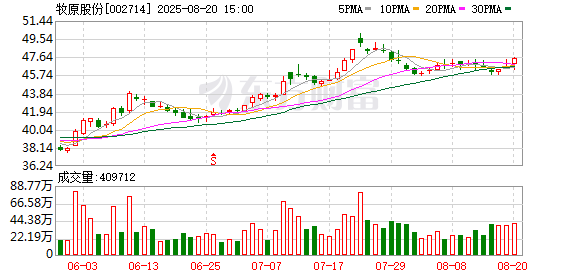
Core Viewpoint - The article highlights the strong financial performance of Muyuan Foods (牧原股份) in the first half of 2025, showcasing significant growth in revenue and net profit, alongside strategic initiatives for market expansion and cost management [1][3]. Financial Performance - The company achieved operating revenue of 764.63 billion yuan, a year-on-year increase of 34.46% [2] - Net profit attributable to shareholders reached 105.3 billion yuan, reflecting a staggering growth of 1169.77% compared to the previous year [1][2] - Basic earnings per share were reported at 1.96 yuan, up 1206.67% year-on-year [1][2] - The net cash flow from operating activities was 17.35 billion yuan, an increase of 12.13% [2] - The weighted average return on equity rose to 13.79%, up 12.49 percentage points from the previous year [2] Business Operations - In the first half of 2025, the company sold 46.91 million pigs, including 38.39 million market pigs and 0.83 million piglets [3] - The company slaughtered 11.41 million pigs, a year-on-year increase of 110.87% [3] - The total sales of fresh and frozen pork products reached 127.36 thousand tons [3] - The company aims to reduce breeding costs, targeting an average cost of 12 yuan/kg for the year [3] Market Expansion - Muyuan Foods is actively exploring overseas markets, having established a subsidiary in Vietnam and submitted an application for H-share listing in Hong Kong [3] Dividend and Share Buyback - The company proposed a cash dividend of 9.32 yuan per 10 shares, totaling approximately 5 billion yuan, which represents 47.50% of the net profit for the first half of 2025 [4] - In the first half of 2025, the total amount for cash dividends and share buybacks was 6.11 billion yuan, accounting for 58.04% of the net profit [4] Stock Performance - As of August 20, 2025, the stock price of Muyuan Foods was 47.5 yuan per share, with a total market capitalization of 259.5 billion yuan [5][6]

A股养猪龙头,净利润同比增长超1100%,要拿出50亿分红
Zheng Quan Shi Bao· 2025-08-20 14:51
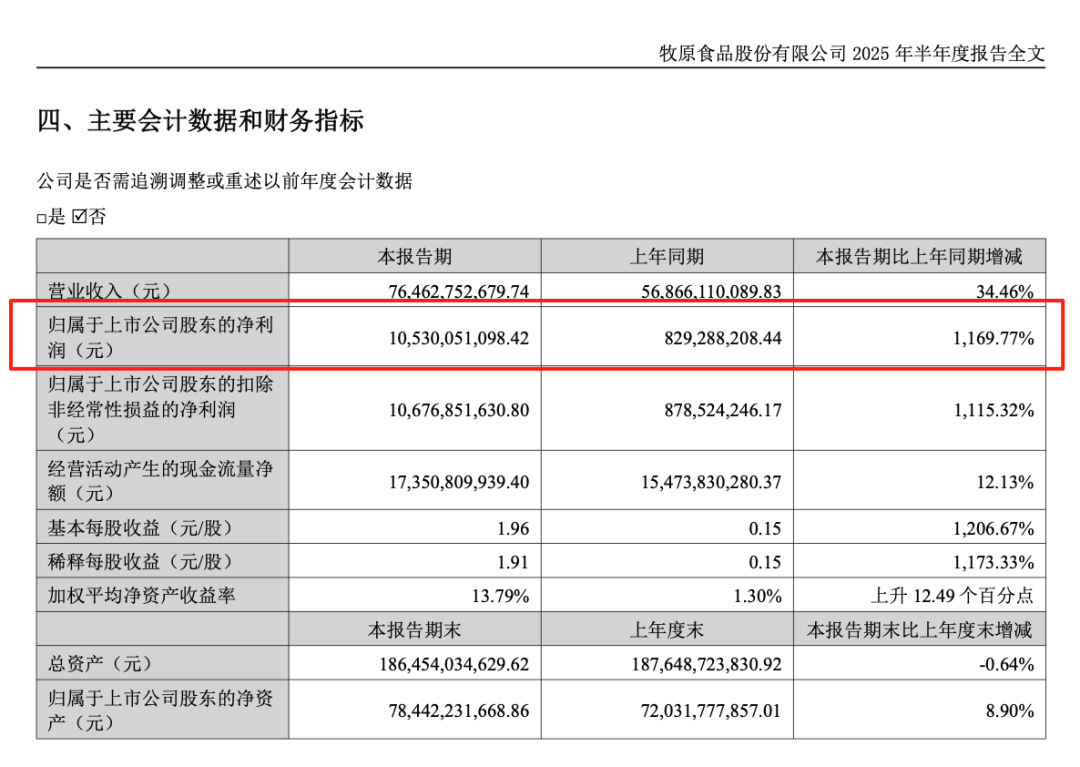
Core Viewpoint - Despite the overall decline in pig prices in the first half of the year, the leading breeding company Muyuan Foods (002714) achieved a net profit exceeding 10 billion yuan, demonstrating its cost advantages in the industry [2][4]. Financial Performance - The company reported operating revenue of 76.46 billion yuan, an increase of 34.46% compared to the same period last year [4]. - The net profit attributable to shareholders reached 10.53 billion yuan, a year-on-year increase of 1169.77% [4]. - The net cash flow from operating activities was 17.35 billion yuan, up 12.13% year-on-year [4]. - Basic earnings per share were 1.96 yuan, reflecting a significant increase of 1206.67% [4]. - The total assets at the end of the reporting period were approximately 186.45 billion yuan, a slight decrease of 0.64% from the previous year [4]. Dividend Policy - The company proposed a cash dividend of 9.32 yuan per 10 shares, totaling 5 billion yuan, which accounts for 47.5% of the net profit for the first half of 2025 [5]. - The total amount for cash dividends and share repurchases in the first half of 2025 was 6.11 billion yuan, representing 58.04% of the net profit [5]. Production and Cost Management - The company sold 46.91 million pigs in the first half of 2025, with a significant increase in slaughtering volume by 110.87% [5][6]. - The complete cost of pig farming was reported to be below 12.1 yuan per kilogram as of June 2025, with a target of an average cost of 12 yuan per kilogram for the year [6]. - The company aims to enhance production indicators through technological innovation and refined management practices [6]. Strategic Initiatives - Muyuan Foods has initiated an "outbound strategy," establishing a subsidiary in Vietnam and applying for H-share listing on the Hong Kong Stock Exchange [6][7]. - The company aims to leverage its technological advantages and cost control to capture growth opportunities in overseas markets [7].
牧原股份20250820
2025-08-20 14:49
Summary of the Conference Call for Muyuan Foods Co., Ltd. Company Overview - **Company**: Muyuan Foods Co., Ltd. - **Industry**: Swine farming and meat processing Key Financial Performance - **Revenue**: In the first half of 2025, revenue reached 51 billion yuan, a year-on-year increase of 12.13% [2] - **Net Profit**: For the same period, net profit was 105.3 billion yuan, showing a growth of over 11 times compared to the previous year [3] - **Debt Ratio**: The debt ratio decreased to 56.06%, down 3.14 percentage points from the end of the first quarter [2][4] - **Cash Flow**: Operating cash flow was 173.51 billion yuan, a year-on-year increase of 12.13% [3] Production and Sales - **Pig Sales**: Sold 46.94 million pigs in the first half of 2025, including 38.39 million commercial pigs [2][5] - **Breeding Stock**: The number of breeding sows is planned to be reduced to 3.3 million by the end of the year, a decrease of 130,000 from the second quarter [2][8] - **Cost Management**: The complete cost of pig farming dropped to approximately 11.8 yuan per kilogram in July, with a target of averaging 12 yuan per kilogram for the year [2][15] Slaughtering and Meat Processing - **Slaughter Volume**: Slaughtered 11.41 million pigs, a year-on-year increase of over 110.87% [6] - **Utilization Rate**: Capacity utilization rate improved to 78.72% [6] - **Losses**: Despite a loss of approximately 100 million yuan, the loss was significantly reduced compared to the previous year [6][20] Shareholder Returns - **Dividend Distribution**: Announced a cash dividend of 9.32 yuan per 10 shares, totaling 5 billion yuan, which is 47.5% of the net profit for the first half of 2025 [7][10] Strategic Initiatives - **Global Expansion**: Funds raised from the Hong Kong stock issuance will be used for R&D and overseas expansion, not for domestic capacity increases [9][11] - **Response to National Policies**: Actively responding to national capacity control policies, taking on 30% of the target [8][25] - **Future Plans**: No new domestic capacity plans for the second half of the year; focus on maintaining existing capacity [9][28] Cost Reduction and Efficiency - **Cost Targets**: Aiming for an average cost of 12 yuan per kilogram for the year, with a goal to reduce it to 11 yuan by year-end [15] - **Cost Management Strategies**: Focus on breeding improvements, disease control, and employee training to enhance production efficiency [15][19] Industry Context - **Market Dynamics**: The company is committed to fulfilling its capacity control commitments, which may influence production and operational plans for the upcoming year [8][27] - **Collaboration with Other Enterprises**: The company is exploring partnerships and collaborative models to enhance its market position and service offerings [21] Conclusion Muyuan Foods Co., Ltd. is demonstrating strong financial performance and strategic initiatives aimed at enhancing production efficiency, responding to national policies, and expanding its global footprint while maintaining a focus on shareholder returns and cost management.
A股养猪龙头净利润同比增长超1100%!要拿出50亿分红!
Zheng Quan Shi Bao Wang· 2025-08-20 14:27
Core Viewpoint - Despite a downward trend in pig prices in the first half of the year, the leading breeding company, Muyuan Foods, achieved a net profit exceeding 10 billion yuan, demonstrating its cost advantages [2]. Financial Performance - The company reported operating revenue of 76.46 billion yuan, an increase of 34.46% compared to the same period last year [4]. - Net profit attributable to shareholders reached 10.53 billion yuan, a year-on-year increase of 1169.77% [4]. - The net cash flow from operating activities was 17.35 billion yuan, up 12.13% from the previous year [4]. - Basic earnings per share were 1.96 yuan, reflecting a 1206.67% increase year-on-year [4]. - The weighted average return on equity rose to 13.79%, an increase of 12.49 percentage points [4]. Dividend Policy - The company proposed a cash dividend of 9.32 yuan per 10 shares, totaling 5 billion yuan, which accounts for 47.5% of the net profit for the first half of 2025 [5]. - The total amount for cash dividends and share buybacks in the first half of 2025 was 6.11 billion yuan, representing 58.04% of the net profit [5]. Production and Sales - In the first half of 2025, Muyuan Foods sold 46.91 million pigs, including 38.39 million market pigs and 0.83 million piglets [5]. - The company slaughtered 11.41 million pigs and sold 127.36 thousand tons of fresh and frozen pork products [5]. Cost Management and Future Strategy - The company reported a decrease in pig breeding costs, with the complete cost in June 2025 being below 12.1 yuan per kilogram [6]. - The company aims to achieve an average cost target of 12 yuan per kilogram for the year through technological innovation and refined management [6]. - Muyuan Foods has initiated an "going global" strategy, establishing a subsidiary in Vietnam and applying for a listing on the Hong Kong Stock Exchange [7]. - The company plans to leverage its technological advantages and cost control to capture opportunities in overseas markets [7].
牧原股份上半年净利润同比增1169.77% 拟合计分红50.02亿元
Zhong Guo Jin Rong Xin Xi Wang· 2025-08-20 13:19
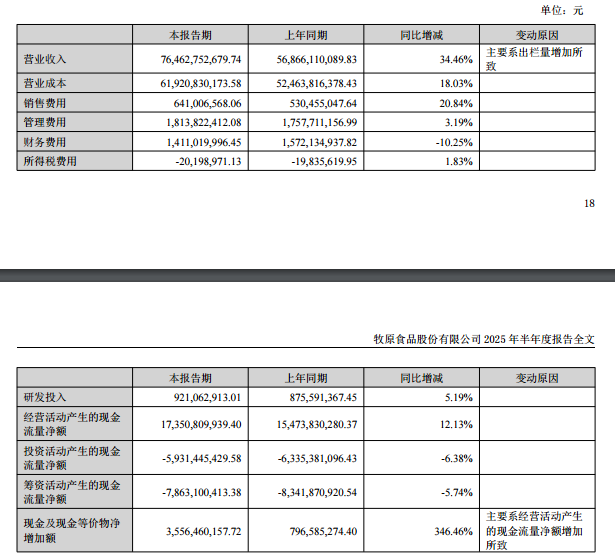
Core Insights - The company reported a significant increase in revenue and net profit for the first half of 2025, with revenue reaching 764.63 billion yuan, a year-on-year growth of 34.46%, and net profit of 105.3 billion yuan, a staggering increase of 1169.77% [1][4]. Financial Performance - Revenue for the first half of 2025 was 76,462.75 million yuan, compared to 56,866.11 million yuan in the same period last year, reflecting a growth of 34.46% [2]. - Operating costs increased to 61,920.83 million yuan, up 18.03% from 52,463.82 million yuan [2]. - The company’s gross profit margin improved, with the breeding business achieving a gross margin of 18.72%, an increase of 10.59 percentage points year-on-year [4]. Business Segments - The breeding business generated 754.46 billion yuan in revenue, a 34.68% increase year-on-year, while the slaughtering and meat business saw revenue rise by 93.83% to 193.45 billion yuan [4][5]. - The company sold 46.91 million pigs in the first half of 2025, including 38.39 million commercial pigs and 8.29 million piglets [5]. Cash Flow and Investments - The net cash flow from operating activities was 17.35 billion yuan, a 12.13% increase from the previous year [3]. - Research and development expenses amounted to 921.06 million yuan, reflecting a 5.19% increase year-on-year [3]. Shareholder Information - As of June 30, 2025, the number of shareholders decreased to 208,952, a decline of 25.13% from the previous quarter [6]. - The average shareholding per person increased to 18,200 shares, up 33.57% from the last period [7]. Market Performance - The company's stock closed at 47.5 yuan per share on August 20, 2025, with a market capitalization of 259.5 billion yuan [8].
东兴证券:7月猪价冲高回落 关注产能去化
智通财经网· 2025-08-20 09:31
Core Viewpoint - The report from Dongxing Securities indicates that the prices of piglets, live pigs, and pork are expected to fluctuate in July 2025, with average prices at 35.73 CNY/kg, 14.91 CNY/kg, and 25.37 CNY/kg respectively, reflecting a mixed trend in price changes [1] Industry Supply and Demand Performance - In July, pig prices rose and then fell, with a slight rebound in early August before continuing to decline, leading to an average price of 13.82 CNY/kg by August 11 [1] - The supply side was influenced by the rhythm of supply, with group farms reducing output to support prices in early July, but facing pressure from increased supply from individual farmers later in the month [2] - The demand side saw weak consumption due to high summer temperatures, leading to sluggish sales for slaughterhouses [2] Capacity Change Trends - As of June, the number of breeding sows was reported at 40.43 million, showing a slight increase of 0.02% month-on-month, with a narrowing growth rate [2] - Data from July indicated a 0.52% increase in breeding sow samples, while other data remained stable, suggesting a potential halt in growth since February [2] Policy Guidance - Since late May, policies have focused on "reducing production capacity, controlling weight, and limiting secondary fattening," signaling a stabilization of pig prices [3] - Stricter environmental regulations have been implemented, particularly in southern water network areas, which may lead to short-term price pressures but are expected to benefit long-term market stability [3] Future Market Outlook - The ongoing capacity regulation driven by policy is expected to be a key theme in the near future, with an anticipated increase in the elimination of outdated capacity [4] - High-quality production capacity in 2025 is expected to maintain profitability due to cost advantages, with a recommendation to focus on leading companies in the industry such as Muyuan Foods, Wens Foodstuff Group, and others [4] July Sales Data of Listed Companies - In July, the average sales prices for major companies were as follows: Muyuan Foods at 14.30 CNY/kg, Wens Foodstuff Group at 14.58 CNY/kg, Zhengbang Technology at 14.31 CNY/kg, and New Hope Liuhe at 14.44 CNY/kg, with respective month-on-month changes of 1.56%, 1.32%, 1.85%, and 1.83% [5] - The sales volume for these companies showed a mixed trend, with Muyuan Foods down by 10.40% to 750,000 heads, while Wens Foodstuff Group increased by 5.24% to 316,000 heads [5] - The average weight of pigs sold decreased across most companies, indicating a continued trend of reduced weights in the industry [5]


建信期货生猪日报-20250820
Jian Xin Qi Huo· 2025-08-20 01:49
Report Information - Report Date: August 20, 2025 [2] - Report Type: Pig Daily Report [1] Industry Investment Rating - No relevant information provided. Core Viewpoints - The supply of pigs in August is expected to increase significantly, with high enthusiasm among farmers for selling. Meanwhile, demand is in the off - season, resulting in a relatively loose supply - demand situation, and spot prices may continue to face pressure. In the futures market, the near - month 2509 contract fluctuates weakly following the spot market. In the medium - to - long - term for far - month contracts, although supply shows a slight increase, contracts like 2511 and 2601 are in the peak demand season, and with positive factors such as the anti - involution high - quality development initiative and strengthened environmental protection, the downside space is relatively limited [9]. Summary by Section 1. Market Review and Operational Suggestions Market Conditions - Futures: On the 19th, the main 2511 contract of live pigs opened slightly higher and then fluctuated upwards, closing with a positive line. The highest price was 13,930 yuan/ton, the lowest was 13,810 yuan/ton, and the closing price was 13,900 yuan/ton, up 0.18% from the previous day. The total open interest of the index decreased by 4,425 lots to 181,426 lots. - Spot: On the 19th, the average price of ternary pigs nationwide was 13.67 yuan/kg, up 0.03 yuan/kg from the previous day [8]. Market Analysis - Demand side: The utilization rate of pig pens is high, and the enthusiasm for secondary fattening is currently low, with most in a wait - and - see state. Due to the hot weather, terminal demand is weak, and orders from slaughtering enterprises are average. The current slaughtering progress is fast, and the operating rate and slaughter volume of slaughtering enterprises have increased slightly. On August 18, the slaughter volume of sample slaughtering enterprises was 140,400 heads, 800 heads less than the previous day but 1,400 heads more than a week ago. - Supply side: According to Yongyi sample data, the planned pig slaughter volume of sample enterprises in August is 24.72 million heads, a 6.6% increase compared to the actual slaughter volume in July. The enthusiasm of farmers for selling is high, and the slaughter progress is fast. The utilization rate of secondary fattening pens remains high, and there are still secondary - fattened pigs to be released, so there is still pressure on slaughter volume, and the slaughter weight fluctuates slightly [9]. 2. Industry News - No specific news content provided in the text. 3. Data Overview - Profit: As of August 15, the average profit per self - bred and self - raised pig was 101 yuan/head, a week - on - week decrease of 36 yuan/head; the average profit per pig purchased as a piglet was - 52 yuan/head, a week - on - week increase of 1.3 yuan/head. - Piglet price: The average market sales price of 15 - kg piglets in the week of August 15 was 484 yuan/head, 33 yuan/head lower than the previous week. - Slaughter volume: In the week of August 15, the slaughter volume of the slaughter sample was 1.6335 million heads, an increase of 30,100 heads compared to the previous week, a month - on - month increase of 1.88%; the average daily slaughter volume of the daily slaughter sample was 138,446 heads, an increase of 1,321 heads compared to the previous week, with an average daily increase of 0.96%. - Planned slaughter volume: The planned pig slaughter volume of sample enterprises in August is 24.72 million heads, a 6.6% increase compared to July. - Average slaughter weight: As of the week of August 15, the average slaughter weight of live pigs nationwide was 127.82 kg, an increase of 0.02 kg compared to the previous week, a month - on - month increase of 0.02%, and an increase of 1.65 kg compared to the same period last year, a year - on - year increase of 1.31% [14].