纺织服装

Search documents
石家庄前首富李兆廷,被拘留
Xin Lang Cai Jing· 2026-02-14 03:01
Core Viewpoint - The detention of Li Zhaoting, the actual controller of Shanghai Jialinjie Textile Co., Ltd., is seen as an extension of the administrative accountability to criminal investigation regarding securities violations [3]. Group 1: Company Background - Shanghai Jialinjie Textile Co., Ltd. is primarily engaged in high-end knitted fabrics and outdoor sportswear [4]. - The company reported a revenue of 918 million yuan for the first three quarters of 2025, with a net profit increase of 205.46% year-on-year, and over 60% of its revenue coming from overseas [4]. Group 2: Li Zhaoting's Background - Li Zhaoting, born in 1965, co-founded Dongxu Group in 1997 and led its transformation into a leading enterprise in the liquid crystal glass substrate industry [2]. - He was once the richest person in Shijiazhuang, with a peak wealth of 22 billion yuan, ranking 837th on the Hurun Global Rich List [2]. Group 3: Legal Issues - From 2015 to 2019, under Li Zhaoting's leadership, Dongxu Group engaged in significant financial fraud, inflating revenues by 47.825 billion yuan and profits by 13.001 billion yuan [2]. - The company was penalized with a total fine of 1.7 billion yuan, with Li Zhaoting personally fined 590 million yuan and banned from the securities market for life [2].
落地山东!国家安全防护用纺织品质量检验检测中心获批筹建
Da Zhong Ri Bao· 2026-02-14 02:04
Core Viewpoint - The establishment of the National Safety Protective Textile Quality Inspection and Testing Center marks a significant advancement in China's safety protective textile industry, aiming to enhance industry standards, worker safety, and national emergency response capabilities [1][3]. Group 1: Industry Significance - Safety protective textiles are crucial in various sectors, including renewable energy, high-end equipment manufacturing, emergency rescue, aerospace, national defense, healthcare, and strategic infrastructure, serving as the last line of defense for worker safety [2]. - China's safety protective textile industry is the largest globally, with a fiber processing volume projected to reach 640,000 tons in 2024, reflecting a 7% year-on-year growth and an average annual growth rate of 7.7% over the past decade [2]. - Shandong Province is a key production base for safety protective products, with an industry scale exceeding 20 billion yuan, accounting for approximately 18%-20% of the national market [2]. Group 2: Challenges and Solutions - Insufficient testing capabilities have become a critical bottleneck for the industry's advancement, particularly in high-end testing areas like arc protection and combustion protection, which have been dominated by foreign institutions [2][3]. - The new testing center aims to localize high-end testing services, significantly reducing testing costs and time, thereby enhancing overall industry quality and international competitiveness [3]. Group 3: Testing Capabilities and Innovations - The center will develop comprehensive testing capabilities across the entire industry chain, focusing on mechanical protection, fire resistance, temperature protection, electrical protection, chemical protection, biological protection, and electromagnetic radiation protection [4]. - The center has already developed testing platforms for arc protective fabrics and garments, achieving 100% consistency with data from Canadian and Spanish laboratories in ASTM standard blind sample tests [4]. - Advanced testing equipment will be introduced, covering over 90% of key projects for 41 types of protective clothing, addressing long-standing dependencies on foreign testing [5]. Group 4: Strategic Alignment and Future Goals - The center's establishment aligns with national strategies for safety production and industrial upgrading, supporting the goals outlined in the "Textile Industry Quality Improvement and Upgrading Implementation Plan (2023-2025)" [3][6]. - The center aims to enhance innovation capabilities and international competitiveness in the safety protective textile industry, contributing to public safety and worker health [7]. - Future objectives include creating a first-class national public testing and technical service platform, integrating into the broader context of high-quality economic and social development [7].
太突然!资本大佬李兆廷被公安拘留 身家曾超200亿
Mei Ri Jing Ji Xin Wen· 2026-02-14 00:48
Group 1 - Li Zhaoting, born in July 1965, was a prominent figure in the photovoltaic industry and the leader of the "Dongxu system" [1] - In 2019, Li Zhaoting became the richest person in Shijiazhuang with a wealth of 23.5 billion yuan, controlling three listed companies: Dongxu Photovoltaic, Dongxu Lantian, and Jialinjie [1] - The China Securities Regulatory Commission (CSRC) launched an investigation into Li Zhaoting and his companies for violations such as information disclosure and fraudulent issuance, resulting in fines totaling approximately 1.7 billion yuan, marking a recent high for single-case penalties [2] Group 2 - The Hebei Securities Regulatory Bureau imposed a warning and a fine of about 590 million yuan on Li Zhaoting, along with a lifetime ban from the securities market for him and four others [2] - Currently, only Jialinjie remains among the listed companies of the "Dongxu system," which specializes in high-end outdoor sports fabric and garment development and sales [2] - According to Jialinjie's Q3 2025 report, the company achieved a revenue of 918 million yuan and a net profit of approximately 51.996 million yuan in the first three quarters, representing a year-on-year increase of 205.46% [2] Group 3 - On February 13, Jialinjie announced that Li Zhaoting was detained by the Shijiazhuang Public Security Bureau, with an ongoing investigation [4] - As of the announcement date, the company had not received any requests from authorities for assistance in the investigation, and the control of the company had not changed [4] - The company's board and senior management continued to perform their duties normally, and the operational activities of the company remained unaffected [4]


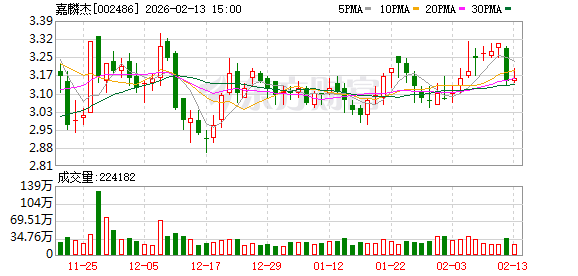
深夜突发!昔日石家庄首富李兆廷 被公安拘留!身家曾超200亿元 此前因欺诈发行等被罚5.9亿元并终身市场禁入
Hua Xia Shi Bao· 2026-02-14 00:47
Group 1 - The actual controller of the company, Li Zhaoting, has been detained by the Shijiazhuang Public Security Bureau, and the related case is under investigation [2] - The company has not received any notification from authorities requiring assistance in the investigation, and its control has not changed [2] - Company operations, including production and management, are reported to be normal and not significantly affected by the incident [2] Group 2 - Li Zhaoting is a well-known figure in the photovoltaic and energy sectors, previously ranked as the richest person in Shijiazhuang with a wealth of 23.5 billion yuan in 2019 [3] - Li Zhaoting has faced regulatory scrutiny, including a total fine of approximately 1.7 billion yuan for violations related to information disclosure and fraudulent issuance, leading to the delisting of associated companies [3] - The company, established in 2001, specializes in the research and sales of high-end outdoor sports fabric and garments, with a focus on self-developed knitted fabric series [3] Group 3 - For the first three quarters of 2025, the company reported a revenue of 918 million yuan and a net profit attributable to shareholders of 51.996 million yuan, representing a year-on-year increase of 205.46% [4] - The company's net profit for the third quarter alone reached 22.247 million yuan, showing a significant year-on-year growth of 451.31% [4] - The company's non-recurring net profit for the first three quarters was 49.578 million yuan, with a year-on-year increase of 318.59% [4]
资本大佬李兆廷突然被拘留!他是石家庄前首富,身家曾超200亿
Mei Ri Jing Ji Xin Wen· 2026-02-13 22:20
Group 1 - The actual controller of the company, Li Zhaoting, has been detained by the Shijiazhuang Public Security Bureau, but the company has not received any notification to assist in the investigation, and its control has not changed [1] - Li Zhaoting is not holding any position in the company and the board and senior management are functioning normally, ensuring that the company's production and operations remain unaffected [1] - The company has reported a revenue of 918 million yuan and a net profit of approximately 51.996 million yuan for the first three quarters of 2025, marking a year-on-year increase of 205.46% [4] Group 2 - The company specializes in high-end outdoor sports fabric and garment research and sales, with products including self-developed knitted fabric series [3] - The company has shown significant growth in its financial performance, with a net profit of 22.247 million yuan in the third quarter, representing a year-on-year increase of 451.31% [4] - Li Zhaoting was previously a prominent figure in the photovoltaic industry and faced severe penalties from the China Securities Regulatory Commission for violations, leading to the delisting of his associated companies [3]
002486,实控人被拘留
Shang Hai Zheng Quan Bao· 2026-02-13 15:50
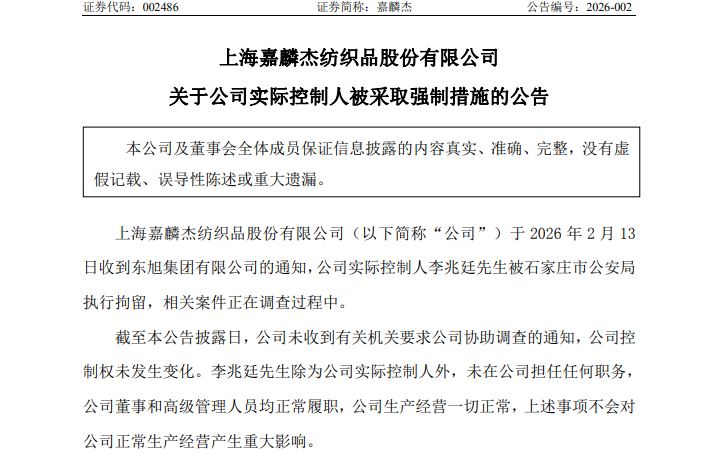
Core Viewpoint - The company, Jialinjie, announced that its actual controller, Li Zhaoting, has been detained by the Shijiazhuang Public Security Bureau, and the related case is under investigation. However, the company asserts that it has not received any requests for assistance in the investigation and that its control has not changed [2][5]. Group 1 - As of the announcement date, the company has not received any notification from authorities requiring assistance in the investigation, and the control of the company remains unchanged [5]. - Li Zhaoting, while being the actual controller, does not hold any position within the company, and the board and senior management are functioning normally [5]. - The company's production and operations are reported to be normal, and the recent events are not expected to have a significant impact on its operations [5]. Group 2 - In June 2025, the company disclosed that its controlling shareholder, Shaoxing Guojun Enterprise Management Co., and its actual controller, Li Zhaoting, received an administrative penalty from the Hebei Securities Regulatory Bureau for false disclosures and fraudulent bond issuance [5]. - The company stated that the administrative penalty is unrelated to its daily operations and will not affect its business activities [5]. - Jialinjie's business includes the production and sale of high-end fabric and garments, achieving a revenue of 918 million yuan and a net profit of approximately 51.996 million yuan in the first three quarters of 2025 [5]. Group 3 - As of February 13, the company's stock closed at 3.16 yuan per share, with a market capitalization of 2.605 billion yuan [6].
鲁泰 A:25年扣非利润承压,26年展望积极,战略合作值得期待-20260214
Xinda Securities· 2026-02-13 13:20
Investment Rating - The report assigns a positive outlook for the company, indicating a potential for growth in 2026 despite challenges in 2025 [1][3]. Core Insights - The company expects a significant increase in net profit for 2025, projected between 570 million to 630 million yuan, representing a year-on-year growth of 38.92% to 53.54%. However, the net profit excluding non-recurring items is expected to decline by 10.85% to 23.29% [1][2]. - The strategic partnership with MF France and FR Japan, which involves the transfer of 46.12% equity in Tianqin International, is anticipated to enhance the company's operational capabilities and market reach [1][2]. - The company is optimistic about its core business performance in 2026, with expectations of improved operational profits driven by a stable macroeconomic environment and increased production capacity from its Vietnam project [3]. Financial Performance Summary - For 2025, the company is projected to have total revenue of 5,978 million yuan, a slight decrease of 1.8% year-on-year, while net profit is expected to rise to 612 million yuan, a 49.1% increase [4]. - The earnings per share (EPS) for 2025 is forecasted at 0.75 yuan, with a price-to-earnings (P/E) ratio of 9.96 [4]. - The company anticipates a gradual recovery in revenue and profit margins in 2026, with total revenue expected to reach 6,579 million yuan, reflecting a growth rate of 10.1% [4].

鲁泰A(000726):25年扣非利润承压,26年展望积极,战略合作值得期待
Xinda Securities· 2026-02-13 12:32
Investment Rating - The report assigns a positive outlook for the company, indicating a potential for growth in 2026 despite challenges in 2025 [1]. Core Insights - The company expects a significant increase in net profit for 2025, projected between 570 million to 630 million yuan, representing a year-on-year growth of 38.92% to 53.54%. However, the net profit excluding non-recurring items is expected to decline by 10.85% to 23.29% [1][2]. - The strategic partnership with MF France and FR Japan, which involves the transfer of 46.12% equity in Tianqin International, is anticipated to enhance the company's operational capabilities and market reach [1][2]. - The company is optimistic about its core business performance in 2026, with expectations of improved operational profits driven by the recovery of overseas orders and increased production capacity from its Vietnam project [3]. Financial Performance Summary - For 2025, the company is projected to have total revenue of 5,978 million yuan, a slight decrease of 1.8% year-on-year, while net profit is expected to rise to 612 million yuan, a 49.1% increase [4]. - The earnings per share (EPS) for 2025 is forecasted at 0.75 yuan, with a price-to-earnings (P/E) ratio of 9.96 [4]. - The company anticipates a gradual recovery in revenue and profit margins in 2026, with total revenue expected to reach 6,579 million yuan and net profit at 606 million yuan [4].
黑牡丹为子公司担保5.4亿元,三季度营收增但利润降
Jing Ji Guan Cha Wang· 2026-02-13 07:28
Group 1 - The company has signed external guarantee contracts totaling 540 million yuan for three subsidiaries, aimed at supporting operational development [1] - The total amount of external guarantees reached 3.995 billion yuan, accounting for 38.52% of the recently audited net assets [1] Group 2 - The stock price of the company is currently 9.39 yuan, with a slight increase of 0.32% on the day and a cumulative rise of 1.51% over the last five trading days [2] - The company’s stock performance is slightly better than the average of the real estate sector, which has seen a decline of 0.16% [2] Group 3 - For the first nine months of 2025, the company reported revenue of 2.443 billion yuan, a year-on-year increase of 34.79%, while the net profit attributable to shareholders decreased by 19.62% to 63.7921 million yuan [3] - The revenue structure is primarily composed of engineering construction (46.67%) and real estate business (27.94%), with the textile and apparel segment continuing to shrink [3] - The earnings per share for the third quarter of 2025 is 0.06 yuan, which is below the industry average [3] Group 4 - Institutional attention towards the company is relatively low, with the latest sentiment being neutral and no significant changes in ratings [4] - The company faces transformation pressures amid a sluggish industry sales backdrop, but its involvement in new urbanization and data center concepts has attracted some long-term valuation recovery interest from investors [4]

假期涨知识!全网播放超300万的视频栏目,这样拆解不同行业的生意经
中泰证券资管· 2026-02-13 05:02
Core Viewpoint - The article emphasizes the importance of understanding various industries through a series of educational videos, aiming to clarify industry dynamics and business models for investors [2]. Group 1: Lithium Battery Industry - The video discusses the basic principles of batteries, including the selection of anode and cathode materials, separators, electrolytes, and packaging processes, while reviewing the development of the lithium battery industry [4]. - It focuses on the constraints and opportunities that have shaped China's lithium battery supply chain, exploring future technological breakthroughs and the potential for second-tier companies to catch up [4]. Group 2: Baijiu (Chinese Liquor) Industry - The video explores how grain is transformed into baijiu, the classification of different aroma types, and the distinct paths taken by renowned liquor companies [5]. - It analyzes the historical development, brewing techniques, competitive landscape, and changes in supply and demand within the baijiu industry, discussing the formation of high-end, mid-range, and low-end market segments [5]. Group 3: E-commerce Industry - The video examines the rapid rise of e-commerce platforms like Taobao, JD.com, and Pinduoduo, and how live-streaming e-commerce is transforming traditional models [7]. - It analyzes revenue sources, business models, competitive advantages, and future trends in e-commerce, particularly in the context of slowing user growth and rising customer acquisition costs [7]. Group 4: Textile and Apparel Manufacturing - The video traces the evolution of the textile industry from the late Qing Dynasty to modern brand collaborations, focusing on the competitive history and development of the manufacturing sector [9]. - It discusses the segmentation of the textile industry, brand partnerships, and the current challenges faced by manufacturers in a globally competitive environment [9]. Group 5: Textile and Apparel Branding - The video highlights the diverse demands and competitive dynamics in the textile branding sector, analyzing market size distribution and competitive pressures across different price segments [10]. - It explores strategies for brands to enhance product design and development, reduce operational risks, and optimize channel experiences to improve sales efficiency [10]. Group 6: Banking Industry - The video focuses on the functions, revenue sources, and major profit-generating activities of banks, as well as risk management and non-performing loans [12]. - It discusses how banks earn through interest spreads and intermediary services, and examines the impact of regulatory requirements and economic cycles on credit policies [12].