
数据产业

Search documents
多领域“硬核”数据传递积极信号 印证经济韧性强、活力足
Yang Shi Wang· 2025-08-29 03:26
Economic Overview - China's economy is showing a steady and positive trend, with various recent data indicating ongoing development [1] Logistics Sector - The total social logistics volume in China exceeded 200 trillion yuan in the first seven months, reaching 201.9 trillion yuan, a year-on-year increase of 5.2% [4] - The logistics demand in high-end manufacturing and green low-carbon sectors is growing robustly, with logistics for units and household goods increasing by 6.2% year-on-year [4] - The logistics industry generated a total revenue of 8.2 trillion yuan in the first seven months, reflecting a year-on-year growth of 4.9% [13] - The growth momentum in the logistics sector is notably stronger in the central and western regions, with the western region's business volume index reaching 52.3% and the central region at 50.9%, both above the national average [13][15] E-commerce and Online Retail - E-commerce logistics is experiencing diversified development, with online retail sales of physical goods increasing by 6.3% year-on-year, outpacing the growth of total retail sales of consumer goods by 1.5 percentage points [15] International Logistics - International logistics is emerging as a new growth point, with cargo and mail transport volume on international routes reaching 38.8 million tons in the first seven months, a year-on-year increase of 21.5% [17] Data Industry - The scale of China's data industry has surpassed 5.8 trillion yuan, with an expected annual growth rate of over 15% from 2025 to 2030 [10] - The data industry shows a tiered distribution, with the eastern region accounting for nearly 70% of the total industry scale, while the central and western regions account for 17.2% and 13.1%, respectively [20] - The Yangtze River Delta region exhibits significant industry clustering, with over 100,000 data enterprises and a scale accounting for 22.6% of the national total [20]


影响市场重大事件:业务准入加快推进,卫星产业拐点在即;我国自主研发脑机接口成功完成脑深部肿瘤边界精准定位临床试验
Mei Ri Jing Ji Xin Wen· 2025-08-29 01:33
Group 1: Industry Developments - Shanghai is promoting the integration of "security + AI," focusing on emerging fields such as intelligent robotics and low-altitude economy, with a goal to enhance the cybersecurity industry in the Yangtze River Delta and nationwide [1] - The global satellite IoT connections are expected to grow at a compound annual growth rate (CAGR) of 23.8% from 2023 to 2030, with satellite broadband and direct smart phone communication identified as transformative services [2] - The Ministry of Industry and Information Technology (MIIT) has issued guidelines to optimize business access and promote the development of the satellite communication industry, indicating a strategic shift and potential industry turning point [3] Group 2: Technological Innovations - Chinese researchers have developed the world's first adaptive, full-bandwidth, high-speed wireless communication module based on optoelectronic integration technology, achieving transmission rates exceeding 120 Gbps, which meets 6G communication requirements [4] - A new brain-computer interface technology has been successfully tested for precise tumor boundary localization during surgery, marking a significant breakthrough in clinical applications [7][8] Group 3: Data Industry Growth - China's data industry has surpassed 5.8 trillion yuan, maintaining an annual growth rate of over 15%, with expectations to continue this trend from 2025 to 2030 [9] - The National Data Bureau plans to introduce several industry policies this year, including data property rights and digital industry clusters, to support the development of the digital economy [5] Group 4: Corporate Performance - China Life Insurance is focusing on the Hong Kong stock market for its newly approved Qualified Domestic Institutional Investor (QDII) quota, highlighting the market's potential for equity investment [6] - Huawei Cloud's overall computing power has increased by nearly 250% year-on-year, with a significant rise in customers using its Ascend AI cloud services [11]
乘“数”而上!中国数据产业“家底”不断壮大 算力总规模跃居全球第二
Yang Shi Wang· 2025-08-28 12:17
Core Insights - The Chinese big data industry is experiencing strong growth, with a current scale exceeding 5.8 trillion yuan and an annual growth rate of over 15% [1][5][7] - By the end of 2025, the added value of the digital economy is expected to reach 49 trillion yuan, accounting for approximately 35% of GDP [1][10] Industry Overview - The data industry in China utilizes modern information technology for the development of products and services based on data resources, facilitating their circulation and application [4] - There are over 400,000 data enterprises in China, with more than 100,000 located in the Yangtze River Delta region [4][2] Future Projections - The data industry is projected to maintain an annual growth rate of over 15% for the next five years, with an estimated scale exceeding 13 trillion yuan by 2030 [7][5] - China's total computing power ranks second globally, with significant advancements in digital infrastructure [8][10]

利好突袭!刚刚,集体异动!
券商中国· 2025-08-28 10:25
Core Viewpoint - The data industry is experiencing significant growth and support from government initiatives, with a focus on building data infrastructure and promoting digital economy integration [1][4][5]. Group 1: Government Initiatives - The National Data Bureau announced plans to launch over ten industry policies this year, including data property rights and digital industry clusters [1][4]. - A total of 30 policies have been proposed to support high-quality development of the digital economy and urban digital transformation [4][5]. - The data industry is projected to reach a value of approximately 49 trillion yuan by the end of this year, accounting for about 35% of GDP [5]. Group 2: Market Performance - On August 28, data center stocks saw a significant rebound, with over 20 related stocks hitting the daily limit or rising more than 10% [1][7]. - Notable stocks included Tianfu Communication, which rose by 20%, and Hanwujing, which increased by nearly 16%, reaching a market capitalization of over 660 billion yuan [1][3]. Group 3: Industry Growth - The data industry in China is maintaining an annual growth rate of over 15%, with a current market size exceeding 5.8 trillion yuan [7]. - The number of high-quality data sets has surpassed 400 petabytes, with a significant portion of model training data being in Chinese [4][5]. - Daily token consumption has exceeded 30 trillion, reflecting a growth of over 300 times in a year and a half [4]. Group 4: Technological Development - The National Data Bureau is advancing the construction of national data infrastructure and exploring six technical routes, including privacy protection computing and blockchain [4][6]. - The integration of artificial intelligence and data supply innovation is emphasized, with a focus on enhancing data quality for AI applications [7][8].





5.8万亿元,动能强劲!数据产业重点企业分布呈现东部引领、中西部比翼格局
Yang Shi Wang· 2025-08-28 09:39
Core Insights - The data industry in China is experiencing a robust growth rate of over 15% annually, with a current market size exceeding 5.8 trillion yuan [1][3] - The workforce in the data industry has surpassed 5 million, creating new job roles such as data annotators, data brokers, data scientists, data analysts, and algorithm engineers [3] - The distribution of the data industry shows a significant concentration in the eastern region, which accounts for nearly 70% of the total industry scale [4][8] Industry Distribution - The data industry in China is distributed in a tiered manner, with the eastern, central (including northeastern), and western regions having industry scales of 40,819 billion yuan, 10,075.6 billion yuan, and 7,699 billion yuan respectively, representing 69.7%, 17.2%, and 13.1% of the national total [4] - The Yangtze River Delta region exhibits a pronounced industrial agglomeration effect, hosting over 100,000 data enterprises and accounting for 22.6% of the national industry scale [5] - The Zhejiang Data Trading Center has seen a 110% increase in transaction volume since 2025 [6] Regional Characteristics - The current distribution of key enterprises in the data industry shows that the eastern region leads, while the central and western regions are developing in tandem, influenced by better intellectual and educational resources, data technology supply conditions, and a rich market for data usage in the eastern region [8]
我国数据产业年均增速超15% 东部规模占全国近七成
Yang Shi Xin Wen· 2025-08-28 07:12
Group 1 - The core viewpoint of the article highlights that China's data industry is experiencing an annual growth rate of over 15%, with significant regional disparities in its distribution [1][7] - The eastern region dominates the data industry, accounting for nearly 70% of the national scale, with specific figures showing the eastern, central, and western regions at 40,819 billion yuan, 10,075.6 billion yuan, and 7,699 billion yuan respectively, representing 69.7%, 17.2%, and 13.1% of the total [1][3] - The Yangtze River Delta region exhibits a pronounced industrial clustering effect, hosting over 100,000 data enterprises and contributing 22.6% to the national industry scale [3] Group 2 - In Hangzhou, a data trading center lists an average of over 90 data products each month, which are utilized by demand-side purchasers to develop various applications such as navigation and loan risk control systems [5] - The current development pattern of China's data industry features leading enterprises in the eastern region while the central and western regions are developing in tandem, influenced by factors such as better educational resources, data technology supply, and a robust data industry ecosystem in the east [7]

国家数据局:今年将推出数据产权、数字产业集群等十余项政策
Nan Fang Du Shi Bao· 2025-08-28 05:16
Group 1 - The 2025 China International Big Data Industry Expo opened in Guiyang, with the National Development and Reform Commission announcing several industry policies to enhance data infrastructure and optimize the development environment [2] - The National Data Bureau is accelerating the construction of national data infrastructure, with six technical routes being piloted, including trusted data spaces and blockchain [2] - As of July, the total scale of intelligent computing in China reached 780,000 Pflops, ranking second in the world [2] Group 2 - The National Data Bureau has released 70 public data application scenarios to promote the effective use and security of data resources, with over 11,000 data resources, products, and services registered [2] - In the first half of the year, data trading institutions launched 3,328 new data products, a 70% increase year-on-year, with a significant rise in high-quality datasets in the AI sector [3] - By 2024, there will be over 400,000 data enterprises in China, with an industry scale of 5.86 trillion yuan, reflecting a 117% increase since the end of the 13th Five-Year Plan [3]

2025数博会开幕 贵州建成全球首条400G全光网算力通道 数博会
Zhong Guo Jing Ying Bao· 2025-08-28 05:16
Group 1 - The 2025 China International Big Data Industry Expo (Big Data Expo) opened in Guiyang, Guizhou, with the theme "Data Gathering Industrial Momentum, Smartly Initiating New Development Chapters" [2] - The event attracted over 16,000 registered guests and featured 375 domestic and foreign enterprises [2] - Guizhou's digital economy has developed significantly under the guidance of national leadership, with a focus on data center construction and enhancing computational power to seize new opportunities [2][3] Group 2 - Guizhou aims to leverage the rapid development of artificial intelligence as a strategic opportunity, focusing on key areas such as intelligent computing, high-quality data set construction, industry models, and digital information industries [3] - The Big Data Expo includes six themed exhibition halls showcasing new technologies, products, solutions, and applications in the digital economy [3]

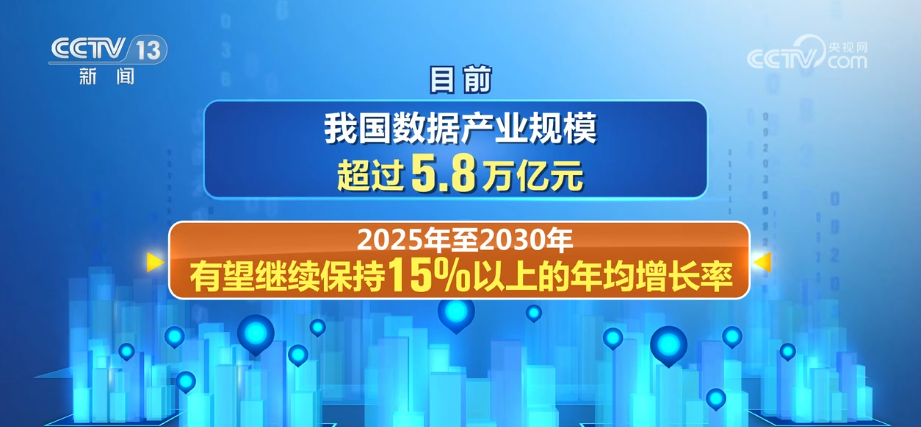
规模超5.8万亿元 我国数据产业年均增长率超15%
Yang Shi Xin Wen· 2025-08-28 03:13
Core Insights - The data industry in China is experiencing a robust annual growth rate of over 15% [1] - The current scale of China's data industry exceeds 5.8 trillion yuan, with expectations to maintain the same growth rate from 2025 to 2030 [1] Industry Overview - The data industry is recognized as an emerging sector with strong development momentum [1] - The National Bureau of Statistics has indicated that the growth potential of the data industry remains strong [1]
徐麟李炳军会见国家数据局党组书记、局长刘烈宏一行
Zheng Quan Shi Bao Wang· 2025-08-28 01:24
Core Insights - The meeting between Guizhou provincial leaders and the head of the National Data Bureau emphasizes the commitment to strengthening the digital economy in Guizhou [1] - Guizhou aims to develop key industries such as computing power, data, artificial intelligence, and electronic information [1] - The National Data Bureau expresses ongoing support for Guizhou's digital economy and data industry development [1] Industry Focus - Guizhou is focusing on enhancing its digital economy by prioritizing the development of computing power and data industries [1] - The province is also looking to leverage artificial intelligence and electronic information sectors to drive economic growth [1] - The collaboration with the National Data Bureau is expected to provide guidance and support for innovation and data utilization [1]