钢铁业

Search documents
A股晚间热点 | 央行发文!事关跨境支付
智通财经网· 2025-07-04 14:09
Group 1 - The People's Bank of China has released a draft for public consultation regarding the rules for the Renminbi Cross-Border Payment System (CIPS), detailing account management, funding, and settlement processes [1] - The Ministry of Housing and Urban-Rural Development emphasizes the importance of promoting stable and healthy development in the real estate market, urging local authorities to implement precise policies [2] - The State-owned Assets Supervision and Administration Commission (SASAC) is pushing for a new round of mineral exploration strategies to enhance the resource security of important metal minerals [3] Group 2 - The Ministry of Commerce announced the imposition of anti-dumping duties on imported brandy from the European Union starting July 5, 2025 [6][7] - Insurance funds have been actively acquiring shares in the steel industry, with 15 out of 46 A-share steel companies now held by insurance capital, marking a notable trend in investment [8] - The National Energy Administration reported that the national electricity load reached a historical high of 1.465 billion kilowatts on July 4, driven by high temperatures, indicating strong demand in the power sector [15]


险资罕见举牌“钢铁巨头” 15家钢铁企业被险资持股
news flash· 2025-07-04 10:12
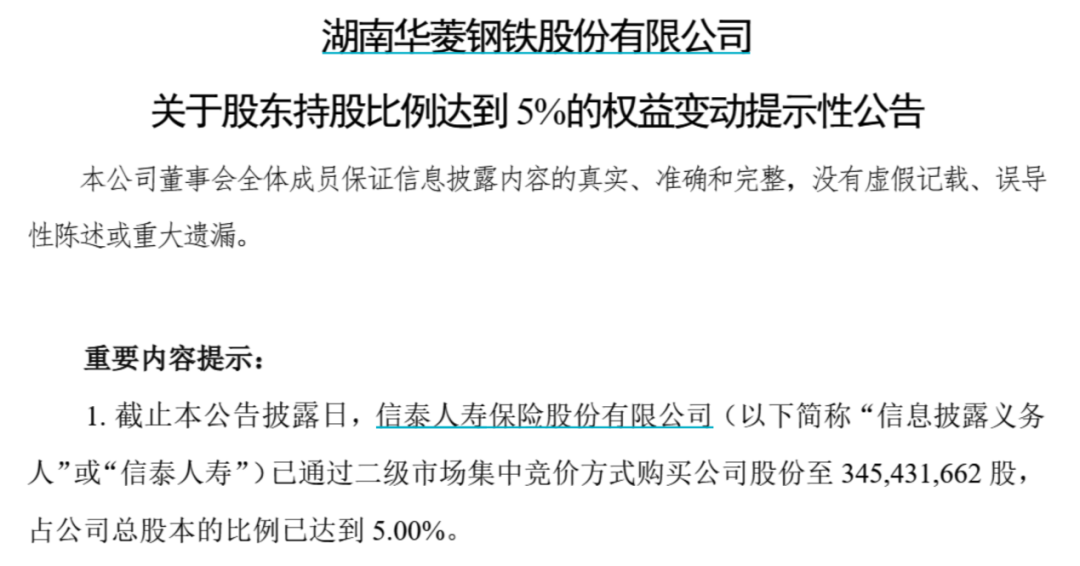
今年以来险资频频举牌,尤其在公用事业、银行领域布局明显加快,近期更是少见举牌钢铁业。7月3 日,"湖南钢铁巨头"华菱钢铁(000932)公告称,信泰人寿已通过二级市场集中竞价方式购买该公司股 份至3.45亿股,占公司总股本的比例已达到5%,触及举牌线。险资举牌钢铁企业较为少见。数据显 示,截至2025年第一季度,在46家A股钢铁企业中,仅有15家企业被险资持股,华菱钢铁、抚顺特钢 (600399)、武进不锈(603878)有3家险资持股,其余均仅有1至2家险资持股。(21世纪经济报道) ...

湖南华菱钢铁股份有限公司
Shang Hai Zheng Quan Bao· 2025-07-03 19:14
Core Viewpoint - The announcement indicates that Xintai Life Insurance Co., Ltd. has increased its shareholding in Hunan Hualing Steel Co., Ltd. to 5.00%, reflecting confidence in the company's future development and value [2][3]. Group 1: Shareholding Details - As of the announcement date, Xintai Life has acquired a total of 345,431,662 shares, representing 5.00% of the total share capital of Hunan Hualing Steel [2][5]. - The increase in shareholding was achieved through the secondary market, with Xintai Life purchasing an additional 690,900 shares on July 3, 2025, at an average price of 4.84 yuan per share [4][18]. - Prior to this transaction, Xintai Life held 344,740,762 shares, which accounted for 4.99% of the total share capital [18]. Group 2: Purpose and Impact of Shareholding Change - The purpose of this increase in shareholding is to enhance Xintai Life's influence over Hunan Hualing Steel and to support the company's growth, aiming to share in its long-term benefits [3][15]. - This change in shareholding does not trigger a mandatory bid and will not alter the control of the company or its major shareholders [3][5]. Group 3: Company Background - Xintai Life Insurance was established in May 2007, with a registered capital of 10.204 billion yuan, and is primarily owned by Wuchan Zhongda Group Co., Ltd. [2]. - The company operates in various regions, including Zhejiang and Jiangsu, with 18 branches providing a range of life insurance services [2].
华菱钢铁: 简式权益变动报告书
Zheng Quan Zhi Xing· 2025-07-03 16:27
住所:浙江省杭州市萧山区盈丰街道大稻望朝商务中心 1 幢 9 层、19-21 层、2 幢 通讯地址:浙江省杭州市萧山区盈丰街道大稻望朝商务中心 1 幢 9 层、19-21 层、2 幢 股份变动性质:增持 签署日期:二〇二五年七月三日 上市公司名称:湖南华菱钢铁股份有限公司 股票上市地:深圳证券交易所 股票简称:华菱钢铁 股票代码:000932.SZ 信息披露义务人:信泰人寿保险股份有限公司 湖南华菱钢铁股份有限公司 信息披露义务人声明 本部分所述词语或简称与本报告书"释义"所述词语或简称具有相同含义。 截至本报告书签署日,除本报告书披露的持股信息外,信息披露义务人没 有通过任何其他方式增加或减少其在华菱钢铁中拥有权益的股份。 四、本次权益变动是根据本报告书所载明的资料进行的。除信息披露义务 人外,没有委托或者授权任何其他人提供未在本报告书中列载的信息和对本报 告书做出任何解释或者说明。 一、信息披露义务人依据《中华人民共和国证券法》(简称《证券 法》)、《上市公司收购管理办法》(简称《收购办法》)、《公开发行证券 的公司信息 披露内容与格式准则第 15 号一权益变动报告书》(简称《准则 15 号》)及相关 的 ...
华菱钢铁: 关于股东持股比例达到5%的权益变动提示性公告2025-44
Zheng Quan Zhi Xing· 2025-07-03 16:27
湖南华菱钢铁股份有限公司 证券代码:000932 证券简称:华菱钢铁 公告编号:2025- 一、本次增持情况 | 公司名称 | 信泰人寿保险股份有限公司 | | | | | --- | --- | --- | --- | --- | | 统一社会信用代码 | 91330000661747515B | | | | | 成立日期 | 2007 5 | 年 | 月 | 18 日 | | 注册资本 | 10,204,081,633 | | | 元人民币 | | 法定代表人 | 谭宁 | | | | 关于股东持股比例达到 5%的权益变动提示性公告 本公司董事会全体成员保证信息披露内容的真实、准确和完整,没有虚假记载、误导 性陈述或重大遗漏。 浙江省杭州市萧山区盈丰街道大稻望朝商务中心 1 幢 9 层、19- 重要内容提示: 人"或"信泰人寿")已通过二级市场集中竞价方式购买公司股份至 345,431,662 股, 占公司总股本的比例已达到 5.00%。 一大股东是物产中大集团股份有限公司(600704.SH)。信泰保险在浙江、江苏等地已 设立 18 家分公司,经营各类人身保险业务。 第一大股东发生变更。 泰人寿出具的《 ...
险资出手,“二线钢王”被举牌
Zhong Guo Ji Jin Bao· 2025-07-03 14:17
Core Viewpoint - Insurance capital is increasingly acquiring stakes in listed companies, with Xintai Life Insurance recently increasing its holdings in Hualing Steel, reflecting a broader trend in the market [1][8]. Company Summary - Hualing Steel, established in 1958 and headquartered in Changsha, Hunan, is a leading player in the steel industry, ranking first globally in wide plate production and second in seamless steel pipe production [6]. - The company has made significant strides since its restructuring, investing 3% to 4% of its revenue in R&D, which is notably higher than the industry average of 1.5% [6]. - Hualing Steel's high-end products command a price 30% to 50% higher than regular steel, with a projected net profit of 238 yuan per ton in 2024, significantly above the industry average [6]. - The company serves major clients in high-tech sectors, including top shipbuilding firms and leading automotive manufacturers like Tesla and BYD [6]. - Hualing Steel's recent financial performance shows a 59.99% decline in net profit to 2.032 billion yuan in 2024, despite a 9.58% increase in cash flow from operating activities [7]. - The company plans to distribute a dividend of 1 yuan per 10 shares in 2024, totaling approximately 700 million yuan, and has initiated a share buyback plan of 200 million to 400 million yuan to enhance shareholder value [7]. Industry Summary - In 2023, insurance capital has acquired stakes in 15 listed companies, including five banks, indicating a strong interest in high-dividend sectors [8][9]. - The trend of insurance companies acquiring stakes is driven by regulatory policies encouraging long-term investments in the stock market, with a focus on high-yield sectors such as banking, public utilities, and energy [9]. - Recent regulatory changes have increased the allocation limits for insurance funds in equity assets, further promoting this trend [9].
险资出手,“二线钢王”被举牌
中国基金报· 2025-07-03 14:08
Core Viewpoint - The article discusses the recent acquisition of shares in Hualing Steel by Xintai Life Insurance, highlighting the trend of insurance capital increasing its stake in listed companies, particularly in the steel industry [1][10]. Group 1: Share Acquisition Details - On July 3, Xintai Life Insurance increased its holdings in Hualing Steel by purchasing 690,900 shares, accounting for 0.01% of the total circulating shares, at a cost of approximately 3.34 million yuan, with an average transaction price of 4.84 yuan per share [1]. - Since January 2025, Xintai Life has cumulatively acquired 345 million shares of Hualing Steel, representing 5.00% of the total share capital [1]. Group 2: Company Performance and Strategy - Hualing Steel, established in 1958 and headquartered in Changsha, Hunan, is the world's largest producer of wide and thick plates and ranks second in seamless steel pipe production, with a crude steel output ranking 14th globally [6]. - Despite a significant profit decline of 59.99% in 2024, with a net profit of 2.032 billion yuan, Hualing Steel's operating cash flow increased by 9.58% to 5.778 billion yuan [7][8]. - The company continues to prioritize R&D, investing 3% to 4% of its revenue annually, significantly higher than the industry average of 1.5% [7]. - Hualing Steel plans to distribute a dividend of 1 yuan per 10 shares in 2024, totaling approximately 700 million yuan, and has initiated a share buyback plan for 200 million to 400 million yuan to enhance shareholder value [8]. Group 3: Industry Trends and Insurance Capital - In 2023, insurance capital has acquired stakes in 15 listed companies, with a notable focus on banks, public utilities, and energy sectors [10]. - Regulatory policies have encouraged insurance companies to invest more in the stock market, with a directive for state-owned insurance firms to allocate 30% of new premiums to A-shares starting in 2025 [10]. - The current wave of acquisitions by insurance capital is driven by the need for higher dividend income, as companies seek to enhance cash returns [10][11].
上海国资,加码大模型独角兽!利好来了!广州楼市重磅;首批科创债ETF来了→
新华网财经· 2025-07-03 00:33
Investment and Financial Policies - Zhipu announced a strategic investment of 1 billion yuan from Pudong Venture Capital Group and Zhangjiang Group, with the first transaction completed recently [1] - The Guangzhou Housing Provident Fund Management Center is soliciting public opinions on the implementation of the "Commercial Housing Loan to Housing Provident Fund Loan" policy from July 2 to July 11, aiming to reduce the interest burden on contributors [6][9] Market Developments - The first batch of 10 Science and Technology Innovation Bond ETFs was approved on July 2 [2][15] - The People's Bank of China conducted a reverse repurchase operation of 98.5 billion yuan at a fixed rate of 1.4% on July 2, with a net withdrawal of 266.8 billion yuan [4] Industry Performance - From January to May, the added value of China's electronic information manufacturing industry grew by 11.1% year-on-year, with a revenue of 6.49 trillion yuan, up 9.4% year-on-year [7] - Zhejiang Province announced the establishment of a financial service mechanism for urban renewal, with 49 key projects expected to have a total investment of over 110 billion yuan [7] Corporate Actions - Taobao announced a consumer and merchant subsidy of 50 billion yuan over the next 12 months [19] - Longhua District in Shenzhen released a three-year action plan to promote the cultivation of listed companies, enhancing cooperation with financial research institutions [8] Regulatory Updates - The National Internet Information Office launched a special action to rectify illegal online activities related to enterprises, focusing on managing and addressing false information [5] - The China Securities Regulatory Commission reported that 24 out of the first 26 new floating rate funds have completed fundraising, totaling 22.68 billion yuan [17]



谁更需要高关税?
Hu Xiu· 2025-06-27 10:51
Group 1 - The core argument of the article revolves around the historical and contemporary perspectives on high tariffs and trade protectionism, particularly in developing countries [1][2][4] - The article highlights the contradiction that while many economists have proven the ineffectiveness of protected industries, the call for high tariffs persists, especially from advanced nations [3][4] - The article discusses the evolution of trade policies in the U.S. as outlined by Douglas Irwin, focusing on three main goals: Revenue, Restriction, and Reciprocity, with the emphasis shifting over time [5][30] Group 2 - The "Infant Industry Argument" proposed by Alexander Hamilton suggests that nascent industries require temporary protection from foreign competition to develop [6][7] - Friedrich List expanded on Hamilton's ideas, advocating for differentiated and progressive tariffs to protect industries with potential for growth while allowing for eventual transition to free trade [10][11] - Raul Prebisch's "Center-Periphery" theory posits that developing countries must break the unequal trade relationship with industrialized nations through strategies like import substitution and export-oriented growth [13][14][16] Group 3 - Empirical studies by economists like Frédéric Bastiat and Amasa Walker demonstrate that trade protection often leads to inefficiencies and does not guarantee the intended benefits for domestic industries [19][22] - Philippe Aghion's research indicates that protectionist policies can hinder economic dynamism and lead to stagnation, as seen in Japan's economy [28][29] - The article suggests that non-tariff measures may be more effective than tariffs in achieving trade protection goals, as supported by various studies [29][30] Group 4 - The article outlines the historical phases of U.S. trade policy, indicating a potential return to a focus on revenue generation through tariffs as the national debt escalates [33][39] - The shift in U.S. industrial structure towards services and the geographical concentration of manufacturing has implications for future trade policy [37][38] - The increasing national debt and its impact on fiscal policy may drive the U.S. government to prioritize high tariffs as a means of revenue generation [38][39]

韩国央行半年报:韩国金融体系基本稳定,要警惕美国关税风险
Di Yi Cai Jing· 2025-06-26 06:48
Group 1 - The core viewpoint of the articles highlights the significant impact of external factors, particularly U.S. tariffs and political uncertainty, on the South Korean economy, overshadowing domestic political changes [1][5] - The Bank of Korea has conducted four interest rate cuts in 2025, lowering the rate to 2.5%, the lowest since August 2022, in response to political uncertainty and market volatility [1] - South Korea's GDP growth unexpectedly contracted by 0.1% in Q1 2025, marking the first contraction since Q4 2020, leading the Bank of Korea to revise its GDP forecast for the year down from 1.5% to 0.8% [1] Group 2 - The Bank of Korea warns of risks associated with rising housing prices, particularly in the Seoul metropolitan area, which could exacerbate household debt and threaten financial stability [3] - From December 2013 to May 2025, the cumulative increase in housing prices in Seoul outpaced the national average by 69.4 percentage points, indicating a growing disparity between capital and non-capital regions [3] - As of June 2025, housing prices in Seoul have continued to rise, with core area prices reaching 120,000 to 150,000 RMB per square meter, and some luxury apartments exceeding 500,000 RMB per unit [3] Group 3 - South Korea's household debt remains high at 91.7% of GDP, second only to Canada, with a continuous increase over 17 years, raising concerns about economic growth and financial stability [4] - The Bank of Korea aims to gradually reduce the household debt-to-GDP ratio to 80% to mitigate economic constraints [4] - To address the polarization in housing prices, the report emphasizes the need for government initiatives to develop regional cities and reduce excessive regional imbalances [4] Group 4 - The U.S. tariffs imposed on South Korea, including a 25% tariff and specific tariffs on steel and automotive industries, have created significant uncertainty in the capital markets [5] - Ongoing negotiations between South Korea and the U.S. have yet to yield substantial results, with the South Korean Trade Minister emphasizing the need to prioritize national interests in trade discussions [5] - The Bank of Korea reported a record high current account surplus of $118.23 billion with the U.S. in 2024, driven by strong U.S. domestic demand and increased investments from South Korea [6]