铁路建设

Search documents
向“新”而行 “质”胜未来--中国铁建“十四五”发展新质生产力培育壮大新动能
Zhong Guo Chan Ye Jing Ji Xin Xi Wang· 2026-01-12 22:07
Core Viewpoint - China Railway Construction Corporation (CRCC) is driving an industrial leap through innovation during the 14th Five-Year Plan period, focusing on strategic national needs and the characteristics of the construction industry [1] Group 1: Strategic Development - CRCC is actively developing new productive forces and constructing a system that aligns with these forces, aiming to break down barriers to new momentum development [2] - The "1256" mid-to-long-term development strategy outlines CRCC's path for the next 10 to 20 years, with the goal of becoming a world-class modern enterprise and focusing on upgrading traditional construction and nurturing strategic emerging industries [2] - The establishment of the CRCC Research Institute and various industry technology research institutes supports a systematic innovation framework, enhancing the development of strategic emerging industries and providing a robust support system for a "second growth curve" [2] Group 2: Technological Advancements - CRCC is committed to overcoming key technical challenges and has achieved significant breakthroughs, such as the independent development of a 8.61-meter main bearing for shield machines, positioning itself at a world-leading level in this area [4] - The company has made strides in green production, with significant orders for bamboo-wound pipelines, indicating a strong market potential in the new materials sector [4][5] - Innovations in other fields include the development of aerogels and new photocatalytic materials, which have entered the market for air purification and building materials [5] Group 3: Digital Transformation - Since the 14th Five-Year Plan, CRCC has been promoting transformation through six key areas: high-end, intelligent, green, digital, refined, and international [6] - The company has developed advanced machinery for railway construction, such as the world's first thousand-ton high-speed rail bridge erection machine, showcasing its technological leadership [6] - CRCC is advancing digital transformation by establishing a computing power center and integrating technologies like Beidou and laser radar to enhance efficiency in design and construction processes [7]

这些标志性节点,映照央企海外精彩
Ren Min Ri Bao· 2026-01-12 20:23
Group 1 - The core viewpoint of the articles highlights the significant progress of Chinese state-owned enterprises in overseas engineering projects, particularly in the context of the Belt and Road Initiative, with over 6,000 projects initiated during the 14th Five-Year Plan period [5] - The opening of the world's longest single-route airline, connecting Shanghai to Buenos Aires via Auckland, marks a new chapter in air travel and trade between China and South America, with the first flight occurring on December 4, 2025 [7][8] - The Ximandu project in Guinea, recognized as one of the largest greenfield iron ore projects globally, officially commenced production on November 11, 2025, with a total investment exceeding $20 billion [10][11] Group 2 - The new airline route significantly reduces travel time from nearly 30 hours to approximately 25 hours, facilitating over 6,000 passengers in its first month of operation [7][9] - The Ximandu project is expected to achieve an annual production capacity of 120 million tons, contributing to Guinea's economic growth and creating thousands of local jobs [12][13] - The revitalization of the TAZARA railway aims to enhance logistics capabilities, increasing freight capacity from about 200,000 tons to 2.4 million tons annually, thereby supporting various industries and improving transportation efficiency [15][16]




开局“十五五” 实干启新程
Xin Lang Cai Jing· 2026-01-12 16:57
Core Viewpoint - The article emphasizes the importance of expanding domestic demand and stabilizing growth as a fundamental strategy for China's economic development, highlighting the collaborative efforts of various provinces to enhance investment and consumption, thereby laying a solid foundation for the "14th Five-Year Plan" period [4][13]. Investment and Consumption - Domestic demand is identified as the primary driving force for economic growth, with a focus on expanding effective investment and releasing consumption potential [4]. - Provinces are actively pursuing major project construction, with Hunan Province planning 2,676 central investment and provincial key construction projects, achieving over 530 billion yuan in cumulative investment by 2025 [5]. - By 2026, various regions aim to stabilize and enhance investment quality, with Hunan proposing a "project planning" initiative to accelerate the construction of key infrastructure projects [5][6]. Consumer Market Development - The article discusses the optimization of consumption policies, with provinces like Jiangsu focusing on expanding service consumption and promoting new consumption hotspots such as the silver economy and AI-driven consumption [6]. - Hunan is set to implement policies to promote service consumption and enhance the effectiveness of consumption upgrade initiatives [6][7]. Private Investment - Private investment is highlighted as a crucial support for growth and employment, with provinces like Fujian and Zhejiang implementing reforms to create a favorable environment for private enterprises [7]. - By 2026, regions will enhance policy incentives to stimulate private investment, focusing on reducing entry barriers and operational costs for private enterprises [7][8]. Technological Innovation and Industry Upgrade - The cultivation of new productive forces through technological innovation is emphasized as a key support for high-quality development [8]. - Provinces are encouraged to balance traditional industry upgrades with the development of emerging industries, with initiatives in places like Hunan and Jiangsu focusing on AI and digital economy advancements [9][10]. Regional Coordination and Collaboration - The article underscores the importance of regional cooperation in driving industrial upgrades, with various regions collaborating on emerging industry chains [11]. - Efforts to facilitate the flow of resources and promote open cooperation are highlighted, with provinces like Fujian and Yunnan working on cross-regional resource optimization and trade partnerships [12]. Conclusion - The development blueprint outlined by various provinces aligns with national strategic deployments while showcasing regional strengths, aiming to contribute significantly to China's modernization efforts by 2026 [13].

战严寒 保进度 长王铁路灵台段隧道掘进冲刺
Xin Lang Cai Jing· 2026-01-12 09:46
长王铁路专用线全长约49.27公里,其中灵台县境内28.58公里。线路北起西平铁路长庆桥站,南至灵台 县王家沟站,途经庆阳市宁县、平凉市泾川县和灵台县。铁路按单线电气化设计,时速80公里,远期运 能可达2500万吨/年,主要承担煤炭、化工等大宗货物运输。项目总投资67.4亿元,其中灵台段投资39.1 亿元,总工期48个月。 责任编辑:樊醒民 沿线地形复杂,桥隧比高达87.48%,含桥梁7.46公里、隧道35.64公里,施工难度大。面对严寒,指挥 部提前制定专项方案和应急预案,为连续施工提供保障。 "林王隧道全长8211米,斜井长713米,是全线重点控制工程之一。"中铁一局长王铁路项目常务副经理 黄涛介绍道,为加快工程建设,施工单位在元旦假期和暴雪天气期间依然坚持作业,组织人员设备清扫 积雪保障建设物资运输。 目前斜井已完成610米,完成比例86%。计划春节前完成斜井施工,为林王隧道正洞施工奠定坚实基 础。 长王铁路建成后,将结束灵台县不通铁路的历史,显著改善交通条件,拉近与关中平原城市群、陇东能 源基地的时空距离,对优化区域交通格局、促进资源开发、推动产业升级、巩固脱贫成果、助力乡村振 兴具有深远意义。 长王 ...
中泰高铁项目二期拟启动招标
Shang Wu Bu Wang Zhan· 2026-01-12 08:01
Core Viewpoint - The Thailand-China railway project Phase II (Nakhon Ratchasima to Nong Khai) is entering a critical advancement phase, with preparations for the first three civil engineering contracts underway, aiming for public consultation completion and tendering to start in 2026 [1] Group 1: Project Details - The entire Phase II project consists of 8 contract segments, covering a total distance of 357 kilometers, with an estimated total investment of approximately 341.3 billion Thai Baht [1] - The construction period is planned for 4 years, with the goal of officially opening the railway by 2031 [1] Group 2: Timeline and Milestones - The year 2026 is designated as the year for concentrated "bidding, tendering, and construction" for the second phase of the Thailand-China high-speed railway [1] - Subsequent contracts will be opened for public consultation and tendering in batches, ultimately achieving direct connectivity to the Laos border at Nong Khai, enhancing regional transportation and cross-border connectivity [1] Group 3: Phase I Updates - The Phase I project (Bangkok to Nakhon Ratchasima) has been under construction since 2017, but two contracts are currently stalled due to issues: one related to shared structures with the "Three Airports High-Speed Rail" requiring joint venture contract modifications, and the other concerning the impact assessment on the Ayutthaya World Heritage site, which is undergoing design adjustments expected to take about six months [1]
雄忻高铁全线控制性工程北太行山隧道全线贯通
Xin Hua Wang· 2026-01-12 05:11
Core Viewpoint - The successful completion of the Beitaihang Mountain Tunnel marks a significant milestone for the Xiongxin High-Speed Railway, establishing a solid foundation for its timely operation, enhancing transportation links between Hebei and Shanxi provinces [1][2]. Group 1: Project Overview - The Beitaihang Mountain Tunnel, part of the Xiongxin High-Speed Railway, spans 12.519 kilometers with a maximum depth of 600.96 meters and a minimum depth of 20 meters, classified as a high-risk tunnel due to geological challenges [1]. - The tunnel construction faced various geological risks, including water and mud bursts, rock explosions, collapses, and fault zones, necessitating advanced construction techniques and safety measures [1]. Group 2: Technological and Environmental Measures - The construction team employed advanced technologies such as advanced geological forecasting, monitoring, and digital control systems to enhance safety and efficiency during the tunneling process [1][2]. - To adhere to environmental protection standards, wastewater treatment facilities were established near tunnel entrances and mixing stations, ensuring that wastewater is treated to meet regulatory standards before discharge [2]. Group 3: Economic and Social Impact - The Xiongxin High-Speed Railway, stretching approximately 342 kilometers, is a crucial part of China's "Eight Vertical and Eight Horizontal" high-speed rail network, significantly improving transportation connections between Shanxi and the Beijing-Tianjin-Hebei region [2]. - The completion of this railway project is expected to promote economic and social development along the route and facilitate regional collaborative growth [2].
未来五年全省建设改造高速公路1000公里
Liao Ning Ri Bao· 2026-01-12 01:05
Group 1 - The core viewpoint of the articles highlights significant progress in the construction of transportation infrastructure in Liaoning Province over the past five years, with a focus on highways, railways, and logistics improvements [1][2] Group 2 - Liaoning has completed 752 kilometers of highways, bringing the total highway mileage to 4,853 kilometers, and railway and high-speed rail operational mileage to 6,998 kilometers and 2,386 kilometers, respectively [1] - During the "14th Five-Year Plan" period, the province plans to construct and renovate 1,100 kilometers of railways, 1,000 kilometers of highways, and 10,000 kilometers of ordinary trunk roads [1] - The total investment in transportation infrastructure reached 271 billion yuan, a 19.1% increase compared to the "13th Five-Year Plan," with an average of over 60 projects exceeding 100 million yuan annually [1] - The province aims to enhance transportation service capabilities by improving logistics and transportation cooperation among the three northeastern provinces and one region, with a significant increase in the proportion of new energy buses by 41 percentage points [2] - The province has implemented a governance system that includes project management and planning guidance, achieving a 100% online service rate for transportation administrative services [2] - By the end of the "15th Five-Year Plan," Liaoning aims to establish a comprehensive transportation framework characterized by "dual cores, two axes, three rings, and six corridors," significantly enhancing the quality and resilience of its transportation infrastructure [2]
广花城际最大直径盾构隧道贯通
Xin Lang Cai Jing· 2026-01-11 19:16
Core Viewpoint - The successful completion of the shield tunneling for the Guangzhou East to Huadu Tiangui Intercity Railway marks a significant milestone in the construction of the line, which is crucial for the integration of the Guangdong-Hong Kong-Macau Greater Bay Area's transportation network [1] Group 1: Project Details - The shield tunnel has a maximum excavation diameter of 13.56 meters, making it the largest diameter shield tunnel for the Guanghua Intercity line [1] - To address complex working conditions, a single-tube double-track construction scheme was adopted, utilizing the "Yangcheng" large-diameter shield machine [1] - The "Yangcheng" shield machine is equipped with an intelligent system aimed at achieving the engineering goal of "one-time excavation, halving the risk" [1] Group 2: Strategic Importance - The Guanghua Intercity Railway is a vital component of the intercity railway network in the Guangdong-Hong Kong-Macau Greater Bay Area [1] - Upon completion, the line will facilitate connectivity with Guangzhou Metro Line 18 and the Nanzhu (Central) Intercity Railway, contributing to the establishment of a "one-hour living circle" in the Greater Bay Area [1] - The project further promotes the development of the "Railway-based Greater Bay Area" initiative [1]
合池铁路全线首个隧道正式进洞
Xin Lang Cai Jing· 2026-01-11 17:16
Core Viewpoint - The construction of the Xiajia Tunnel, the first tunnel to commence excavation for the Hefei-Chizhou Railway, marks significant progress in the railway project, which is part of China's 14th Five-Year Plan for railway development [1] Group 1: Project Overview - The Hefei-Chizhou Railway starts from Hefei West Station and spans approximately 199.5 kilometers, including 82.5 kilometers of existing high-speed rail and 117 kilometers of new track, designed for a speed of 250 km/h [1] - The project is a collaborative investment by Anhui Railway Group and the cities of Hefei, Tongling, and Chizhou, featuring seven stations, with two new stations being built [1] Group 2: Strategic Importance - Upon completion, the Hefei-Chizhou Railway will enhance the high-speed rail network in southwestern Anhui, facilitating regional connectivity and improving transportation for the public [1] - The railway is expected to be operational by 2029, contributing to the development of the Hefei metropolitan area and the multi-layered rail transit network in the Yangtze River Delta [1]
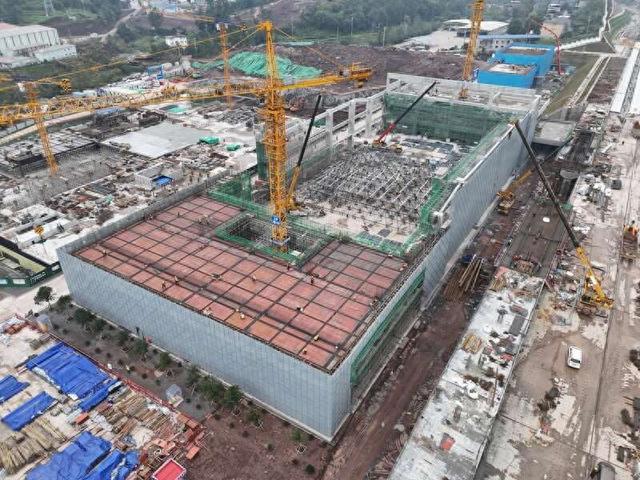
渝万高铁新进展:丰都北站主体结构封顶
Xin Lang Cai Jing· 2026-01-11 08:59
Group 1 - The main point of the article is the completion of the main structure of the Fengdu North Station, a key project of the Yuwan High-Speed Railway, marking significant progress in its construction [2] - The station building covers an area of 12,000 square meters and features a side-down layout with a cast-in-place reinforced concrete frame and a steel structure grid roof [2] - The project team employs a dynamic construction management model to address challenges related to schedule and technology [2] Group 2 - BIM (Building Information Modeling) technology is utilized in the construction process for load analysis and optimization design of the support system [2] - An intelligent monitoring system is implemented on-site to collect key data in real-time and provide early warnings, ensuring safety and quality during construction [2] - The Yuwan High-Speed Railway is a crucial part of the national "eight vertical and eight horizontal" high-speed rail network, playing an important role in enhancing regional rail network layout and promoting economic and social development along the route [2]