
加密货币

Search documents
美联储主席大热门沃勒:加密货币技术“没啥好怕” 美联储应与业界共推支付创新
Hua Er Jie Jian Wen· 2025-08-21 00:54
Core Viewpoint - The blockchain seminar held before the Jackson Hole global central bank conference highlighted the importance of embracing technological innovations in digital assets and stablecoins to drive economic growth in the U.S. [1] Group 1: Technological Innovation in Payments - Christopher Waller, a Federal Reserve governor, emphasized that the current advancements in computing power, data processing, and distributed networks are fostering innovative payment services [1] - Waller stated that the evolution of payment systems is primarily driven by technological progress, with private sector innovations leading the way, while the Federal Reserve plays a supportive role [3][4] Group 2: Collaboration Between Public and Private Sectors - Waller advocated for collaboration between the Federal Reserve and the private sector to explore the potential of decentralized finance (DeFi) technologies, which could enhance traditional payment systems [2][3] - He highlighted the need for the Federal Reserve to continue embracing technological advancements to modernize services and support private sector innovation [3][5] Group 3: Research on New Payment Technologies - The Federal Reserve is currently researching innovations in payment technologies, including tokenization, smart contracts, and the application of artificial intelligence [3][4] - Waller expressed the importance of understanding these trends to better support private enterprises using related infrastructure and to evaluate the potential of emerging technologies to improve existing Federal Reserve platforms and services [4] Group 4: Positive Outlook on Cryptocurrency - Waller's remarks come amid a broader acceptance of the cryptocurrency industry within the Federal Reserve, as another official, Michelle Bowman, also praised the benefits of new technologies like AI and cryptocurrencies [5] - The discussions at the seminar indicate a growing recognition of the need for banks and regulators to adapt to the evolving landscape of digital assets to maintain their relevance in the economy [5]
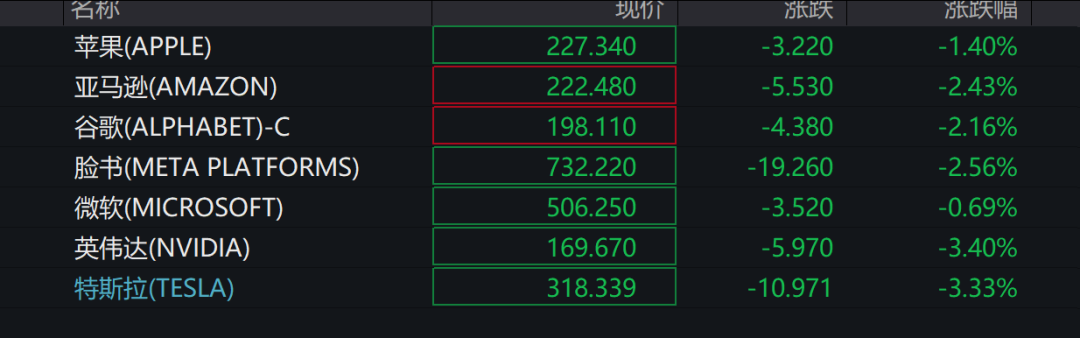
美股科技股大跌,英伟达跌超3%,黄金涨破3340美元
2 1 Shi Ji Jing Ji Bao Dao· 2025-08-20 15:32
Market Overview - US stock indices experienced a decline, with the Dow Jones down 0.23%, S&P 500 down 0.84%, and Nasdaq Composite dropping 1.51% [1] - Major tech stocks fell, with the "Magnificent Seven" index down 2%, and Nvidia and Tesla dropping over 3% [1] - Nvidia's market value decreased by over $155 billion following a 3.5% drop on August 19, continuing its decline with a further drop of 3.54% [1] Economic Indicators - The Consumer Price Index (CPI) for July showed a year-on-year increase of 2.7%, maintaining the same growth rate as June, while the core CPI rose to 3.1% from 2.9% in June, exceeding the Federal Reserve's 2% target [3] - The market's expectations for a rate cut by the Federal Reserve have increased following the stable CPI data [3] Investment Sentiment - Wall Street shows mixed views on the future of US stocks, with a prevailing optimistic sentiment as several financial institutions raised their year-end targets for the S&P 500 index [5] - Citigroup raised its target from 6300 to 6600, while UBS increased its target from 5500 to 6100 [5] - A survey indicated that 45% of fund managers consider "going long on the Magnificent Seven" as the most crowded trade [5] Valuation Concerns - Howard Marks from Oaktree Capital noted that while the average P/E ratio for the Magnificent Seven is about 33, it is justified due to their strong market positions and profitability [6] - In contrast, the average P/E ratio for the remaining S&P 500 companies is 22, significantly above historical averages, raising concerns about overall market valuation [6] Economic Outlook - Stifel warned of a potential downturn, suggesting that the S&P 500 could drop by up to 14% by year-end, potentially closing at 5500 [6] - Morgan Stanley's CIO highlighted mixed signals in economic data, indicating risks from a cooling labor market and rising price pressures [6]

加密货币、稳定币概念股走低,Robinhood跌超5%
Sou Hu Cai Jing· 2025-08-20 15:10
Group 1 - Cryptocurrency and stablecoin stocks have declined, with Bitfarms dropping over 6%, Robinhood falling more than 5%, and Circle and Canaan Technology decreasing over 4% [1] - Riot Platforms, Bullish, and Trump Media Technology Group have all seen declines of more than 3.5% [1] - The market is currently focused on the Jackson Hole Federal Reserve annual meeting, leading investors to withdraw from technology stocks and high-risk assets [1]




美股全线下挫,科技股大跌,英伟达跌超3%,黄金涨破3340美元
2 1 Shi Ji Jing Ji Bao Dao· 2025-08-20 15:04
Market Overview - US stock market indices experienced a decline, with the Dow Jones down 0.23%, S&P 500 down 0.84%, and Nasdaq down 1.51%, falling below 21,000 points [1] - Major tech stocks, including Nvidia and Tesla, saw declines exceeding 3%, contributing to the overall market downturn [1][2] Technology Sector - Nvidia's stock fell by 3.5%, resulting in a market capitalization loss of over $155 billion, with further declines noted on subsequent trading days [2][3] - The technology sector's performance is under scrutiny, with the "Big Seven" tech stocks being a focal point for investors, as 45% of fund managers consider "going long" on these stocks the most crowded trade [10] Economic Indicators - The US consumer price index (CPI) showed a year-over-year increase of 2.7% in July, maintaining the same growth rate as June, while the core CPI rose to 3.1%, above the Federal Reserve's 2% target [7][8] - Market expectations for a rate cut by the Federal Reserve in September are tempered, with analysts suggesting that a 50 basis point cut is unlikely [6] Investment Sentiment - Optimism in the market is reflected in revised year-end targets for the S&P 500, with Citigroup raising its target from 6,300 to 6,600 points and UBS from 5,500 to 6,100 points [9] - Despite the positive sentiment, there are warnings from investment firms about potential economic slowdowns and the risks associated with high valuations in the stock market [11]

BTC与ETH市场震荡回调 XBIT解析背后多重因素及最新展望
Sou Hu Cai Jing· 2025-08-20 14:54
Core Viewpoint - Bitcoin (BTC) reached a historical high of $124,128 but has since declined to $113,597, marking an 8.5% drop from its peak, with a weekly decline of 4.8% and a 24-hour drop of 1.3% [1][3] Group 1: Bitcoin Market Dynamics - The recent decline in Bitcoin's price has triggered a broader pullback in the cryptocurrency market, with a total liquidation of $450.55 million in the past 24 hours [1][3] - The Producer Price Index (PPI) data exceeding expectations has heightened concerns about the Federal Reserve's potential pause on interest rate cuts, impacting risk assets like Bitcoin [3] - Key support levels have been breached, with $112,000 identified as a critical short-term support; a drop below $110,000 could lead to panic selling [3] - Investor sentiment has turned pessimistic as retail investors show decreased willingness to hold positions following Bitcoin's drop below $113,000 [3] - Historical patterns suggest that extreme bearish sentiment may precede a market reversal, as seen in June when BTC rebounded 26% after a similar decline [3] Group 2: Ethereum Market Response - Ethereum (ETH) has also experienced a decline, dropping 4.5% from a weekly high of $4,350 to a low of $4,150, reflecting its strong correlation with Bitcoin [4] - The number of ETH in the staking withdrawal queue has reached a record high of 910,461 ETH (approximately $39.1 billion), creating pressure from profit-taking and rising borrowing costs [4] - The active address count for Ethereum has decreased by 28% from July's peak, indicating a contraction in market risk appetite [5] Group 3: Future Outlook and Investment Strategies - Despite short-term volatility, industry experts remain optimistic about Bitcoin's long-term prospects, with predictions of a 50% chance of BTC surpassing $150,000 by year-end [5] - Ethereum faces challenges from staking unlocks and macroeconomic uncertainties, but long-term narratives remain strong, with some institutions projecting ETH could reach $6,000 to $8,000 by year-end [6] - The cryptocurrency market's volatility is attributed to high leverage and macroeconomic factors, with decentralized exchanges providing tools for investors to manage risks and capitalize on price fluctuations [6]
美股异动 | 加密货币生态圈股票延续昨日跌势 Circle(CRCL.US)跌超3.5%
智通财经网· 2025-08-20 14:50
Group 1 - The cryptocurrency ecosystem stocks continued their downward trend, with Bitcoin-related stocks such as Bit Digital (BTBT.US) falling by 2.8% and Hut 8 Mining (HUT.US) dropping over 4% [1] - Ethereum-related stocks like Bitmine Immersion Technologies (BMNR.US) decreased by more than 1.8%, while Bit Digital (BTBT.US) saw a decline of over 3% [1] - Cryptocurrency exchange stocks, including Coinbase (COIN.US), fell by more than 2%, and Robinhood (HOOD.US) experienced a drop of over 5.9% [1] Group 2 - Stablecoin leader Circle (CRCL.US) saw a decline of over 3.5% [1]





美股异动|加密货币、稳定币概念股走低,Robinhood跌超5%
Ge Long Hui· 2025-08-20 14:36
Group 1 - Bitfarms declined over 6.6% [1] - Robinhood fell more than 5% [1] - Circle and Canaan Creative dropped over 4% [1] - Riot Platforms, Bullish, and Trump Media Technology Group each decreased by more than 3.5% [1] Group 2 - The market is focused on the Jackson Hole Federal Reserve annual meeting this week [1] - Investors are withdrawing from technology stocks and high-risk assets [1]
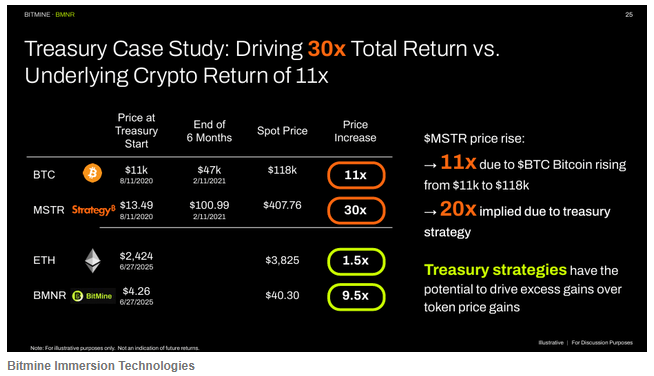
Tom Lee领航!Bitmine(BMNR.US)转型全球最大ETH储备库 剑指MSTR暴涨神话?
Zhi Tong Cai Jing· 2025-08-20 07:21
Core Viewpoint - Bitmine Immersion Technologies has transitioned from a Bitcoin mining company to a leading Ethereum reserve company, aiming to hold 5% of the global circulating supply of Ethereum, driven by the strategy of leveraging Ethereum's growth potential [1][3]. Group 1: Company Strategy and Growth - Bitmine has raised significant capital through stock issuance, expanding its operations to acquire Ethereum, and has become the largest Ethereum reserve institution with 1.15 million ETH valued at $5.2 billion [2][3]. - The company’s strategy mirrors that of Michael Saylor's Strategy, focusing on leveraging Ethereum's price appreciation to enhance shareholder value [3]. - As of August 11, Bitmine increased its Ethereum holdings by 316,863 ETH in one week, showcasing its aggressive accumulation strategy [2]. Group 2: Market Position and Valuation - Bitmine's total market capitalization stands at $6.33 billion, with its Ethereum holdings alone accounting for a significant portion of its asset value [2]. - Analysts believe that as Bitmine's Ethereum reserves grow, its net asset value will increase, potentially leading to a premium over its asset value if Ethereum continues to rise [1][2]. - The company is positioned to benefit from the increasing institutional interest in Ethereum, as evidenced by significant purchases from firms like BlackRock and SharpLink Gaming [5]. Group 3: Industry Context and Future Outlook - Ethereum is recognized as a decentralized platform that supports smart contracts and decentralized applications (dApps), making it a core player in the cryptocurrency ecosystem [4]. - The recent passage of the GENIUS Act establishes a federal regulatory framework for stablecoins, which could enhance Ethereum's liquidity and its role in asset tokenization [5]. - Tom Lee predicts that Ethereum could reach $25,000 by 2028, highlighting its potential as a major macro trading opportunity in the coming years [8].
32.5亿资金疯狂出逃狗狗币!DOGE未平仓合约暴跌8.24%,熊市已定?
Sou Hu Cai Jing· 2025-08-20 06:55
Market Overview - The cryptocurrency market is experiencing a significant downturn, leading to a decline in investor confidence, particularly affecting Dogecoin (DOGE) [2] - The total open interest for DOGE futures contracts has dropped by 8.24%, with active open futures contracts falling to 1.516 billion DOGE (approximately $3.25 billion), marking the lowest level since early August [2] Dogecoin Performance - Dogecoin's price has seen a substantial decline, with a 4.4% drop in the last 24 hours, currently priced at $0.2121 [4] - The decrease in open interest for DOGE futures highlights a reduction in investor confidence, as contracts have either been liquidated or traders are closing positions to hedge against further losses [5] Market Sentiment - There is speculation that the overall cryptocurrency market may be entering a bearish phase, with investors showing caution towards investing more in the DOGE derivatives market [4] - Historical trends suggest that a continuous decline in open interest often leads to more severe market downturns, raising concerns among investors despite some analysts predicting a potential recovery for DOGE [7]

抢在央行重磅年会前,币圈先在杰克逊霍尔开大会,美联储、SEC高官和特朗普儿子都将出席
Hua Er Jie Jian Wen· 2025-08-20 03:44
加密货币行业正在杰克逊霍尔展现前所未有的政治影响力。在美联储主席出席杰克逊霍尔央行年会前三 天,怀俄明区块链峰会已率先在当地拉开帷幕,吸引了美联储高官、SEC新主席和特朗普家族成员等参 与。 8月19日,据媒体报道,美国证券交易委员会(SEC)新任主席Paul Atkins、特朗普儿子Eric Trump,以 及两位被列入特朗普接替鲍威尔候选名单的美联储理事均将出席这场在杰克逊霍尔举行的区块链峰会。 此次峰会比堪萨斯城联储在杰克逊湖酒店的年度央行会议提前三天举行。美联储负责监管的副主席鲍曼 (Michelle Bowman)向与会者表示,美国正"处于一个看似巨大转变的开端,这将改变我们对金钱、价 值和金融系统结构的思考方式"。 分析人士指出,这场活动标志着高盛分析师此前所描述的"稳定币之夏"达到高潮。随着特朗普政府对 该行业表示全力支持并通过全面监管法规,资金今年大量涌入稳定币和其他加密产品,推动全球加密市 场价值首次达到约4万亿美元。 美联储理事、SEC高官、特朗普儿子都将参会 美联储高级官员对加密货币创新展现出明显的政策开放态度。除了鲍曼就银行系统创新发表演讲外,美 联储理事沃勒(Christopher ...