
公募基金

Search documents
A股盘前播报 | 商务部回应安世半导体相关问题 公募业绩比较基准指引出炉
智通财经网· 2025-11-03 00:43
Group 1 - The Ministry of Commerce responds to ASML-related issues, indicating that China will consider exemptions for eligible exports due to disruptions in the global supply chain caused by inappropriate government interventions [1] - The China Securities Regulatory Commission has released guidelines for public fund performance benchmarks, aiming to prevent style drift and enhance investment behavior stability [2] - The Ministry of Finance and the State Taxation Administration clarified that taxpayers selling standard gold outside exchanges must pay value-added tax according to existing regulations [3] Group 2 - In October, new energy vehicle companies reported strong delivery numbers, with Leap Motor exceeding 70,000 units, Xiaopeng and NIO setting monthly delivery records, and Xiaomi maintaining over 40,000 units [4] - The solid-state battery technology industry conference was held, emphasizing the importance of demand and corporate profitability for market sustainability [5] - Citic Securities identified structural opportunities in the market, focusing on manufacturing upgrades, Chinese enterprises going abroad, and edge AI [7] - Everbright Securities suggested that the market may continue to experience range-bound fluctuations, with a focus on opportunities in media and computer sectors related to AI applications [9] Group 3 - China has achieved its first thorium-uranium nuclear fuel conversion based on molten salt reactors, which could enhance energy independence and has broad market prospects [10] - The introduction of a new payment channel for high-value innovative drugs in 2025 is expected to create significant investment opportunities in the pharmaceutical sector [11] - The president of the China Animal Husbandry Association emphasized the need to control pig production capacity, predicting a year-on-year decline in pig prices by 2025 [12]


非银金融行业点评报告:业绩比较基准指引征求意见,进一步落实公募基金改革
Soochow Securities· 2025-11-01 15:09
Investment Rating - The industry investment rating is maintained at "Add" [1][7] Core Viewpoints - The report discusses the release of the "Guidelines for Performance Comparison Benchmarks of Publicly Raised Securities Investment Funds" by the CSRC, which aims to guide industry institutions in establishing a more stable investment style and providing long-term stable returns for investors, thus further implementing public fund reforms [4] - The guidelines emphasize the importance of performance comparison benchmarks, which should reflect the core elements and investment style agreed upon in the fund contract and should not be changed arbitrarily once selected [4] - The report highlights the establishment of a performance comparison benchmark element library, which will encourage and guide industry institutions to standardize the selection of benchmarks representing equity assets [4] Summary by Sections - **Event Overview**: The CSRC has published guidelines and operational details for performance comparison benchmarks, which will help in the high-quality development of public funds [4] - **Key Guidelines**: The guidelines include the necessity for benchmarks to reflect product positioning and investment style, the establishment of internal control mechanisms by fund managers, and the need for performance compensation to be linked to whether the fund outperforms its benchmark [4] - **Implementation Timeline**: A one-year transition period is set for fund managers to adjust existing products' benchmarks to better align with fund contracts and actual styles without impacting market stability [4]
监管拟规范公募基金业绩比较基准选取和使用
Zheng Quan Ri Bao· 2025-10-31 16:08
Core Viewpoint - The China Securities Regulatory Commission (CSRC) has released draft guidelines and operational rules for public fund performance benchmarks, aiming to standardize the selection and use of performance benchmarks in public funds, enhance internal controls, and protect investors' rights [1][2][3] Group 1: Regulatory Framework - The new guidelines and operational rules aim to fill regulatory gaps in the public fund sector, promoting the standardization of performance benchmarks [3] - The CSRC's previous action plan emphasizes investor-centric reforms, including measures related to performance benchmarks [2] Group 2: Benchmark Functions - Performance benchmarks serve as a "anchor" to clarify investment styles and constrain investment behaviors, preventing style drift and enhancing investment stability [2] - They also act as a "yardstick" to measure fund performance against the market, influencing the assessment of fund managers and executives [2] Group 3: Implementation Measures - The guidelines require fund managers to establish comprehensive internal control mechanisms covering the entire process of benchmark selection, disclosure, monitoring, evaluation, and accountability [4] - Fund managers must ensure that selected benchmarks reflect the product's positioning and investment style, and cannot be changed arbitrarily [4] Group 4: Performance Assessment - The guidelines mandate the establishment of a performance assessment system centered on fund investment returns, linking manager compensation to performance relative to benchmarks [5] - Fund evaluation mechanisms will be revised to incorporate benchmarks as a key criterion for assessing fund management performance [5] Group 5: External Supervision - The guidelines outline responsibilities for custodians and sales institutions to ensure compliance with benchmark-related regulations, enhancing transparency in fund operations [6] - Fund managers and sales institutions are required to display benchmark performance alongside fund performance to facilitate investor comparisons [6] Group 6: Future Initiatives - The CSRC plans to guide industry institutions in optimizing existing products' benchmarks during the transition period to ensure alignment with fund contracts and actual styles [7] - A benchmark element library will be established to encourage standardized selection of benchmarks that represent equity assets [8] - Future revisions to compensation assessment rules will further align the interests of fund managers and investors, enhancing investor satisfaction [8]
防止“风格漂移”,公募基金的“锚”和“尺”来了!
Zheng Quan Ri Bao Wang· 2025-10-31 13:15
Core Viewpoint - The China Securities Regulatory Commission (CSRC) has released draft guidelines and operational rules for performance benchmarks of publicly offered securities investment funds, aiming to enhance the regulatory framework and improve fund management practices [1][5][6]. Summary by Sections Guidelines and Operational Rules - The guidelines and operational rules emphasize that performance benchmarks should accurately reflect product positioning and investment style, aligning with the fund contract's investment objectives, scope, strategies, and restrictions [2][9]. - Fund managers are required to appoint fund managers with relevant investment research experience based on product positioning and investment style, and once a benchmark is selected, it cannot be changed arbitrarily due to changes in fund managers, short-term market fluctuations, or performance evaluations [2][9]. Management Responsibilities - Company management is responsible for the selection of benchmarks, ensuring their representativeness, constraint, and sustainability [3][10]. - Fund managers must strengthen the comparison of active equity fund performance against benchmarks, with significant underperformance leading to a decrease in the performance compensation of relevant fund managers [5][11]. Evaluation and Accountability - Fund evaluation agencies are required to use performance benchmarks as a key criterion for assessing fund management, enhancing the scientific and objective measurement of fund performance, risk control, and style stability [3][11]. - Custodians are tasked with supervisory responsibilities, including reviewing fund contracts, monitoring investment style stability, and ensuring proper information disclosure [7][12]. Transition and Benchmark Library - The CSRC plans to facilitate a smooth transition for existing products to optimize benchmarks, ensuring they align with fund contracts and actual styles without destabilizing the market [13][14]. - An industry expert group will be established to create a benchmark element library, which will guide industry institutions in selecting appropriate benchmarks for equity assets [7][14]. Compensation and Performance Assessment - Future revisions will include detailed requirements for fund manager compensation assessment, linking it to fund performance relative to benchmarks [4][11][14]. - The guidelines aim to reinforce the binding of interests between fund managers, executives, and investors, enhancing investor satisfaction [14].
影响7亿基民,行业重大改革落地
Zhong Guo Ji Jin Bao· 2025-10-31 11:37
Core Viewpoint - The introduction of the "Guidelines for Performance Benchmarking of Publicly Offered Securities Investment Funds" and the "Operational Details for Performance Benchmarking" by the China Securities Regulatory Commission (CSRC) aims to standardize performance benchmarks in the public fund industry, enhancing investment management discipline and promoting stable investment styles, ultimately benefiting investors with long-term returns and attracting more medium to long-term capital into the market [1]. Group 1: Benchmark Representation - The guidelines emphasize that benchmarks should accurately reflect the product's positioning and investment style, aligning with the fund contract's investment goals and strategies [2]. - Fund managers are required to appoint experienced fund managers based on the performance benchmark and cannot change the benchmark arbitrarily due to manager changes or short-term market fluctuations [2]. - The operational details further specify requirements for product design, benchmark display, and matching benchmarks with investment strategies [3]. Group 2: Investment Constraints - The guidelines mandate a comprehensive control mechanism for the selection, disclosure, monitoring, and accountability of performance benchmarks [4]. - Decision-making for benchmark selection is elevated to the company management level, holding them accountable for the benchmark's representation and objectivity [4]. - Independent departments are tasked with monitoring deviations from benchmarks and assessing potential risks [4]. Group 3: Performance Assessment - The guidelines require fund managers to establish a performance assessment system centered on fund investment returns, linking it to compensation management [5]. - Fund managers must ensure that if a fund's long-term performance significantly lags behind the benchmark, the related fund manager's compensation should decrease accordingly [5]. Group 4: Ecosystem Interaction - The guidelines call for custodians to fulfill their supervisory roles, ensuring compliance with fund contracts and monitoring investment styles [6]. - Fund managers and sales institutions are required to display both fund performance and benchmark performance to facilitate investor comparisons [6]. - Fund evaluation agencies are encouraged to use benchmarks as a key criterion for assessing fund management performance [6]. Group 5: Smooth Transition - The CSRC aims to guide industry institutions in optimizing benchmarks for existing products during the transition period to avoid market instability [9]. - A benchmark library will be established to encourage standardized selection of benchmarks that represent equity assets [9]. - The fund industry association will revise performance assessment and compensation guidelines to align fund managers' interests with those of investors [10].
刚刚!影响7亿基民,行业重大改革落地
Zhong Guo Ji Jin Bao· 2025-10-31 10:40
Core Viewpoint - The introduction of the "Guidelines for Performance Benchmarking of Publicly Offered Securities Investment Funds" and the "Operational Details for Performance Benchmarking" by the China Securities Regulatory Commission (CSRC) aims to standardize performance benchmarks in the public fund industry, which is valued at over 36 trillion yuan, enhancing investment management discipline and promoting long-term stable returns for investors [1] Group 1: Benchmark Representation - The guidelines emphasize that benchmarks should accurately reflect the product's positioning and investment style, aligning with the fund contract's investment goals, scope, strategies, and restrictions [2] - Fund managers are required to appoint experienced fund managers based on the selected performance benchmark, which cannot be changed arbitrarily due to manager changes, short-term market fluctuations, or performance assessments [2][3] - The operational details further specify requirements for product design, benchmark display, and the matching of benchmarks with products, ensuring that benchmarks reflect the fund's primary investment objectives and strategies [3] Group 2: Strengthening Investment Constraints - The guidelines mandate the establishment of a comprehensive control mechanism covering the selection, disclosure, monitoring, correction, and accountability of performance benchmarks [4] - Decision-making for benchmark selection is elevated to the company management level, which bears primary responsibility for the benchmark's representativeness and objectivity [4] - Independent departments are required to monitor deviations from benchmarks and assess the rationality and potential risks of such deviations [4][5] Group 3: Guiding Assessment through Benchmarks - The guidelines require fund managers to establish a performance assessment system centered on fund investment returns, linking compensation to fund performance relative to benchmarks [6] - Fund managers must ensure that if a fund's long-term performance significantly lags behind its benchmark, the performance-related compensation for the fund manager should decrease accordingly [6] Group 4: Constructing a Positive Interaction Ecosystem - The guidelines outline responsibilities for other market institutions, including custodians, sales organizations, and evaluation agencies, to ensure a cohesive industry ecosystem [7] - Custodians are tasked with supervising and reviewing fund contracts and investment styles, while sales organizations must present both fund performance and benchmark performance to investors [7][8] - Evaluation agencies are required to use benchmarks as a key criterion for assessing fund management performance, enhancing the objectivity of evaluations [7][8] Group 5: Ensuring Smooth Transition - The CSRC will guide industry institutions to optimize existing product benchmarks during the transition period, ensuring alignment with fund contracts and actual styles without destabilizing the market [10] - A benchmark library will be established to encourage standardized selection of representative benchmarks for equity assets [11] - The CSRC will enhance daily supervision of benchmark selection and usage, focusing on compliance and addressing violations [11]
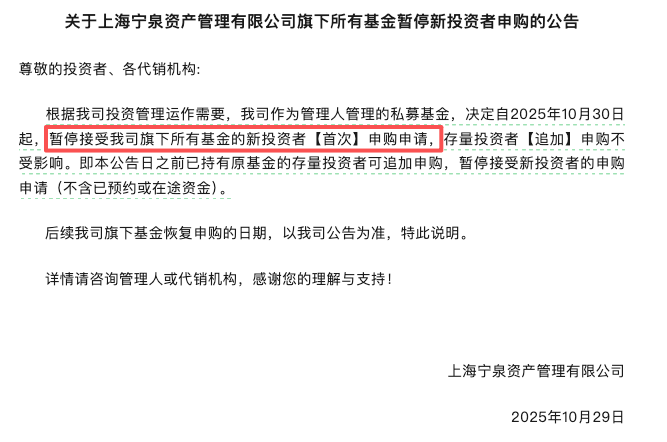
百亿私募巨头,暂停新客申购
21世纪经济报道· 2025-10-30 11:35
Core Viewpoint - The A-share market has shown strong performance, with the Shanghai Composite Index closing at 4016.33 points, marking a near ten-year high, but concerns about market overheating have emerged, particularly highlighted by Ningquan Asset's decision to halt new client subscriptions for all its funds starting October 30, 2025 [1][3][11]. Market Conditions - The rapid rise in market temperatures has led to visible bubbles in certain hot sectors and stocks, prompting Ningquan Asset to issue a cautious signal [3][12]. - Ningquan Asset's management scale has exceeded 45 billion yuan, positioning it among the top tier of domestic stock private equity firms [3]. Ningquan Asset's Strategy - Ningquan Asset's investment philosophy is characterized as "farming-style," focusing on stable, high-dividend assets rather than chasing high-risk, high-reward opportunities [6][10]. - The firm has maintained a diversified portfolio, with significant holdings in real estate, basic chemicals, and electric power sectors, reflecting a conservative approach to investment [9][10]. Industry Trends - A trend of limiting subscriptions has been observed across the asset management industry, with several private equity firms taking similar actions to balance growth and performance [11][12]. - The market is experiencing a shift in investment focus, with some firms expressing optimism about structural opportunities despite overall market caution [15][17]. Future Outlook - Some institutions are optimistic about a "slow bull" market, while others remain cautious, emphasizing the need for earnings support for further market growth [15][17]. - The investment landscape is evolving, with firms adjusting their portfolios in response to changing market conditions and potential economic recovery [18].


A股站上4000点后,宁泉资产为何对新钱“按下暂停键”?
2 1 Shi Ji Jing Ji Bao Dao· 2025-10-30 10:21
Core Viewpoint - The A-share market continues to show strong fluctuations, with the Shanghai Composite Index closing at 4016.33 points, marking a nearly ten-year high, which has raised concerns about market overheating and potential bubbles in certain sectors [1][2][13]. Market Performance - As of October 29, the Shanghai Composite Index reached 4016.33 points, the third time in history it has closed above 4000 points, following similar occurrences in May 2007 and April 2015 [1]. - The rapid rise in market temperature has been noted, with clear bubbles visible in some popular sectors and stocks [4][13]. Company Actions - Ningquan Asset announced a suspension of new client subscriptions for all its funds starting October 30, 2025, while existing clients can still add to their investments. This decision has drawn significant market attention [2][11]. - The firm has a management scale exceeding 450 billion yuan and employs a team of 27, with 19 dedicated to investment research [4]. Investment Philosophy - Ningquan Asset adopts a "farming-style" investment approach, focusing on stable, high-dividend assets rather than chasing high-risk opportunities. This strategy aims for consistent returns over time [7][14]. - The firm emphasizes maintaining a diversified portfolio, with significant holdings in real estate, basic chemicals, and electric power sectors, which are viewed as stabilizing assets during market volatility [9][10]. Market Sentiment and Future Outlook - The recent limit on subscriptions is interpreted as a cautious signal regarding the overheated market, with Ningquan Asset highlighting the rapid market rise and the presence of bubbles [4][13]. - Other private equity firms are also adopting similar cautious strategies, with several announcing subscription limits across various fund types [12][11]. Broader Industry Trends - The asset management industry is experiencing a wave of subscription limits as firms balance growth and performance, with both private and public funds taking similar actions [11][12]. - Some firms remain optimistic about structural opportunities in the market, while others express caution, indicating a divergence in strategies among leading private equity firms [16][18].
11月7日,公募业盛会合肥召开!报名启动,共话高质量发展行业命题
财联社· 2025-10-29 08:10
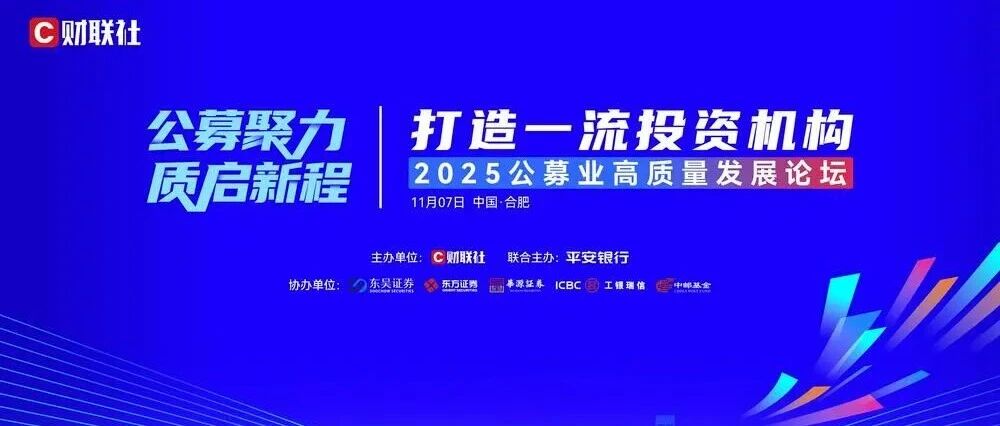
Core Viewpoint - The upcoming forum titled "Building First-Class Investment Institutions: High-Quality Development of Public Funds" aims to explore the future development of China's public fund industry, focusing on strategic direction, governance structure optimization, and research and investment system reform [1][2][3]. Group 1: Event Overview - The forum will take place on November 7, 2025, in Hefei, co-hosted by Caixin and Ping An Bank, gathering regulatory leaders, public fund executives, and industry experts for in-depth discussions [1][2]. - The event will feature a closed-door meeting for executives, thematic speeches from public fund leaders, and roundtable discussions to foster deep reflections on the industry [2][4]. Group 2: Industry Context - China's public fund industry has surpassed a total scale of 36 trillion yuan, marking a significant milestone and reflecting the growing demand for wealth management among residents [11]. - Despite the growth in scale, the industry faces structural challenges, including severe performance differentiation among fund products, declining management fees, intensified competition, and a lack of investor trust [12][13]. Group 3: Future Opportunities - The public fund industry is transitioning from a focus on scale expansion to a commitment to quality, aiming to become first-class investment institutions that serve the real economy and help residents preserve and increase their wealth [12][15]. - The industry is expected to benefit from China's economic transformation, with new growth drivers emerging in technology innovation, green economy, digital economy, and high-end manufacturing [15][16]. - The shift in residents' asset allocation towards financial assets presents a significant opportunity for public funds, with projections indicating that the investable asset scale could exceed 300 trillion yuan in the next five years [15].
公募基金“换帅潮”观察:头部机构集中调整,多为股东委派
Nan Fang Du Shi Bao· 2025-10-23 12:03
Core Insights - The public fund industry has experienced a significant leadership change since 2025, with 47 fund companies changing chairpersons, involving 85 individuals, which is nearly 30% of the total industry institutions [1][2] - Major institutions like Huaxia Fund, China Merchants Fund, and Bosera Fund have also undergone leadership changes, indicating a reshaping of the industry landscape [1][2] Leadership Changes in Major Institutions - In the first three quarters, 43 public fund companies changed chairpersons, a nearly 23% increase from 35 in the same period last year [2] - Bosera Fund announced the resignation of Jiang Xiangyang on October 15, with Zhang Dong taking over as chairman [2] - Huaxia Fund appointed Zou Yingguang as chairman after the departure of Zhang Youjun on September 30 [2] - China Merchants Fund's chairman Wang Xiaoqing resigned on September 24, with Zhong Wenyue temporarily assuming the role [2] Frequent Changes in Smaller Institutions - Smaller fund companies have seen more frequent leadership changes, with some like Xingyin Fund changing chairpersons twice since April 2023 [4] - Certain companies, such as Xinjiang Qianhai United Fund and Xinda Australia Fund, are currently operating with interim chairpersons due to vacancies [4] Factors Driving the Leadership Changes - The leadership changes are attributed to multiple factors, including the industry's shift from "scale competition" to "capability competition" [5][6] - Increased competition and stricter regulatory requirements have prompted shareholders to replace chairpersons to enhance governance and drive investment transformation [6] - Some changes are due to normal transitions, such as retirements, while others are influenced by regulatory policies aimed at optimizing governance structures [6] Impacts of Leadership Changes - The impact of these changes can vary significantly, potentially serving as a turning point for development or leading to setbacks [7] - Effective transitions can inject new energy into investment research and business innovation, while poor transitions may disrupt core talent retention and research momentum [7] - Companies are encouraged to clarify new leaders' responsibilities and strategic directions to ensure stability during transitions [7] Conclusion - The leadership changes in the public fund industry represent an inevitable outcome of industry transformation and a new starting point for high-quality development [8] - The future challenge for the industry will be balancing strategic continuity with innovative breakthroughs amidst these changes [8]