芯片设计

Search documents
陈立武的无限战争
投中网· 2026-01-03 06:32
Core Viewpoint - The article discusses the significant role of Chen Liwu in the rise of China's semiconductor industry, highlighting his achievements and the challenges he faces as CEO of Intel, particularly regarding potential conflicts of interest due to his extensive investment network [4][5][8]. Group 1: Chen Liwu's Background and Achievements - Chen Liwu is a prominent figure in the semiconductor industry, comparable to leaders like Jensen Huang and Lisa Su, having previously led Cadence, a major EDA company, and won the Robert N. Noyce Award in 2022 [4]. - His investment firm, Walden International, has been highly active in the semiconductor sector since 1987, investing in over 100 companies, including notable firms like SMIC and Zhaoyi Innovation [4]. - Chen's entry into China in 1993 marked a significant moment in the venture capital landscape, contributing to the growth of the industry from its nascent stages [4]. Group 2: Intel's Challenges and Chen's Role - Intel faced a record quarterly loss of $16.6 billion (approximately 116.9 billion RMB) before Chen's appointment as CEO, which led to a 25% increase in Intel's stock price on the day of his announcement [8]. - Following his appointment, Chen successfully attracted significant investments from SoftBank ($2 billion) and Nvidia ($5 billion) to support Intel's semiconductor manufacturing [5][8]. - Despite these successes, Chen's extensive investment network has led to internal trust issues at Intel, with employees expressing concerns over potential conflicts of interest [5][17]. Group 3: The Rivos Acquisition Controversy - Intel's interest in acquiring Rivos, a chip design company valued at $2 billion, has raised eyebrows as Rivos was incubated by Chen, who is also a board member and early investor [9][11]. - The acquisition bid has escalated Rivos's valuation to $4 billion due to competitive interest from both Intel and Meta, which complicates the situation further [9][10]. - Chen's involvement in the Rivos acquisition has led to accusations of potential conflicts of interest, prompting Intel's board to question his role in the decision-making process [14][17]. Group 4: Broader Implications for the Semiconductor Industry - The semiconductor industry is characterized by high R&D costs, often exceeding 20% of annual sales, necessitating significant investment and collaboration for growth [20]. - The article emphasizes that the future of semiconductor companies relies on strategic investments and acquisitions, particularly for established firms like Intel looking to adapt to new market demands [20]. - Chen's dual role as an investor and CEO highlights the complexities of navigating corporate governance and investment strategies in a rapidly evolving industry [19][21].


联芸科技12月30日获融资买入3017.29万元,融资余额5.74亿元
Xin Lang Cai Jing· 2025-12-31 01:41
Group 1 - The core viewpoint of the news is that 联芸科技 (Lianyun Technology) is experiencing significant trading activity, with a notable increase in financing and stockholder numbers, indicating growing investor interest [1][2]. Group 2 - On December 30, Lianyun Technology's stock price fell by 1.09%, with a trading volume of 261 million yuan. The financing buy-in amount for the day was 30.17 million yuan, while the financing repayment was 29.17 million yuan, resulting in a net financing buy of 1.00 million yuan. The total financing and securities balance reached 575 million yuan [1]. - The financing balance of Lianyun Technology is 574 million yuan, accounting for 4.25% of its circulating market value, which is above the 90th percentile level over the past year, indicating a high level of financing activity [1]. - On the same day, Lianyun Technology had no shares repaid in securities lending, with 2,900 shares sold short, amounting to 133,700 yuan at the closing price. The securities lending balance was 30,440 yuan, also exceeding the 90th percentile level over the past year [1]. Group 3 - As of December 19, the number of shareholders for Lianyun Technology reached 17,500, an increase of 1.94% from the previous period. The average circulating shares per person decreased by 1.90% to 16,716 shares [2]. - For the period from January to September 2025, Lianyun Technology reported a revenue of 921 million yuan, representing a year-on-year growth of 11.59%. The net profit attributable to the parent company was 90.06 million yuan, reflecting a year-on-year increase of 23.05% [2]. - Among the top ten circulating shareholders as of September 30, 2025, several new institutional investors emerged, including 嘉实上证科创板芯片ETF (Jia Shi Shanghai Stock Exchange Sci-Tech Innovation Board Chip ETF) as the second-largest shareholder with 1.57 million shares, and others like 诺安积极回报混合A (Noan Active Return Mixed A) and 泰康新锐成长混合A (Taikang New Growth Mixed A) also entering the list [2].
2026年国补继续!购车补贴2万封顶;又一中资半导体企业被强制出售股权;广汽多名高管被带走,反腐风暴席卷整车、合资、零部件全链条
雷峰网· 2025-12-31 00:37
Key Points - GAC Group is facing a corruption investigation involving multiple executives, including Vice President Zheng Heng and former executives from GAC Honda and GAC Parts, amid a challenging performance environment with losses exceeding 4.3 billion yuan in the first three quarters of 2025 and a sales decline of over 10% year-on-year [4][5] - The investigation is seen as a response to the company's poor performance and potential "gray costs" in procurement, which could erode profits by billions [5] - The Chinese semiconductor company, Jiangguang Asset Management, is being forced to sell its 80.2% stake in UK-based FTDI due to national security concerns raised by the UK government, following a strategic acquisition made in December 2021 for $414 million [7][8] - The 2026 national subsidy policy for vehicle purchases has been announced, with 625 billion yuan allocated, maintaining a cap of 20,000 yuan for car purchase subsidies, while expanding support for household appliances and smart products [10][11] - Meta has acquired AI company Butterfly Effect, which includes the Manus product, with the core team relocating to Singapore, indicating a significant shift in the AI landscape [12][13] - MiniMax, an AI startup, is set to go public with an estimated valuation of over 46 billion HKD, aiming to raise over $600 million, highlighting the competitive nature of the AI sector in China [17][18] - Xiaopeng Motors' chairman, He Xiaopeng, predicts that true fully autonomous driving will be achieved by 2026, transitioning directly from L2 to L4 capabilities [21][22] - Longxin Technology has applied for an IPO on the Sci-Tech Innovation Board, seeking to raise 29.5 billion yuan, positioning itself as a leading DRAM manufacturer in China [35][36] - The global automotive market is witnessing a decline in Porsche's sales, with a reported 28% drop in the Chinese market, leading to multiple dealership closures [41][42] - TSMC is accelerating its 3nm production plans in Arizona to meet the demands of major clients like Apple and NVIDIA, amid increasing competition in the semiconductor industry [45]


中资半导体企业,被英国政府强迫出售超80%股权!预计损失重大
Mei Ri Jing Ji Xin Wen· 2025-12-30 22:37
Core Viewpoint - The Chinese semiconductor investment firm Jian Guang Asset is forced to sell its 80.2% stake in FTDI due to a retrospective review initiated by the UK government under the National Security and Investment Act, citing national security risks [1]. Group 1: Company Background - Jian Guang Asset acquired 80.2% of FTDI for $414 million in December 2021, marking a strategic move into the high-end analog chip sector by Chinese capital [1]. - FTDI, established in 1992 and headquartered in Glasgow, UK, is a leading company in the global USB bridge chip market, serving over 50 countries with products across various sectors including consumer electronics and automotive [2]. Group 2: Investment Implications - The forced sale of FTDI's shares may occur at a price significantly lower than the company's true value, potentially leading to substantial losses for the company and its shareholders [1]. - The acquisition by Dian Lian Technology, which aimed to gain control over FTDI through its investment in Jian Guang Asset's funds, has not been implemented, although it holds a 21.17% stake in Feite Holdings, which controls FTDI [3]. Group 3: Legal and Regulatory Context - The UK government issued a formal order for FTDI to divest its shares due to national security concerns, reflecting a trend of increased scrutiny on foreign investments in sensitive sectors [3][4]. - Previous cases, such as the forced sale of Newport Wafer Fab by Wingtech Technology, indicate a growing regulatory environment affecting Chinese investments in the UK semiconductor industry [4].


芯原股份:预计未来公司会将更多研发资源投入客户项目
Zheng Quan Ri Bao Wang· 2025-12-30 12:39
Core Viewpoint - The company anticipates an increase in chip design business orders, leading to a shift in resource allocation towards customer projects, which will result in a decrease in the proportion of R&D investment relative to operating revenue [1] Group 1 - The company plans to invest more R&D resources into customer projects as chip design orders increase [1] - The proportion of R&D investment in relation to operating revenue is expected to decline [1]

天数智芯招股:发行价为144.6港元 募资规模约为37亿港元
Zheng Quan Shi Bao· 2025-12-30 09:32
Core Viewpoint - Shanghai Tensu Intelligent Chip Co., Ltd. (Tensu) is launching an IPO in Hong Kong, aiming to raise approximately HKD 3.7 billion with a share price of HKD 144.6, marking a significant step in the domestic general GPU market [1][2] Group 1: IPO Details - The IPO subscription period is from December 30 to January 5, with shares expected to begin trading on January 8 [1] - The offering consists of 25.43 million shares, with 10% allocated for public sale in Hong Kong and the remainder for international placement [1] - The net proceeds will primarily fund R&D for general GPU chips and solutions, with 80% allocated for product development, 10% for sales and marketing, and 10% for operational expenses [1] Group 2: Company Background and Market Position - Tensu is recognized as a leading player in the domestic general GPU sector, with a cumulative shipment of over 52,000 units and a revenue compound annual growth rate (CAGR) of nearly 70% over the past three years [2][4] - The company has established a comprehensive product matrix, including the "Tianhai" training series and "Zhikai" inference series, catering to diverse computational needs across various industries [4][11] - Tensu has achieved significant milestones, being the first in China to mass-produce both inference and training general GPUs, as well as the first to utilize 7nm advanced technology for these products [7][8] Group 3: Financial Performance - Revenue has shown substantial growth, increasing from CNY 189 million in 2022 to CNY 540 million in 2024, with a projected revenue of CNY 324 million for the first half of 2025, reflecting a year-on-year growth of 64.2% [11][12] - The company maintains a high gross margin, with figures of 59.4%, 49.5%, and 49.1% from 2022 to 2024, and a rebound to 50.1% in the first half of 2025 [12] Group 4: Market Trends and Opportunities - The domestic general GPU market is experiencing a dual growth trend driven by surging demand and domestic substitution, with projections indicating a market size of CNY 1,546 billion by 2024 and CNY 7,153 billion by 2029 [14] - The market share of domestic general GPUs is expected to rise from 8.3% in 2022 to over 50% by 2029, highlighting the significant potential for domestic players like Tensu [14][15] - As a pioneer in the industry, Tensu is well-positioned to capitalize on market expansion and domestic substitution opportunities, supported by ongoing capital investment and a focus on next-generation chip development [15]
通业科技并购方案迎优化:更务实、更可持续
Quan Jing Wang· 2025-12-30 03:11
Core Viewpoint - Tongye Technology announced a significant asset acquisition and related party transaction, planning to acquire a 91.69% stake in the power communication chip design company, Silin Technology, with multiple optimizations in valuation, acquisition ratio, and equity binding to alleviate financial pressure and enhance cooperation [1][2] Valuation - The valuation of Silin Technology's 100% equity was adjusted from no more than 670 million yuan to 612 million yuan, reducing the transaction price for the 91.69% stake to 561 million yuan, directly easing Tongye Technology's payment pressure [1] Financial Support - The plan includes interest-free loans from the actual controller amounting to 50 million yuan for one year, effectively lowering external financing needs and financial costs. Remaining funds are expected to be secured through merger loans, benefiting from favorable bank support in the current policy environment [1] Equity Structure - The core team of Silin Technology will reduce their share acquisition from 10% to 6%, alleviating their purchase pressure while ensuring deep interest binding through shareholding. Tongye Technology's actual controller will retain over 68% of the shares post-transaction, solidifying control and addressing market concerns regarding potential "disguised share reductions" [1]
一图看懂天数智芯(9903.HK)IPO
Ge Long Hui· 2025-12-30 01:37
Group 1 - The company TianShu ZhiXin (9903.HK) is launching its IPO today with a share price of HKD 144.6, aiming to raise approximately HKD 3.7 billion by offering 25.43 million shares, with trading expected to commence on January 8 [1][6][7] - TianShu ZhiXin is the first company in China to achieve mass production of general-purpose GPU chips for inference and training, utilizing advanced 7nm technology [7][22] - The company offers a comprehensive range of general-purpose GPU products and AI solutions, including GPU chips and customized AI computing solutions tailored for various industries [6][10][12] Group 2 - The Chinese AI chip market is projected to grow significantly, with a compound annual growth rate (CAGR) of 80.3% from 2022 to 2024 and 29.1% from 2025 to 2029 [15][16] - The general-purpose GPU market in China is also expected to expand, with a CAGR of 70.1% from 2022 to 2024 and 29.5% from 2025 to 2029 [18][19] - The domestic general-purpose GPU production rate is anticipated to increase from 3.6% in 2022 to 31% by 2029 [18] Group 3 - The company's R&D team consists of experienced professionals, with over 70% holding master's degrees or higher, and the core team has more than 20 years of industry experience [19][20] - TianShu ZhiXin has successfully completed three generations of general-purpose architecture iterations for its GPU products [19][20] - The company has delivered over 52,000 general-purpose GPUs across more than 290 clients in various sectors, including financial services and healthcare [23][24] Group 4 - The company's revenue is projected to grow at a CAGR of 68.8%, with revenues reaching RMB 539.5 million in 2022 and expected to increase significantly in the following years [37][38] - The gross profit is also expected to rise, with a CAGR of 33.1%, indicating strong financial performance [41][42]

中国首家通用GPU企业天数智芯(9903.HK)今起招股,一手入场费14606港元
Xin Lang Cai Jing· 2025-12-30 01:32
Core Viewpoint - TianShu ZhiXin (9903.HK) is launching an IPO from December 30 to January 5, with a share price of HKD 144.6, aiming to raise approximately HKD 3.7 billion for product development and market expansion [1][2]. Group 1: IPO Details - The IPO will offer 25.43 million shares, with 10% allocated for public offering in Hong Kong and the remaining for international placement [1]. - The estimated net proceeds will be used primarily for R&D (approximately 80%), with the remainder allocated for sales and marketing (10%) and general corporate purposes (10%) [1]. Group 2: Company Background - TianShu ZhiXin was established in 2015 and has focused on the general GPU sector for 10 years [2]. - The company has launched multiple GPU products since 2021, achieving a cumulative shipment of 52,000 units by June 30, 2025, serving over 290 clients [2]. - The company has recorded significant revenue growth, with projected revenue of CNY 539 million in 2024 and a compound annual growth rate of 68.8% from 2022 to 2024 [2]. Group 3: Industry Position - TianShu ZhiXin has become a leading player in China's general GPU industry, being the first to achieve mass production of training and inference GPUs, particularly using advanced 7nm technology [2].
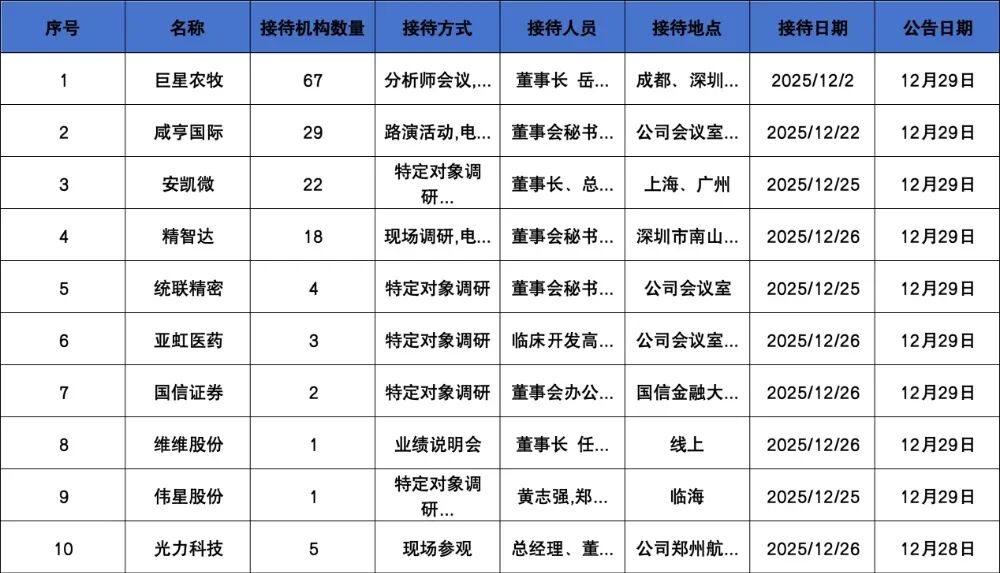
易方达、嘉实、富国基金等67家明星机构调研巨星农牧!
Xin Lang Cai Jing· 2025-12-29 13:45
Group 1: Company Overview - Company "巨星农牧" has successfully progressed in its 2025 operational plan, with key indicators showing a cumulative sale of 3.9144 million pigs from January to November, nearing the annual target of over 4 million pigs [1][34] - The total cost of commodity fattened pigs in November was approximately 6.2 yuan per jin, lower than the annual target of 6.5 yuan per jin, with a continuous downward trend expected to reach 6.0 yuan per jin [1][34] - The company has established a core risk defense covering finance, production, and assets to ensure financial health and operational safety [3][34] Group 2: Strategic Initiatives - The company is actively responding to national policies by halting the construction of new breeding farms and eliminating inefficient production capacity to improve breeding quality [3][34] - Innovations are focused on key technologies such as genetic inheritance, precision nutrition, and biosecurity, with an emphasis on applying artificial intelligence (AI) in behavior monitoring and market forecasting [3][34] - The company is laying out a strategic blueprint for competitive migration in the industry chain by enhancing efficiency and cost control [4][34] Group 3: Financial Performance - Projected revenue for 2025 is 7.5 billion yuan, reflecting a growth rate of 23.39% compared to 2024 [7][37] - The net profit attributable to shareholders for 2025 is estimated at 175 million yuan, with a significant decrease of 66.30% compared to 2024 [7][37] - The diluted earnings per share for 2025 is expected to be 0.34 yuan, with a price-to-earnings ratio (PE) of 53.90 [7][37] Group 4: Company "咸亨国际" Overview - The company aims to unlock stock incentives in 2025 based on achieving revenue of 4.5 billion yuan or a net profit of 260 million yuan, representing growth of approximately 24.8% and 18% respectively compared to 2024 [9][39] - The company maintains a stable cash dividend ratio above 60%, with cumulative dividends exceeding the IPO fundraising amount [9][39] Group 5: Robotics Application and Market Strategy - As an MRO service provider, the company focuses on energy, transportation, and emergency sectors, with significant market potential for robotics applications [10][40] - The company has been expanding into special robotics since entering the drone industry in 2012, with plans to develop quadruped robots and humanoid robots by 2026 [10][40] - The company possesses a comprehensive system capability that includes perception, decision-making, and execution, leveraging AI for enhanced operational efficiency [10][40] Group 6: Company "安凯微" Overview - The company specializes in IoT smart hardware SoC chips, with a focus on applications in smart homes, security, and industrial IoT [27][57] - The global market for home cameras is projected to reach 21.491 million units by 2025, with the company holding over 20% market share in 2022 and 2023 [27][57] - The company has developed a range of core technologies, including SoC, ISP, and machine learning, with over 75% of its main chip products being self-developed [28][58]