
保险经纪

Search documents
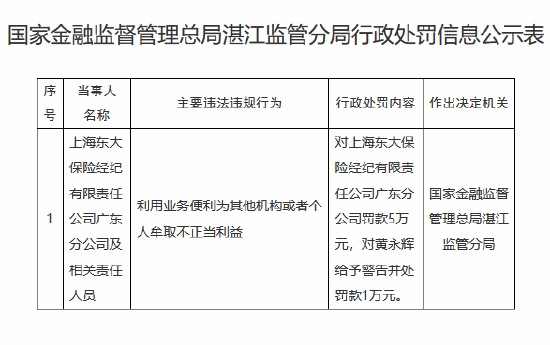
上海东大保险经纪广东分公司被罚5万元:利用业务便利为其他机构或者个人牟取不正当利益
Xin Lang Cai Jing· 2026-02-12 13:35
Group 1 - The Shanghai Dongda Insurance Brokerage Co., Ltd. Guangdong Branch was fined 50,000 yuan for utilizing business convenience to obtain improper benefits for other institutions or individuals [1][2][3] - Huang Yonghui, a responsible individual, received a warning and was fined 10,000 yuan for his involvement in the misconduct [1][2][3] - The penalties were issued by the Zhanjiang Regulatory Branch of the National Financial Supervision Administration [1][2][3]

华尔街新交易逻辑:先卖了再说!
Xin Lang Cai Jing· 2026-02-12 08:42
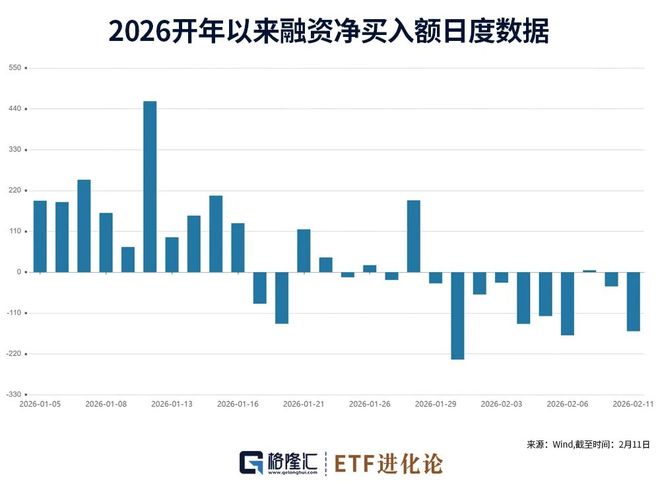
Group 1 - The core trading logic on Wall Street has shifted from identifying AI winners to indiscriminately selling potential AI losers, driven by fears of traditional business models being disrupted by AI advancements [1][2][3] - The recent sell-off has affected various sectors, including SaaS software, insurance brokerage, wealth management, and real estate services, with notable declines such as a 14% drop for JLL and a 12% drop for CBRE, marking their largest single-day declines since the pandemic [1][2] - Gabelli Funds' manager John Belton highlighted that any company with potential disruption risk is facing indiscriminate selling [3] Group 2 - In the A-share market, leveraged funds have begun to reduce their positions after a period of aggressive buying, with net selling occurring on 9 out of the last 10 trading days, totaling 974 billion yuan in sales [3][10] - Major companies experiencing net selling include Kweichow Moutai, Industrial Fulian, and Zhongji Xuchuang, with net selling amounts of -27.88 billion yuan, -23.49 billion yuan, and -23.27 billion yuan respectively [7][8] - Despite the reduction in positions in broad-based ETFs, there has been significant buying in specific ETFs such as Hai Futong Zhongzheng Short Bond ETF and E Fund Zhongzheng Overseas Internet ETF [10] Group 3 - The market is showing a strong interest in sectors related to economic recovery and domestic demand improvement, with significant inflows into the chemical sector and other related industries [17][18] - The recent price increases across various sectors, including upstream resources and consumer goods, indicate a potential inflationary trend, with PPI data showing a month-on-month increase of 0.4% and a narrowing year-on-year decline to -1.4% [21][22] - The upcoming Spring Festival is expected to boost consumer spending, with major companies launching significant promotional campaigns and government initiatives to stimulate the economy [26][27]
AI恐慌交易席卷美国地产服务板块,头部企业股价暴跌12%-14%,创2020年以来最大单日跌幅
Jin Rong Jie· 2026-02-12 03:32
Group 1 - The U.S. real estate services sector has been significantly impacted by the latest wave of AI-induced panic selling, with major companies like CBRE and JLL experiencing stock price drops of 12% and 14% respectively, marking their largest single-day declines since the COVID-19 pandemic began in 2020 [1] - The commercial real estate industry in the U.S. has been struggling to recover due to the pandemic's disruption of office space demand and high interest rates suppressing transaction volumes, despite some growth in niche areas like data centers and high-end office leasing driven by the AI boom [1] - Investors are increasingly wary of the potential impact of AI technology on the industry, fearing that automation and streamlined transaction processes could disrupt high-fee, labor-intensive business models, leading to a shift away from real estate service firms perceived as vulnerable to AI disruption [1] Group 2 - Barclays analyst Brendan Lynch noted that the recent stock price declines appear "excessive" given that there were no significant negative developments in the news, indicating that the associated risks have not changed [2] - Jefferies analyst Joe Dickstein believes that the threat of AI to leasing and capital markets is limited, asserting that firms like CBRE will maintain their positions as large leasing and transaction intermediaries due to their scale advantages in data accumulation and industry relationships [2] - The panic selling triggered by AI concerns has spread across multiple sectors, including SaaS, insurance brokerage, and wealth management, with significant stock pressure observed following the launch of AI-based applications in these industries [2]


华尔街年初热门交易 全军覆没
Sou Hu Cai Jing· 2026-02-11 16:49
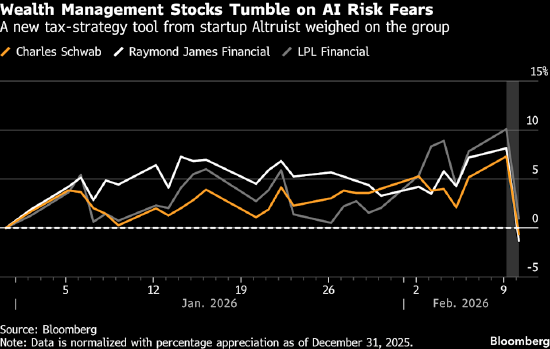
Market Sentiment Shift - The recent market turmoil is not caused by a single factor, indicating a significant shift in sentiment on Wall Street compared to the panic sell-off triggered by tariff policies last April [1] - Earlier predictions suggested that the U.S. stock market would experience its longest rally in nearly two decades, driven by expectations of sustained AI momentum, unexpectedly strong economic resilience, and gradual interest rate cuts by the Federal Reserve [1][6] AI Disruption Concerns - Concerns about AI potentially disrupting or reshaping certain U.S. industries and companies have emerged as investors worry about the transition of AI investments into commercial products [1][2] - The launch of a new tool by startup Altruist aimed at helping financial advisors has sparked fears of automation threatening the wealth management sector, leading to significant stock declines for firms like Raymond James Financial Inc. (down 8.8%) and Charles Schwab Corp. (down 7.4%) [2] Broader Market Impact - The sell-off affected not only tech stocks but also other previously popular trades on Wall Street, with the S&P 500 software and services index losing nearly 8% over the week, marking its worst weekly performance since March 2020 [6] - The S&P 500 insurance index dropped 3.9%, the largest single-day decline since October of the previous year, reflecting the broader impact of AI-related concerns on various sectors [2] Investment Strategy Shift - Analysts suggest a shift in investment focus from "AI enablers" to "AI beneficiaries," indicating a potential change in which companies will benefit from AI advancements [3][4] - Despite the recent volatility, some analysts believe the market's reaction may be an overreaction, with the fundamentals still supporting a stable growth outlook [8][9] Economic Indicators - The ISM manufacturing PMI showed better-than-expected performance, indicating potential for stable growth and avoidance of inflationary pressures, which is crucial for the stock market and the Federal Reserve [8] - Recent strong earnings reports from various companies have reinforced the initial positive expectations, although concerns about the sustainability of high valuations in tech and other sectors remain [7]
美股下一个“AI受害者”已经出现,市场正在提前定价!
美股研究社· 2026-02-11 11:06
Core Viewpoint - The article discusses the recent internal rotation in the U.S. stock market, highlighting a shift from a few large-cap stocks leading the market to a broader participation across various sectors, while also addressing the impact of AI on traditional business models and the resulting market volatility [5][7][8]. Market Performance - On Tuesday, the S&P 500 fell by approximately 0.3%, while the Dow Jones Industrial Average rose by about 0.1%, reaching a new historical high [5]. - The equal-weighted S&P index also reached a record high, indicating a shift in market dynamics with around 300 stocks in the S&P 500 rising [7]. Retail Sales Data - The U.S. Commerce Department reported that December retail sales were flat month-over-month, significantly below the expected 0.4% growth, indicating a slowdown in consumer spending [9]. - Core retail sales, excluding autos and gas, even showed a decline, reflecting weakened consumer spending momentum during the holiday season [9]. Interest Rate Expectations - The weak retail data led to a rise in U.S. Treasury prices and a decline in yields, with the futures market increasing the probability of three rate cuts within the year, with two already priced in [9]. - Historical trends suggest that rate cut expectations typically support risk assets, but the current market shows a divergence where rates are falling but stocks are not rising, particularly in the tech sector [11]. AI Impact on Market Sentiment - Market participants are shifting their interpretation of AI's impact from a growth narrative to concerns about short-term disruptions, leading to a "sell first, think later" mentality [12]. - Investors are moving from an "AI is a panacea" mindset to a more pragmatic "performance realization" phase, anticipating greater differentiation between winners and losers in the market [12]. Institutional Perspectives - There is a noticeable divergence in institutional views on the tech sector, with Goldman Sachs warning about the risks of overestimating AI's growth potential and emphasizing the need for actual earnings and cash flow improvements to support tech valuations [13]. - UBS downgraded its rating on the U.S. tech sector from "overweight" to "neutral," citing key risks while still acknowledging the long-term potential of AI [14]. Wealth Management Sector - The wealth management sector has come under scrutiny following the launch of an AI tool by Altruist Corp., which automates tasks traditionally reliant on human expertise, raising concerns about the core revenue models of wealth management firms [17][18]. - The market reacted sharply, with significant declines in stocks of major wealth management firms, indicating fears about the long-term competitive structure of the industry under AI pressure [19][21]. Broader Market Reactions - The sell-off in the market has been attributed to fears that AI tools could undermine the intermediary value of insurance brokers, leading to a significant drop in the insurance brokerage sector [22]. - The recent downturn in the software sector has seen substantial market capitalization losses, with estimates indicating a combined loss of approximately $611 billion across software, financial services, and asset management sectors [26]. Conclusion - The current market environment reflects a transition from viewing AI as a beneficiary narrative to recognizing potential victims, with traditional software companies facing heightened scrutiny and volatility [27]. - The article suggests that this phase serves as a valuation and business model stress test, prompting a reevaluation of which revenue models are based on irreplaceable value versus those reliant on information asymmetry [34].






华尔街新交易逻辑:抛售处于AI冲击范围内的股票
Xin Lang Cai Jing· 2026-02-11 09:52
Core Viewpoint - Concerns about artificial intelligence (AI) are escalating on Wall Street, leading to significant sell-offs across various sectors, particularly in companies perceived to be at risk of disruption by AI technologies [1][14]. Group 1: Market Reactions - A recent sell-off was triggered by the launch of a tax strategy tool by Altruist Corp, resulting in stock price declines of over 7% for major financial firms like Charles Schwab and Raymond James [1][14]. - The sell-off extended to European wealth management firms, with companies like AJ Bell and St. James's Place experiencing simultaneous declines [1][14]. - This downturn is noted as one of the most significant since the market turmoil in April, reflecting a "sell first, ask questions later" mentality among investors [1][14]. Group 2: Investor Sentiment - Investors are shifting focus from identifying potential winners to avoiding any companies that exhibit even a slight risk of being replaced by AI [4][17]. - The narrative around AI has evolved from skepticism about its practical applications to a recognition of its disruptive potential, as evidenced by the rapid deployment of powerful AI tools [6][20]. - The market's reaction indicates a heightened sensitivity to negative news, with stock prices plummeting by 10% on minor adverse signals, a phenomenon unlikely to occur in markets with lower valuations [27]. Group 3: Industry Implications - The software industry has been particularly affected by AI-related anxieties, with fears spreading to other sectors such as finance, insurance, and legal services following the introduction of new AI tools [8][21]. - Altruist's CEO noted the unexpected market reaction, which resulted in the evaporation of billions in market value for several investment firms, highlighting the competitive threat posed by their new product [22][21]. - The architecture used to develop Altruist's tool is perceived as capable of replacing roles within the wealth management industry, suggesting a significant shift in operational dynamics [10][24]. Group 4: Future Outlook - Experts express uncertainty about the future impact of AI, with some suggesting that the actual disruption may occur more slowly than anticipated [25][26]. - The current market environment reflects a broader anxiety about the sustainability of high valuations driven by AI investments and the resilience of the U.S. economy [27][12]. - The ongoing developments in AI are still in their infancy, and making definitive predictions about their long-term effects remains challenging [13][12].
AI淘金热变成AI恐慌潮!华尔街新共识:躲开一切可能被颠覆的公司
华尔街见闻· 2026-02-11 09:15
Core Viewpoint - The investment logic on Wall Street is undergoing a significant transformation, with investors rapidly selling stocks of companies that may be disrupted by AI, rather than focusing on identifying AI winners [3][4]. Group 1: Market Reactions - A recent sell-off was triggered by the launch of Altruist Corp.'s tax strategy tool, Hazel, which caused major wealth management companies like Charles Schwab and Raymond James Financial to see stock declines of over 7%, marking the largest drop since the market crash in April [4]. - The panic began when Anthropic introduced a new tool, leading to a deep correction across software, financial services, asset management, and legal services sectors [5][7]. - The insurance brokerage industry was also affected, with stocks plummeting after Insurify launched a ChatGPT-based application for comparing auto insurance rates [7]. Group 2: Industry Impact - Altruist's Hazel tool highlights the market's deep anxiety regarding AI's potential to disrupt traditional financial services, as it can perform tasks that typically require an entire team for just $100 a month [6][7]. - The fear of AI disruption has spread from the software industry to broader sectors, indicating a significant shift in market sentiment [5][7]. Group 3: Diverging Opinions - Despite the prevailing panic, some market participants question the speed and extent of AI disruption, suggesting that technological upheaval often takes longer than anticipated [10][11]. - Concerns about AI's impact on various industries may be premature, as the market is still in the early stages of understanding AI's long-term implications [12]. Group 4: Market Sensitivity - The current sell-off reflects a general anxiety over high valuations in the market, which have been driven by a surge in AI spending and unexpected economic resilience [13]. - In a highly sensitive market environment, even minor negative signals can lead to significant stock declines, as investors prefer to err on the side of caution regarding potential AI disruptions [13].


华尔街新交易策略:抛售处于AI冲击范围内的股票
Xin Lang Cai Jing· 2026-02-11 09:08
Core Viewpoint - Concerns about artificial intelligence (AI) are escalating on Wall Street, leading to significant stock sell-offs across various companies, from small software firms to large wealth management firms [1][3][9]. Group 1: Market Reactions - A recent sell-off was triggered by the launch of a tax planning tool by the startup Altruist, causing stocks of companies like Charles Schwab, Raymond James Financial, and LPL Financial Holdings to drop by 7% or more [1][4]. - The sell-off extended to Europe, impacting wealth management companies such as AJ Bell, Brewin Dolphin, and St. James's Place [1][3]. - This decline is noted as one of the most severe since the market downturn in April due to trade tensions, reflecting a "sell first, ask questions later" mentality among investors [1][7]. Group 2: Industry Impact - The software industry has been particularly affected, with companies like Dassault Systemes experiencing a 20% drop in stock price following disappointing earnings reports [3][9]. - The introduction of AI tools by companies like Anthropic has led to widespread declines in stocks across software, financial services, asset management, and legal services sectors [3][9]. - The insurance sector also faced significant stock declines after Insurify launched a new application utilizing ChatGPT for comparing auto insurance rates [4][10]. Group 3: Investor Sentiment - Investors are shifting from selecting potential winners in the AI space to avoiding any companies perceived to be at risk of being replaced by AI technologies [3][9]. - The CEO of Graniteshares expressed uncertainty about future developments, indicating a shift in sentiment from optimism about AI to fear of its disruptive potential [3][9]. - Concerns about the sustainability of stock valuations have intensified, with market participants reacting sharply to any negative signals [11].
AI淘金热变成AI恐慌潮!华尔街新共识:躲开一切可能被颠覆的公司
硬AI· 2026-02-11 08:40
Core Viewpoint - Investors are shifting from seeking AI winners to rapidly selling stocks of companies that may be disrupted by AI, leading to a panic selling mentality across various sectors, including software, financial services, wealth management, insurance brokerage, and legal services [2][3]. Group 1: Market Reaction to AI Disruption - The latest wave of selling was triggered by the launch of a tax strategy tool, Hazel, by Altruist Corp., which caused significant stock price drops of over 7% for wealth management firms like Charles Schwab, Raymond James Financial Inc., and LPL Financial Holdings Inc., marking the largest decline since the market crash in April [3][5]. - The panic began when Anthropic introduced a new tool that led to a deep correction in software, financial services, asset management, and legal services sectors, indicating a turning point in market sentiment [6][8]. - The insurance brokerage sector was also heavily impacted after Insurify launched a new application using ChatGPT to compare auto insurance rates, resulting in substantial stock losses for U.S. insurance brokers [6][8]. Group 2: Concerns Over AI's Impact - The introduction of AI tools like Hazel highlights deep-seated anxieties about AI disrupting traditional financial services, as these tools can perform tasks that typically require entire teams, with costs as low as $100 per month [5][6]. - Market participants are increasingly concerned that any intermediary services that could be replaced by AI face existential threats, leading to widespread selling [6][8]. Group 3: Diverging Market Opinions - Despite the prevailing panic, some market analysts express skepticism about the speed and extent of AI disruption, suggesting that technological upheaval often takes longer to materialize than anticipated [8]. - Historical context indicates that industries like banking have faced challenges from emerging technologies, such as cryptocurrencies and electronic services, but these have not significantly undermined their dominance [8]. Group 4: Market Sensitivity and Valuation Concerns - The current sell-off reflects broader anxieties regarding elevated stock valuations, which have been pushed up by a surge in AI spending and unexpected economic resilience in the U.S., making investors highly sensitive to negative signals [10]. - In a tense market environment, even minor product launches from small startups can lead to significant volatility in large public companies, as investors prefer to err on the side of caution regarding potential AI disruptions [10].

AI淘金热变成AI恐慌潮!华尔街新共识:躲开一切可能被颠覆的公司
Hua Er Jie Jian Wen· 2026-02-11 05:58
Core Viewpoint - Wall Street is experiencing a significant shift in investment logic, with investors rapidly selling stocks of companies that may be disrupted by AI, leading to widespread panic and sell-offs across various sectors [1][2]. Group 1: Impact on Wealth Management - The recent sell-off was triggered by Altruist Corp.'s launch of the AI tax strategy tool Hazel, which caused major wealth management firms like Charles Schwab and Raymond James to see stock declines of over 7%, marking the largest drop since April [1][2]. - Altruist's CEO Jason Wenk noted that the market reaction was surprising, erasing billions in market value for several investment firms, and emphasized that the architecture used to build Hazel could replace many roles in wealth management that typically require entire teams [2][3]. Group 2: Broader Industry Concerns - The fear of AI disruption has expanded from the software industry to financial services, asset management, and legal services, particularly after new tools from companies like Anthropic and Insurify were introduced [1][3]. - Insurify's launch of a ChatGPT-based application for comparing auto insurance rates led to significant stock declines among U.S. insurance brokers, reflecting investor concerns about the survival of intermediary services that could be replaced by AI [3]. Group 3: Market Sentiment and Valuation Sensitivity - Despite the prevailing panic, some market participants question the speed and extent of AI disruption, suggesting that technological upheaval often takes longer to materialize than anticipated [4]. - The current sell-off also highlights a general anxiety regarding high valuations in the market, where even minor negative signals can lead to significant stock price declines, indicating a highly sensitive investment environment [5].